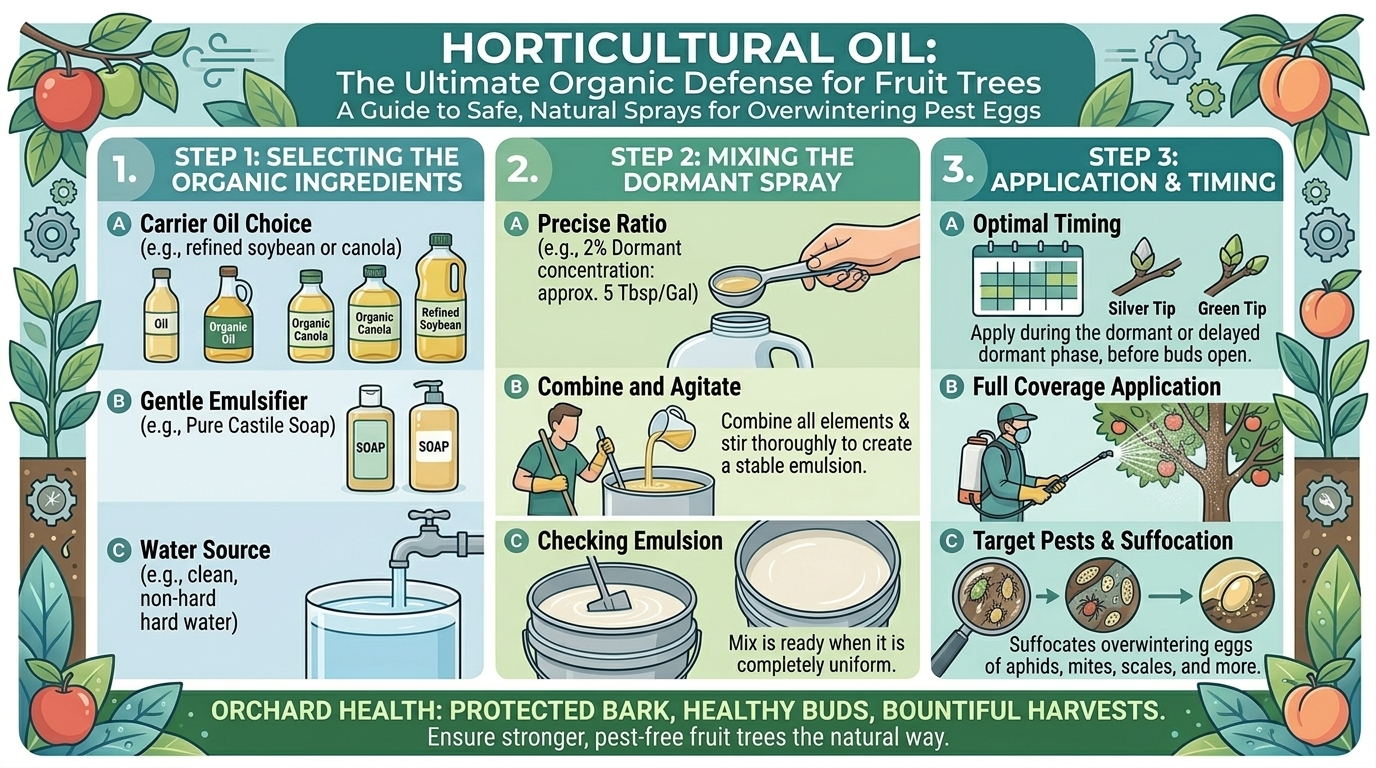
How to Make an Organic Horticultural Oil Spray to Suffocate Overwintering Insect Eggs on Fruit Trees
The arrival of autumn and winter brings a welcome slowdown to backyard orchard management. As fruit trees drop their leaves and enter dormancy, it is easy to assume that garden pests have vanished until spring. Unfortunately, reality is quite the opposite. Clinging invisibly to the bark, tucked deep inside twig crotches, and hiding within bud scales are the microscopic insurance policies of next season’s destruction: overwintering insect eggs, scale insects, aphids, mites, and psyllid cocoons.
If left unchecked, these dormant invaders hatch in spring the moment the sun warms the branches, launching an immediate assault on tender new leaves and blossoms. While commercial chemical pesticides offer a quick fix, they often destroy beneficial pollinators, leave toxic residues on edible fruit, and disrupt your garden’s delicate ecosystem.
For conscious gardeners managing orchards across diverse American microclimates—from urban container plots in San Francisco and New York to sprawling suburban homesteads in Texas, California, and Washington State—making your own organic horticultural oil spray is the ultimate preventative weapon. This comprehensive guide explores the entomology of overwintering pests, exact DIY recipes, safe application protocols, and expert tips to safeguard your fruit trees naturally.
1. The Science of Dormant Oil: How It Works
To understand why horticultural oil is so effective, you must look at how insects breathe during their dormant or egg stages.
+-----------------------------------------------------------------+
|             THE MECHANISM OF HORTICULTURAL OIL SUFFOCATION      |
|                                                                 |
|   [1. Target Identification]                                    |
|   - Soft-bodied insects, mites, and insect eggs respire using   |
|     tiny microscopic breathing tubes known as spiracles.        |
|              |                                                  |
|              v                                                  |
|   [2. The Oil Barrier Coating]                                  |
|   - When sprayed during tree dormancy, refined horticultural oil|
|     forms an ultra-thin, continuous micro-film over the bark.   |
|              |                                                  |
|              v                                                  |
|   [3. Respiratory Suffocation]                                  |
|   - The oil blocks oxygen from entering the spiracles or shell  |
|     pores, suffocating the pests and unhatched embryos safely.  |
+-----------------------------------------------------------------+
Because this mechanism is purely physical rather than chemical, target pests cannot build genetic immunity to horticultural oils, making it one of the most reliable and sustainable pest-management tools in organic agriculture.
2. Common Overwintering Pests Targeted by Dormant Oil
Dormant oil spray is a broad-spectrum preventative treatment that eliminates several primary orchard threats before they hatch:
- Aphid Eggs: Tiny, dark oval eggs laid in bark crevices that hatch into ravenous stem mothers in early spring.
- Scale Insects (Armored & Soft Scale): Stationary, shell-like insects that encrust twigs, sucking sap and secreting sticky honeydew.
- Mite Eggs (Spider Mites & European Red Mites): Microscopic red or amber eggs clustered on spurs and branch junctions.
- Pear Psylla & Mealybug Nymphs: Dormant nymphs hiding beneath loose bark layers.
3. DIY Organic Horticultural Oil Recipe
Commercial dormant oils are widely available, but crafting your own organic horticultural oil at home using pure vegetable oil and liquid castile soap is cost-effective, non-toxic, and simple to mix.
Ingredients & Equipment
- Base Oil: 1 cup of pure, cold-pressed vegetable oil (canola, soybean, or sunflower oil). Avoid mineral oils derived from petroleum if you strictly prefer 100% organic botanical inputs.
- Emulsifier: 1 to 2 tablespoons of pure liquid castile soap (unscented or peppermint). Soap is essential because oil and water do not mix naturally; the soap binds them into a stable suspension.
- Water: 1 gallon of soft, lukewarm water (distilled or rain water is ideal, especially if your tap water is hard).
- Equipment: A clean glass jar with a tight-fitting lid, a measuring cup, and a pump sprayer or garden pressure sprayer.
Step-by-Formulation Process
- Create the Stock Emulsion: Pour 1 cup of vegetable oil and 2 tablespoons of liquid castile soap into your glass jar. Secure the lid and shake vigorously for 60 to 90 seconds until the mixture turns into a thick, uniform, milky-white concentrate. This is your stock concentrate.
- Dilute for Application: Add 2 to 2.5 tablespoons of your freshly made stock concentrate into 1 gallon of lukewarm water in your garden sprayer. Shake gently to combine. Note: This creates a safe 1.5% to 2% concentration ideal for dormant fruit trees.
4. When and How to Apply: Timing is Everything
Applying horticultural oil at the wrong time of year or under incorrect weather conditions can severely damage your trees. Follow these strict seasonal guidelines:
+-----------------------------------------------------------------+
|             THE GOLDEN RULES OF DORMANT SPRAYING                |
|                                                                 |
|   [Rule 1: True Tree Dormancy Only]                             |
|   - Spray only when deciduous trees are completely dormant      |
|     (after leaf drop in late fall/winter and before bud break in|
|     early spring).                                              |
|              |                                                  |
|              v                                                  |
|   [Rule 2: Temperature Sweet Spot]                              |
|   - Ambient temperatures must remain above 40°F (4°C) and below |
|     85°F for at least 24 hours post-application.                |
|              |                                                  |
|              v                                                  |
|   [Rule 3: Moisture and Dryness Window]                         |
|   - Ensure zero rain is forecasted for at least 24 hours; foliage|
|     must be completely dry when sprayed.                        |
+-----------------------------------------------------------------+
Critical Warnings
- Never Spray Evergreens with Heavy Dormant Oils: Broadleaf evergreens (like citrus trees in warm regions) require ultra-light, refined “summer oils” at much lower concentrations, as heavy dormant oils will dissolve their protective leaf waxes and suffocate the tree.
- Avoid Sulfur Sensitivity: Never apply horticultural oil within 30 days of applying any sulfur-based fungicide. The combination creates a chemical reaction that burns tree bark and foliage.
5. Regional Climate Strategies Across the United States
Your local geography dictates when and how you execute your winter orchard maintenance:
New York City and San Francisco
Urban and coastal yards experience damp winters with moderate frost risks. In San Francisco, where winters are mild, fruit trees (like apples, pears, and stone fruits) enter a shorter dormancy window. Apply your dormant oil in late January or February just before bud swell. In New York, target a mild winter day in late November (post-leaf drop) or early March before spring green-up.
Washington State
The Pacific Northwest is characterized by wet, rainy winters. Because rain washes fresh oil off bark instantly, you must check local weather radar meticulously. Choose a multi-day dry weather window to spray your backyard apple and cherry trees.
Texas and California
In warmer southern regions, deciduous fruit trees (like peaches and plums) require specific “chill hours” to set fruit. Winters are short and mild. Apply your horticultural oil in mid-January when trees are fully dormant. Avoid spraying during sudden winter heatwaves where temperatures exceed 85°F, as high heat combined with oil causes severe cellular phytotoxicity (leaf and bark burn).
6. Step-by-Step Orchard Application Protocol
- Pruning First: Always complete your annual structural pruning before applying dormant oil. Pruning removes diseased, crossed, and pest-infested wood first, reducing the surface area you need to spray and saving precious oil.
- Sanitation Cleanup: Rake up all fallen leaves, mummified fruits, and garden debris from beneath the tree canopy and discard them. Do not compost infested debris.
- Calibrate Your Sprayer: Fill your pressure sprayer with the diluted oil mixture. Pump to build steady pressure.
- The Drenching Technique: Spray every single square inch of the tree until it glistens. Pay special attention to hidden cracks in the bark, branch crotches, twig tips, and the main trunk down to the soil line where overwintering insect eggs congregate.
- Clean Equipment: Thoroughly rinse your sprayer tank, nozzle, and hose with warm, soapy water immediately after use to prevent oil residue from gumming up internal valves.
7. Comprehensive Orchard Dormant Care Schedule
| Timing | Action Item | Primary Objective |
| Late Autumn (Nov–Dec) | Leaf cleanup & structural pruning | Remove diseased wood and eliminate primary leaf-litter habitat |
| Mid-Winter (Jan–Feb) | DIY Horticultural Oil Spray (1.5% dilution) | Suffocate overwintering scale, aphid eggs, and mite casings |
| Early Spring (Mar) | Secondary inspection & sticky bands | Catch emerging crawlers before they scale trunk walls |
| Spring Bloom | Beneficial insect release (Ladybugs/Lacewings) | Establish natural predators just as remaining pests hatch |
8. Frequently Asked Questions (FAQs)
1. What makes horticultural oil “organic” when made at home?
When made using cold-pressed botanical vegetable oils (such as canola or sunflower oil) combined with pure castile soap, the mixture breaks down naturally in soil microbes without leaving synthetic chemical residues or heavy petroleum toxins behind.
2. Can I use olive oil or coconut oil instead of canola oil?
It is best to avoid heavy cooking oils like unrefined coconut oil (which solidifies at lower winter temperatures) or extra virgin olive oil (which contains complex impurities). Light, refined vegetable oils like canola or soybean oil emulsify cleanly and flow smoothly through sprayer nozzles.
3. What happens if it rains immediately after I spray my fruit trees?
If heavy rain falls within 12 to 24 hours of application, it will wash the oil film off the bark before it can suffocate the targeted eggs, requiring you to reapply once the tree is completely dry.
4. Will DIY horticultural oil kill beneficial insects like bees?
During deep winter dormancy, beneficial pollinators like bees and ladybugs are inactive and hidden away, meaning dormant oil poses zero risk to them provided you apply it strictly during the dormant season before flowers bloom.
5. Can I spray horticultural oil on evergreen trees?
Heavy dormant oils will damage or kill broadleaf evergreens by dissolving their protective leaf wax. If you must treat evergreens or citrus in warmer climates, use a specialized, highly refined “summer oil” at a much weaker 0.5% to 1% concentration.
6. Why is my homemade oil mixture separating in the sprayer?
Oil and water naturally repel each other. If your mixture separates quickly, you either used too little liquid castile soap or didn’t shake the stock concentrate vigorously enough during initial formulation. Add a teaspoon more soap and shake well.
7. How much DIY oil spray do I need for a standard backyard fruit tree?
A mature dwarf or semi-dwarf backyard fruit tree typically requires about 1 to 2 quarts of mixed spray solution to achieve a thorough, dripping wet coverage from trunk to twig tips.
8. Will horticultural oil cure fungal diseases like powdery mildew?
While horticultural oil has minor suffocating effects on fungal spores, its primary purpose is insect and egg eradication. For fungal issues, pair your oil spray with an organic copper fungicide or sulfur spray, keeping a 30-day gap between oil and sulfur applications.
9. Can I store leftover oil mixture for next season?
Do not store diluted spray mixtures, as water breaks down the soap emulsion over time. However, you can store your concentrated oil-and-soap stock mixture in a sealed glass jar in a cool, dark cupboard for up to a year.
10. How do I know if my DIY spray concentration is too strong?
If your mixture exceeds a 3% oil-to-water ratio, it can form too heavy a barrier, sealing off plant tissue respiration and causing leaf and bud burn when spring arrives. Stick strictly to a 1.5% to 2% ratio for dormant trees.
9. Conclusion
Mastering orchard health is an exercise in proactive prevention rather than reactive emergency treatment. By making your own organic horticultural oil spray at home, you harness a powerful, eco-friendly weapon that targets overwintering insect eggs and scale at their most vulnerable stage without introducing harsh synthetic poisons into your backyard ecosystem.