How to design a sustainable permaculture home garden layout that mimics natural forest ecosystems? Modern gardening often relies on a high-input, high-maintenance dynamic: synthetic fertilizers, heavy irrigation, constant tilling, and continuous weed suppression. Permaculture flips this paradigm. By designing a garden modeled directly after natural forest ecosystems—specifically the multilayered structure of a wild forest edge—you can build a self-sustaining, resilient, and deeply productive food system.
Forest ecosystems thrive without human intervention. They build their own topsoil, retain their own moisture, manage pest populations through biodiversity, and recycle organic waste into plant nutrition. By incorporating permaculture principles into your home layout, your garden will work with nature rather than against it.
Whether you are gardening on an expansive acre in Texas, a suburban plot in New York or Washington, a backyard layout in California, or an urban micro-space in San Francisco, this comprehensive blueprint guides you through designing, establishing, and maintaining a sustainable permaculture forest garden.
What is a Permaculture Food Forest?
A permaculture food forest (or forest garden) is a low-maintenance, multi-tiered agricultural system that integrates perennial fruit and nut trees, berry bushes, edible shrubs, herbs, perennial vegetables, and root crops.
Instead of planting single crops in isolated monoculture rows, a food forest stacks plants vertically and horizontally in mutually supportive communities known as plant guilds.
Core Benefits of Food Forest Systems
- Soil Building: Deep-rooting dynamic accumulators draw minerals up from subsoils, while nitrogen-fixing plants naturally fertilize neighboring crops.
- Microclimate Creation: Tall canopy trees buffer harsh winds, shade sensitive lower layers, and reduce overall moisture loss.
- Natural Pest Resilience: Broad plant diversity attracts beneficial predatory insects, predatory wasps, and birds, establishing natural pest management without chemical sprays.
- Extreme Climate Adaptability: High organic soil cover and deep perennial root structures hold water, making systems resilient against drought, flash flooding, and extreme heat waves.
The 7 Layers of a Permaculture Food Forest
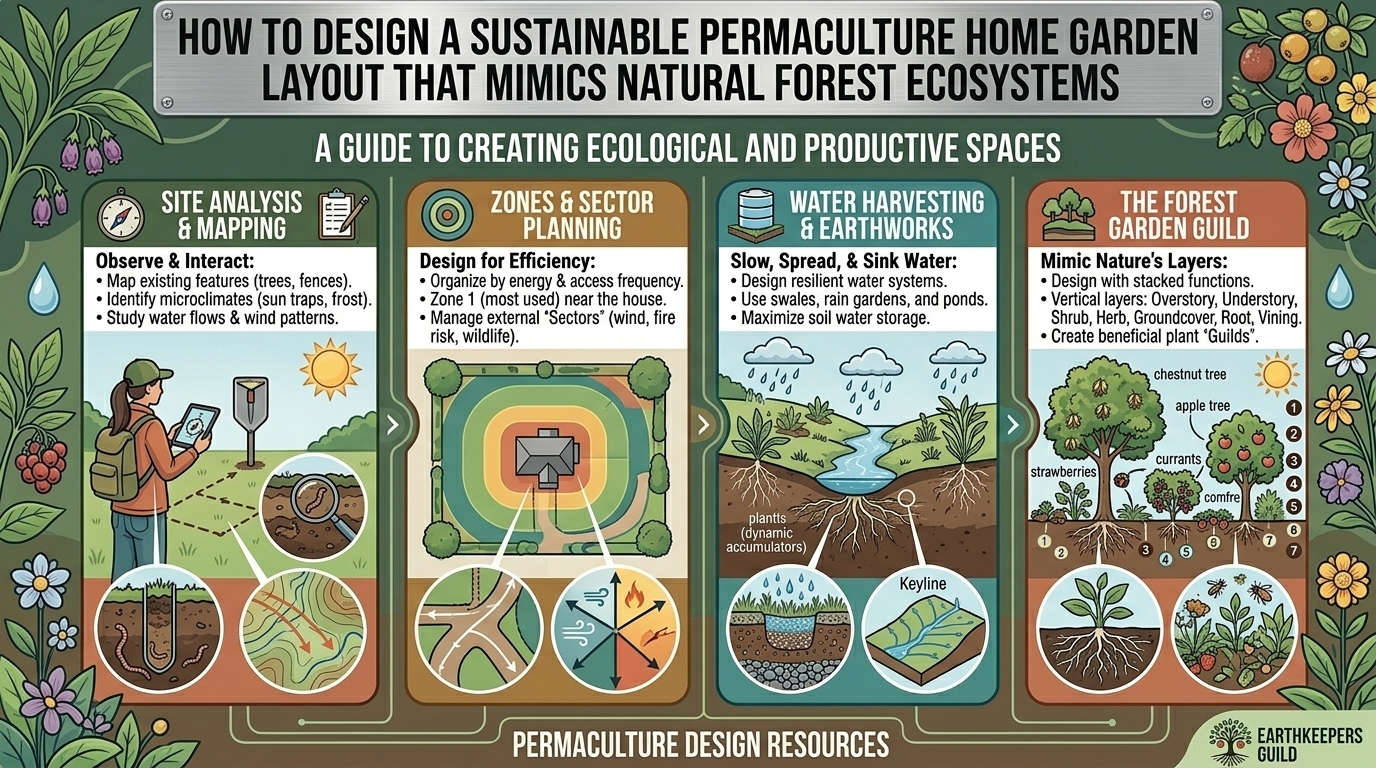
In a natural forest, plants occupy distinct vertical niches to capture sunlight and harvest root zone nutrients efficiently. A fully realized food forest incorporates up to seven distinct layers (plus an optional eighth fungal layer).
                      [LAYER 1: OVERSTORY CANOPY]
                             (Pecan, Oak)
                                  │
                      [LAYER 2: UNDERSTORY]
                        (Apple, Peach, Fig)
                                  │
                      [LAYER 3: SHRUB LAYER]
                      (Blueberry, Elderberry)
                                  │
                      [LAYER 4: HERBACEOUS]
                      (Comfrey, Borage, Kale)
                                  │
             ┌────────────────────┴────────────────────┐
             ▼                                         ▼
   [LAYER 5: RHIZOSPHERE]                     [LAYER 6: GROUNDCOVER]
   (Garlic, Horseradish)                      (Strawberries, Clover)
             │
             └────────────────────┬────────────────────┘
                                  ▼
                      [LAYER 7: VINES/CLIMBERS]
                         (Grapes, Passionfruit)
- The Overstory / Canopy Layer: The tallest trees (20–40+ feet). Examples: Chestnut, Pecan, Oak, or large seedling fruit trees. Provides overall structure, wind suppression, and light shade.
- The Understory / Sub-Canopy Layer: Dwarf or semi-dwarf fruit trees (10–20 feet). Examples: Apples, Pears, Peaches, Plums, Figs, and Persimmons.
- The Shrub Layer: Woody bushes (3–10 feet) that thrive in dappled light. Examples: Blueberries, Currants, Gooseberries, Elderberries, and Hazelnut bushes.
- The Herbaceous Layer: Non-woody perennial plants (1–5 feet) that die back in winter. Examples: Comfrey, Borage, Echinacea, Yarrow, and perennial kale.
- The Rhizosphere / Underground Layer: Root crops that loosen soil and yield edible tubers. Examples: Garlic, Horseradish, Jerusalem Artichokes, Sweet Potatoes, and Daikon Radish.
- The Groundcover / Soil Surface Layer: Low-growing horizontal spreaders (under 1 foot) that act as living mulch, keeping soil cool and stopping weed germination. Examples: Alpine Strawberries, White Clover, and Creeping Thyme.
- The Vertical / Vine Layer: Climbing plants that weave upward through the canopy and shrub trunks. Examples: Hardy Kiwi, Grapes, Passionfruit, and Hops.
- The Fungal Layer (Optional 8th Layer): Mycelial networks that link roots, decompose woody matter, and produce edible mushrooms like Wine Caps (Stropharia) or Shiitakes.
Regional Adaptations Across the US
Designing a permaculture system requires aligning with your specific climate zone, rainfall patterns, and soil conditions.
| Region / Location | Primary Climate Factors | Recommended Canopy & Shrub Species | Key Guild Strategy |
| Texas | Intense summer heat, periods of drought, heavy clay or alkaline soils | Pecan, Jujube, Fig, Pomegranate, Mexican Plum, Texas Persimmon | Shade & Swales: Utilize heavy canopy shade to protect cool-season crops. Use swales or keyhole beds to retain rainwater. |
| California | Dry Mediterranean summers, water restrictions, variable soils | Olive, Fig, Citrus, Almond, Avocado (coastal), Mulberry | Water Harvesting: Focus heavily on sunken beds, greywater integration, and thick woodchip mulching to maximize water retention. |
| San Francisco | Cool coastal fog, ocean winds, microclimates, urban footprint | Apple, Pear, Plum, Alpine Strawberry, Fuchsia Berry, Artichoke | Windbreaks & Microclimates: Plant dense windbreaks along exposed sides. Maximize vertical stacking in compact urban footprints. |
| Washington | Cool, wet winters; warm, dry summer spells; acidic soils | Chestnut, Asian Pear, Blueberry, Lingonberry, Hazelnut, Sea Buckthorn | Sun & Drainage: Space canopy trees wider to allow light penetration. Use raised mound planting (Hugelkultur) to prevent winter root rot. |
| New York | Hot, humid summers; severe freeze-thaw winter cycles | Heritage Apple, American Chestnut, Pawpaw, Elderberry, Jostaberry | Freeze Protection: Site tender species on southern slopes. Wrap trunks and use stone heat sinks (thermal mass) to shield roots from frost. |
Step-by-Step Design Protocol: From Site Analysis to Planting
Step 1: Sector Analysis & Observation
Observe your land across seasons before digging. Map out:
- Sun Trajectories: Track seasonal light shifts, identifying full sun, partial shade, and full shade zones.
- Water Movement: Identify where rainwater flows, pools, or drains rapidly during heavy storms.
- Prevailing Winds: Locate direction of freezing winter winds or scorching summer breezes.
- Microclimates: Take note of heat-retaining brick walls, cold low spots, and shaded fence lines.
Step 2: Earthworks & Passive Water Harvesting
Before planting, shape the land to catch, store, and sink water into the soil table naturally:
- Swales on Contour: Dig shallow, level trenches across slopes to capture runoff and direct water deep into root zones.
- Hugelkultur Beds: Construct raised mounds filled with rotting logs, branches, leaves, and topsoil. The buried wood acts like an underground sponge, storing moisture and slowly releasing nutrients for years.
- Rain Barrel & Cistern Connections: Direct roof gutters toward holding tanks or directly into distribution swales.
Step 3: Design Plant Guilds
Never plant trees in isolation. Group plants into functional communities centered around a primary producer (like an apple or peach tree):
                       [CENTRAL FRUIT TREE]
                     (e.g., Semi-Dwarf Apple)
                                │
        ┌───────────────────────┼───────────────────────┐
        ▼                       ▼                       ▼
 [NITROGEN FIXER]      [DYNAMIC ACCUMULATOR]      [INSECT ATTRAC TANT]
 (Goumi Berry /         (Russian Comfrey)          (Yarrow / Dill)
  White Clover)                 │                       │
        │                       ▼                       ▼
        │             [PEST REPELLENT PLANT]    [LIVING GROUND COVER]
        └────────────>  (Garlic / Alliums)   <── (Alpine Strawberry)
Step 4: Sheet Mulching (Lasagna Gardening)
Clear lawn or weeds without tilling, which destroys soil mycorrhizal networks:
- Mow vegetation flush to the ground.
- Water the area thoroughly and add soil amendments like greensand or kelp meal.
- Overlay thick, unprinted cardboard or 4–6 layers of newspaper, overlapping edges by 6 inches.
- Add a 4-inch layer of nitrogen-rich green material (compost, green waste, grass clippings).
- Add a 4-inch layer of carbon-rich brown material (straw, leaves, woodchips).
- Allow the layers to decompose into rich, living topsoil over 2–4 months.
Long-Term Maintenance & Management Tips
- Chop-and-Drop Pruning: Instead of removing prunings, chop soft green stems and leaves from deep-rooted accumulators (like comfrey or goumi berry) and drop them directly beneath fruit tree canopies as fresh, organic mulch.
- Manage Sunlight Over Time: As canopy trees mature, trim lower limbs (pruning up) to ensure sufficient light reaches the shrub and herbaceous layers below.
- Iterative Planting: Plant pioneer species (fast-growing nitrogen fixers like alder, autumn olive, or nurse trees) early on. As canopy fruit trees grow, gradually thin out pioneer species to yield space for permanent food producers.
10 Frequently Asked Questions (FAQ)
1. How much space do I need to build a permaculture food forest?
You can build a food forest in any space! A full multi-tiered forest garden works best on a quarter-acre or more, but you can build micro-guilds around a single dwarf fruit tree in small suburban yards or urban San Francisco backyards using vertical stacking.
2. How long does it take for a permaculture garden to become self-sustaining?
Most food forests take 3 to 5 years to establish their root systems, canopy shade, and fungal networks. During years 1 and 2, supplemental watering, weeding, and mulching are required. By year 4 or 5, external inputs drop significantly.
3. Can I grow annual vegetables like tomatoes and peppers in a food forest?
Yes, but place them along the sunny south edges (in the Northern Hemisphere) or in light clearings (sun pockets). As canopy trees mature and create shade, shift interior plantings to shade-tolerant perennial crops like rhubarb, hostas, berries, and perennial greens.
4. Will a food forest attract unwanted pests or rodents?
Monocultures are vulnerable to pest outbreaks, whereas diverse food forests attract natural predators like ladybugs, hoverflies, birds, snakes, and frogs that keep pest populations in check. Keeping fallen fruit cleaned up reduces unwanted rodent visits.
5. What are dynamic accumulators, and why are they important?
Dynamic accumulators are plants with deep taproots (such as Russian Comfrey, Dandelion, and Chicory) that extract subsoil minerals (calcium, potassium, magnesium) and bring them up into their leaves. When these leaves decay, they fertilize the topsoil for neighboring plants.
6. How do I prevent grass from invading my fruit tree guilds?
Plant a thick perimeter of bulbous or dense perennial plants around your guild edge. Garlic, chives, daffodils, and comfrey create living root barriers that stop grass rhizomes from invading.
7. Do permaculture gardens require fertilizers?
Chemical fertilizers are not needed. Food forests generate their own nutrients through nitrogen-fixing trees and shrubs (like Sea Buckthorn, Goumi, and Clover), dynamic accumulators, organic leaf drop, and rich soil fungal networks.
8. Can I build a permaculture layout in heavy clay soil?
Yes! Avoid tilling clay, as tilling breaks down soil structure and forms hardpan layers. Build up using Hugelkultur beds or sheet mulching, and plant deep-rooting bio-drills like Daikon Radish to naturally fracture heavy clay.
9. What is the difference between a standard orchard and a food forest?
A standard orchard consists of evenly spaced fruit trees planted in monoculture over mown grass, requiring high inputs of fertilizer, pesticides, and mowing. A food forest stacks multiple vertical layers of edible perennials, nitrogen fixers, and beneficial attractants to mimic a wild forest.
10. How do I harvest from a multi-layered food forest efficiently?
Design clear, winding pathways using gravel, thick woodchips, or stepping stones during the initial planning phase. Keep low-growing ground covers clear of primary footpaths, and place frequently harvested kitchen herbs along main garden entryways (Permaculture Zone 1).
Conclusion
Designing a sustainable permaculture home garden layout allows you to transform a standard yard into a resilient, highly productive ecosystem. By mimicking the multi-tiered structure of natural forests, harvesting water passively, building living topsoil, and pairing mutually supportive plants into guilds, you create a garden that grows more fertile and abundant each passing year.