Aphids are the perennial nemesis of gardeners everywhere. These sap-sucking pests multiply with terrifying speed, coating the tender new growth of vegetables, roses, and ornamentals in sticky honeydew and draining your plants of vitality. While chemical insecticides offer a quick fix, they often destroy beneficial insect populations along with the pests, leaving your garden vulnerable to recurring, resistant infestations.
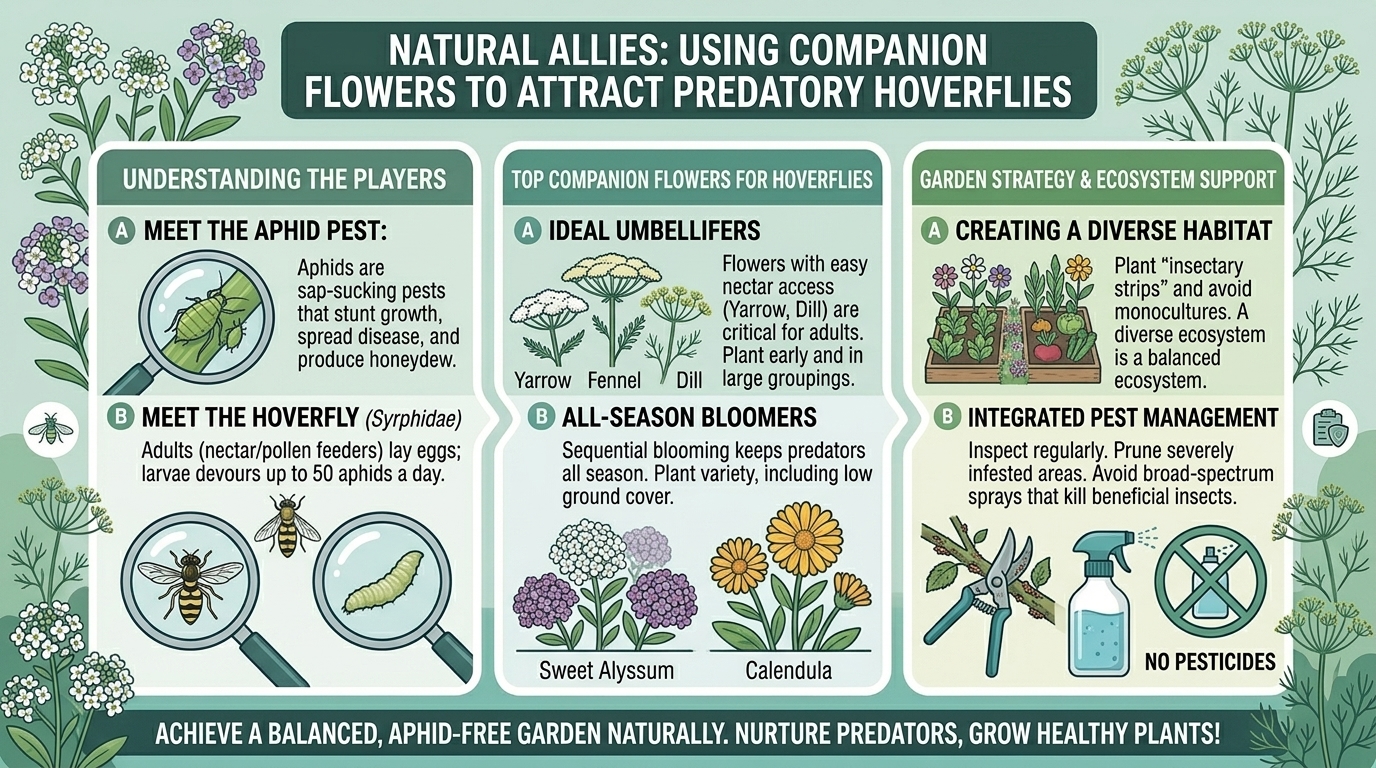
Fortunately, nature provides its own highly efficient security force: predatory hoverflies (family Syrphidae). Adult hoverflies resemble miniature bees or wasps, hovering effortlessly in mid-air before darting forward with astonishing precision. While the adults feed exclusively on nectar and pollen, their voracious offspring—the maggot-like hoverfly larvae—are absolute aphid-eating machines. A single hoverfly larva can consume hundreds of aphids before pupating, making them one of the most powerful biological control agents in organic gardening.
To harness this natural pest control, you need to invite these beneficial insects into your landscape by planting the right companion flowers. This comprehensive guide explores the biology of hoverflies, the specific flower varieties that attract them, garden design strategies, and frequently asked questions to help you build a thriving, aphid-free ecosystem.
Understanding the Hoverfly: Nature’s Secret Weapon
Before diving into plant varieties, it helps to understand why hoverflies are so valuable and what they look for in a habitat. Hoverflies belong to the order Diptera (true flies), meaning they have only one pair of wings, unlike bees and wasps which have two. Despite their harmless nature, their striking yellow-and-black warning coloration is a form of Batesian mimicry that deters predators like birds.
The Two-Stage Benefit
- The Adults (Pollinators): Adult hoverflies are prolific pollinators. They require a steady supply of nectar and pollen to fuel their flight and fuel egg production.
- The Larvae (Predators): Adult female hoverflies scout for aphid colonies before laying their tiny, oval white eggs right in the middle of the pest cluster. Within days, the legless, slug-like larvae hatch and immediately begin hunting. Lacking eyes, they sweep their front ends back and forth, impaling aphids on their mouthparts, injecting paralyzing enzymes, and drinking them dry.
By catering to the adult hoverflies’ dietary and habitat needs using companion flowers, you guarantee a continuous pipeline of hungry larvae ready to eradicate your aphid problems organically.
The Top Companion Flowers to Attract Hoverflies
Hoverflies have specific morphological traits—primarily shorter mouthparts compared to butterflies or long-tongued bees—meaning they prefer flat-topped, daisy-like, or umbel-shaped flowers that offer easy access to nectar and pollen.
1. Sweet Alyssum (Lobularia maritima)
Sweet alyssum is arguably the absolute gold standard for attracting beneficial insects, including hoverflies, parasitic wasps, and lacewings.
- Why it works: It produces a dense, continuous carpet of tiny white, pink, or purple flowers shaped in small clusters. The abundant, shallow blossoms provide an easy nectar source for adult hoverflies.
- Garden Placement: Plant sweet alyssum as a living mulch around the base of aphid-prone crops like brassicas, tomatoes, and roses, or line your vegetable bed pathways with it.
2. Dill (Anethum graveolens)
Dill is a member of the Umbelliferae (or Apiaceae) family, characterized by its umbrella-shaped flower heads (umbels) composed of dozens of tiny yellow blossoms.
- Why it works: Hoverflies adore umbel flowers. The flat, wide surface area gives them a comfortable landing pad, while the microscopic florets provide rich, accessible nectar.
- Garden Placement: Allow a few dill plants to bolt and flower in your garden beds rather than harvesting all of them for culinary use. They act as prime hoverfly magnets near lettuce, beans, and peppers.
3. Fennel (Foeniculum vulgare)
Like dill, fennel produces dramatic, feathery foliage topped with large, bright yellow umbrella-shaped flower heads.
- Why it works: Fennel’s massive pollen yield attracts a wide array of beneficial predatory insects. Its tall stature also makes it a prominent visual beacon from a distance.
- Garden Placement: Plant fennel toward the back of garden beds or in dedicated perennial herb patches. Note: Keep fennel away from tomatoes, coriander, and caraway, as it can stunt their growth.
4. Coriander / Cilantro (Coriandrum sativum)
If you let cilantro go to seed, it shoots up delicate white and pale pink umbel flowers that hoverflies cannot resist.
- Why it works: Cilantro blooms relatively quickly in warm weather, making it one of the earliest reliable sources of beneficial insect fuel in late spring.
- Garden Placement: Plant succession crops of cilantro throughout the season so you always have a patch bolting and flowering to support local hoverfly populations.
5. Yarrow (Achillea millefolium)
Yarrow is a hardy perennial native to North America and Europe, prized for its flat-topped clusters of tightly packed flowers in shades of yellow, white, pink, and red.
- Why it works: The broad, flat surface of a yarrow bloom allows multiple adult hoverflies to land and feed simultaneously. Furthermore, yarrow foliage is exceptionally sturdy, providing safe resting perches.
- Garden Placement: Integrate yarrow into perennial borders, cottage gardens, or meadow-style plantings adjacent to fruit trees and rose gardens prone to green aphids.
6. Golden Marguerite / Dyer’s Chamomile (Anthemis tinctoria)
Golden Marguerite features bright, daisy-like yellow flowers paired with deeply divided, fern-like foliage.
- Why it works: Belonging to the Asteraceae family, daisies offer a central disk of tubular florets packed with high-protein pollen that female hoverflies require to develop their eggs.
- Garden Placement: Excellent for borders, rock gardens, and sunny vegetable garden perimeters.
7. Coreopsis (Coreopsis spp.)
Also known as tickseed, coreopsis produces masses of bright yellow, golden, or reddish-brown daisy-like flowers throughout the summer months.
- Why it works: They are exceptionally drought-tolerant, low-maintenance, and put on a continuous floral display that keeps adult hoverflies sustained over a long growing season.
- Garden Placement: Perfect for sunny garden edges, pollinator strips, and native plant containers.
8. Buckwheat (Fagopyrum esculentum)
Often grown as a cover crop, buckwheat produces dense clusters of small white flowers that bloom rapidly from seed.
- Why it works: Buckwheat is a premier nectar plant for a wide spectrum of beneficial insects. It begins flowering just 3 to 5 weeks after planting, providing an immediate biological control boost.
- Garden Placement: Broadcast buckwheat in empty garden beds between crop rotations to enrich the soil and summon predatory hoverflies.
Designing a Hoverfly-Friendly Garden Ecosystem
Simply scattering a few flower seeds is a great start, but creating a resilient ecosystem requires a strategic approach to garden design and maintenance:
- Continuous Succession Planting: Hoverflies are active from early spring through the first autumn frosts. Ensure you have overlapping bloom times—for instance, planting cilantro for spring, yarrow and dill for mid-summer, and late-season coreopsis for fall.
- Avoid Broad-Spectrum Pesticides: This is the most critical rule of biological pest control. Using synthetic insecticides or even heavy-handed organic sprays like pyrethrins will kill the adult hoverflies and their larvae, trapping you in a continuous chemical dependency cycle.
- Provide Water Sources: Beneficial insects need hydration. Set up a shallow bee bath or saucer filled with fresh water and pebbles so hoverflies can land safely and drink without drowning.
- Eliminate Pest “Deserts”: Maintain a diverse landscape. Monocultures (planting large blocks of a single crop) invite massive pest outbreaks because beneficial predator populations cannot establish quickly enough to keep up. Interplant your companion flowers directly among susceptible vegetables.
Frequently Asked Questions (FAQ)
1. Do hoverfly larvae bite or sting humans?
No, absolutely not. Adult hoverflies are completely harmless—they lack stingers and mouthparts capable of piercing human skin (they mimic bees purely for defense). Their maggot-like larvae are also completely docile, moving slowly across plant surfaces to consume aphids without posing any threat to humans, children, or pets.
2. How do I distinguish hoverfly larvae from caterpillar pests?
Hoverfly larvae are legless, tapered, and lack a distinct head capsule; they often look like tiny, translucent slugs or teardrops lying flat against the leaf surface. Caterpillars possess distinct legs, prolegs, and head capsules and generally chew large holes in leaves, whereas hoverfly activity leaves leaves intact while aphid numbers mysteriously plummet.
3. How quickly do companion flowers attract hoverflies to an infestation?
If hoverflies are present in your local environment, they can discover new nectar sources and aphid colonies within hours to a few days. However, establishing a robust, self-sustaining population that reliably controls major outbreaks takes a few weeks of continuous flowering and habitat building.
4. Can I buy hoverflies commercially like ladybugs?
While some specialty beneficial insect suppliers sell lacewings, predatory mites, and ladybugs, commercial availability of live adult hoverflies is rare due to their high mobility. The most effective, cost-efficient, and natural way to establish hoverflies is to attract wild populations using the companion flowers listed in this guide.
5. Why are my dill and cilantro plants attracting hoverflies, but I still have aphids?
Adult hoverflies feed on nectar and pollen, but they only lay eggs when they detect an active aphid colony nearby. If your flowers are thriving but your vegetables still have aphids, the female hoverflies are likely still searching out the specific colonies to lay their eggs. Give the system a week or two for the newly hatched larvae to reach sufficient size and voraciousness.
6. Are there specific colors that attract hoverflies best?
Yes. Scientific studies show that adult hoverflies exhibit a strong visual preference for yellow and white flowers. While they will visit blue or purple blossoms occasionally, yellow umbellifers and daisy-like flowers yield the highest visitation rates.
7. Do hoverflies overwinter in the garden?
Yes. Hoverflies overwinter in various life stages depending on the species—some as pupae tucked into the leaf litter or topsoil, and others as migrating adults that fly south or seek shelter in protected garden nooks, sheds, and hollow plant stems. Leaving some garden debris over winter helps support their lifecycle.
8. Will companion flowers interfere with my vegetable crop yields?
Not at all. In fact, they will enhance your yields. By attracting hoverflies and other pollinators like native bees and parasitic wasps, your pollination rates will increase while destructive sap-sucking pests are kept below damaging economic thresholds.
9. What should I do if my dill or fennel plants get overrun by swallowtail butterfly caterpillars?
It is a common dilemma: dill and fennel are also host plants for black swallowtail butterfly caterpillars. If you notice swallowtail caterpillars, try to share! Allow a few stems for the butterflies and reserve other sections of your herb patch specifically for hoverfly attraction, or plant a larger volume of umbelliferous flowers to accommodate both beneficial species.
10. Can I grow these companion flowers in containers on a balcony or patio?
Yes! Sweet alyssum, dwarf coreopsis, and potted herbs like dill and cilantro thrive in containers, window boxes, and urban balcony gardens. Even high-rise apartment gardeners can successfully attract hoverflies to protect indoor or patio container plants from aphid invasions.
Conclusion
Managing aphids doesn’t have to mean reaching for toxic chemicals or spending hours manually squishing pests off your precious plants. By integrating natural companion flowers like sweet alyssum, dill, yarrow, and coreopsis into your garden design, you transform your yard into an inviting habitat for predatory hoverflies. These remarkable insects provide a free, self-sustaining biological defense system that protects your vegetables, flowers, and ornamental shrubs while fostering a balanced, thriving, and vibrant ecological community.