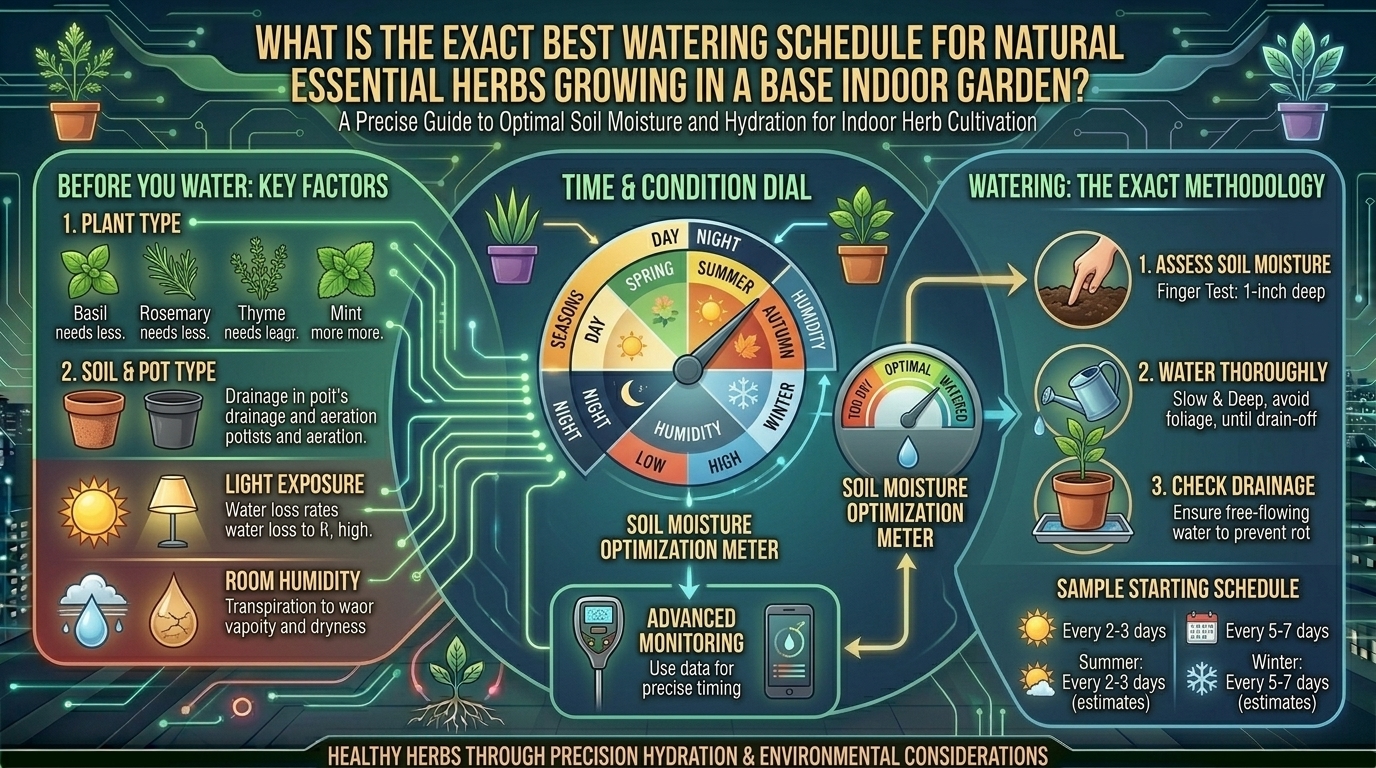
What Is the Exact Best Watering Schedule for Natural Essential Herbs Growing in a Base Indoor Garden?
Cultivating a collection of fresh, aromatic essential herbs—such as basil, rosemary, mint, thyme, and cilantro—is one of the most satisfying projects for any indoor home gardener. Whether you are managing a sleek kitchen herb garden in an urban New York City apartment, working with bright window light in San Francisco, nurturing pots in a Seattle home, or dealing with the intense indoor air-conditioning cycles of a Texas residence, having fresh culinary herbs at your fingertips transforms cooking.
However, ask ten different indoor gardeners how often you should water your herbs, and you will likely get ten different answers. Some will say “water every Monday,” while others insist on waiting until the leaves droop.
Here is the ultimate truth every indoor gardener needs to know: There is no calendar-based watering schedule that works for all indoor herbs.
Relying on a rigid schedule (like “water every 3 days”) is the absolute fastest way to drown your basil or dehydrate your rosemary. Because indoor environments fluctuate based on ambient temperature, humidity, container size, and soil composition, the exact best watering schedule is dictated by soil moisture and plant biology, not a clock.
This comprehensive, expert-backed guide breaks down how to water your indoor essential herbs like a pro, tailoring your approach to each specific plant variety to ensure a thriving, aromatic indoor harvest.
1. The Golden Rule of Indoor Herb Watering: The Finger Test
Before picking up your watering can, you must understand how indoor potting soil behaves. Unlike outdoor garden beds where moisture evaporates slowly and roots can search deep into the earth, indoor containers hold a finite volume of soil that dries from the top down and the inside out.
The Two Watering Camps of Indoor Herbs:
- Drought-Tolerant Mediterranean Herbs (Rosemary, Thyme, Oregano, Sage): These herbs evolved along the dry, rocky, sun-drenched coastlines of Southern Europe. They despise “wet feet” and will develop root rot rapidly if kept in soggy soil. Their soil must dry out almost completely between waterings.
- Moisture-Loving Tender Herbs (Basil, Cilantro, Parsley, Mint): These leafy green herbs originate from more temperate or tropical understory climates. They prefer soil that stays consistently moist (like a wrung-out sponge) and will wilt dramatically if allowed to dry out completely.
The Universal Finger Test:
Never guess whether your herbs need water. Use the Knuckle Test:
- Push your index finger straight down into the potting soil up to your second knuckle (about 1 to 2 inches deep).
- If the soil feels dry and warm at your fingertips, it is time to water.
- If the soil still feels damp, cool, or sticks to your skin, do not water. Leave it alone for a few more days.
2. Tailoring Watering Schedules by Herb Variety
Every essential herb has unique physiological needs. Grouping your herbs based on their watering requirements will make your indoor maintenance effortless.
A. Basil (Ocimum basilicum)
- Watering Need: Moderate to High (Moisture-Loving)
- Habit: Basil is a thirsty, fast-growing herbaceous plant with large leaves that transpire moisture rapidly.
- Schedule Tip: Water thoroughly whenever the top 1 inch of soil feels dry. If basil goes too long without water, its leaves will instantly droop limply. However, do not leave standing water in its saucer, as basil stems rot easily at the soil line.
B. Rosemary (Salvia rosmarinus)
- Watering Need: Low (Drought-Tolerant)
- Habit: Rosemary has needle-like, leathery leaves designed to lock in moisture. It hates wet soil.
- Schedule Tip: Let the entire pot dry out completely—down to the bottom of the container—before watering again. When you do water, drench the soil thoroughly until it runs out the drainage holes, then let it drain completely.
C. Mint (Mentha)
- Watering Need: High (Constant Moisture)
- Habit: Mint is a vigorous survivor that loves damp conditions. In nature, it often grows along stream banks.
- Schedule Tip: Never let mint dry out completely. Keep its soil consistently moist. Note: Always keep mint in its own standalone container; if planted with other herbs, its aggressive roots and constant thirst will crowd and starve out neighboring plants.
D. Thyme and Oregano (Thymus vulgaris & Origanum vulgare)
- Watering Need: Low
- Habit: Like rosemary, these low-growing Mediterranean groundcover herbs thrive on neglect and lean, dry soils.
- Schedule Tip: Allow the soil to dry out completely between waterings. Overwatering thyme is the number one cause of its sudden death indoors.
E. Cilantro (Coriandrum sativum)
- Watering Need: Moderate
- Habit: Cilantro has a delicate root system and a tendency to “bolt” (flower and go to seed) if it experiences drought stress or sudden heat.
- Schedule Tip: Keep the soil evenly moist, watering whenever the top half-inch dries out.
3. The Mechanics of Proper Watering: Bottom Watering vs. Top Watering
How you apply water to your indoor herb pots matters just as much as when you apply it.
Top Watering (The Standard Method)
- How to do it: Pour water slowly and evenly across the surface of the soil using a narrow-spouted watering can until water begins to trickle out of the bottom drainage holes.
- Why it works: It flushes out accumulated mineral salts from organic fertilizers and ensures the entire root zone gets hydrated.
- Crucial Rule: Always empty the saucer beneath your pot 15 minutes after watering. Never let your herb pots sit in stagnant drainage water.
Bottom Watering (The Container Secret Weapon)
- How to do it: Place your potted herb (which must have drainage holes at the bottom) into a shallow tray or sink filled with 1 to 2 inches of water. Let the pot sit for 20 to 30 minutes. The dry potting mix will draw water upward via capillary action. Once the top surface of the soil feels slightly damp, remove the pot and let it drain.
- Why it works: It prevents the topsoil from becoming compacted, thoroughly hydrates dry coco coir or peat moss, and encourages roots to grow downward toward the bottom of the pot.
4. Environmental Factors That Alter Your Watering Frequency
Your indoor herb watering schedule will change dynamically throughout the year based on environmental shifts:
- Seasonal Changes: In spring and summer, your herbs experience active growth spurts and higher sunlight levels, requiring more frequent watering. In fall and winter, indoor heating runs, but lower light levels slow plant metabolism down significantly, meaning herbs need much less water.
- Container Material: Unglazed terracotta pots are porous; they breathe and allow moisture to evaporate quickly through the clay walls (ideal for rosemary and thyme). Plastic pots, glazed ceramic containers, and fabric grow bags retain moisture much longer.
- Indoor Climate Control: Central heating in winter or air-conditioning in summer dries out indoor air rapidly, pulling moisture straight out of your potting soil. Monitor your soil more frequently during extreme weather months.
5. Frequently Asked Questions (FAQ)
1. Can I use a fixed schedule, like watering my indoor herbs every Sunday?
It is strongly discouraged. A fixed calendar schedule ignores changing indoor temperatures, humidity, and the specific growth stage of individual herbs. Always check soil moisture with your finger before watering.
2. Why are the lower leaves of my indoor basil turning yellow and dropping off?
This is typically a sign of overwatering. When soil stays waterlogged, roots suffocate and rot, preventing the plant from taking up nitrogen, which causes lower leaves to yellow and fall away.
3. What is the best time of day to water indoor herbs?
Morning is the absolute best time. Watering in the morning gives your herbs ample hydration to get through the warm daylight hours when transpiration peaks. Avoid watering late at night, as standing moisture on leaves overnight can invite fungal issues.
4. Why is my indoor rosemary turning brittle and dropping needles?
Dry, crispy needles on a indoor rosemary plant are usually a sign of severe underwatering combined with dry indoor heating. While rosemary likes dry soil, letting the root ball become bone-dry for too long causes irreversible dehydration.
5. Do I need to use filtered water for indoor herb gardens?
Most indoor herbs do fine with standard tap water. However, if your tap water is heavily treated with chlorine or chloramines, letting your watering can sit open overnight allows the chlorine gas to dissipate naturally before you water your plants.
6. Can I revive a completely dried-out potted herb?
Yes! If your potting soil has shrunk away from the sides of the pot and become hydrophobic (repelling water), place the entire pot into a basin of water and let it soak for 45 minutes until the root ball is fully rehydrated.
7. Why is white crust forming on the surface of my indoor herb pots?
That white, powdery crust is an accumulation of mineral salts from tap water and organic fertilizers. Flush the soil thoroughly by pouring a large volume of water through the pot, letting it drain out completely, or scrape off the top layer and replace it with fresh compost.
8. Does pot size affect how often I need to water?
Yes! Small pots (3 to 4 inches wide) contain very little soil and dry out in a day or two. Large pots (8 to 12 inches wide) hold a massive reservoir of moisture and can go a week or longer between waterings.
9. Should I mist my indoor herb leaves with water daily?
While it seems like a good way to simulate humidity, misting indoor herbs is generally unnecessary and can actually promote fungal leaf diseases (like powdery mildew) if air circulation is low. Focus on watering the soil directly.
10. How do I know if my herb pot has root rot?
If your herb plant looks perpetually wilted despite having wet soil, gently slide the plant out of its pot. Healthy roots are firm, white, or light tan. Roots affected by rot are brown, mushy, black, and emit a sour, decaying odor. Trim away rotted roots and repot in fresh, well-draining organic soil.
Conclusion
Mastering the watering schedule for your natural essential herbs in an indoor garden comes down to shifting away from a strict calendar and tuning into the needs of your plants. By understanding the distinct preferences of drought-tolerant Mediterranean varieties versus moisture-loving leafy herbs, utilizing the reliable finger test, and ensuring your containers drain properly, you will maintain a vibrant, aromatic indoor herb garden year-round.
What is your favorite essential herb to grow indoors, and what watering method do you find works best in your home? Let us know in the comments below!