Living in a vibrant urban environment—whether you are managing a cozy apartment in New York City, tending a sunny balcony in San Francisco, utilizing a patio in Austin, Texas, or working with compact spaces in Seattle and California—brings a unique appreciation for sustainability. Every day, as you chop vegetables, brew coffee, and slice fruit, you create a steady stream of organic kitchen scraps.
Instead of tossing those valuable resources into the trash bin where they end up in a landfill, you can transform them into “black gold”—nutrient-dense organic compost.
However, if you are growing plants primarily in pots, containers, or indoor setups, composting kitchen waste requires a slightly different approach than maintaining a massive backyard compost heap. Potted plants are delicate, closed ecosystems; applying raw or poorly managed compost to a container can introduce odors, attract pests, or burn plant roots.
This comprehensive, expert-backed guide walks you through the exact step-by-step process of safely turning your daily kitchen food waste into rich, sterile, perfectly cured compost tailored specifically for potted plants.
1. Why Potted Plants Need Special Compost Care
When you garden in the ground, nature provides a massive buffering capacity. Earthworms migrate in, excess moisture drains away into the Earth, and soil microbes balance out minor imbalances instantly.
Containers and pots, by contrast, are finite. Because potted plant roots live in a restricted volume of soil:
- Improperly Cured Compost is Toxic: Raw or half-decomposed food scraps still undergoing active bacterial heat cycles can release organic acids and ammonia that will rapidly burn and kill potted plant roots.
- Moisture Control is Critical: Poorly managed kitchen waste holds too much water, turning pots into soggy, anaerobic swamps that breed fungus gnats and root rot.
- Nutrient Concentration: Potted soil requires balanced, fine-textured humus that integrates smoothly with structural materials like coco coir and perlite.
2. Setting Up Your Kitchen Scrap Collection System
The secret to odor-free, pest-free composting starts right on your kitchen counter or under your sink. If your collection system smells bad or attracts fruit flies before it even reaches your compost bin, your process needs a quick adjustment.
A. The Countertop Bin
- Choose a small, stainless steel or ceramic countertop container equipped with a charcoal filter in the lid. Charcoal filters absorb volatile organic odors entirely.
- Tip: Line your countertop bin with a biodegradable paper bag or a certified home-compostable liner to make emptying effortless.
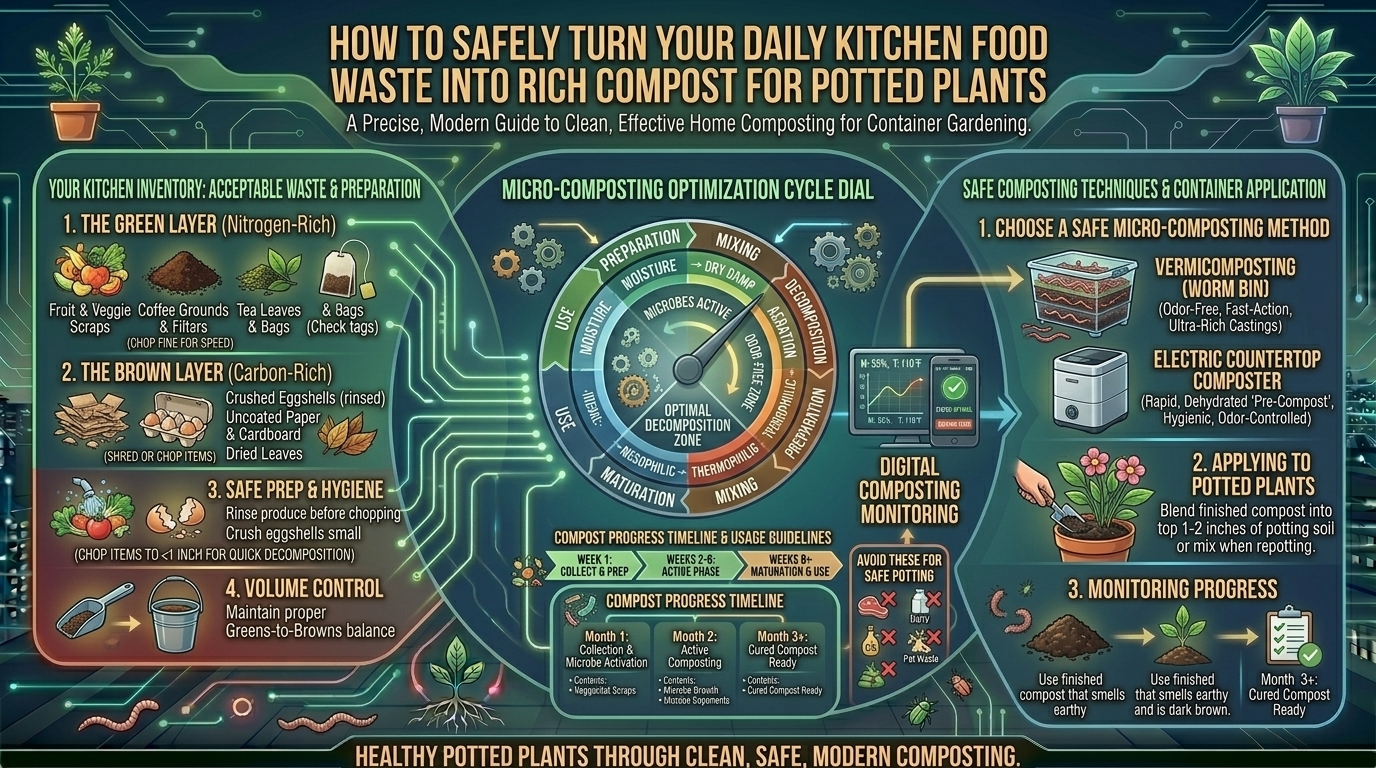
B. What Kitchen Scraps to Collect (“Greens”)
- Raw Vegetable Trimmings: Carrot tops, potato peelings, onion skins, celery ends, and squash guts.
- Fruit Scraps: Apple cores, banana peels, melon rinds, and citrus peels (chop citrus into small pieces so they break down easily).
- Coffee Grounds and Filters: Unbleached paper coffee filters and used coffee grounds are prized by composting microbes and worms.
- Crushed Eggshells: Wash them, bake them briefly to sanitize, and crush them into a fine powder for slow-release calcium.
C. What to Strictly Avoid in Potted Plant Compost
- Oils, Butter, and Greases: These coat organic matter, repel water, lack oxygen, and will instantly attract rodents and foul odors.
- Meat, Fish, Bones, and Dairy: Animal proteins rot slowly, produce horrific smells, and are magnets for flies and maggots.
- Pet Waste: Dog or cat feces harbor dangerous parasites that must never enter a home vegetable container.
3. Choosing the Right Composting Method for Small Spaces
Depending on your living situation, you have three primary methods for converting daily kitchen scraps into safe compost for pots:
Method 1: Indoor Worm Composting (Vermicomposting) — The Best for Apartments
Using a compact, stackable indoor worm bin stocked with Red Wiggler worms (Eisenia fetida), you can feed kitchen vegetable scraps directly to the worms in your kitchen, laundry room, or balcony.
- The Result: Worm castings (vermicompost)—one of the richest, safest, most biologically active organic fertilizers on earth. It never burns plants and can be mixed directly into potting soil.
Method 2: Small Tumbler Composters — Great for Balconies and Patios
A sealed, elevated plastic drum tumbler keeps waste off the ground and allows you to easily rotate your scraps. By balancing your kitchen greens with shredded cardboard (browns), you can generate finished compost in a few short months.
Method 3: Bokashi Fermentation — The Urban Secret Weapon
Bokashi is a Japanese anaerobic fermentation method. You place kitchen scraps (including cooked food, meat, and dairy!) into an airtight bucket and sprinkle them with Bokashi bran (inoculated with beneficial Effective Microorganisms).
- The Result: Within two weeks, the food is pickled and fermented without rotting or smelling. You then bury this fermented material into a pot of soil or an outdoor bin, where it breaks down into rich soil in record time.
4. The Golden Rule: Balancing “Greens” and “Browns”
Kitchen food scraps are wet and nitrogen-heavy (“Greens”). If you put only kitchen scraps into a bin, you will end up with a slimy, foul-smelling, anaerobic sludge.
To create sweet-smelling, safe compost for your potted plants, you must mix in carbon-rich dry materials (“Browns”):
- Browns to include: Shredded brown cardboard, unprinted paper bags, torn egg cartons, dry autumn leaves, and untreated wood shavings.
- The Golden Ratio: Maintain roughly 3 parts Browns to 1 part Greens by volume. Whenever you dump a cup of wet vegetable peels into your bin, add three cups of shredded cardboard or dry leaves on top.
5. How to Tell When Your Compost is Safe for Potted Plants
Never apply raw or half-finished compost straight to your potted plants. To ensure your kitchen waste compost is completely safe, check for these indicators:
- Appearance: It must look dark brown, crumbly, and uniform like rich forest floor humus. You should not be able to recognize individual food scraps.
- Smell: It should smell clean, earthy, and sweet like fresh rain. If it smells like ammonia, sulfur, or rotting garbage, it is still decomposing and needs more oxygen and carbon.
- Temperature: A finished outdoor compost pile should have cooled down entirely to ambient air temperature.
How to Mix It Into Potting Soil:
Pure compost is too rich and dense to use by itself in pots. Create the ultimate potting blend by mixing:
- 20% to 30% Finished Kitchen Compost / Worm Castings
- 40% Coco Coir or Peat Moss (Moisture retention)
- 30% Perlite or Pumice (Aeration and drainage)
6. Frequently Asked Questions (FAQ)
1. Can I put citrus peels (lemons and oranges) into my compost for pots?
Yes, but chop them into small pieces and use them in moderation. Citrus peels are acidic and contain natural oils that slow down decomposition. Ensure your bin has plenty of balancing carbon materials like shredded cardboard.
2. Will indoor worm composting cause fruit flies in my home?
If managed correctly, a vermicomposting bin will not attract fruit flies. Always bury fresh kitchen scraps under a 2-inch layer of damp shredded newspaper or coconut coir, and keep the bin tightly covered with a breathable lid.
3. Can I use Bokashi fermented food waste directly in potted plants?
Bokashi-fermented food waste is initially very acidic. If you bury it directly in a small pot with plant roots, it can burn the plant. Bury the fermented waste in a separate bin or pot of soil and let it mellow for 2 to 4 weeks until it neutralizes and breaks down completely before planting in it.
4. How long does it take for kitchen scraps to turn into usable compost?
In an active, well-maintained worm bin, kitchen scraps transform into rich vermicompost in about 6 to 8 weeks. In an outdoor tumbler or balanced bin, it typically takes 2 to 4 months.
5. Can I compost cooked food and leftovers for my pots?
Standard composting bins should avoid cooked food, oils, and dairy because they attract pests and rot poorly. However, if you use a Bokashi fermentation system, you can safely ferment cooked leftovers, meat scraps, and dairy before burying them in soil.
6. Why does my compost bin smell like ammonia?
An ammonia smell means your pile has too many nitrogen-rich “Greens” (like wet food scraps or grass clippings) and lacks oxygen and carbon. Fix this immediately by turning or mixing the pile and adding a generous amount of shredded brown cardboard or dry leaves.
7. Do I need to chop up my kitchen vegetable scraps before composting?
You don’t have to, but chopping scraps into smaller pieces drastically accelerates decomposition. Smaller pieces give beneficial microbes and composting worms more surface area to work with, cutting composting time in half.
8. Can I use moldy bread and cheese from my fridge?
Moldy bread is completely safe to compost (it is just beneficial saprophytic fungi). Avoid moldy cheeses or dairy products in standard open bins, as fats and dairy attract unwanted pests and cause foul odors.
9. Will homemade kitchen compost introduce fungus gnats to my indoor pots?
If compost is not fully cured and finished, it can harbor fungus gnat larvae. Ensure your compost is dark, earthy, and fully broken down before adding it to indoor pots. You can also sterilize or bake small batches of home compost if you want to be 100% sure no pests are present.
10. Can I grow vegetables in 100% pure worm castings?
No. While worm castings are an incredible organic fertilizer, pure castings are too dense and heavy for plant roots. Always blend worm castings (roughly 10% to 20% of your total mix) into a structured potting soil base containing perlite and coco coir.
Conclusion
Turning your daily kitchen food waste into rich, sterile, nutrient-dense compost for your potted plants is one of the most satisfying steps you can take toward a sustainable, zero-waste lifestyle. Whether you choose an indoor worm bin in an apartment, a balcony tumbler, or Bokashi fermentation, closing the loop on your kitchen scraps provides your potted herbs, vegetables, and flowers with the finest organic nutrition available.