Welcome to the ultimate agricultural and kitchen-garden cultivation guide by KCPlants, custom-tailored for passionate food growers across America’s diverse geographic and climatic landscape—from the blazing heat of Texas and Southern California to the rich, brisk growing corridors of New York and Washington, and the unique, fog-kissed maritime microclimates of San Francisco.
Few culinary experiences rival the pure joy of biting into a freshly harvested ear of sweet corn (Zea mays). The kernels burst with a sugary, milky crunch that store-bought grocery store cobs simply cannot replicate. For home gardeners aiming for self-sufficiency, growing corn is an exciting rite of passage.
However, many beginner gardeners make a heartbreaking mistake during their first season. They plant their corn seeds in a long, single straight row along a garden fence line, mimicking the look of large-scale commercial farm equipment. Months later, they tend lush, towering green stalks, pull back the husks with eager anticipation—and discover sparsely filled cobs with missing kernels, blank tips, and erratic, gappy rows.
The culprit behind this common gardening heartbreak isn’t bad soil, insufficient fertilizer, or plant disease. It is a fundamental misunderstanding of corn reproduction: improper pollination caused by linear planting.
To guarantee a harvest of fully pollinated, plump, heavy ears of corn, you must abandon single-row layouts and embrace the block planting method.
This comprehensive, SEO-optimized guide explores the fascinating biology of corn pollination, step-by-step block garden design, regional growing strategies across the US, and actionable tips designed to help your website rank effortlessly on Google.
The Biology of Corn Pollination: Why Single Rows Fail
To understand why block planting is mandatory for success, you must first understand how corn reproduces. Corn is not pollinated by bees or butterflies; it relies almost entirely on the wind.
+-------------------------------------------------------------+
                  THE CORN REPRODUCTION CYCLE
+-------------------------------------------------------------+
| TASSELS (Male):   Form at the very top of the stalk, releasing millions of microscopic pollen grains |
| SILKS (Female):   Emerge from young ear shoots, acting as sticky pollen catchers |
| WIND ACTION:      Gravity and wind blow pollen downward onto the waiting silks |
| THE BLOCK RULE:   Pollen must fall *within* a dense cluster, not blow away into empty space |
+-------------------------------------------------------------+
1. Separate Male and Female Organs
Unlike tomatoes or squash, which feature male and female parts on the same or neighboring flowers, corn plants feature separate male and female organs on the exact same stalk:
- The Tassel: The feathery, branching structure at the very top of the corn stalk acts as the male organ. It produces millions of microscopic, powdery pollen grains.
- The Ear Shoot: Emerging midway down the stalk are the developing ears, wrapped in husks. From the tip of each unfertilized ear protrudes a bundle of long, silky threads known as silks.
2. The Granular Race Against Time
For every individual kernel of corn to form on an ear, a single grain of pollen must land on its corresponding individual silk strand.
- Each silk strand is essentially a hollow tube running down to an unfertilized ovule on the cob.
- When pollen lands on a silk, it germinates and travels down the tube to fertilize that kernel. If a silk never catches a grain of pollen, that specific kernel never develops, resulting in those frustrating, unsightly missing gaps on your harvested cob.
3. Why Single Rows Spell Disaster
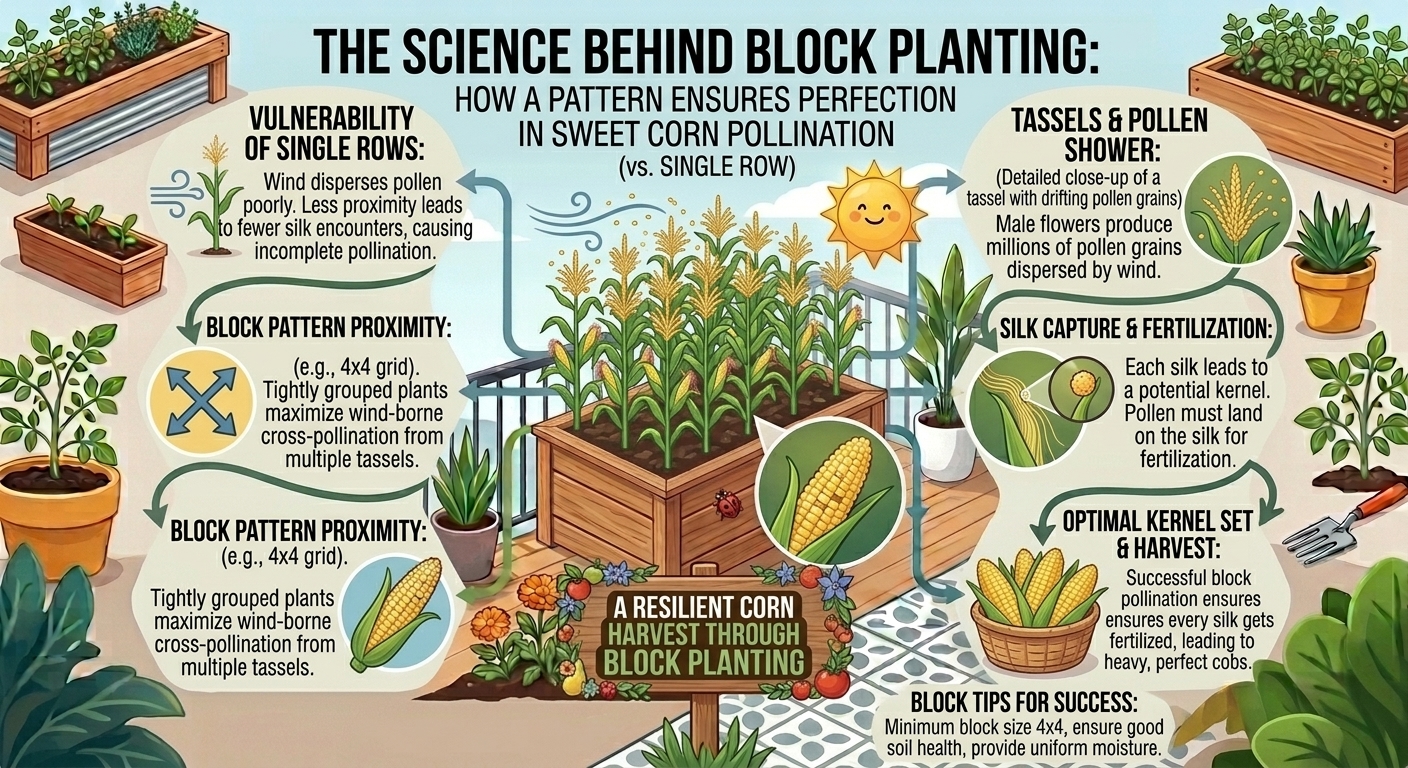
If you plant your corn in a single, long 20-foot straight row, you create an aerodynamic nightmare. When the wind blows, millions of grains of pollen from the top tassels are swept away into the surrounding yard, lawn, or neighboring paths. Very little pollen falls onto the silks of neighboring plants within that thin line, leading to erratic, poor pollination and half-naked cobs.
The Solution: The Block Planting Method
By arranging your corn seeds into a block pattern (a grid or square layout) rather than a line, you completely change the physics of the wind.
+-------------------------------------------------------------+
                  THE BLOCK GRID LAYOUT
+-------------------------------------------------------------+
|   [Stalk]   [Stalk]   [Stalk]   [Stalk]                     |
|   [Stalk]   [Stalk]   [Stalk]   [Stalk]  <-- Dense pollen cloud |
|   [Stalk]   [Stalk]   [Stalk]   [Stalk]      drops straight down |
|   [Stalk]   [Stalk]   [Stalk]   [Stalk]      onto waiting silks |
+-------------------------------------------------------------+
1. Creating a Pollen Cloud
When corn is planted in a block—such as a 4×4 or 5×5 grid of stalks planted close together—the tassels form a dense, interconnected canopy. When pollen is released, it doesn’t blow away into the abyss. Instead, it gets trapped within the microclimate of the block, settling downward like a golden cloud onto the massive mat of silks waiting directly below.
2. The Magic Number: Minimum Stalk Counts
Agricultural extension studies show that to achieve optimal pollination, you should never plant fewer than 16 to 20 total stalks arranged in a square block. A grid of at least 4 rows by 4 rows (spaced properly) ensures that every single silk has maximum exposure to falling pollen.
Step-by-Step Guide: How to Design and Plant a Corn Block
Setting up a successful block planting requires precise spacing, soil preparation, and timing. Follow this professional workflow:
+-------------------------------------------------------------+
                    BLOCK PLANTING WORKFLOW
+-------------------------------------------------------------+
| 1. Select a Full-Sun Location (6 to 8+ hours daily)         |
| 2. Amend Soil Heavily with Nitrogen-Rich Organic Compost    |
| 3. Establish a Grid Layout (Rows and columns 12 inches apart)|
| 4. Direct-Sow Seeds 1 Inch Deep After Soil Reaches 60°F     |
| 5. Thin Seedlings to 12 Inches Apart Once Established       |
+-------------------------------------------------------------+
Step 1: Soil Preparation (Feeding Heavy Eaters)
Corn is one of the most heavy-feeding, heavy-drinking crops in the vegetable garden.
- Before planting, work a generous 3-to-4-inch layer of rich, aged organic compost and blood meal or organic nitrogen fertilizer deep into your garden bed.
- Corn demands loose, well-draining soil with a neutral pH between 6.0 and 6.8.
Step 2: Laying Out the Grid
Instead of digging one long trench, dig a series of parallel short trenches in a square or rectangular footprint.
- Space your parallel trenches 12 to 18 inches apart.
- Drop your corn seeds along each trench, spacing them roughly 8 to 12 inches apart from one another.
- Cover the seeds with 1 inch of soil and tamp down gently.
Step 3: Direct-Sowing vs. Transplants
Always direct-sow corn seeds straight into the garden. Corn features a sensitive, fleshy root system (radicle) that detests being disturbed or root-bound in indoor starter pots. Wait until spring soil temperatures consistently reach 60°F or higher before planting.
Regional Block Planting Strategies Across the US
Different American climates present distinct weather profiles that dictate your planting windows and irrigation management.
☀️ Texas & Southern California (Beating the Heat and Managing Water)
- The Challenge: Blazing summer heatwaves can accelerate corn growth too quickly, while intense UV rays dry out silks before pollination occurs, causing incomplete kernel set.
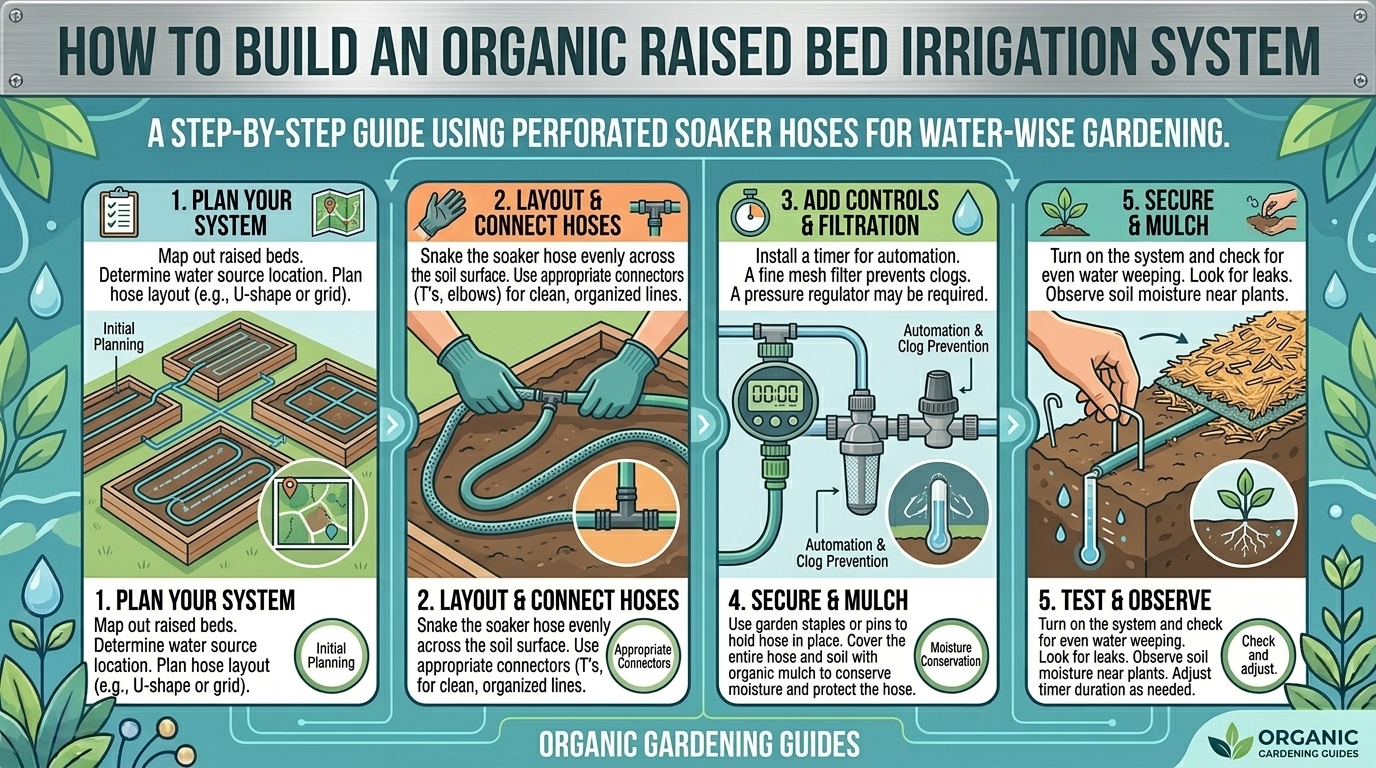
- Regional Strategy: Plant your corn blocks in early spring (February to March in Texas, March to April in SoCal) so the plants tassel and pollinate before peak summer heat hits. Use soaker hoses or drip irrigation beneath the block canopy to keep soil consistently moist, as corn requires immense water during the silking stage.
🌉 San Francisco (Coastal Fog & Cool Microclimates)
- The Challenge: San Francisco’s cool maritime air, rolling fog, and lack of intense summer heat can slow down corn development, requiring careful variety selection.
- Regional Strategy: Choose fast-maturing, cool-tolerant sweet corn varieties (such as early-season yellow or bicolor cultivars). Position your block grid in the absolute sunniest spot on your property to maximize ambient warmth, and avoid over-shading by nearby tall structures.
🌲 Washington & New York (Short Seasons & Summer Thaws)
- The Challenge: Crisp northern springs mean soil warms up slowly, restricting your planting window before autumn frost returns.
- Regional Strategy: Plant your corn blocks in late May once soil temperatures pass 60°F. Use black plastic sheeting laid over the bed a few weeks prior to planting to pre-warm the soil. Select short-season (65-to-80-day) varieties to ensure full harvest before autumn chill arrives.
Advanced Tip: Companion Planting Within the Corn Block
One of the most famous gardening traditions of Indigenous North American agriculture is the Three Sisters method (Corn, Beans, and Squash), which integrates seamlessly into block planting:
- The Corn (The Pole): Provides a natural, sturdy living trellis for climbing plants.
- The Beans (The Nitrogen Fixer): Plant pole beans at the base of your corn stalks after the corn is about 6 inches tall. The beans climb the stalks and pull nitrogen from the air, pumping it back into the soil to feed the heavy-feeding corn.
- The Squash (The Living Mulch): Plant winter squash around the perimeter of the block. Their massive prickly leaves shade the soil, suppress weeds, and retain vital moisture.
Frequently Asked Questions (FAQ)
1. Why did my corn have missing kernels and blank spaces on the cob?
Missing kernels are almost always caused by incomplete pollination. If you planted corn in a single long row instead of a block, wind blew the pollen away before it could land on the silk strands.
2. How many corn stalks do I need minimum for successful block pollination?
You should plant a minimum of 16 to 20 stalks arranged in a square grid (such as a 4×4 or 5×5 pattern). Planting fewer than this drastically reduces the chances of effective wind pollination.
3. Can I hand-pollinate my corn if I accidentally planted in a single row?
Yes! If you realize you planted in a single row, you can act as the wind. Gently cut off the pollen-laden tassels from the top of the stalks in the morning, shake them manually over the waiting silks of your plants, or use a soft artist’s paintbrush to transfer the pollen.
4. How far apart should corn stalks be spaced within a block?
Space your parallel rows 12 to 18 inches apart, and space individual seeds or seedlings 8 to 12 inches apart within those rows. This ensures enough crowding for pollen sharing, but enough room for root development.
5. Can I start corn seeds indoors and transplant them outside?
It is strongly discouraged. Corn has a fragile taproot system that easily suffers transplant shock. Direct-sowing seeds straight into warm garden soil yields much healthier, faster-growing plants.
6. What temperature does soil need to be for corn seeds to germinate?
Corn seeds require soil temperatures of at least 60°F (15°C). Planting seeds in cold, wet spring soil will cause them to rot in the ground before they ever sprout.
7. How much water does block-planted corn need?
Corn is roughly 75% water and requires heavy irrigation—typically 1 to 2 inches of water per week. It is especially critical to keep the soil consistently damp during the tasseling and silking stages; drought stress during silking will cause immediate pollination failure.
8. How do I know when my sweet corn is ready to harvest?
Check the silks at the end of the ear: they should be dry, dark brown, and brittle. Peel back a tiny section of the husk and pierce a kernel with your thumbnail. If a milky-white liquid squirts out, it is at peak sweetness and ready to harvest!
9. Can I grow sweet corn in containers or pots?
Standard sweet corn varieties grow 6 to 8 feet tall and need deep soil, making pots difficult. However, dwarf patio corn varieties (such as ‘On Deck’) can be successfully grown in large 15-to-20-gallon containers—provided you still arrange the pots in a tight block cluster!
10. Why are the bottom leaves of my corn stalks turning yellow?
Yellowing lower leaves can be a sign of nitrogen deficiency (since corn is a heavy feeder) or natural aging as the plant sheds lower foliage shaded by the upper canopy. Side-dress your block with organic nitrogen fertilizer or compost to keep plants dark green and vigorous.
Conclusion
Transitioning away from traditional single-row planting and embracing the block pattern method transforms corn growing from a gamble into a guaranteed success. By understanding how wind pollination works, arranging your stalks into a dense grid, and providing rich soil and consistent water, you unlock a harvest of fully pollinated, plump, sweet ears of corn.