What Are the Best Flowering Perennial Plants to Attract Butterflies and Bees to Your Garden?
Welcome to the ultimate ecological gardening guide by KCPlants, custom-tailored for nature lovers and landscape enthusiasts across America’s diverse geographic regions—from the scorching sun and clay soils of Texas and Southern California to the brisk spring thaws of New York and Washington, and the unique, rolling maritime microclimates of San Francisco.
Step into a flourishing, health-conscious garden on a warm summer afternoon, and you will hear it before you see it: a low, rhythmic, therapeutic hum of life. Honeybees darting from blossom to detail-oriented bumblebees, brilliant monarch butterflies lazily opening and closing their wings on flat-topped flower heads, and hummingbirds whirring through the air. This vibrant motion is the heartbeat of a healthy ecosystem.
Unfortunately, due to urban expansion, widespread pesticide use, and the heavy reliance on sterile monoculture lawns, local populations of beneficial bees, butterflies, and other vital pollinators have faced severe environmental pressures.
The single most effective action you can take as a property owner to reverse this decline is remarkably simple: incorporate flowering perennial plants into your landscaping.
Unlike annual flowers that die at the end of a single season, perennials return year after year, establishing deep root systems and reliably providing nectar, pollen, and larval host material.
This comprehensive, SEO-optimized guide explores the science of pollinator attraction, the top perennial powerhouses for your garden, regional planting strategies across the US, ongoing care tips, and 10 detailed FAQs designed to help your website, kcplants.com, rank effortlessly at the top of Google search results.
Why Pollinators Prefer Perennials: The Ecological Blueprint
To build a garden that truly supports bees and butterflies, you must understand what makes certain flowers irresistible.
+-------------------------------------------------------------+
               THE POLLINATOR ATTRACTION TRIAD
+-------------------------------------------------------------+
| 1. UV COLOR SPECTRUM:  Blues, purples, and yellows attract bees|
| 2. LANDING PLATFORMS: Flat or composite heads for butterflies|
| 3. NECTAR & POLLEN:    High-energy fuel and protein sources |
+-------------------------------------------------------------+
1. Vision and Color Perception
Bees and butterflies view the world through a different visual spectrum than humans. While bees are completely blind to the color red, they possess acute sensitivity to ultraviolet (UV) light. Flowers that feature ultraviolet bullseyes, vibrant blues, rich purples, and bright yellows act like neon billboards for foraging insects.
2. Structural Design Matters
- For Butterflies: Butterflies require wide, flat landing pads where they can perch comfortably while uncoiling their long proboscis to sip deep nectaries. Plants with composite flower heads (like coneflowers and asters) are absolute favorites.
- For Bees: Bees look for tubular or clustered blossoms where they can brush against an abundance of protein-rich pollen grains, transferring them efficiently from flower to flower.
The Top Perennial Plants to Attract Bees and Butterflies
To keep your garden buzzing and fluttering from early spring through late autumn, integrate these heavy-hitting perennial favorites into your landscape beds.
+-------------------------------------------------------------+
                   TOP POLLINATOR PERENNIALS
+-------------------------------------------------------------+
| 1. Purple Coneflower (Echinacea purpurea)                   |
| 2. Perennial Salvia (Salvia spp.)                           |
| 3. Butterfly Weed & Milkweed (Asclepias spp.)               |
| 4. Catmint (Nepeta spp.)                                    |
| 5. New England Aster (Symphyotrichum novae-angliae)         |
| 6. Black-Eyed Susan (Rudbeckia hirta)                       |
+-------------------------------------------------------------+
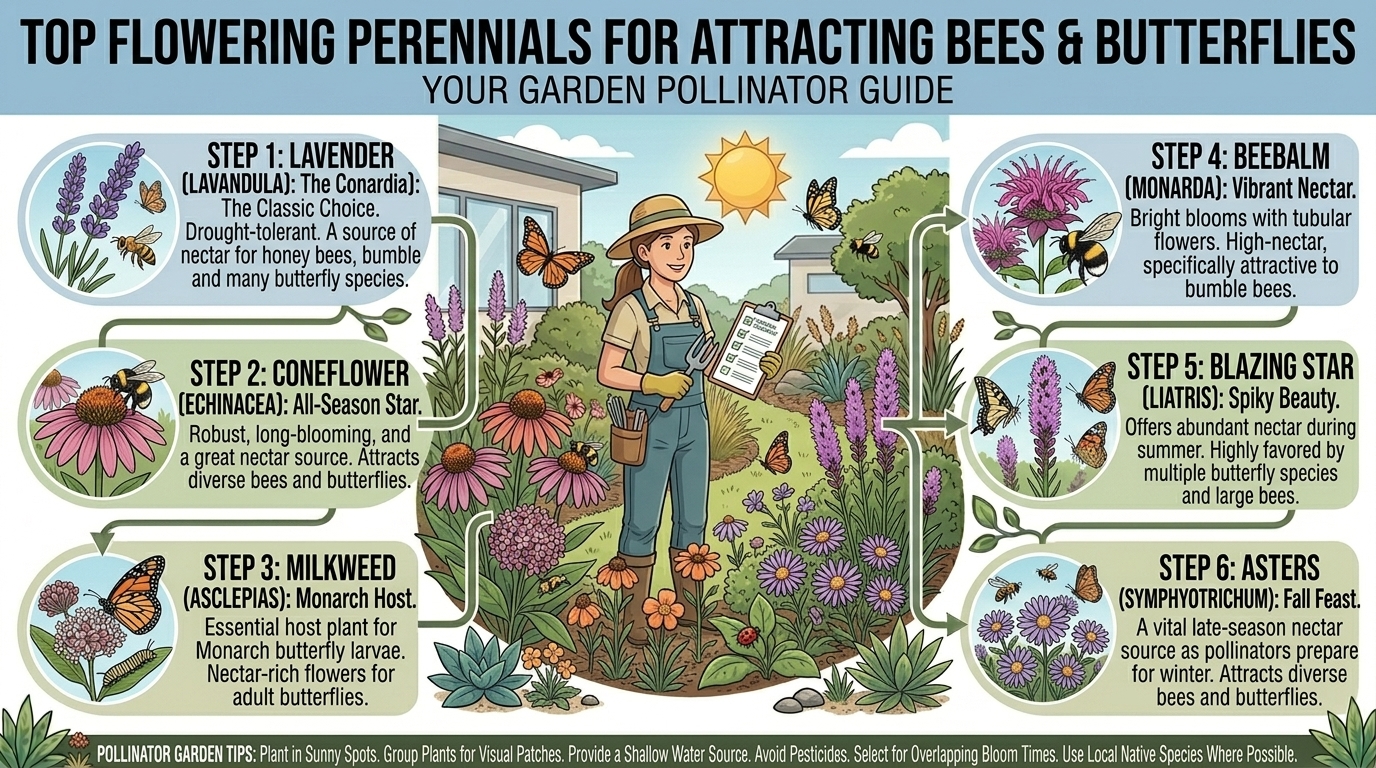
1. Purple Coneflower (Echinacea purpurea)
Coneflowers are the undisputed kings of the summer pollinator garden. Featuring large, prominent copper-orange central cones surrounded by vibrant purple or pink petals, they provide a sturdy landing platform for bumblebees, swallowtail butterflies, and goldfinches. They thrive on neglect, withstand summer drought, and bloom reliably for months.
2. Perennial Salvia (Salvia spp.)
Salvias produce dense, vertical wands of vivid violet-blue, deep indigo, or pink flowers that hum with activity all through late spring and summer. Bees adore their tubular blossoms, while their fragrant foliage makes them completely resistant to deer and rabbits.
3. Butterfly Weed & Milkweeds (Asclepias spp.)
If you want to support monarch butterflies, milkweed is non-negotiable. Butterfly weed (Asclepias tuberosa) produces brilliant clusters of bright orange flowers packed with rich nectar. More importantly, milkweed serves as the exclusive larval host plant for monarch caterpillars, which cannot survive without it.
4. Catmint (Nepeta spp.)
Catmint is an absolute powerhouse for home landscapes. Varieties like ‘Walker’s Low’ form soft, mounding clouds of grey-green foliage smothered in lavender-blue flowers from early summer well into autumn. It attracts endless honeybees and beneficial predatory insects.
5. New England Aster (Symphyotrichum novae-angliae)
While summer flowers get plenty of attention, autumn is a critical survival window for migrating monarchs and late-season bees. Asters burst into a sea of purple, blue, and pink daisies precisely when other garden blooms are fading, providing high-energy fuel before winter.
Regional Planting Strategies Across the US
Different American climates present distinct environmental conditions that dictate your choice of perennial plants.
+-------------------------------------------------------------+
                    REGIONAL CLIMATE ADAPTATION
+-------------------------------------------------------------+
| Texas & SoCal: Heat-tolerant salvias, lantana, and agastache|
| San Francisco: Coastal-adapted buckwheat and native poppies |
| NY & Washington: Cold-hardy coneflowers, asters, and bee balm|
+-------------------------------------------------------------+
☀️ Texas & Southern California (Blazing Heat & Drought)
- The Challenge: High summer temperatures and water restrictions require tough, drought-adapted perennials.
- Regional Strategy: Focus on heat-loving natives like Texas Lantana, Hummingbird Mint (Agastache), Mealy Sage (Salvia farinacea), and Blackfoot Daisy. These plants handle scorching sun and require minimal irrigation once established.
🌉 San Francisco (Coastal Fog & Maritime Microclimates)
- The Challenge: Cool maritime breezes, rolling fog, and sandy soils.
- Regional Strategy: Choose coastal-adapted perennials that love mild weather and fog, such as Coast Buckwheat (Eriogonum latifolium), California Poppy, and Pacific Coast Iris, which naturally attract specialized native coastal bees.
🌲 Washington & New York (Temperate Seasons & Winter Frosts)
- The Challenge: Cold winters and distinct seasonal shifts.
- Regional Strategy: Plant cold-hardy perennials that die back gracefully in winter and explode with growth in spring, including Purple Coneflowers, Bee Balm (Monarda), Black-Eyed Susans, and New England Asters.
Step-by-Step Design Tips for a Pollinator Paradise
To maximize the impact of your perennial garden, follow these professional landscape design tips:
- Plant in Drifts: Instead of scattering single plants randomly, group 3 to 5 plants of the same species together in colorful drifts. Insects spot large blocks of color much faster than isolated single stems.
- Ensure Continuous Bloom: Choose a mix of spring ephemerals, summer powerhouses, and fall-blooming asters so that nectar is available from March through October.
- Avoid Pesticides: Never spray systemic insecticides or neonicotinoids on pollinator plants. These chemicals poison the pollen and nectar, harming the very creatures you want to invite.
- Embrace Winter Mess: Leave dead flower heads and hollow stems standing through winter. They provide crucial overwintering sites for solitary native bees and nutritious seeds for winter birds.
Frequently Asked Questions (FAQ)
1. Which perennial flower attracts the most butterflies?
While many plants attract butterflies, Butterfly Weed (Asclepias tuberosa) and Purple Coneflowers are universally regarded as top-tier magnets for both adult butterflies and caterpillars.
2. Do I need to deadhead my perennials to keep pollinators visiting?
Light deadheading on plants like salvia or catmint encourages a second flush of blooms. However, leaving spent coneflower and black-eyed Susan heads intact in autumn provides essential winter seeds for birds.
3. Will pollinator plants attract stinging wasps and hornets to my patio?
Most bees and butterflies focused on gathering nectar and pollen are docile and ignore humans entirely. Aggressive yellowjackets are scavengers attracted to human food and sugary sodas, not native flower nectar.
4. Can I grow pollinator perennials in pots and containers?
Yes! Compact varieties of lavender, salvia, catmint, and dwarf coneflowers thrive in large 12-to-15-inch pots on sunny balconies and patios.
5. How long do perennial pollinator plants take to establish?
Perennials generally follow the rule: “The first year they sleep, the second year they creep, and the third year they leap!” By year three, they form lush, productive clumps.
6. Do native perennials require a lot of water?
Once established (after 1 to 2 seasons), most native perennial plants are deeply drought-tolerant and rely largely on natural rainfall, making them exceptionally water-wise.
7. Why are native perennials better for bees than exotic flowers?
Many exotic ornamentals have been hybridized into sterile double-petaled forms that lack nectar and pollen, making them useless food sources for local insects.
8. How do I protect pollinator plants from deer?
Select aromatic, fuzzy, or deer-resistant perennials such as Perennial Salvia, Catmint, Lavender, and Russian Sage, which deer typically avoid due to their scented foliage.
9. Can I mix vegetables and pollinator perennials together?
Absolutely! Planting bee-friendly perennials like catmint or salvia right next to your vegetable garden increases pollination rates, resulting in bigger yields for crops like tomatoes, squash, and beans.
10. Where is the best place in the yard to plant a pollinator garden?
Choose a location that receives at least 6 hours of direct daily sunlight, as sun-worshiping bees and butterflies prefer warm, open areas for foraging.
Conclusion
Incorporating the best flowering perennial plants into your landscaping is one of the most rewarding ways to revitalize your outdoor space. By planting colorful, nectar-rich perennials like coneflowers, salvias, milkweeds, and asters, you transform your yard into a vibrant, living sanctuary that supports bees, butterflies, and local biodiversity.
Whether you are gardening under the warm Texas sun, designing a coastal wildlife haven in San Francisco, or cultivating a seasonal paradise in New York, Washington, and California, perennial planting guarantees beauty and ecological health.
Happy gardening from all of us at KCPlants! May your garden overflow with brilliant blooms, fluttering wings, and busy bees all season long.
What are your favorite flowering perennials to grow for bees and butterflies in your local climate? Drop a comment below and share your experience with the KCPlants community!