Introduction: Gardening on the Woodland Edge
Living adjacent to a forest, woodland, or suburban greenbelt offers unmatched serenity, wildlife viewing, and natural beauty. However, for gardeners, this idyllic setting comes with a formidable challenge: deer. Whetailed and black-tailed deer are notorious for treating unprotected woodland borders like an all-you-can-eat buffet, turning months of careful cultivation into shredded stems overnight.
If your property sits along an open timberline without the protection of physical fencing, managing deer pressure can feel like an uphill battle. Fortunately, you don’t have to resign yourself to a landscape of bare soil or ugly plastic netting. By selecting the right deer-resistant perennial flowers, you can create a stunning, resilient, and biodiverse woodland border that thrives despite hungry wildlife.
Tailored for climates and conditions across Texas, New York, California, Washington, and San Francisco, this comprehensive guide covers everything you need to know to select, establish, and maintain a flourishing deer-resistant woodland garden.
1. Understanding Deer Feeding Behavior and Plant Defenses
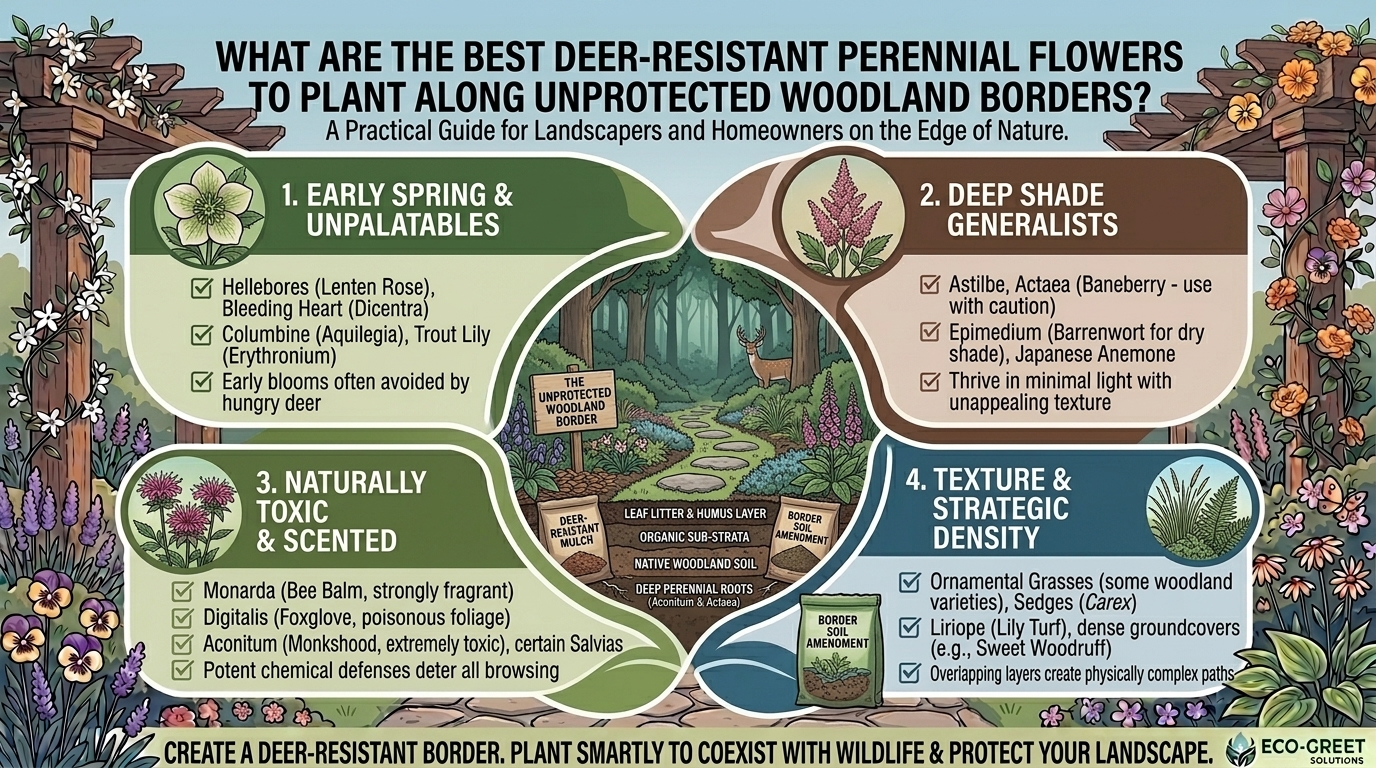
To successfully garden on a woodland border, you must first understand how deer select their meals. Deer are selective browsers rather than grazers; they prefer tender, nutrient-rich new shoots, sweet flower buds, and plants with high moisture content.
Because deer rely heavily on their sense of smell and taste, plants have evolved remarkable natural defenses to deter them. When designing your woodland border, look for perennials that feature:
- Strong Aromatic Oils: Plants with heavy scent profiles (like mints, salvias, and artemisias) overwhelm a deer’s olfactory senses.
- Fuzzy, Hairy, or Leathery Textures: Coarse foliage is unappealing to a deer’s mouth and tongue.
- Toxic or Bitter Sap: Many plants produce unpalatable chemical compounds (alkaloids or glycosides) that cause a bitter taste or digestive upset, training deer to move along.
Note: No plant is 100% “deer-proof.” During severe winters, extreme droughts, or when food is exceptionally scarce, hungry deer will sample plants they would normally ignore.
2. Key Strategies for Unprotected Woodland Borders
Garden borders shared with natural forests present unique environmental hurdles beyond wildlife pressure. Implementing these strategies ensures your perennial flowers thrive:
Managing Dappled Shade and Competition
Woodland borders typically feature shifting shade and intense root competition from mature canopy trees (like oaks, maples, and pines). Your chosen perennials must possess strong root systems capable of competing for soil moisture and nutrients.
Layering Your Planting Design
Create a naturalistic transition from the forest outward by using a three-tier approach:
- The Understory/Back Edge: Taller shrubs and robust perennials that handle heavier shade.
- The Mid-Border: Showy, medium-height perennial flowers that provide seasonal color.
- The Front Edge: Low-growing ground covers that soften the border line and suppress weeds.
3. Regional Plant Selection Guide
Regional climates dictate everything from soil pH to moisture availability. Here are the top deer-resistant perennial flowers tailored for your target locations:
Texas (Hill Country & East Texas Woodlands)
- Autumn Sage (Salvia greggii): Thrives in heat and poor soils. Its aromatic foliage and tubular flowers repel deer while inviting hummingbirds.
- Texas Gold Columbine (Aquilegia chrysantha): Bright yellow blooms that handle partial woodland shade and resist browsing.
- Blackfoot Daisy (Melampodium leucanthum): Tough, mounding perennial with white daisy-like flowers that withstand heavy deer pressure and dry spells.
New York (Northeastern Deciduous Woodlands)
- Bleeding Heart (Dicentra spectabilis): Arching stems of pink or white lacy flowers containing unpalatable alkaloids that deer actively avoid.
- Blue False Indigo (Baptisia australis): Deep-rooted, sturdy perennial with striking blue flower spikes and tough foliage deer bypass.
- Purple Coneflower (Echinacea purpurea): Exceptionally tough with coarse, scratchy seed heads that deter browsing while supporting native goldfinches.
California (Chaparral and Oak Woodland Borders)
- California Poppy (Eschscholzia californica): While technically an annual/short-lived perennial, its bitter sap makes it entirely unpalatable to deer.
- Common Yarrow (Achillea millefolium): Finely textured, fern-like aromatic foliage that resists deer and handles dry summer conditions.
- Pacific Bleeding Heart (Dicentra formosa): Native to West Coast shaded woodlands, featuring delicate pink flowers and deer-resistant chemistry.
Washington & Pacific Northwest (Damp Coniferous Borders)
- Bleeding Heart (Dicentra formosa): Thrives naturally in damp, rich Northwest woodland soils under conifer canopies.
- Sword Fern (Polystichum munitum): Though a fern rather than a flower, its leathery, textured fronds provide essential evergreen structure along shady borders.
- Oregon Grape (Mahonia aquifolium): Glossy, holly-like spiny leaves make this an exceptional physical and chemical barrier against deer browsing.
San Francisco (Coastal Microclimates)
- Sea Thrift (Armeria maritima): Grass-like foliage clumps topped with pink pom-pom flowers that tolerate coastal winds and deer alike.
- Fortnight Lily (Dietes bicolor): Sword-shaped, tough leaves that deer ignore, paired with lovely yellow-and-brown iris flowers.
- Coyote Mint (Monardella villosa): Highly aromatic native mint relative that deer bypass due to its intense essential oils.
4. Top 10 Expert Tips for Successful Woodland Border Gardening
- Group in Drifts: Plant deer-resistant species in large drifts (5 to 7 plants of the same variety) rather than single, isolated specimens. A dense block of scent and texture confuses a deer’s foraging instincts.
- Incorporate Spiky Textures: Intersperse plants with thorns, prickles, or stiff, coarse foliage (such as ornamental grasses or globe thistles) to make browsing physically difficult.
- Leverage Aromatic Herbs: Plant strong-scented herbs like lavender, rosemary, oregano, or mint along the outer perimeter of your border to create an olfactory barrier.
- Protect New Transplants: Young plants have tender, high-nitrogen growth that attracts deer. Protect new installations with temporary cages or a safe commercial repellent for the first 30 to 60 days until they toughen up.
- Rotate Repellents: If you use liquid taste or scent repellents (e.g., putrescent egg solids, garlic, or capsaicin-based sprays), rotate formulas every few weeks so deer do not become habituated to them.
- Amend the Soil Organically: Woodland borders often suffer from depleted topsoil. Mix in rich leaf mold or compost to help perennials establish deep, robust root systems capable of bouncing back if browsed.
- Water Deeply and Infrequently: Encourage deep root penetration by watering thoroughly less often, rather than giving plants shallow daily sprinkles.
- Avoid High-Nitrogen Fertilizers: Over-fertilizing makes plants grow unnaturally fast, producing succulent, tender shoots that are irresistible to wildlife.
- Clear Tall Weeds and Brush: Keep the immediate perimeter clear of overgrown brush where deer can hide or bed down right next to your prized flowers.
- Observe Seasonal Shifts: Understand that deer pressure changes throughout the year. Spring brings high pressure due to nursing does, while late winter brings food scarcity. Adjust your protective measures accordingly.
10 Frequently Asked Questions (FAQ)
1. Are there any flowers that are 100% deer-proof?
No. While many plants are highly deer-resistant due to toxins, strong smells, or coarse textures, no plant is entirely immune if deer are starving or facing extreme environmental stress.
2. Why do deer eat my flowers even when the label says “deer-resistant”?
Labels indicate general tendencies based on typical deer behavior. Young plants, heavily fertilized plants, or local deer herds with unique palate preferences may sample plants they normally avoid.
3. How do I protect new perennial flowers until they establish?
Use temporary wire cages, garden stakes with netting, or apply a reliable commercial deer repellent every two weeks during the first growing season until the plants mature.
4. Do scented plants really keep deer away?
Yes. Deer navigate primarily by smell. Plants with high concentrations of essential oils (like lavender, salvia, and mint) overwhelm their senses and mask the appetizing scent of surrounding vegetation.
5. What are the best deer-resistant flowers for heavy shade?
Bleeding heart (Dicentra), columbine (Aquilegia), hellebores (Lenten rose), and barrenwort (Epimedium) excel in shaded woodland borders while resisting deer.
6. Can I mix deer-resistant flowers with vulnerable plants?
It is risky. If you plant sensitive flowers (like hostas or lilies) among deer-resistant varieties, deer will often trample the resistant plants to reach the tasty treats. Keep vulnerable species closer to the house or inside fenced enclosures.
7. How does winter affect deer browsing on perennials?
Winter brings food scarcity, causing deer to broaden their diet. Evergreen perennials and woody shrubs facing winter browsing may need physical barriers like burlap wraps or chicken wire cages.
8. Are toxic deer-resistant plants dangerous to pets?
Some deer-resistant plants (like hellebores or foxgloves) contain compounds that can be toxic if ingested by dogs or cats. Always research pet safety if you have roaming pets alongside woodland borders.
9. Does physical garden layout affect deer behavior?
Yes. Narrow, linear strips of flowers are easy targets. Planting deep, multi-layered borders makes it harder for deer to navigate comfortably, deterring them from browsing deeply into your yard.
10. How often should I reapply organic deer repellents?
Most liquid or spray repellents wash away during heavy rain or overhead irrigation. Reapply them every 2 to 3 weeks, or immediately following heavy storms, for optimal protection.
Conclusion
Designing a woodland border along an unprotected timberline requires a balance of ecological smarts and strategic plant selection. By choosing hardy, textured, and aromatic perennial flowers tailored to your region—whether you’re gardening in the heat of Texas, the damp woods of Washington, or the coastal breezes of San Francisco—you can transform a vulnerable edge into a vibrant, resilient landscape. Embrace native species, layer your plantings thoughtfully, and enjoy a flourishing woodland garden that commands attention for its beauty rather than serving as a wildlife snack.