How to design a formal geometric herb garden layout framed by low boxwood hedges? Few garden features capture timeless sophistication quite like a formal geometric herb garden framed by low, neatly clipped boxwood hedges. Rooted in European Renaissance parterres and traditional monastic knot gardens, this classical design brings structure, symmetry, and architectural elegance to any landscape. Beyond its historical beauty, a boxwood-framed herb garden is intensely functional—organizing culinary, medicinal, and aromatic herbs into neat, easily accessible beds.
Whether designing a expansive estate feature in Texas, adapting to urban townhouse proportions in New York, organizing micro-zone courtyards across San Francisco and California, or creating a crisp, moisture-tolerant layout in Washington, a formal geometric layout provides year-round structure even when winter dormant herbs recede.
At KC Plants, we guide homeowners through designing, structuring, planting, and maintaining formal gardens tailored to regional climate demands.
1. Principles of Formal Geometric Garden Design
Formal geometric gardens rely on mathematical balance, precise sightlines, and structural enclosures. Unlike informal cottage gardens where plants spill fluidly into pathways, a formal parterre relies on clean boundary lines to frame distinct internal beds.
Classical Layout Patterns
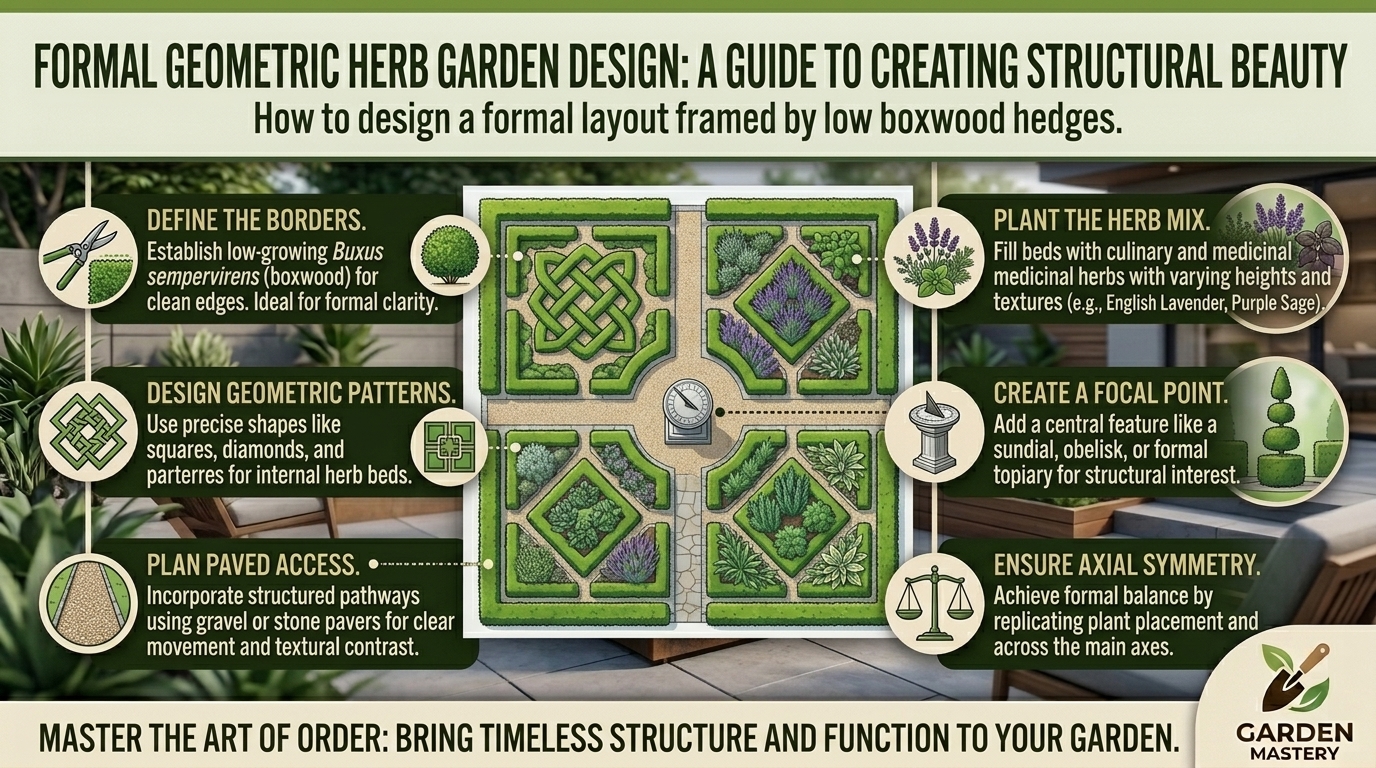
- The Four-Quadrant Cross (Cruciform Layout): A central axis intersected by a perpendicular path divides a square footprint into four symmetrical quadrants. The intersection often features an architectural anchor, such as a stone fountain, sundial, or large urn.
- The Circular Knot Pattern: Intertwining geometric lines formed by boxwood hedging create the visual illusion of ribbons looping over and under each other, filled with contrasting colored herbs.
- The Wheel Layout (Radial Symmetry): A central circular bed with gravel pathways radiating outward like spokes, creating triangular wedge beds framed by low hedges.
Material Selection for Framework and Pathways
Pathways form the skeleton of a geometric garden. They must remain functional and crisp:
- Crushed Gravel & Pea Stone: Provides clean texture, permeable drainage, and satisfying crunch underfoot.
- Flagstone or Brick Pavers: Adds permanent, rustic-formal structure that matches classic residential architecture.
- Boxwood Framework (Buxus species): Evergreen, small-leaved dwarf boxwood varieties (Buxus microphylla ‘Winter Gem’ or Buxus sempervirens ‘Suffruticosa’) provide the permanent living “walls” of the design.
| Garden Layer | Plant / Material Selection | Growth / Spec Height | Regional Suitability | Landscape Function |
| Outer Boxwood Frame | Dwarf Boxwood (Buxus microphylla) | 12–18 in. (clipped height) | Texas, California, San Francisco, NY, WA | Permanent evergreen boundary line and structural frame. |
| Tall Central Anchors | Sweet Bay Laurel (Laurus nobilis) or Rosemary | 3–5 ft (pruned pyramid/topiary) | CA, TX, San Francisco (NY/WA in pots) | Vertical focal point at quadrant centers or axis intersections. |
| Aromatic Fillers | English Lavender (Lavandula angustifolia) | 18–24 in. | California, Washington, NY, Texas | Soft silver-blue foliage with fragrant summer purple blooms. |
| Low Edge Herbs | Prostrate Thyme (Thymus serpyllum) | 2–4 in. | All regions | Soft carpet groundcover along internal path borders. |
| Textural Culinary Fill | Variegated Sage (Salvia officinalis) | 12–18 in. | Texas, CA, NY, WA, San Francisco | Bold, broad yellow-and-green foliage for color contrast. |
2. Step-by-Step Guide to Layout and Installation
Executing a formal garden requires exact measurements before any digging or planting begins. Slight alignment errors compound quickly across geometric lines.
1.Mark Out the Geometric Grid with String and Stake:Establish clean perpendicular axes.
Measure the garden perimeter precisely. Drive wooden stakes at the outer corners and run taut mason string lines. Use the 3-4-5 triangle method to verify that all 90-degree corners are square before removing turf or topsoil.
2.Excavate and Lay Permeable Pathway Base:Ensure year-round walkway usability and drainage.
Excavate pathways to a depth of 4 inches. Install a geotextile fabric layer, followed by a 3-inch compacted crushed stone base topped with 1 inch of pea gravel or flagstone pavers.
3.Plant Low Boxwood Hedges Along Guidelines:Establish precise perimeter spacing.
Dig trenches along the string lines for the dwarf boxwoods. Plant bare-root or container boxwoods 8 to 12 inches apart to ensure they grow together quickly into a seamless, solid green hedge line.
4.Plant Internal Herb Quadrants Symmetrically:Group herbs according to moisture and light needs.
Fill each internal quadrant with culinary and aromatic herbs. Mirror plant species across the central axis so each side balances its counterpart in texture, height, and color.
5.Shear Boxwood Edges and Mulch Beds:Maintain sharp architectural lines.
Prune the top and sides of the boxwood hedge to establish a flat or slightly sloped top. Apply a 2-inch layer of crushed gravel or fine bark mulch inside the herb beds to regulate soil temperature and suppress weeds.
3. Regional Adaptations across Key Growing Zones
Formal gardens must be adapted to local soil and environmental conditions to keep boxwoods healthy and internal herbs producing.
- Texas & Hot Interior Zones: Protect boxwoods from scorching afternoon sun to prevent leaf bronzing. Substitute dwarf yaupon holly (Ilex vomitoria ‘Nana’) or germander (Teucrium chamaedrys) if boxwood blight or heat stress is a concern.
- California & San Francisco Bay Area: Mild, frost-free microclimates allow tender perennial herbs like Sweet Bay, Rosemary, and Culinary Sage to grow year-round inside the boxwood frame.
- Washington & Pacific Northwest: High rainfall requires excellent drainage. Elevate internal herb beds slightly above pathways (raised parterre beds) and use crushed gravel mulch to prevent root rot in Mediterranean herbs like thyme and lavender.
- New York & Cold Eastern Zones: Select winter-hardy boxwood cultivars such as ‘Green Velvet’ or ‘Winter Gem’ that resist cold winter burn. Tender perennial herbs (like Rosemary and Bay Laurel) should be planted in decorative urns so they can be overwintered indoors.
10 Frequently Asked Questions (FAQ)
1. How far apart should I plant dwarf boxwoods for a continuous low hedge?
Space dwarf boxwood plants 8 to 12 inches apart (measured from stem to stem). Closer spacing creates a solid, unified hedge line within 1 to 2 growing seasons.
2. How high should the framing boxwood hedge be kept?
For a standard herb garden, maintain the boxwood hedge at 12 to 18 inches high. This keeps the geometric structure clearly defined without shading out low-growing herbs inside the beds.
3. What alternative plants can I use if Boxwood Blight is a risk in my area?
Excellent boxwood substitutes include Dwarf Yaupon Holly (Ilex vomitoria ‘Nana’), Japanese Holly (Ilex crenata ‘Helleri’), Germander (Teucrium chamaedrys), or Dwarf Myrtle (Myrtus communis ‘Compass’).
4. How often do I need to trim the boxwood hedges to keep them geometric?
Shear boxwood hedges 1 to 2 times per year—typically in late spring after new growth hardens off, and again in late summer to tidy up stray shoots before autumn.
5. Can I grow invasive herbs like mint inside a formal boxwood parterre?
Mint (Mentha) spreads aggressively via underground runners and will quickly invade surrounding beds and boxwood roots. Always plant mint in subterranean root barriers or bottomless containers buried inside the bed.
6. What is the ideal width for pathways in a formal herb garden?
Main central walkways should be 3 to 4 feet wide to allow comfortable walking and wheelbarrow access. Secondary internal pathways between quadrants should be at least 18 to 24 inches wide.
7. How do I maintain exact symmetry across the herb quadrants?
Use identical plant species, pot sizes, and planting distances across corresponding quadrants. Prune herbs regularly to prevent aggressive plants (like sage or oregano) from outgrowing their designated geometric wedge.
8. Are gravel pathways better than grass pathways for a formal herb garden?
Gravel pathways are far superior. Grass paths require lawnmowers and string trimmers that easily damage delicate boxwood branches along the edges, whereas gravel provides zero-maintenance, well-drained walking surfaces.
9. How do I prevent Mediterranean herbs from dying in rainy winter climates?
Herbs like lavender, rosemary, and thyme need fast-draining, lean soil. Mix 30% to 50% coarse sand or fine gravel into native soil and elevate beds 4 to 6 inches above pathway levels.
10. Can I incorporate flowering perennials into a formal herb layout?
Yes! Interplanting flowering herbs like Chives, Lavender, Edible Marigolds, and Calendula introduces vibrant seasonal color while attracting beneficial pollinators to your garden.
Conclusion
Designing a formal geometric herb garden framed by low boxwood hedges brings timeless architectural beauty and organized productivity to any home landscape. By establishing precise structural axes, installing reliable gravel pathways, selecting climate-hardy boxwood cultivars, and arranging culinary herbs with symmetrical balance, you can create a functional centerpiece that delivers year-round visual appeal.