What are the best climbing roses to train horizontally along wooden fence paneling? Training climbing roses horizontally along wooden fence paneling is one of the most effective ways to turn a plain property boundary into a living floral tapestry. While upright canes naturally push growth toward their tips—a growth habit known as apical dominance—bending and training rose canes horizontally triggers lateral bud development along the entire length of the stem. The result is a dramatic increase in flower production, yielding a continuous, dense blanket of blossoms rather than a few scattered flowers high above eye level.
To achieve this classic aesthetic, selecting the right rose varieties is essential. Roses trained horizontally require pliable canes, exceptional disease resistance, reliable reblooming habits, and strong performance across diverse growing environments.
Whether managing high summer heat across Texas, navigating coastal humidity in San Francisco and California, handling damp conditions in Washington, or preparing for cold winters in New York, choosing the right climbing roses ensures long-lasting visual impact and healthy foliage.
At KC Plants, we specialize in helping home gardeners select, structure, and train premium climbing rose varieties tailored to regional climates and hardscaping features.
1. Top Climbing Rose Varieties for Horizontal Fence Training
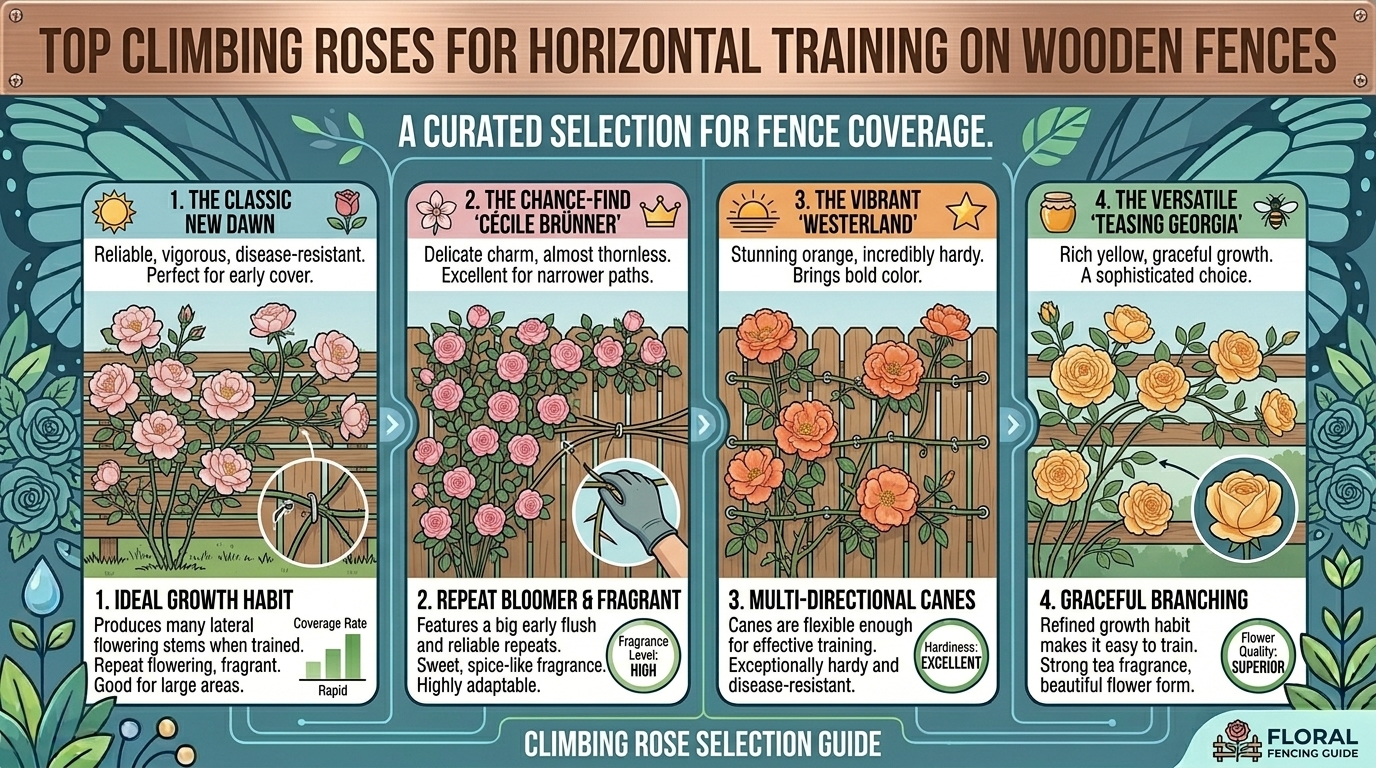
Not all climbing roses bend easily. Rigorous “pillar” roses with stiff, thick canes can split or snap when forced into horizontal lines. The ideal varieties feature pliable, flexible canes that weave smoothly along support wires, offer strong fragrance, and rebloom reliably from spring through autumn.
Outstanding Varieties for Wooden Fences
- Eden Rose (Rosa ‘Pierre de Ronsard’): Renowned for its large, deeply cupped pink and cream blossoms. Features strong, adaptable stems that train beautifully along horizontal fence supports.
- New Dawn: A legendary performer featuring soft shell-pink flowers and glossy, disease-resistant foliage. Its flexible canes spread easily over long fence spans.
- Cecile Brunner (Climbing): Known as the “Sweetheart Rose,” this vigorous climber produces spray after spray of small, perfectly formed light pink buds on pliable stems.
- Zephirine Drouhin: A classic thornless Bourbon climbing rose with fragrant magenta-pink blooms. Ideal for family garden fences and high-traffic patio boundaries.
- Lady of Shalott (Climbing): A striking David Austin English rose producing rich copper-orange flowers with excellent disease resistance and supple stems.
| Climbing Rose Variety | Flower Color & Form | Fragrance Intensity | Cane Flexibility | Best Regional Suitability |
| Eden Rose (‘Pierre de Ronsard’) | Creamy White to Deep Pink (Double) | Mild, Sweet | High: Flexible main canes ideal for weaving. | California, San Francisco, Texas, New York |
| New Dawn | Shell Pink (Semi-Double) | Moderate Fresh Apple | Very High: Fast-growing, highly adaptable canes. | Washington, New York, Texas, California |
| Zephirine Drouhin | Magenta / Hot Pink (Thornless) | Exceptional Damask | High: Pliable, thornless canes safe for fences. | Texas, California, Washington, NY |
| Climbing Cecile Brunner | Soft Powder Pink (Miniature Buttons) | Sweet Tea Fragrance | Extremely High: Long, vine-like flexible growth. | California, San Francisco, Texas |
| Lady of Shalott | Apricot-Orange (Cupped Rosettes) | Rich Tea & Spiced Apple | High: Supple English rose canes. | Washington, New York, San Francisco, CA |
2. Step-by-Step Guide to Mounting and Training Roses on Wooden Panels
Never attach rose canes directly against raw wooden fence boards. Direct contact traps moisture against the wood, promoting fence rot and restricting airflow around rose foliage.
1.Install Heavy-Duty Wire Trellis Standoffs:Prevents wooden fence rot and improves airflow.
Mount heavy-duty eye screws or stainless steel wire standoffs into fence posts, setting them 2 to 4 inches away from the wooden paneling. Run 14-gauge galvanized or stainless steel wire horizontally between posts, spaced 12 to 18 inches apart vertically.
2.Select Strong Primary Canes for Horizontal Anchoring:Identifies main structural growth for framework.
As your rose plant matures, select 3 to 5 strong, healthy primary canes emerging from the graft union or base. Remove weak, spindly shoots to direct energy into main structural framework stems.
3.Bend and Tie Canes Horizontally Along Wire Lines:Encourages lateral flowering spur formation.
Gently arch primary canes sideways, securing them along the horizontal wire supports using soft stretchy garden tie material or natural jute twine. Avoid pulling canes too sharply to prevent stem snapping.
4.Prune Vertical Lateral Shoots Annually:Maintains neat foliage boundary.
As horizontal main canes produce upward-growing side shoots (laterals), prune these flowering spurs back to 2 to 3 buds (about 4 to 6 inches long) in early spring to refresh flower production.
5.Deadhead Spent Blooms and Mulch Base:Sustains continuous floral displays.
Snip off faded flower clusters just above a five-leaflet leaf node throughout summer to encourage rapid reblooming. Apply a 3-inch layer of organic compost mulch around the base to retain soil moisture.
3. Regional Care Adjustments Across Key Growing Zones
Microclimates significantly influence rose growth rates, fungal resistance needs, and watering requirements:
- Texas & Warm Arid Zones: High heat accelerates growth. Train canes during mild winter months. Ensure roses receive morning sun and afternoon light shade to protect delicate blooms, and install drip irrigation to maintain consistent root moisture.
- California & San Francisco (Bay Area Microclimates): Coastal fog and high humidity can induce powdery mildew and black spot. Prioritize highly disease-resistant varieties like New Dawn or Eden Rose, and maintain wide spacing off fence panels to maximize air circulation.
- Washington & Pacific Northwest: Heavy rain during spring and fall creates damp conditions. Ensure fence wires keep foliage 4 inches away from wooden boards so leaves dry quickly after rainfall.
- New York & Cold Eastern Zones: Select cold-hardy varieties rated for USDA Zone 5 or colder. In late autumn, apply extra mulch over root zones and graft unions to protect against harsh winter freezes.
10 Frequently Asked Questions (FAQ)
1. Why is training rose canes horizontally better than letting them grow straight up?
Training canes horizontally breaks apical dominance (the plant’s tendency to send sap only to the highest tip). This encourages every dormant node along the stem to sprout vertical side shoots (laterals) that produce abundant blooms.
2. Will climbing rose thorns ruin or rot my wooden fence?
Thorns themselves do not damage wood, but rose foliage resting directly against wooden panels traps humidity, preventing the wood from drying out after rain. Using wire standoffs keeps foliage off the wood and preserves your fence.
3. How far off the wooden fence should support wires be placed?
Position support wires 2 to 4 inches away from the wooden fence panels. This gap provides sufficient air movement to prevent black spot disease and allows easy access when tying canes.
4. What is the best material to tie rose canes to wire supports?
Use soft stretchy green tie tape, hollow vinyl garden tubing, or natural jute twine. Avoid bare metal twist ties or thin wire, which can cut into expanding rose stems as they thicken.
5. When is the best time of year to prune and tie horizontal climbing roses?
Perform major structural pruning and cane tying in late winter or early spring while the plant is dormant before new growth emerges. Light deadheading and minor tying can be done throughout summer.
6. Can thornless climbing roses be trained along wooden fences?
Yes! Varieties like Zephirine Drouhin and Lady Banks are practically thornless, making them exceptionally easy and safe to tie along backyard fence lines near patios and walkways.
7. How long does it take for a climbing rose to cover a fence panel?
Most established climbing roses take 2 to 3 years to build a robust structural root system and cover an 8-to-10-foot horizontal fence section with flowering canes.
8. How do I stop climbing roses from bare leg syndrome (losing bottom leaves)?
Bending main canes horizontally forces lower buds to break into new growth, preventing the plant from becoming bare at the bottom. Adding medium-height perennials in front of the rose base also frames the lower structure nicely.
9. How often should I fertilize climbing roses on a fence line?
Feed climbing roses with a balanced, slow-release rose fertilizer in early spring as growth begins, followed by a liquid organic feed (such as fish emulsion or kelp meal) after the first main bloom wave in summer.
10. Are climbing roses safe for small dog-friendly yards?
Yes, but choosing low-thorn or thornless varieties (like Zephirine Drouhin) ensures pets running along fence lines are safe from scratches.
Conclusion
Training climbing roses horizontally along wooden fence paneling transforms basic property lines into vibrant, fragrant features. By selecting flexible, continuous-blooming varieties like Eden Rose, New Dawn, and Zephirine Drouhin, installing proper wire standoffs, and bending primary canes to trigger lateral flowering spurs across Texas, California, San Francisco, Washington, and New York, you ensure a healthy, high-performing floral display.