What Are the Primary Differences Between Topsoil, Garden Soil, and Potting Mix for Beginners?
Stepping into the world of gardening for the first time can feel overwhelming, especially when you walk down the aisle of your local nursery or home improvement center. Rows of heavy plastic bags labeled “Topsoil,” “Garden Soil,” and “Potting Mix” line the shelves, often looking remarkably similar to the untrained eye.
Choosing the wrong bag for your planting project is one of the most common—and frustrating—mistakes beginners make. Planting delicate container flowers in heavy topsoil can suffocate roots and turn concrete-hard, while filling an entire raised bed with airy potting mix can cause your plants to dry out in a matter of hours while draining your wallet dry.
Whether you are designing a container balcony garden overlooking the skyline in San Francisco, cultivating backyard beds in the unpredictable weather of New York, working with dense clay in Texas, or managing moisture-rich soils in Washington State and California, understanding the fundamental differences between these three foundational growing mediums is the absolute key to gardening success.
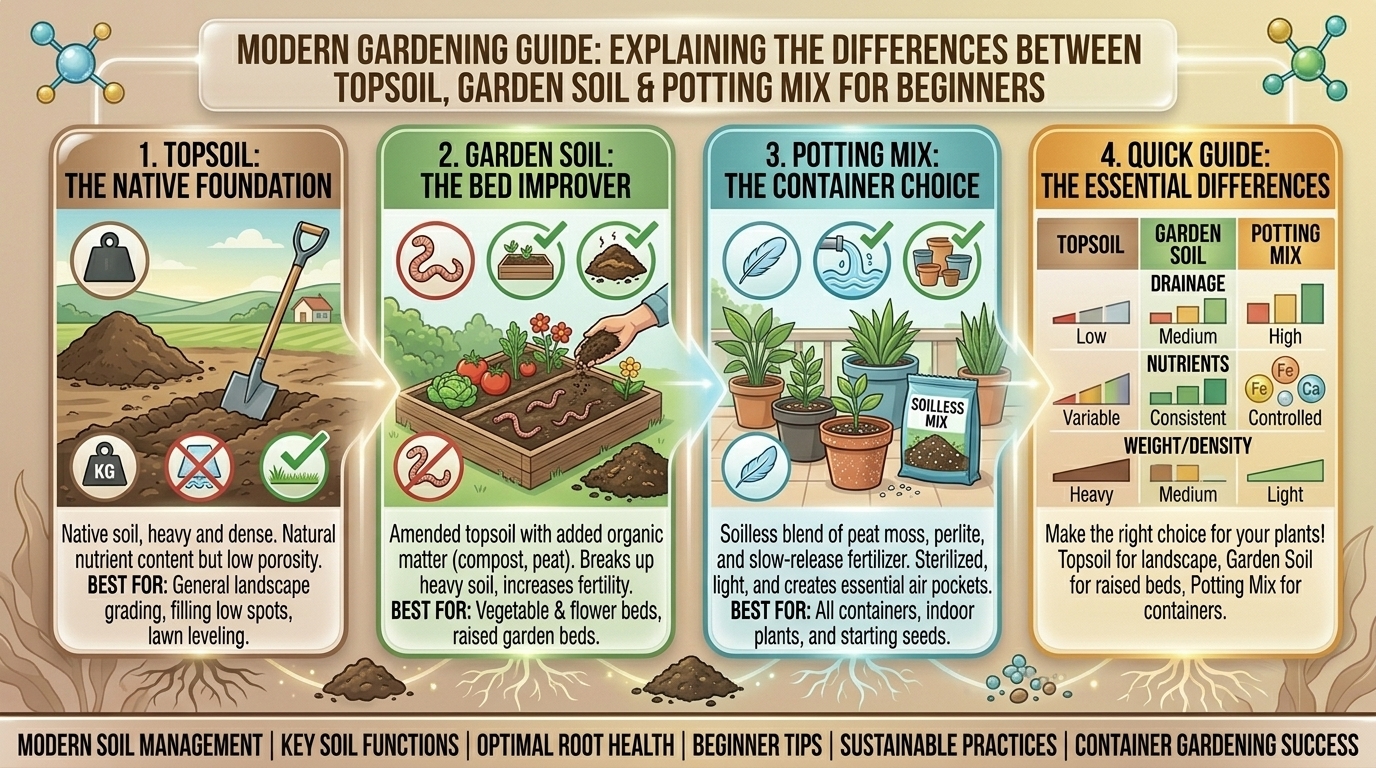
1. The Anatomy of Growing Media: Quick Comparison
Before diving into the detailed breakdown of each product, here is a high-level comparison to help you understand their distinct compositions and intended uses at a glance.
| Medium Type | Primary Composition | Density & Weight | Best Used For |
| Topsoil | Native earth, clay, silt, sand, minimal organic matter | Extremely heavy, dense | Filling large holes, grading, lawn leveling, base layer |
| Garden Soil | Topsoil amended with compost, peat, bark, and fertilizers | Moderate to heavy | In-ground raised beds, traditional inground vegetable and flower gardens |
| Potting Mix | Sphagnum peat, coco coir, perlite, vermiculite (Zero real soil) | Lightweight, fluffy | Container gardening, hanging baskets, indoor houseplants, seed starting |
2. Topsoil: The Earth’s Foundation
What Is It?
Topsoil represents the uppermost layer of the earth’s natural crust—typically the top 2 to 6 inches. It is mined or scraped in large quantities from construction sites, agricultural fields, or cleared land.
By definition, topsoil is raw earth. Depending on where it was sourced, it can be heavy in clay, high in sand, or rich in silt. Because it is sold in its natural or minimally processed state, it usually contains very little added organic matter and few nutrients.
Texture and Physical Properties
Topsoil is dense, heavy, and packs down tightly. When wet, it can become slick and muddy; when dry, it often bakes into a hard crust. It lacks the porous structure required for healthy root growth when confined to tight spaces.
When to Use Topsoil
- Lawn Repair and Patching: Filling in bare spots in your lawn or grading uneven areas in your yard.
- Large-Scale Yard Shaping: Filling deep holes, building berms, or raising the grade of your landscape before laying sod.
- As a Base Layer: Used underneath higher-quality amendments when filling massive landscaping features.
When NOT to Use It
- Never use topsoil in pots or containers. Inside a container, topsoil compacts completely, cutting off oxygen to roots and choking out plants.
- Do not use it alone in raised beds. Without amendments, it will compact, drain poorly, and stunt plant growth.
3. Garden Soil: The In-Ground Powerhouse
What Is It?
Garden soil (often labeled as “raised bed soil” or “planting mix” for in-ground use) is a hybrid product. Manufacturers take native topsoil and heavily amend it with organic matter—such as aged compost, shredded bark, peat moss, or manure—along with slow-release fertilizers.
Texture and Physical Properties
Garden soil is much richer, darker, and looser than raw topsoil. The added organic matter creates natural air pockets, improves moisture retention, and feeds beneficial soil microbes. However, it is still formulated to be heavy enough to anchor large plants firmly in the ground.
When to Use Garden Soil
- Traditional In-Ground Gardens: Tilling or digging it directly into your existing backyard earth to improve nutrient levels and texture.
- Raised Beds: Filling raised garden beds where plants can root deeply into the earth below or benefit from a rich, heavy soil matrix.
- Perennial Shrub and Tree Planting: Backfilling holes when planting new landscape shrubs, ornamental trees, or perennial flower beds.
When NOT to Use It
- Container Gardening: Even though it is called “soil,” garden soil is still far too dense for small pots, planters, or window boxes. It lacks the drainage capacity required for confined containers.
4. Potting Mix: The Lightweight Container Champion
What Is It?
Here is the most important secret for beginner gardeners: Traditional potting mix contains zero actual dirt or topsoil.
Instead, potting mix is a sterile, engineered blend designed specifically to mimic optimal soil conditions in a controlled environment. It typically consists of:
- Bulking/Water-Retaining Agents: Sphagnum peat moss, coconut coir (pith), or composted forest products.
- Aeration and Drainage Agents: Perlite (white volcanic puffs), vermiculite (shiny mineral flakes), or coarse sand.
- Nutrients: Starter fertilizers or slow-release granules to feed young plants.
Texture and Physical Properties
Potting mix is exceptionally lightweight, fluffy, and porous. It feels spongy in your hands and will never pack down into a brick-like consistency. This loose structure ensures that plant roots receive plenty of oxygen while excess water drains out rapidly through container holes.
When to Use Potting Mix
- Potted Plants and Planters: Any plant growing in a pot, container, urn, or window box on your patio, deck, or porch.
- Hanging Baskets: Where weight is a major concern and moisture management is critical.
- Indoor Houseplants: Tropicals, ferns, and succulents that require crisp aeration and fast-draining media.
- Seed Starting: Sterile mixes prevent damping-off disease in fragile seedlings.
When NOT to Use It
- In-Ground Garden Beds: Potting mix is too light and airy for open ground. If placed directly in a garden bed, it will dry out too fast, wash away easily in heavy rains, and lack the stabilizing density needed for large outdoor crops.
5. Regional Gardening Considerations: Matching Soil to Your Climate
Geography plays a massive role in how these mediums behave in your landscape. Here is how gardeners in different regions should approach soil choices:
California & San Francisco
- The Challenge: Mediterranean dry spells, water restrictions, and often heavy clay or sandy coastal soils.
- The Solution: Use garden soil heavily amended with compost to build moisture retention in dry beds. For container gardens on urban balconies in San Francisco, high-quality potting mix blended with coco coir helps combat quick wind-drying.
Texas
- The Challenge: Relentless summer heat and notoriously heavy, alkaline “Blackland Prairie” clay soils.
- The Solution: Avoid using raw topsoil if your native earth is already heavy clay. Instead, mix garden soil and rich organic compost directly into your native dirt to break up compaction and improve water infiltration.
New York
- The Challenge: Humid summers, variable seasonal rainfall, and urban container gardening constraints.
- The Solution: Urban gardeners relying on rooftop or terrace containers must use premium potting mix to keep weight manageable. For suburban backyard vegetable plots, incorporating garden soil helps manage freeze-thaw spring cycles.
Washington State
- The Challenge: High seasonal rainfall, damp conditions, and naturally acidic forest soils.
- The Solution: Drainage is paramount. If using garden soil in raised beds, ensure it includes coarse bark or perlite. For potted plants, potting mix prevents waterlogging and root rot during wet Pacific Northwest winters.
6. Frequently Asked Questions (FAQ)
1. Can I use potting mix in my raised garden beds?
While you can, it is generally not recommended for deep raised beds unless you are on a balcony or need extreme weight reduction. Potting mix dries out much faster than garden soil and is significantly more expensive per cubic foot. It is best reserved for containers.
2. What happens if I put topsoil in a potted plant?
Topsoil will pack down tightly inside the container, suffocating the root system. Water will struggle to drain, leading to root rot, fungal issues, and eventually the death of your plant. Always use potting mix for containers.
3. Can I make my own garden soil at home?
Yes! You can create excellent garden soil by mixing equal parts native topsoil, finished homemade compost, and peat moss or coco coir, along with a handful of organic fertilizer.
4. Why is potting mix so expensive compared to topsoil?
Topsoil is simply scooped from the earth with minimal processing. Potting mix is an engineered, sterile blend of specialized ingredients (like perlite, peat, and vermiculite) designed to provide specific aeration, pH balance, and disease-free environments for containers.
5. Does potting mix expire or go bad?
Over time (usually 1 to 2 seasons), potting mix breaks down, loses its physical structure, and becomes compacted. Furthermore, plants exhaust its nutrient supply. It is best to refresh or replace container potting mix every spring.
6. Can I use garden soil for indoor houseplants?
No. Garden soil is too heavy, retains too much moisture indoors, and may harbor weed seeds, gnats, or outdoor fungal spores that thrive in indoor environments. Always use a sterile indoor potting mix.
7. What is the difference between “raised bed soil” and “garden soil”?
They are often very similar. Raised bed soil is typically a specialized type of garden soil formulated to be slightly lighter, cleaner, and pre-enriched with extra organic matter since raised beds sit above ground level.
8. How do I know if my soil drains well?
Perform a simple percolation test: Dig a hole about 6 inches deep, fill it with water, and let it drain completely. Fill it a second time and time how long it drains. If it drains at a rate of 1 to 2 inches per hour, your drainage is ideal.
9. Should I fertilize my plants if I buy bagged soil?
Most commercial garden soils and potting mixes come pre-charged with slow-release fertilizers that feed plants for the first 3 to 6 months. After that period, you will need to supplement with regular organic liquid or granular fertilizers.
10. Can I mix topsoil and potting mix together?
It is best to avoid this combination. The dense, heavy properties of topsoil will counteract the lightweight, porous nature of potting mix, creating an unpredictable texture that neither container plants nor in-ground plants prefer. Match the medium strictly to where it is being placed.
Conclusion
Understanding the distinct roles of topsoil, garden soil, and potting mix is the single most important foundational step you can take as a gardener. Remember the golden rule: Topsoil belongs on the ground for grading and lawns, garden soil belongs in in-ground beds and raised beds, and potting mix belongs exclusively in containers.
One comment on “What are the primary differences between topsoil, garden soil, and potting mix for beginners?”