Every experienced gardener eventually encounters the disheartening phenomenon of the “tired flower bed.” After a couple of heavy growing seasons, once-vibrant flower beds begin to look sluggish. Annuals produce fewer blossoms, perennials struggle to push through a crusted soil surface, and the earth feels depleted, compacted, and lifeless.
When your ornamental beds lose their vitality, running out to buy synthetic chemical fertilizers is rarely the best fix. Chemicals offer a temporary, superficial green-up while doing nothing to repair the structural decay of the soil. The true, sustainable remedy lies underground: restoring the organic foundation of your beds with mushroom compost.
Packed with slow-release nutrients, incredible moisture-retention properties, and beneficial microbial life, mushroom compost is a secret weapon for waking up exhausted soil and triggering an explosion of annual blooms.
Whether you are battling heavy, baking clay in Texas, balancing urban container and courtyard limitations in New York and San Francisco, or managing moisture and drainage across Washington State and California, this comprehensive guide explores how to harness mushroom compost to rejuvenate your landscape.
1. What Is Mushroom Compost and Why Is It Magic for Flowers?
Mushroom compost (often sold commercially as “spent mushroom substrate” or SMS) is a byproduct of the commercial mushroom-growing industry. Contrary to popular belief, it is not made of rotting mushrooms; rather, it is the rich, organic growing medium left over after a commercial crop of mushrooms (like white button or portobello varieties) has been fully harvested.
The Specialized Recipe
To grow mushrooms, commercial producers create a heavily engineered, sterile compost recipe consisting of natural ingredients:
- Agricultural Straw and Hay
- Horse or Poultry Manure
- Gypsum (Calcium Sulfate)
- Peat Moss, Corn Cobs, and Cottonseed Meal
During the 3-to-4-month pasteurization and growing cycle, millions of microscopic fungi break down these raw components into a uniform, highly concentrated, dark organic humus.
The Nutritional and Physical Benefits
- Balanced Macro-Nutrients: It provides a gentle, non-burning supply of Nitrogen, Phosphorus, and Potassium (N-P-K), which supports strong root systems and heavy flower bud development.
- Abundant Calcium: Thanks to the gypsum added during production, mushroom compost delivers a generous dose of calcium—an essential element for preventing blossom end rot and strengthening cell walls in heavy-blooming annuals.
- Microbial Awakening: It reintroduces beneficial bacteria and fungi that break down locked-up minerals in the earth, transforming lifeless dirt into a living ecosystem.
2. Important Caveats: Salt, pH, and Sensitive Plants
While mushroom compost is incredible for tired flower beds, it has a few unique characteristics that every gardener must understand before application.
The Salinity Factor
Because mushroom compost often utilizes manures and gypsum during production, fresh mushroom compost can contain elevated levels of soluble salts (sodium and potassium).
- The Risk: Extremely delicate seedlings, salt-sensitive plants (like ferns, azaleas, rhododendrons, and blueberries), or young annuals can suffer from root burn if planted directly into unaged, raw mushroom compost.
- The Fix: Always leach fresh mushroom compost thoroughly with water before use, or let it weather outdoors through a good rain cycle. Alternatively, blend it 50/50 with native soil or standard organic compost.
The Alkaline pH Reality
Mushroom compost tends to be moderately alkaline (often hovering around a pH of 7.0 to 8.0) due to the lime and gypsum used in its creation.
- Best Suited For: Most standard annual flowers, roses, daylilies, and perennials that prefer neutral to slightly alkaline conditions will thrive.
- Avoid For: Acid-loving ornamentals like hydrangeas (if you want vibrant blue blooms), camellias, gardenias, and ericaceous shrubs unless you balance the pH accordingly.
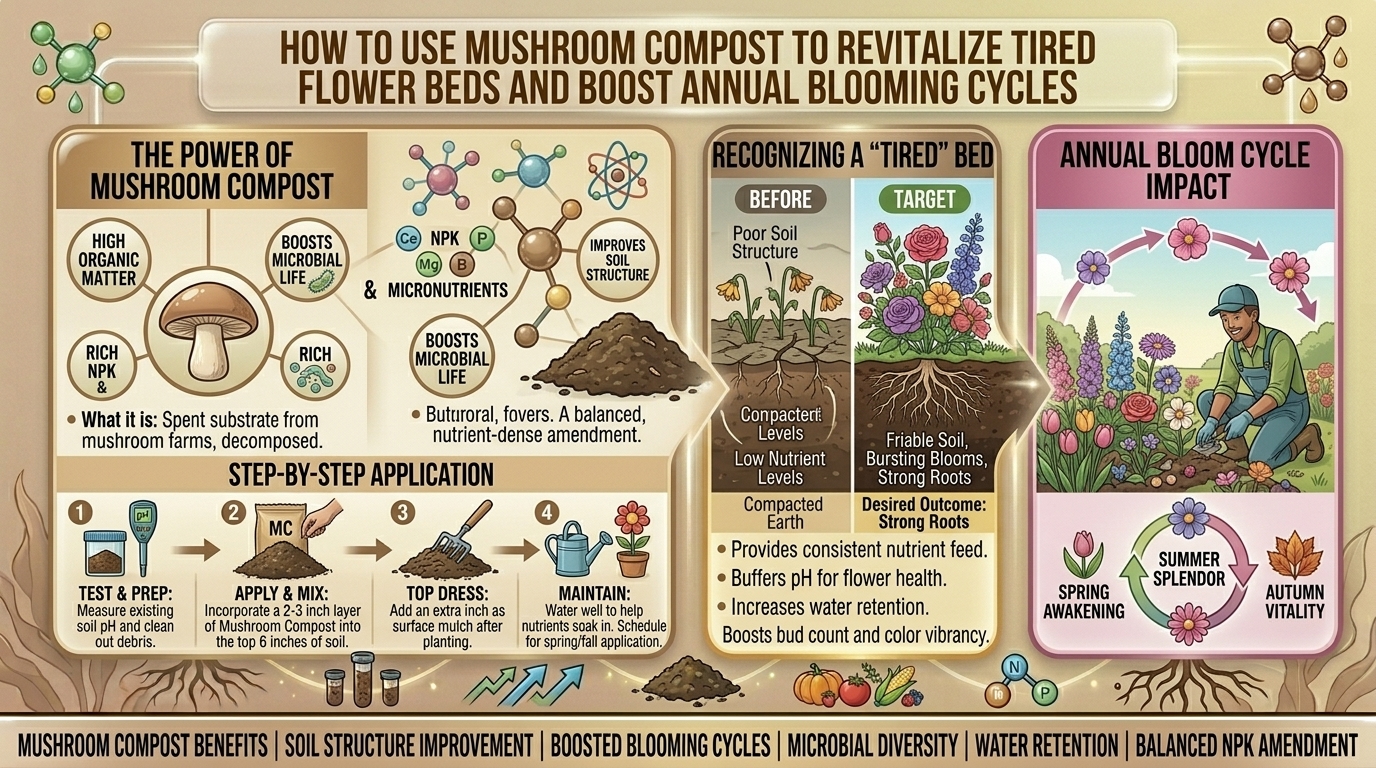
3. Step-by-Step Guide: Revitalizing Tired Beds with Mushroom Compost
Transforming a compacted, exhausted flower bed into a vibrant blooming haven requires a deliberate, step-by-step approach.
[ Assess Tired Flower Bed ]
       │
       ├──> Step 1: Clear Debris & Weeds
       │
       ├──> Step 2: Broadfork / Loosen Compacted Earth
       │
       ├──> Step 3: Apply a 2-to-3-Inch Layer of Mushroom Compost
       │
       └──> Step 4: Work In / Top-Dress & Water Deeply
Step 1: Clear and Weed
Remove any dead annual stalks, fallen debris, and stubborn perennial weeds. This ensures that the nutrients in your mushroom compost feed your desired flowers rather than opportunistic weeds.
Step 2: Aerate the Soil
Tired soil is almost always compacted. Use a garden fork or broadfork to gently loosen the top 4 to 6 inches of earth without completely flipping the soil strata (which disrupts beneficial soil layers).
Step 3: Apply the Compost Layer
Spread a 2-to-3-inch layer of aged mushroom compost evenly across the surface of the bed. If you are working around established perennial root zones, be careful not to pile thick compost directly against woody stems or crowns, which can cause collar rot.
Step 4: Blend or Top-Dress
- For Empty Beds (Pre-Planting): Work the compost into the top 4 inches of native soil using a cultivator.
- For Established Beds: Simply leave the compost as a rich, dark surface top-dressing mulch. Earthworms and soil microbes will pull the organic matter down into the root zone naturally over a few weeks.
Step 5: The Post-Application Soak
Water the bed thoroughly immediately after application. This initial deep soaking washes away any lingering surface salts and triggers immediate microbial activity.
4. Regional Application Strategies Across the U.S.
Soil composition and regional climates dictate how mushroom compost interacts with your landscape:
California & San Francisco
- The Climate Challenge: Mediterranean dry spells and sandy coastal soils or hard clay frames.
- The Strategy: In San Francisco and coastal California, urban garden beds often suffer from structural depletion. Top-dressing with mushroom compost acts as a moisture-locking sponge, drastically cutting down irrigation needs while feeding heavy-blooming Mediterranean annuals and perennials.
Texas
- The Climate Challenge: Relentless summer heat, intense sun, and heavy “Blackland Prairie” clay that bakes into solid bricks.
- The Strategy: Work mushroom compost and coarse organic matter deeply into Texas clay beds. The gypsum in the mushroom compost helps break apart sticky clay particles, drastically improving drainage and root penetration during torrential spring storms and scorching summer heat.
New York
- The Climate Challenge: Humid summers, variable seasonal rainfall, and suburban clay-loam mixes that lose fertility over repetitive growing cycles.
- The Strategy: Apply a fresh layer of mushroom compost in late autumn or early spring. The winter freeze-thaw cycles help integrate the compost smoothly into the earth, priming perennial flower beds for an explosive spring blooming cycle.
Washington State
- The Climate Challenge: Heavy seasonal rainfall that leaches nutrients, combined with naturally acidic forest soils.
- The Strategy: Washington soils tend to be quite acidic. The slightly alkaline nature of mushroom compost actually acts as a fantastic natural buffer, raising low pH levels closer to neutral while supplying vital calcium to heavy-blooming ornamentals.
5. Frequently Asked Questions (FAQ)
1. Can I plant seeds directly into pure mushroom compost?
No. Pure mushroom compost is far too rich, dense, and high in soluble salts for delicate seeds to germinate successfully. Always sprout seeds in a dedicated seed-starting mix, and reserve mushroom compost for established garden beds and mature transplants.
2. Will mushroom compost attract pests or rodents?
Generally, no. Because the material is thoroughly pasteurized during the commercial mushroom-growing process, it does not harbor weed seeds or animal pests. However, like any rich organic matter, earthworms will flock to it, which in turn attracts birds and toads.
3. How often should I reapply mushroom compost to my flower beds?
An annual top-dressing of 1 to 2 inches applied in early spring or late autumn is ideal for maintaining optimal fertility in heavy-blooming annual and perennial beds.
4. Is mushroom compost safe for vegetable gardens too?
Yes! While this guide focuses on flower beds, mushroom compost is fantastic for vegetable gardens (especially heavy feeders like tomatoes, peppers, and squash) once it has been weathered or leached of excess salts.
5. Why are my leaves turning yellow after adding mushroom compost?
If you applied fresh, unweathered mushroom compost, the high salt content or transient nitrogen tie-up might cause temporary nutrient stress. Give the bed a very heavy watering to flush out excess salts, and ensure the compost was well-aged before application.
6. Can I use mushroom compost for container-grown flowers?
Pure mushroom compost is too heavy and dense for pots; it will pack down and drain poorly. However, you can blend up to 20% to 25% mushroom compost into a lightweight potting mix to give container annuals a massive nutrient boost.
7. Does mushroom compost help suppress weeds?
While a thick top-dressing acts as a physical mulch that suppresses weed seed germination for a short time, mushroom compost is so nutrient-dense that persistent weed seeds that blow in from elsewhere may eventually sprout if you do not add a layer of shredded bark on top.
8. How does mushroom compost affect hydrangea flower colors?
Hydrangea flower color (pink vs. blue) is dictated by soil acidity. Because mushroom compost tends to be neutral to slightly alkaline, applying it heavily around blue hydrangeas may cause them to shift toward pink over time due to the available calcium.
9. Where can I buy bulk mushroom compost?
You can purchase mushroom compost in bags at local garden centers, or in bulk by the cubic yard from local landscape supply yards, mulch yards, or directly from nearby mushroom farms if you live in an agricultural region.
10. How long does it take for mushroom compost to improve flower blooms?
You will often see visual improvements in foliage color and plant vigor within 3 to 4 weeks of application, followed by a dramatic, noticeable increase in flower bud production and blossom longevity throughout the active growing season.
Conclusion
Tired flower beds are not a permanent failure; they are simply a sign that your soil’s natural ecosystem needs a biological recharge. By introducing nutrient-dense, structure-repairing mushroom compost, you provide your annuals and perennials with the exact mineral balance, calcium boost, and microbial activity they need to thrive.
Whether you are designing a vibrant courtyard garden in New York, reviving baking clay in Texas, or optimizing moisture retention in California and Washington, incorporating mushroom compost into your annual routine turns exhausted earth into a breathtaking canvas of continuous color.