Walking out to your garden to inspect your prized tomatoes, lush peppers, or vibrant roses, only to discover a disheartening spread of pale, yellowing leaves, is an experience every grower dreads. Known scientifically as chlorosis, this condition signals that a plant is failing to produce adequate chlorophyll—the vital green pigment responsible for capturing sunlight and converting it into energy.
While yellow leaves can stem from various issues—such as overwatering, nitrogen deficiency, or pests—one of the most common and easily fixable culprits is a lack of magnesium. Enter Epsom salt, chemically known as magnesium sulfate ($MgSO_4$). This inexpensive, unassuming household staple has been a secret weapon of master gardeners for generations.
Whether you are battling nutrient-locked alkaline soils in Texas, managing urban container spaces in San Francisco, dealing with variable seasonal rainfall in New York, or balancing moisture and leaching in Washington State and California, this comprehensive guide explores the science of magnesium sulfate, how to identify magnesium deficiency, and how to use Epsom salt safely to restore your plants to lush, vibrant health.
1. The Science of Chlorosis: What Is Magnesium’s Role?
To understand why Epsom salt works wonders on yellowing foliage, we have to look inside plant cell biology. Magnesium is not just a minor trace element; it is the absolute centerpiece of the chlorophyll molecule.
The Chlorophyll Core
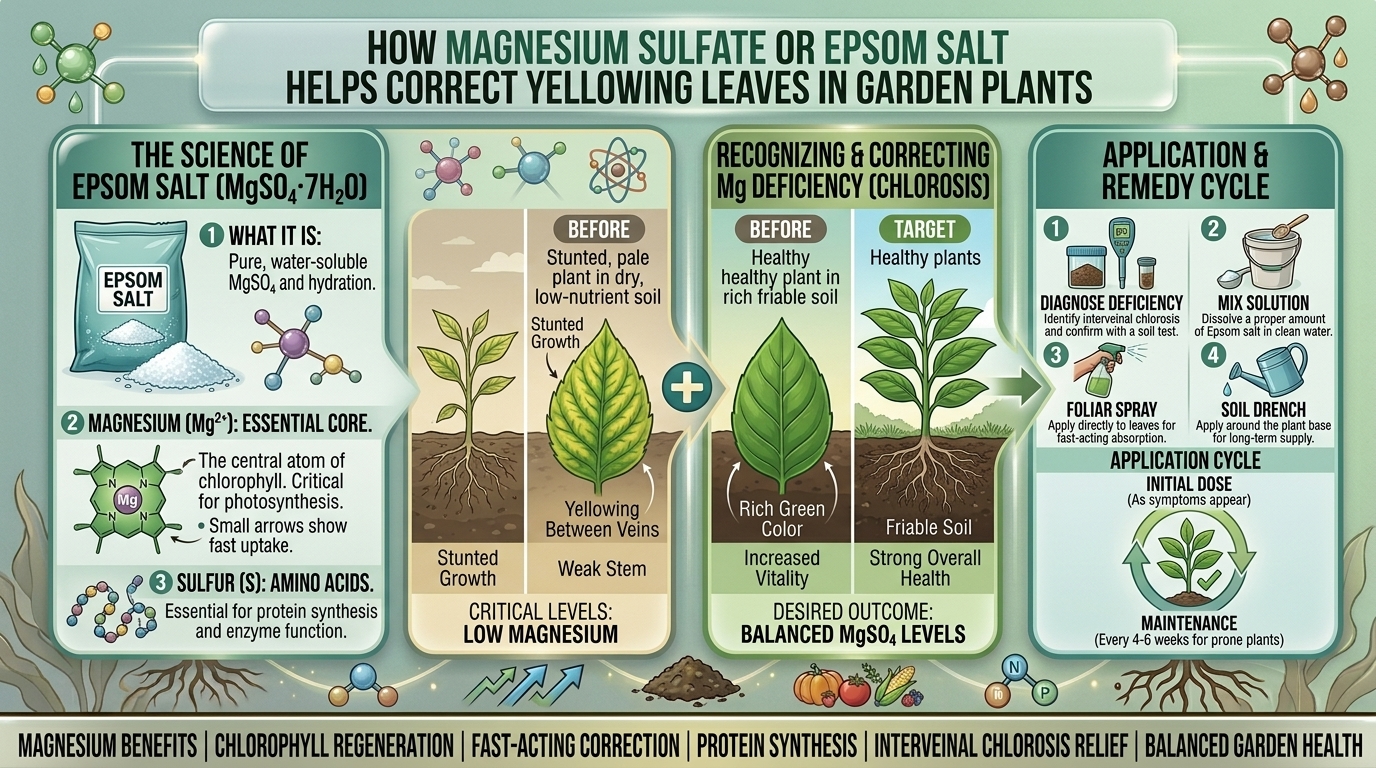
At the dead center of every single chlorophyll molecule sits a single magnesium ion ($Mg^{2+}$). Without an adequate supply of magnesium, a plant simply cannot manufacture chlorophyll.
- Mobile Nutrients: Magnesium is a mobile nutrient within the plant. When a plant experiences a deficiency, it pulls magnesium away from its older, lower leaves to feed new, emerging top growth.
- The Visual Telltale Sign: This mobility explains why magnesium deficiency always starts from the bottom up. The older leaves turn yellow between the green veins (interveinal chlorosis), while the veins themselves sometimes retain a greenish tint before the entire leaf eventually yellows and drops.
Beyond Chlorophyll: Enzyme Activation and Phosphorus Uptake
Magnesium does more than just provide color. It acts as a biological activator for numerous plant enzymes, driving the production of carbohydrates, sugars, and proteins. Furthermore, magnesium acts as a carrier for phosphorus, helping plants shuttle vital energy throughout their vascular systems and encouraging robust root development and heavy fruit set.
2. When to Use Epsom Salt (And When NOT To)
While Epsom salt is a fantastic horticultural tool, it is not a cure-all plant vitamin. Misusing it can actually harm your garden.
The Golden Rule: Diagnose Before You Drench
Before applying magnesium sulfate, you must confirm that your plants are actually suffering from a magnesium deficiency rather than something else.
- True Magnesium Deficiency: Older leaves turn yellow between the veins while the soil pH is within a normal range.
- Nitrogen Deficiency (Often Confused): If the entire leaf (including the veins) turns a uniform pale light green or yellow, starting from the older leaves upward, your plant is likely lacking nitrogen, not magnesium.
- Iron Deficiency: If new top leaves turn yellow while older leaves remain green, the issue is usually an iron or pH lock-out, which Epsom salt will not fix.
The Danger of Nutrient Antagonism
Excess magnesium in the soil can create a chemical imbalance. High levels of magnesium can block a plant’s ability to absorb calcium and potassium. Therefore, you should never apply Epsom salt blindly or continuously without a soil test or clear visual symptoms.
3. Step-by-Step Guide: How to Apply Epsom Salt Safely
Depending on how rapidly your plants need rescue, you can apply magnesium sulfate via foliar sprays or root drenches.
[ Identify Interveinal Chlorosis ]
       │
       ├──> Method A: Foliar Spray (Rapid Rescue for Severe Deficiency)
       │
       ├──> Method B: Soil Drench / Root Zone Application (Long-Term Fix)
       │
       └──> Method C: Pre-Planting Soil Amendment (Preventative)
Method A: The Foliar Spray (Fastest Absorption)
When plants show acute yellowing during the peak growing season, spraying a diluted solution directly onto the leaves delivers magnesium straight to the chloroplasts within hours.
- The Recipe: Dissolve 1 to 2 tablespoons of Epsom salt into 1 gallon of warm water. Stir until completely dissolved.
- Application: Pour the mixture into a clean garden sprayer and mist the leaves thoroughly, ensuring coverage on the undersides.
- Timing: Always spray in the early morning or late evening. Never spray under the hot midday sun, as water droplets can act as magnifying glasses and scorch the foliage.
Method B: The Soil Drench (Root Zone Correction)
For established plants showing steady yellowing, feeding the roots provides a sustained supply of magnesium.
- The Recipe: Dissolve 1 tablespoon of Epsom salt per gallon of water for standard garden beds.
- Application: Pour the solution directly onto the soil around the base of the plant, soaking the root zone. Repeat every 3 to 4 weeks if deficiency symptoms persist.
Method C: Pre-Planting Soil Amendment
If you know your soil lacks magnesium (confirmed by a soil test), you can mix it directly into the ground before planting heavy-feeding crops like tomatoes and peppers.
- The Application: Work 1 tablespoon of dry Epsom salt granules into the soil directly at the bottom of the planting hole, covering it with a thin layer of dirt so roots do not make direct, concentrated contact with the raw salt crystals.
4. Regional Soil Realities: Magnesium Across the U.S.
Soil chemistry varies dramatically across the country, influencing how plants absorb magnesium:
California & San Francisco
- The Challenge: Mediterranean dry spells and sandy coastal soils or hard clay frames. Sandy soils leach water-soluble minerals like magnesium very quickly.
- The Solution: Coastal gardeners utilizing raised beds or sandy native earth often benefit from periodic Epsom salt root drenches, especially for heavy-feeding container tomatoes and citrus trees.
Texas
- The Challenge: Heavy alkaline “Blackland Prairie” clay soils often feature high calcium levels, which can competitively block magnesium uptake.
- The Solution: While Texas clay holds minerals tightly, high pH levels can lock up trace elements. Applying a targeted foliar spray of Epsom salt bypasses soil lock-out entirely, providing immediate relief to chlorotic leaves.
New York
- The Challenge: Humid summers and suburban or urban garden plots that have been cultivated intensively for decades, depleting core trace minerals.
- The Solution: Incorporating magnesium sulfate around heavy-fruiting crops and roses during mid-summer helps maintain vibrant green foliage through humid, rainy stretches.
Washington State
- The Challenge: High seasonal rainfall leaches mobile nutrients deep into the subsoil, resulting in naturally acidic, damp soils.
- The Solution: Pacific Northwest gardeners frequently need to replenish leached magnesium and calcium. A balanced application in spring prepares the soil for cool-season crops.
5. Frequently Asked Questions (FAQ)
1. Are Epsom salt and table salt the same thing?
No! Table salt is sodium chloride ($NaCl$), which is toxic to plants and will dehydrate and kill your garden. Epsom salt is magnesium sulfate ($MgSO_4$), which provides safe, essential minerals that plants actively utilize.
2. Which garden plants benefit the most from Epsom salt?
Heavy feeders and high-fruiting crops show the most dramatic positive response to magnesium. This includes tomatoes, peppers, roses, potatoes, citrus trees, and corn.
3. Can I use Epsom salt on indoor houseplants?
Yes! Indoor potted plants frequently suffer from magnesium depletion because nutrients wash away with every watering. A monthly drench using a weak solution (1 teaspoon per gallon of water) keeps indoor foliage deep green.
4. Will Epsom salt change my soil pH?
No. Unlike agricultural lime (which raises pH) or elemental sulfur (which lowers pH), magnesium sulfate is pH-neutral. It will not alter the acidity or alkalinity of your garden soil.
5. Can I overdose my plants with Epsom salt?
Yes. Excessive magnesium can build up in the soil, causing salt stress and blocking the plant’s uptake of vital calcium and potassium. Always follow recommended dilution ratios and avoid constant, unneeded applications.
6. How quickly will I see results after spraying yellow leaves?
If the yellowing is genuinely due to a magnesium deficiency, you will often notice a visible greening of the foliage within 3 to 7 days following a foliar spray.
7. Does Epsom salt help tomato blossom end rot?
A common gardening myth is that Epsom salt cures blossom end rot. Blossom end rot is actually caused by a calcium deficiency (often triggered by erratic watering). While Epsom salt contains magnesium, it does not supply calcium; use agricultural lime or calcium nitrate instead.
8. Can I add Epsom salt to my compost pile?
While you can, it is generally unnecessary. Standard compost made from varied kitchen scraps, yard waste, and leaves already contains a diverse natural balance of trace minerals.
9. Is expired Epsom salt still safe to use in the garden?
Pure magnesium sulfate does not expire or degrade chemically over time. As long as it has been kept dry and free of moisture clumps, old Epsom salt works just as effectively as a fresh bag.
10. How do I know if my soil test indicates a magnesium deficiency?
A professional lab soil test will report your magnesium levels in parts per million (ppm) or as a percentage of your soil’s Cation Exchange Capacity (CEC). Generally, magnesium should make up roughly 10% to 15% of the soil’s base saturation. If it drops significantly below that, supplementation is warranted.
Conclusion
Yellowing leaves do not have to spell disaster for your garden. By understanding the vital role of magnesium in chlorophyll production, you can accurately diagnose whether your plants are suffering from a true nutrient deficiency.
Armed with Epsom salt ($MgSO_4$), you have a safe, affordable, and scientifically proven remedy at your fingertips. Whether you are correcting chlorosis on heavy-fruiting tomatoes in Texas, boosting roses in New York, or maintaining container vitality in San Francisco, a measured application of magnesium sulfate will quickly bring your garden back to vibrant, healthy green life.