There is little that dampens the joy of indoor plant parenting quite like walking over to your lush fiddle-leaf fig or thriving pothos, only to have a cloud of tiny, frantic black bugs erupt from the soil and buzz around your face.
Fungus gnats (Bradysia species) are the most common household pest for indoor gardeners. While adult gnats do not bite humans, damage furniture, or feed on plant foliage, their presence is an infuriating nuisance. Worse yet, their microscopic, translucent larvae live hidden beneath the soil surface, where they voraciously chew through delicate root hairs and organic matter, stunting plant growth and leaving seedlings vulnerable to disease.
Most commercial pest-control guides immediately suggest drenching your pots in harsh chemical insecticides or synthetic aerosols. However, spraying toxic chemicals inside your living room, kitchen, or bedroom is unnecessary and harmful to your indoor air quality and beneficial soil biology.
Fortunately, you can completely prevent and eradicate fungus gnats using 100% natural, eco-friendly methods.
Whether you are managing moisture-trapping indoor collections in Washington State, dealing with high humidity in New York, maintaining urban apartments in San Francisco, or handling container gardens across California and Texas, this comprehensive guide explores the life cycle of fungus gnats, natural prevention strategies, and safe eradication protocols.
1. Understanding the Enemy: The Fungus Gnat Life Cycle
To defeat fungus gnats, you must understand what attracts them and how they reproduce.
The Anatomy of an Infestation
Fungus gnats are weak flyers drawn exclusively to moist organic soil and decaying matter.
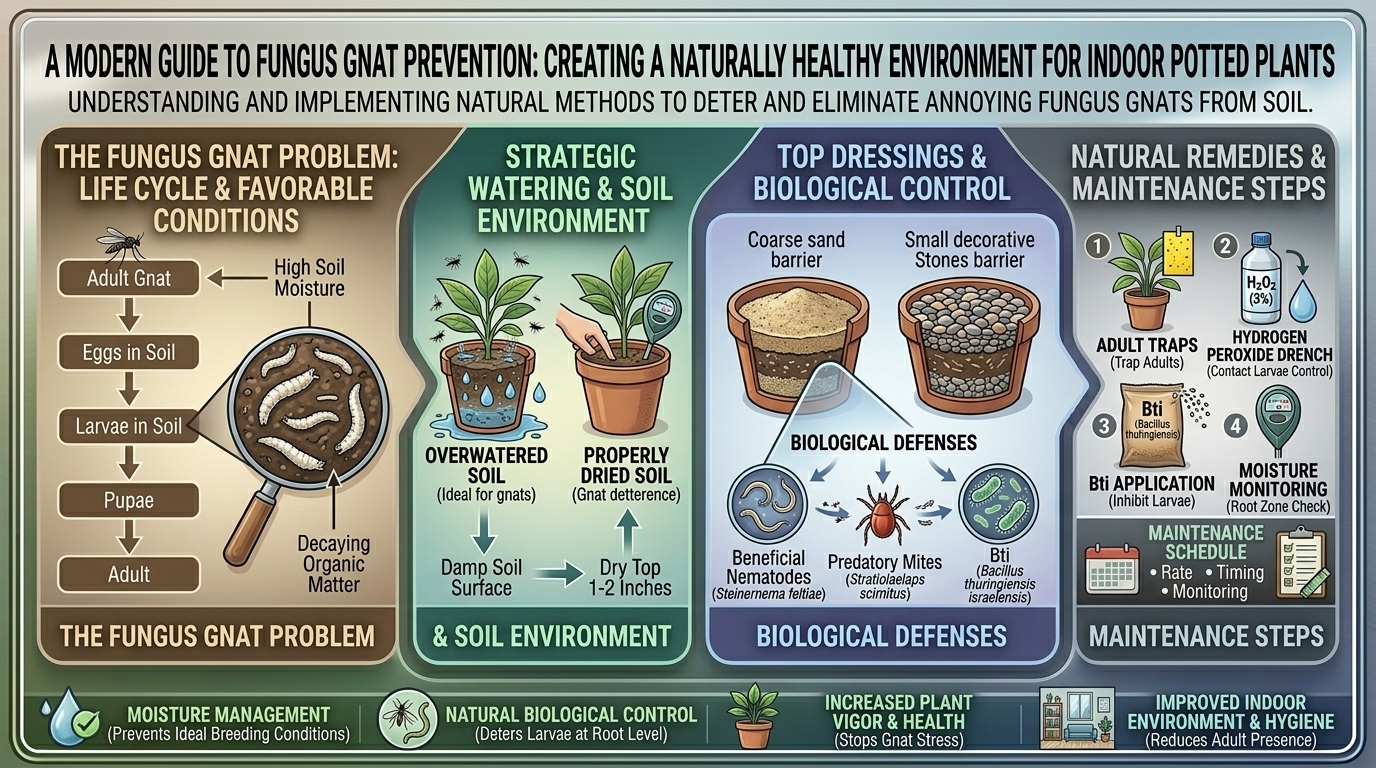
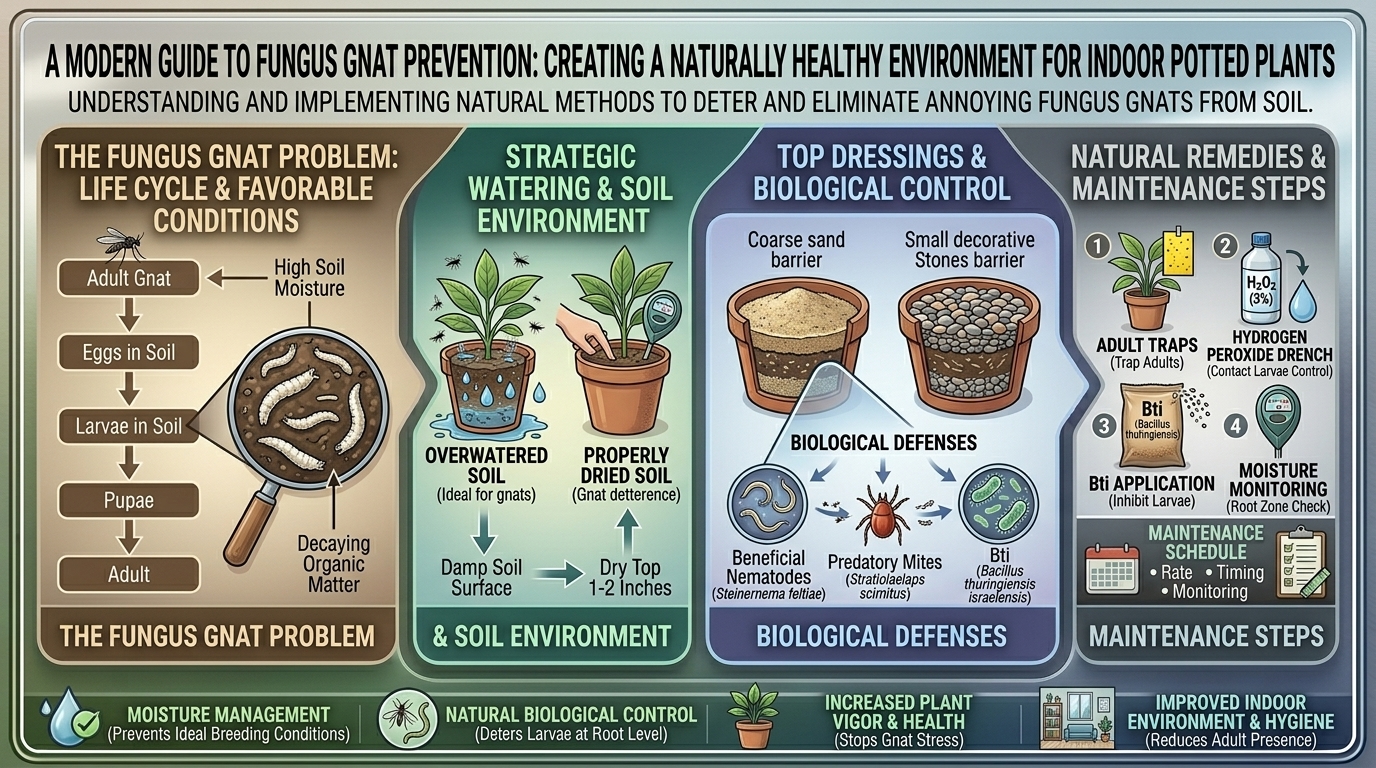
- The Egg: A single female gnat can lay up to 200 eggs in damp, rich potting soil over her short week-long lifespan.
- The Culprit Larvae: Within days, those eggs hatch into tiny, worm-like larvae with distinct black heads. For about two weeks, these larvae feed on soil fungi, algae, organic debris, and—when populations surge—the fine root hairs of your potted plants.
- The Pupa and Adult: After pupating in the soil, adult gnats emerge to mate, restarting the frustrating cycle.
The Overwatering Trigger
Fungus gnats cannot survive in dry soil. Consistently soggy, un-aerated topsoil is the primary trigger for infestations. If your pots never get a chance to dry out between waterings, you are inadvertently running a five-star luxury resort for gnats.
2. Natural Prevention Strategies: Keeping Gnats Away Permanently
Prevention is always easier than eradication. Implement these preventative cultural habits to make your indoor potted plants completely uninviting to gnats:
[ Preventative Soil Management ]
       │
       ├──> 1. Master the "Dry-Out" Rule (Surface Drying)
       │
       ├──> 2. Apply Mineral Surface Barriers (Gnat-Proof Layer)
       │
       ├──> 3. Switch to Bottom-Watering Techniques
       │
       └──> 4. Use Coarse, Well-Aerated Potting Mixes
1. Master the “Dry-Out” Rule
Never water your indoor plants on a rigid schedule (e.g., “every Tuesday”). Instead, test the soil manually. Stick your finger 1 to 2 inches deep into the potting mix. If the soil still feels damp at that depth, do not water. Allowing the top layer of soil to dry out completely between watering cycles kills gnat eggs and larvae, which require constant moisture to survive.
2. Apply a Physical Surface Barrier
Adult gnats need to lay their eggs directly onto moist organic matter. If you block their access to the soil, they cannot reproduce.
- Horticultural Sand: Spread a 1/2-inch layer of coarse, sharp horticultural sand (not fine beach sand) over the top of your potting soil. Sand dries out rapidly after watering, creating a barrier that adult gnats cannot penetrate to lay eggs.
- Gravel or Pumice: Alternatively, top-dress your pots with fine decorative gravel, expanded clay pebbles, or dry pumice stones.
3. Practice Bottom-Watering
Instead of pouring water over the top of your soil—which keeps the surface perpetually soggy—place your potted plants into a basin or tray filled with 1 to 2 inches of water for 20 to 30 minutes. The roots and lower soil absorb moisture via capillary action, while the top 2 inches of soil remain bone dry, instantly starving surface-dwelling gnat larvae of moisture.
4. Choose Porous, Fast-Draining Potting Mixes
Avoid dense, heavy potting soils that retain water for weeks. Always mix your potting soil with perlite, pumice, or orchid bark to ensure rapid drainage and high air porosity.
3. Natural Eradication Protocols: How to Clear an Active Infestation
If you already have a full-blown swarm of gnats buzzing around your indoor jungle, use these safe, natural remedies to wipe them out:
1. Bti (Bacillus thuringiensis israelensis)
- What It Is: A naturally occurring soil bacterium that targets the digestive tracts of gnat, mosquito, and blackfly larvae without harming humans, pets, earthworms, or plants.
- How to Use: Buy mosquito dunks or granules containing Bti (such as Mosquito Bits). Soak a chunk of the dunk in your watering can for 30 minutes, then use that water on your plants. The biological bacteria eradicate gnat larvae within 24 to 48 hours of ingestion.
2. Sticky Yellow Traps
- What It Is: Bright yellow sticky cards placed upright in your pots.
- How to Use: Adult gnats are naturally attracted to the color yellow. These traps catch flying adults, stopping them from mating and laying new eggs, though you must combine them with larval treatments (like Bti) to eliminate the underground generation.
3. Pure Cold-Pressed Neem Oil Soil Drench
- What It Is: An organic oil pressed from the seeds of the neem tree that acts as a natural insect growth regulator.
- How to Use: Mix organic neem oil with a drop of mild dish soap and warm water, then use it as a soil drench. It suffocates remaining larvae and disrupts their maturation cycle.
4. Regional Realities: Managing Indoor Gnats Across U.S. Climates
Indoor microclimates and seasonal shifts dictate how easily gnats establish indoors:
Washington State & Pacific Northwest
- Climate Challenge: Extended damp, cool winters and high ambient indoor humidity keep potted plant soil wet much longer, making gnat outbreaks common during the heating season.
- Management Strategy: Rely heavily on bottom-watering and increase indoor air circulation with small oscillating fans near plant shelves.
New York & Northeast
- Climate Challenge: Humid summer months combined with tightly sealed winter apartments where heating systems create tropical indoor ecosystems.
- Management Strategy: Allow potting mixes to dry out deeper during winter heating months, and deploy Bti water treatments at the first sign of autumn indoor migration.
Texas
- Climate Challenge: Intense outdoor heat drives people indoors with air conditioning, but over-watering houseplants in oversized containers during humid transitional seasons triggers sudden gnat surges.
- Management Strategy: Switch to coarse, fast-draining perlite-heavy soil blends that shed excess moisture rapidly.
California & San Francisco
- Climate Challenge: Coastal fog in San Francisco and mild indoor temperatures allow houseplants to thrive year-round, but constant indoor humidity invites pests if watering is not carefully managed.
- Management Strategy: Use horticultural sand top-dressings on all indoor decorative pots to block egg-laying permanently.
5. Frequently Asked Questions (FAQ)
1. Can fungus gnats bite humans or pets?
No. Adult fungus gnats lack mouthparts capable of biting humans, cats, dogs, or other household pets. They are entirely harmless to mammals, though their buzzing around your face and food can be highly irritating.
2. Can fungus gnats kill my healthy houseplants?
Adult gnats do not damage plants. However, in a severe, unmanaged infestation, thousands of hungry larvae underground can strip away fine root hairs, causing wilting, yellowing leaves, slowed growth, and stunted development, especially in young seedlings or delicate cuttings.
3. Are store-bought bug sprays safe to use indoors?
Many standard aerosol household insecticides contain synthetic pyrethrins or harsh chemicals that can trigger asthma, irritate skin, and leave toxic residues on indoor surfaces where children and pets play. Natural treatments like Bti and yellow sticky cards are much safer for indoor living spaces.
4. How long does it take to get rid of a fungus gnat infestation completely?
Because gnat eggs hatch and mature over a 2-to-3-week cycle, you must maintain your treatment protocol (such as Bti watering and sticky traps) for at least 3 to 4 weeks to ensure you catch every emerging generation.
5. Why do fungus gnats suddenly appear after I bring a plant indoors?
Many retail nurseries keep plants outdoors or in open, humid greenhouses where gnat activity is natural. When you bring those plants inside, the lack of natural predators (like spiders and predatory beetles) allows the gnat population to explode in your warm living room.
6. Can I use hydrogen peroxide to kill gnat larvae?
Yes. A mixture of 1 part 3% hydrogen peroxide to 4 parts water poured into the soil will fizz upon contact with organic matter, killing gnat larvae instantly on contact. However, it also temporarily sterilizes beneficial soil microbes, so use it sparingly compared to gentle Bti bacteria.
7. Do indoor plant watering globes cause fungus gnats?
Yes, watering globes or self-watering spikes that keep the soil surface constantly soaked are notorious for triggering massive fungus gnat infestations. If you use globes, ensure the soil has regular dry-out periods between refills.
8. Will letting my plant dry out completely kill my houseplant?
Most popular indoor houseplants (like monsteras, pothos, snake plants, and ZZ plants) actually prefer their soil to dry out between waterings. Letting the top 2 inches dry out safely suppresses gnats without harming the plant’s health.
9. Can I put my houseplants outside to get rid of gnats?
Moving infested houseplants outdoors temporarily allows natural predators (like birds, beneficial insects, and parasitic wasps) to feed on the gnats. However, ensure outdoor temperatures match your plant’s tropical needs, and inspect them for outdoor pests before bringing them back inside.
10. Does cinnamon stop fungus gnats?
Dusting cinnamon on the soil surface has mild antifungal properties that can discourage mold growth, which indirectly reduces food sources for gnats. However, cinnamon alone will not eliminate an active gnat infestation or kill stubborn larvae.
Conclusion
Preventing and eliminating indoor fungus gnats does not require toxic chemical sprays or harsh synthetic pesticides. By mastering the art of surface soil drying, switching to bottom-watering techniques, applying physical sand barriers, and introducing biological controls like Bti bacteria, you can reclaim your indoor living space and keep your potted plants vibrant and healthy.
Whether you are managing urban apartments in San Francisco, high-humidity rooms in New York, or container collections across Washington, Texas, and California, natural pest prevention ensures your indoor garden remains a stress-free sanctuary.
What indoor plants do you currently grow, and what natural remedies have you found most effective when dealing with stubborn household pests?