If you have ever harvested vegetables that looked lackluster, tasted bland, or seemed persistently vulnerable to pest attacks and fungal diseases, the culprit might not be a lack of standard nitrogen, phosphorus, or potassium ($N$-$P$-$K$). More often than not, the hidden bottleneck in modern backyard gardens is a profound, invisible deficiency in trace minerals.
Over decades of intensive cultivation, urban and suburban soils across the country have been stripped of their elemental diversity. Standard chemical fertilizers replace the big three macronutrients, but they do nothing to replenish the dozens of vital micronutrients—such as cobalt, zinc, copper, boron, and selenium—that soil microbes and plants require to achieve optimal health.
Enter rock dust (also known as mineral dust or rock powder)—the ultimate natural amendment for restoring primordial fertility to depleted earth.
Whether you are working with heavy clay in Texas, managing urban courtyard plots in San Francisco, revitalizing suburban garden beds in New York, or adapting to leaching soils across Washington State and California, this comprehensive guide explores the science of rock dust, its immense benefits, and how to apply it for a thriving, nutrient-dense garden.
1. The Geological Science: Why Soils Become Depleted
To understand the transformative power of rock dust, you must first look at how natural ecosystems build fertile soil over geological timescales.
The Glacial Legacy
In pristine wilderness, fertile soils were originally created by glaciers grinding massive mountain rock formations into fine mineral dust over millennia. Wind and rain distributed these mineral-rich glacial flours across valleys and plains.
- The Depletion Cycle: In our backyard gardens, this natural geological replenishment stopped long ago. Every time you harvest a crop, pull weeds, or rake away leaves, you permanently remove minerals from your property.
- The Macronutrient Illusion: Synthetic fertilizers mask this depletion by forcing rapid plant growth using only $N$-$P$-$K$. Meanwhile, trace mineral reserves hit rock bottom, resulting in fragile plants and tasteless produce.
What Is Rock Dust?
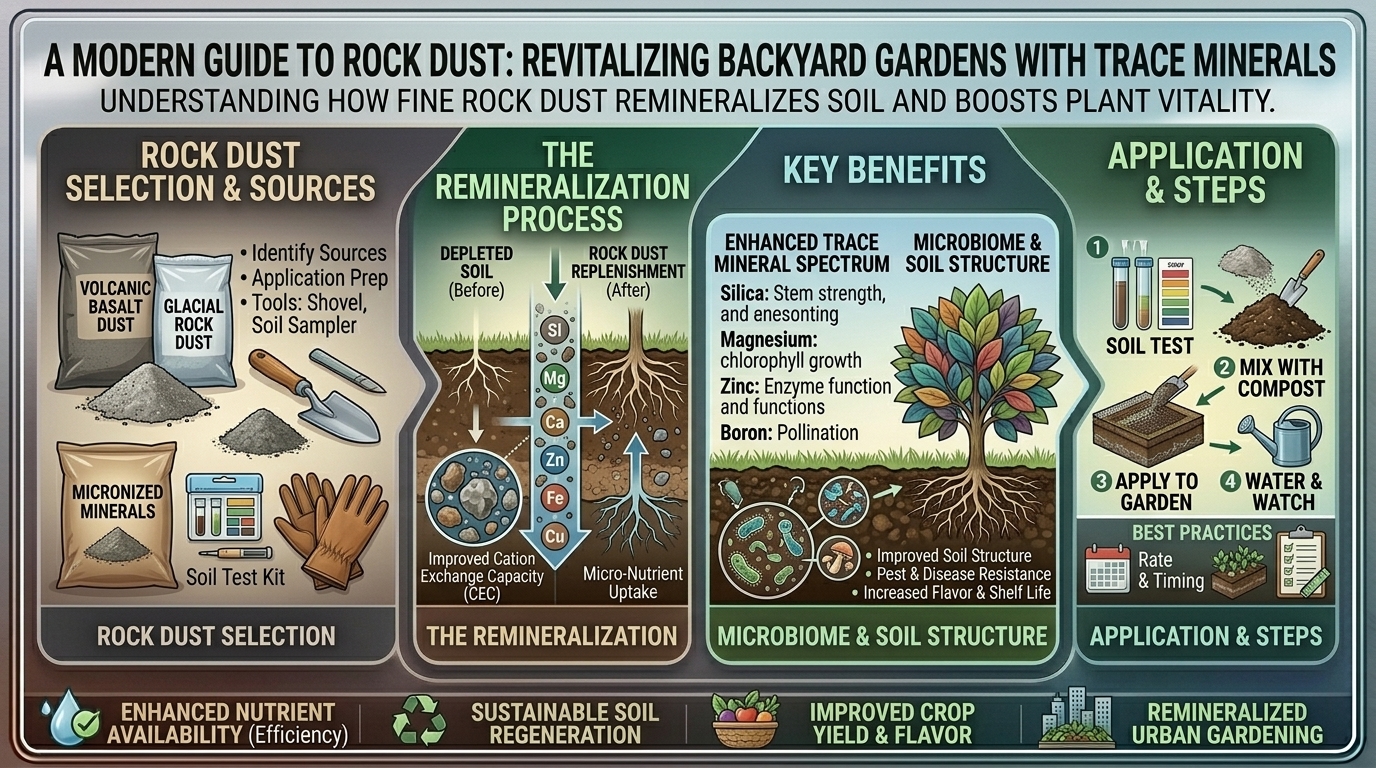
Rock dust consists of mechanically pulverized, non-synthetic rock—most commonly sourced from glacial moraine, volcanic basalt, or granite. Because it is raw, unrefined rock, it contains no synthetic chemicals, heavy metal contaminants, or artificial salts, making it 100% organic and safe for the soil food web.
2. Key Benefits of Adding Rock Dust to Your Garden
When you reintroduce mineral dust to your backyard soil, a cascade of biological and physical improvements takes place:
[ Rock Dust Application ]
       │
       ├──> 1. Feeds the Soil Food Web (Microbial Activation)
       │
       ├──> 2. Delivers Essential Trace Micronutrients
       │
       ├──> 3. Enhances Plant Brix Levels (Natural Pest Resistance)
       │
       └──> 4. Improves Soil Structure & Cation Exchange Capacity (CEC)
1. Recharging the Microbial Workforce
Soil bacteria and mycorrhizal fungi cannot live on carbon and nitrogen alone; they require trace minerals as co-factors for their enzymatic processes. Mineral dust acts as a multivitamin for soil microbes, causing populations to multiply rapidly and break down organic matter with greater efficiency.
2. Boosting Plant Brix Levels and Immunity
Plants grown in mineral-rich soil produce higher Brix levels (a measurement of sugar, vitamin, and mineral content in plant sap). High-Brix plants develop thicker cell walls and produce natural biochemical exudates that actively deter sap-sucking pests like aphids and spider mites.
3. Enhancing Cation Exchange Capacity (CEC)
Rock dust improves your soil’s Cation Exchange Capacity—its chemical ability to hold onto and exchange essential nutrient ions with plant roots, preventing valuable minerals from washing away during heavy rains.
3. Types of Rock Dust: Basalt vs. Glacial Moraine
Not all rock powders are created equal. Choosing the right type depends on your garden’s specific soil goals:
- Glacial Moraine (Glacial Rock Dust): Milled from a diverse mix of ancient rocks ground by glaciers, glacial dust offers the widest spectrum of multi-element trace minerals. It is exceptional for general soil restoration and long-term mineral balancing.
- Volcanic Basalt: Formed from cooled volcanic lava, basalt is exceptionally rich in iron, magnesium, calcium, and silica. It is the gold standard for structuring heavy clay soils and boosting structural cell strength in fruiting crops like tomatoes and squash.
- Granite Dust: A slower-weathering rock dust that breaks down very gradually, making it ideal for long-term sandy soil conditioning where quick nutrient leaching is a concern.
4. Step-by-Step Guide: How to Apply Rock Dust
Applying rock dust is simple, but technique ensures maximum contact with your soil’s biological network.
Step 1: Broadcast as a Top-Dressing or Soil Mix
- For New Beds: Mix 10 to 20 pounds of rock dust per 100 square feet directly into the top 4 to 6 inches of your garden soil or raised bed mix.
- For Established Beds: Broadcast 2 to 3 pounds per 100 square feet evenly across the soil surface as an annual top-dressing, gently scratching it into the top inch of earth.
Step 2: Combine with Compost and Biology
Rock dust requires moisture and microbial action to weather and break down into plant-available ions.
- The Ultimate Synergy: Always apply rock dust alongside finished compost, worm castings, or organic mulch. The organic matter provides the acids and microbial enzymes needed to digest the rock powder rapidly.
5. Regional Realities: Rock Dust Across U.S. Climates
Regional soil profiles and weather patterns dictate how quickly rock dust integrates into your landscape:
California & San Francisco
- Climate Challenge: Dry Mediterranean summers and intensive container gardening can exhaust soil minerals quickly.
- Application Strategy: Urban gardeners in San Francisco and inland valley plots should mix basalt rock dust directly into potting soils and container blends to replicate deep, mineral-rich earth in restricted spaces.
Texas
- Climate Challenge: Heavy alkaline clay soils in Texas lock up many native minerals, but lack broad-spectrum trace diversity.
- Application Strategy: Incorporate glacial rock dust and compost into heavy clay beds in early spring. The mineral dust helps flocculate clay particles while providing the micronutrients necessary to fuel heat-tolerant crops.
New York
- Climate Challenge: Intensive backyard vegetable cultivation in suburban New York quickly depletes trace minerals over successive growing seasons.
- Application Strategy: Apply an annual spring dusting of volcanic basalt to all raised beds and kitchen garden plots to restore mined minerals before planting heavy feeders.
Washington State
- Climate Challenge: High rainfall leaches soluble mobile nutrients out of Pacific Northwest soils rapidly.
- Application Strategy: Use slow-weathering granite or basalt dust combined with rich leaf mold compost to build a resilient, mineral-retentive soil sponge that resists heavy winter rain leaching.
6. Frequently Asked Questions (FAQ)
1. Will rock dust change my soil pH?
Most silicate rock dusts (like basalt and glacial moraine) are close to neutral in pH and will not drastically alter your soil’s acid-base balance. However, some types containing calcium carbonate can have a very mild liming effect over long periods, which is generally beneficial for neutral-loving vegetables.
2. Can I use gravel dust or driveway screenings instead of agricultural rock dust?
No. Commercial quarry screenings or driveway gravel dust often contain chemical residues, asphalt binders, or inappropriate aggregate sizes that do not weather correctly and can ruin soil structure. Always purchase pure, finely milled agricultural-grade rock dust.
3. How long does it take for rock dust to become available to plants?
Because rock dust is a natural, unrefined mineral source, it does not dissolve instantly like synthetic chemical fertilizers. It breaks down gradually over 3 to 12 months through biological weathering, providing a slow, steady, sustained release of trace minerals.
4. Is rock dust safe to inhale while applying?
Fine rock dust contains microscopic mineral particles and silica. Inhaling large quantities of dust can irritate your respiratory tract. Always wear a basic dust mask or respirator when broadcasting dry rock powder on a windy day.
5. Can I add rock dust to my compost pile?
Yes! Adding rock dust to your compost pile is a fantastic practice. The composting bacteria and fungi help pre-weather the minerals, resulting in a rich, mineral-fortified finished compost that supercharges your garden beds.
6. Do container plants benefit from rock dust?
Absolutely. Potted plants and container vegetables are entirely isolated from native geology and exhaust their limited soil mineral reserves within a single growing season. Adding 1 to 2 tablespoons of rock dust per gallon of potting mix transforms container performance.
7. Will rock dust burn my plant roots?
Never. Unlike high-nitrogen synthetic fertilizers or fresh animal manures, rock dust is completely inert and chemical-free. It has a neutral osmotic pressure and will never cause chemical root burn, even if applied in generous quantities.
8. How often do I need to reapply rock dust to my garden?
Unlike compost, which gets consumed and must be added every season, minerals do not disappear once integrated. A thorough application of rock dust every 2 to 3 years is typically sufficient to maintain a rich baseline of trace elements in a backyard garden.
9. Can rock dust help fix blossom end rot in tomatoes?
While blossom end rot is primarily caused by irregular watering and calcium uptake issues, adding calcium- and magnesium-rich basalt rock dust to your soil helps establish a steady, long-term mineral reserve that supports robust cellular wall development in fruiting crops.
10. Does rock dust replace the need for N-P-K fertilizers?
No. Rock dust is a mineralizer, not a direct nitrogen or phosphorus fertilizer. It supplies the missing micronutrients and trace elements, which should be used in conjunction with organic compost, cover crops, and balanced organic amendments for a complete fertility program.
Conclusion
Revitalizing a depleted backyard garden requires looking beyond quick-fix chemical fertilizers and embracing the wisdom of natural geology. By incorporating fine rock dust—such as glacial moraine or volcanic basalt—into your soil alongside rich organic compost, you restore the vital trace minerals that nature intended plants to consume.
Whether you are gardening in a San Francisco courtyard, managing heavy clay in Texas, or cultivating plots across New York, Washington, and California, rock dust unlocks superior flavor, robust plant immunity, and bountiful, nutrient-dense harvests.
Have you ever experimented with mineral rock dust in your garden beds, and what differences did you notice in your harvest quality?