Stepping out into your summer vegetable garden to inspect your sprawling zucchini, winter squash, and cucumber vines should be one of the most rewarding experiences of the growing season. However, mid-summer often brings a frustrating, unmistakable sight: a dusting of pale white, talcum-powder-like spots splashed across the broad green leaves of your cucurbits.
Within days, those innocent-looking white patches expand, merge, coat entire foliage surfaces, and cause leaves to turn yellow, wither, and curl up. Your once-vigorous vines look prematurely aged, devastated, and incapable of finishing their fruit set.
You are witnessing powdery mildew—one of the most persistent, widespread fungal diseases affecting cucurbits (squash, cucumbers, melons, and pumpkins) worldwide.
While commercial agriculture often relies on harsh synthetic fungicides to combat fungal pathogens, home gardeners can easily prevent, control, and eradicate powdery mildew using 100% natural, organic remedies.
Whether you are managing coastal fog and humidity in San Francisco, high summer humidity in New York, heavy pest and fungal pressures in Washington State, or battling intense seasonal shifts across California and Texas, this comprehensive guide explores the biology of powdery mildew, proven natural sprays, and proactive cultural practices to save your squash and cucumber harvests.
1. The Enemy Profile: Understanding Powdery Mildew
To stop powdery mildew effectively, you must understand how this specialized fungus operates. Unlike traditional plant fungi that require standing water or drenched soil to germinate, powdery mildew thrives under unusual conditions.
The Fungal Mechanics
Powdery mildew is not caused by a single fungus, but by a family of closely related fungal species (such as Podosphaera xanthii and Erysiphe cichoracearum) that are obligate parasites—meaning they require living plant tissue to survive.
- The Spore Spread: Fungal spores (conidia) are microscopic and travel effortlessly on summer breezes from neighboring weeds or decaying garden debris.
- The Dry-Weather Paradox: While most fungi need rain and wet leaves to germinate, powdery mildew spores germinate successfully in dry, warm conditions. They actually require low humidity to reproduce, though high humidity (like morning dew or coastal fog) helps the spores hydrate and infect plant cells.
- The Damage: The fungus sends tiny feeding structures (haustoria) into the outer cells of squash and cucumber leaves to siphon away plant sugars. This drains the plant’s energy, stunts fruit development, and severely reduces photosynthesis.
2. Top Natural Organic Remedies to Stop Powdery Mildew
When powdery mildew first appears on your vines, do not reach for toxic chemical sprays. These safe, organic home remedies stop the fungus dead in its tracks.
[ Natural Powdery Mildew Treatment Arsenal ]
       │
       ├──> Remedy 1: Potassium Bicarbonate Spray (Eradicant)
       │
       ├──> Remedy 2: Pure Neem Oil Solution (Preventative & Disruptive)
       │
       ├──> Remedy 3: Organic Milk & Water Spray (Antifungal Proteins)
       │
       └──> Remedy 4: Micronized Wettable Sulfur (Mineral Defense)
1. Potassium Bicarbonate Spray
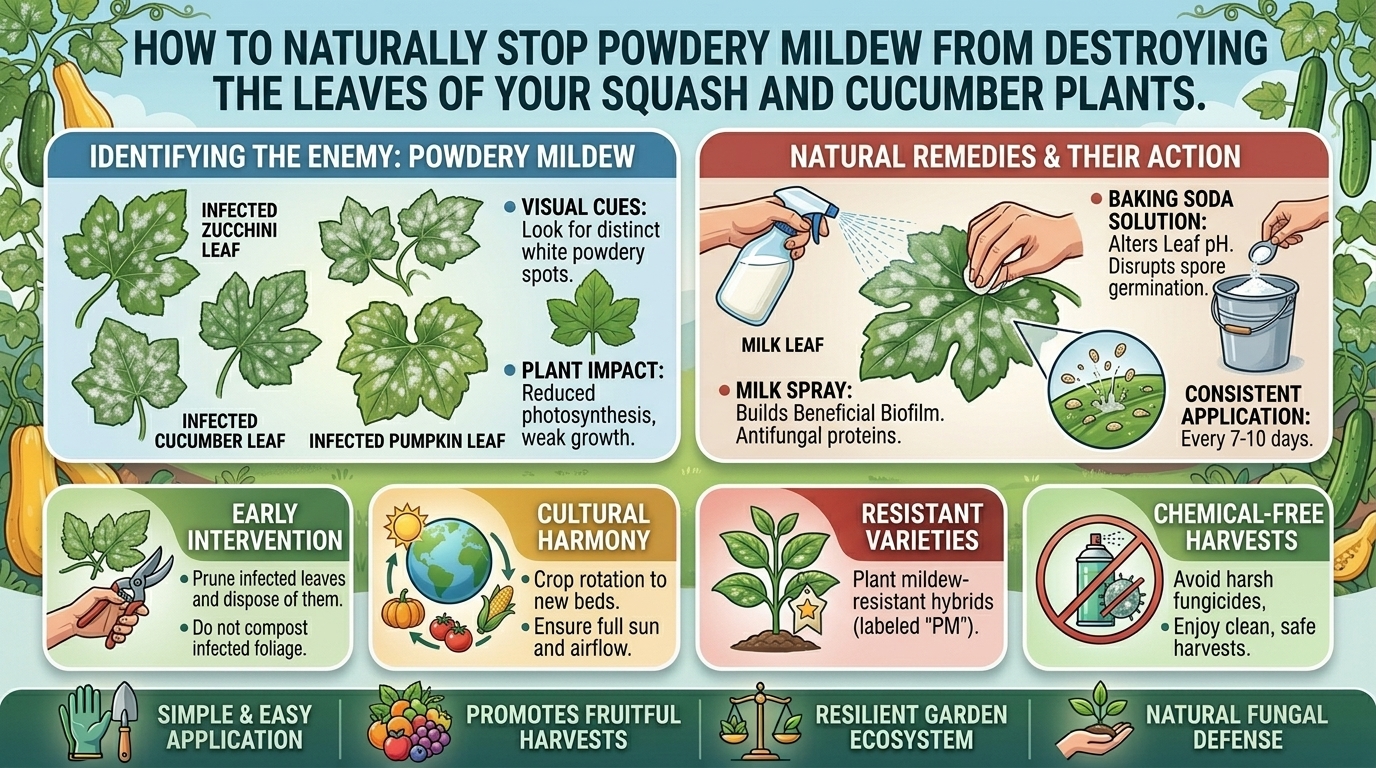
Potassium bicarbonate is a powerful, organic contact fungicide that alters the pH on the leaf surface, creating an alkaline environment where fungal spores cannot survive.
- The Recipe: Mix 1 tablespoon of potassium bicarbonate (baking soda can work in a pinch, but potassium bicarbonate is superior and safer for plants), 1 teaspoon of liquid castile soap (as a surfactant), and 1 gallon of water.
- Application: Spray thoroughly over all infected leaf surfaces. It kills active spores on contact.
2. Pure Cold-Pressed Neem Oil
Neem oil is a botanical powerhouse derived from the seeds of the neem tree.
- The Recipe: Mix 2 tablespoons of cold-pressed neem oil and 1 teaspoon of mild liquid dish soap into 1 gallon of warm water.
- Application: Mist the tops and undersides of squash and cucumber leaves every 7 to 10 days. Neem oil suffocates fungal spores and stops mycelial growth. Warning: Never apply neem oil in direct midday sun, or the oil will magnify heat and burn the leaves.
3. The Organic Milk Spray Method
It sounds unconventional, but dairy milk is a scientifically proven, highly effective organic treatment for powdery mildew.
- The Recipe: Mix 1 part milk (whole milk works best due to its fat content) with 9 parts water (e.g., 1 cup of milk to 9 cups of water).
- Why It Works: Proteins in milk (like globulin) react with sunlight to produce natural antiseptic free radicals that destroy fungal cells, while amino acids boost the plant’s natural immune response. Spray every 7 days in the morning sun.
4. Micronized Wettable Sulfur
For severe, stubborn outbreaks on thick-stemmed winter squash or pumpkins, elemental sulfur is an OMRI-listed natural mineral fungicide.
- Application: Dust or spray micronized wettable sulfur according to package instructions. Crucial Warning: Never apply sulfur within 30 days of using an oil spray (like neem oil), as the chemical reaction between sulfur and oil will severely burn and destroy plant foliage.
3. Cultural Prevention: Stopping Mildew Before It Starts
Sprays are only a band-aid if your growing practices invite disease. Implement these essential cultural strategies:
[ Cultural Prevention Strategy ]
       │
       ├──> 1. Plant Disease-Resistant Cultivars
       │
       ├──> 2. Maximize Air Circulation (Proper Spacing & Pruning)
       │
       ├──> 3. Morning Drip Irrigation (Keep Leaves Dry)
       │
       └──> 4. Full Sunlight Exposure (6+ Hours Daily)
1. Choose Resistant Varieties
The easiest way to defeat powdery mildew is to select cucurbit seed varieties bred specifically for disease resistance. Look for cucumber varieties like Marketmore 76 or resistant zucchini cultivars labeled with “PM” (Powdery Mildew resistant) on the seed packet.
2. Space and Prune for Airflow
Squash and cucumbers are notorious for forming massive, tangled jungle-like canopies.
- Space your plants at least 3 to 4 feet apart.
- As the vines mature, prune away older, yellowing lower leaves that touch the soil or block airflow. This allows wind and sun to dry out morning moisture rapidly.
3. Water the Soil, Never the Leaves
Overhead sprinkler irrigation splashes fungal spores from the soil onto lower leaves and keeps foliage damp. Always use drip irrigation or soaker hoses laid directly on the soil surface, and water early in the morning so any accidental splashes dry quickly in the sun.
4. Regional Realities: Managing Powdery Mildew Across U.S. Climates
Regional environments dictate how aggressively powdery mildew attacks your garden:
San Francisco & Coastal California
- Climate Challenge: Heavy marine fog layers roll in nearly every summer evening, bathing squash and cucumber leaves in persistent moisture while mild daytime temperatures create ideal fungal breeding windows.
- Management Strategy: Plant squash in the sunniest, wind-sheltered microclimates of your yard, and apply preventative milk or potassium bicarbonate sprays proactively before fog season peaks.
Washington State & Pacific Northwest
- Climate Challenge: Cool, damp spring weather followed by sudden warm summer spells creates rapid transitions that shock plants and trigger aggressive fungal outbreaks.
- Management Strategy: Provide ample spacing between cucumber trellises and prune inner leaves aggressively to maximize sunlight penetration through overcast skies.
New York & Northeast
- Climate Challenge: Humid summer rainstorms and sultry nights foster explosive fungal growth across suburban vegetable plots.
- Management Strategy: Inspect squash stems weekly in July and August, removing the first few infected leaves immediately and applying preventive neem oil sprays.
Texas
- Climate Challenge: Intensely hot summers combined with high humidity near coastal zones or irrigated suburban yards stress cucurbit vines, making them prime targets for late-season powdery mildew.
- Management Strategy: Maintain consistent soil moisture using deep mulching so plants remain vigorous, and apply sulfur or potassium bicarbonate during cooler morning hours.
5. Frequently Asked Questions (FAQ)
1. Can I eat squash and cucumbers from a plant infected with powdery mildew?
Yes, absolutely! Powdery mildew is an obligate plant parasite that attacks living plant cells; it does not infect human beings or animals, and it does not make the harvested vegetables toxic or unsafe to eat. If the fruit itself looks healthy and clean, wash it and enjoy it.
2. Should I rip out and throw away my squash plants if they get powdery mildew?
Not necessarily. If the mildew appears late in the growing season (late summer/early autumn) when your squash plants are already winding down, you can simply manage it and continue harvesting. However, if powdery mildew strikes early in the season (June/July) on young plants, it can stunt growth, requiring immediate treatment.
3. Will baking soda from my kitchen pantry cure powdery mildew?
Standard kitchen baking soda (sodium bicarbonate) can work against powdery mildew, but sodium ions can build up in the soil and burn plant roots if used repeatedly. Potassium bicarbonate is much safer for long-term garden use because potassium is a beneficial plant nutrient.
4. Why does powdery mildew always start on the lower leaves?
Lower leaves are older, receive less sunlight and airflow, and sit closer to the soil surface where fungal spores splash up during rain or watering. Inspecting your lower leaves weekly allows you to catch and prune out early infections.
5. Can I use a milk spray indoors if I am growing cucumbers in a greenhouse?
Yes! The organic milk-and-water spray works wonderfully in greenhouses or indoor container setups. The mild dairy scent typically vanishes within a few hours as it dries in the light.
6. Does copper fungicide work on powdery mildew?
Traditional copper-based fungicides are primarily designed to combat bacterial infections and certain downy mildews. While some copper formulas list powdery mildew on the label, sulfur and potassium bicarbonate are generally much more effective and targeted eradicants for powdery mildew.
7. Can powdery mildew spread to my tomato and pepper plants?
Generally, no. The species of fungi that cause powdery mildew are often host-specific. The powdery mildew attacking your squash and cucumbers (Podosphaera xanthii) will rarely cross over to infect your tomatoes, peppers, or corn, though it will readily spread to your pumpkins and melons.
8. How long does it take for natural sprays to clear up powdery mildew?
Natural organic sprays like potassium bicarbonate or neem oil kill active surface spores on contact, but they will not turn a white, scarred leaf back to green. Your goal is to stop the spread to new, emerging leaves. Prune away heavily damaged leaves and protect the fresh growth.
9. Will overhead watering wash powdery mildew spores away?
No. Spraying water onto infected leaves with a hose actually helps wash and splatter fungal spores onto neighboring healthy leaves and surrounding soil, accelerating the spread of the infection across your garden.
10. How can I prevent powdery mildew from returning next year?
Practice strict end-of-season garden hygiene. In autumn, remove and destroy (or hot-compost) all infected squash and cucumber vine debris. Rotate your crops so cucurbits are planted in a completely different garden bed the following year, breaking the fungal overwintering cycle.
Conclusion
Conquering powdery mildew on your squash and cucumber plants does not require toxic synthetic fungicides or destructive chemical sprays. By understanding the unique dry-weather biology of this fungus and utilizing safe, natural organic treatments like potassium bicarbonate, cold-pressed neem oil, and simple milk sprays—combined with smart cultural practices like proper spacing, morning drip irrigation, and disease-resistant varieties—you can protect your harvest.
Whether you are gardening against coastal fog in San Francisco, managing high humidity in New York, navigating damp conditions in Washington, or overseeing vibrant plots across Texas and California, natural mildew management guarantees a thriving, bountiful cucurbit harvest.
What natural remedies have you found most effective when managing powdery mildew on your squash and cucumber vines during peak summer growing season?