How to Stop Whiteflies from Multiplying Rapidly Under the Leaves of Your Indoor Tomato Plants
Welcome back to kcplants.com, your ultimate online sanctuary for indoor gardening mastery and sustainable urban crop cultivation. Whether you are growing compact determinate tomato varieties on a sun-drenched balcony in San Francisco or New York, cultivating patio heirlooms in containers across California and Texas, or nurturing indoor hydroponic tomatoes through brisk winters in Washington, indoor tomato growing offers incredible rewards—until an uninvited guest crashes the party.
Among all sap-sucking indoor pests, few are as frustratingly persistent or prolific as the whitefly.
If you gently brush against your indoor tomato plants and suddenly notice a swirling cloud of tiny, moth-like white insects fluttering up from the foliage before settling back down beneath the leaves, you are facing a rapid whitefly invasion. Left unchecked, these tiny pests multiply with staggering speed, coating your tomato leaves in sticky honeydew, stunting your fruit set, and threatening your entire indoor harvest.
This comprehensive guide explores the biology of indoor whiteflies, why indoor tomato plants are prime targets, and how to execute a multi-layered organic eradication strategy to stop them in their tracks.
Part 1: The Anatomy of an Outbreak (Understanding Whiteflies)
Whiteflies (Aleyrodidae family) are not actually flies; they are tiny, sap-sucking true bugs closely related to aphids, scales, and mealybugs. When brought indoors into climate-controlled homes, whiteflies find an artificial paradise free from outdoor predators, wind, and rain, allowing their populations to explode exponentially.
The 4-Stage Life Cycle
- The Egg: Female whiteflies lay hundreds of tiny, oval eggs in circular patterns exclusively on the undersides of young tomato leaves. Freshly laid eggs are white, turning darker as they mature.
- The Crawler Nymph: Within a week, eggs hatch into microscopic, flat, mobile nymphs known as crawlers. They wander across the leaf for a short time before anchoring themselves permanently to the leaf tissue to feed.
- The Sessile Stage (Scale-like): For the majority of their juvenile life, whitefly nymphs look like tiny, translucent, scale-like bumps glued to the leaf. They feed voraciously on tomato phloem sap.
- The Adult: The nymph transforms into a winged adult, ready to fly to neighboring leaves, mate, and lay hundreds of new eggs. Under warm indoor conditions, this entire cycle can repeat in as little as 3 weeks.
Why Tomatoes Are Their Favorite Food
Tomato plants feature lush, soft, nutrient-rich foliage and fuzzy trichomes (hairs) that create ideal microclimates for whiteflies to hide. Furthermore, continuous indoor warmth—especially during winter heating cycles in northern states like New York and Washington—removes natural dormancy triggers, enabling whiteflies to breed continuously year-round.
Part 2: The Tell-Tale Signs of a Whitefly Infestation
Catching a whitefly outbreak before populations overwhelm your tomato plants is crucial. Look for these key diagnostic indicators:
- The Flutter Cloud: The most obvious sign is a flurry of tiny white specks launching into the air when you shake or brush against your tomato stems.
- Yellowing and Chlorosis: As thousands of insects pierce plant cells to extract sap, leaves develop a speckled, mottled yellow appearance and eventually wither and drop off.
- Sticky Honeydew and Sooty Mold: Whiteflies excrete a sugary, sticky liquid waste called honeydew. This coats lower leaves, inviting black sooty mold to grow, which blocks vital sunlight from reaching the foliage.
Part 3: Step-by-Step Protocol to Eradicate Whiteflies Naturally
Because indoor tomatoes are food crops meant for your kitchen table, you must avoid harsh synthetic chemical pesticides and systemic poisons. Instead, use this powerful 4-step organic eradication framework:
Step 1: Mechanical Reduction (The Vacuum or Shower)
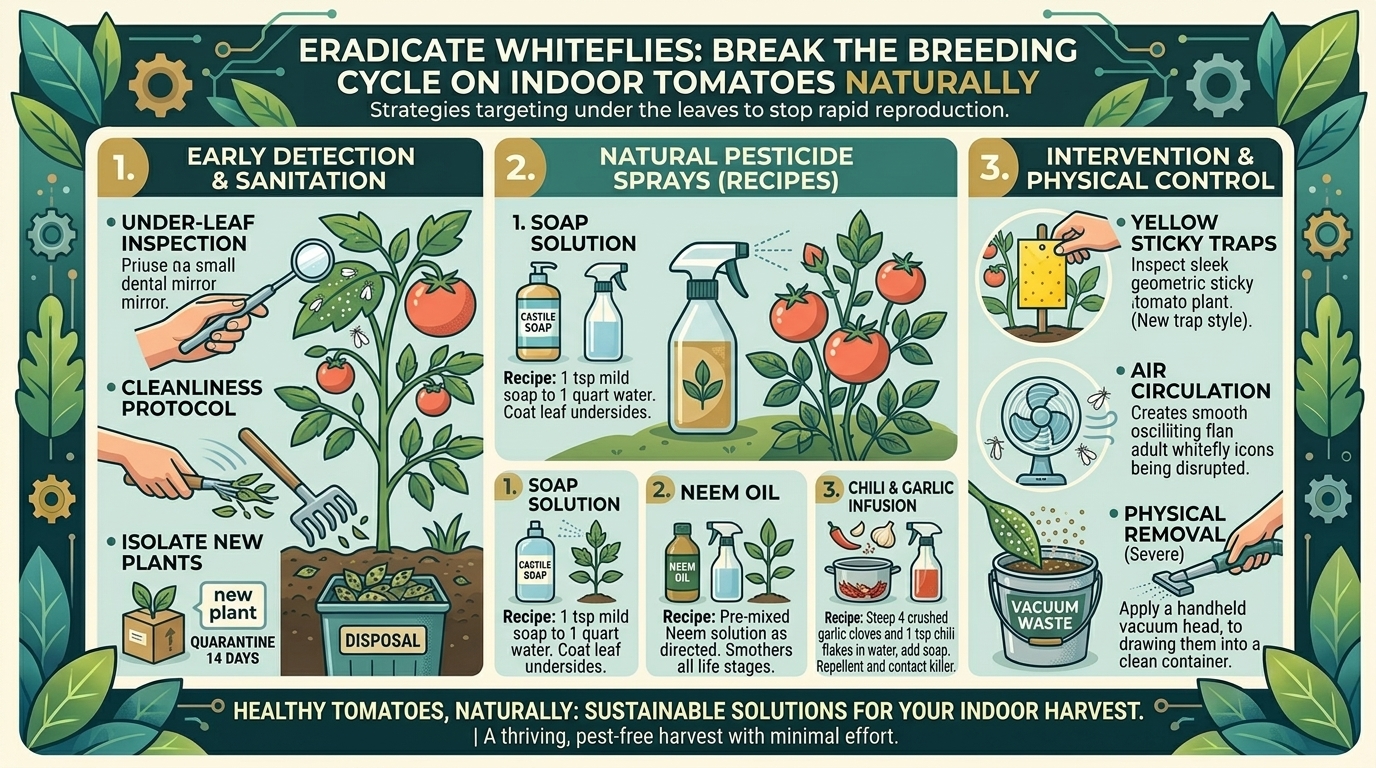
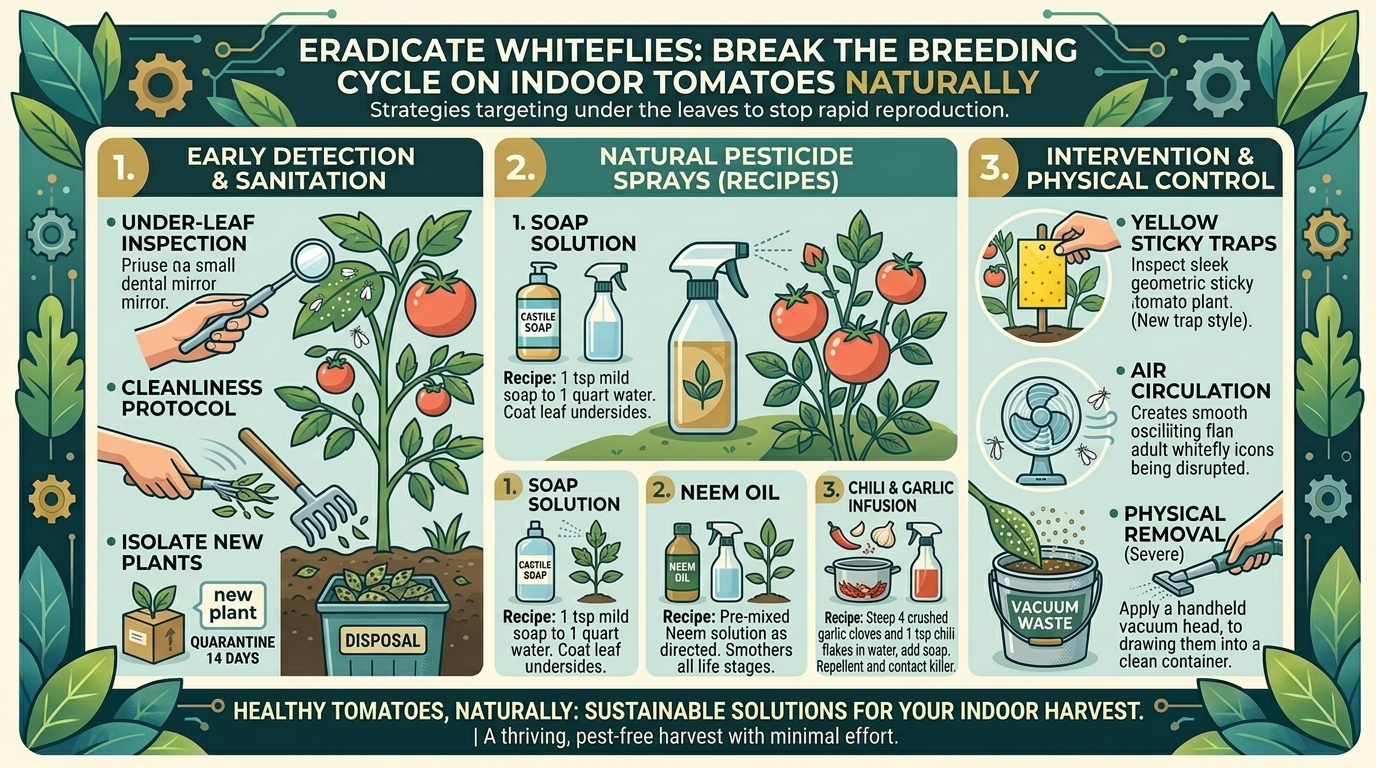
- Gentle Blast: Take your potted indoor tomato plants to a sink or shower. Use a lukewarm stream of water to thoroughly rinse the undersides of every leaf. This physically dislodges hundreds of eggs, crawlers, and adult flyers.
- Handheld Vacuum Trick: For heavy adult populations, use a battery-held handheld vacuum on a low setting to gently vacuum resting adult whiteflies off the leaf undersides before starting liquid treatments.
Step 2: Yellow Sticky Traps (The Adult Magnet)
- The Visual Attraction: Adult whiteflies possess an innate, irresistible attraction to the exact shade of bright chartreuse yellow.
- Placement: Hang bright yellow sticky cards directly inside and immediately above your tomato canopy. As adults are disturbed or fly between branches, they become permanently trapped on the adhesive surface, drastically cutting down reproductive rates.
Step 3: Apply Organic Horticultural Insecticidal Soap or Neem Oil
- Target the Undersides: Mix a commercial organic potassium salt insecticidal soap or cold-pressed neem oil according to label instructions. Using a fine mist spray bottle, thoroughly coat every single surface, paying obsessive attention to the undersides of the leaves where eggs and nymphs reside.
- Suffocation Action: The soap or oil physically coats and suffocates the soft-bodied nymphs on contact without harming your tomato fruit.
Step 4: The 7-Day Treatment Window
- Breaking the Cycle: Because insecticidal soaps do not penetrate whitefly eggs, you must repeat your spray application every 5 to 7 days for at least 3 to 4 weeks. This ensures that newly hatched crawlers are eliminated before they mature into egg-laying adults.
Part 4: Proactive Prevention Tips for Indoor Tomato Growers
Once your indoor tomato plants are free of whiteflies, maintain your success with these preventative habits:
- Inspect New Additions: Whiteflies are frequently hitchhikers on fresh nursery starts or garden herbs brought indoors. Always quarantine new plants for 2 to 3 weeks.
- Introduce Beneficial Insects (If Applicable): For indoor greenhouses or large enclosed sunrooms, releasing tiny predatory wasps (Encarsia formosa) or predatory mites is an exceptionally effective biological control method against whiteflies.
- Improve Air Circulation: Run a small oscillating indoor fan on low speeds near your tomato plants. Good airflow prevents stagnant humidity pockets and disrupts whitefly flight paths.
- Clean Foliage Regularly: Gently wiping down large tomato stems and lower leaves keeps dust down and removes early stray pests.
Part 5: Frequently Asked Questions (FAQ)
1. Will whiteflies kill my indoor tomato plants?
Yes, if left untreated. While a small number of whiteflies are merely a nuisance, a massive, unchecked population will suck the plant dry, stunt fruit development, cause premature defoliation, and weaken the tomato so severely that it collapses.
2. Can I use dish soap from my kitchen to kill whiteflies?
Standard dish soaps are formulated to cut grease and strip oils. They lack the precise potassium fatty acid balances of commercial insecticidal soaps and often contain harsh detergents that can burn and strip tender tomato leaf tissue. It is always safer to use certified horticultural soap.
3. Do whitefly eggs hatch through insecticidal soap sprays?
No. Horticultural soaps and oils kill active nymphs and adults on contact, but they generally do not penetrate the tough outer shell of whitefly eggs. This is why repeating your spray every 5 to 7 days is mandatory to catch emerging nymphs.
4. Are whiteflies dangerous to humans or pets?
No. Whiteflies do not bite humans, transmit diseases to people, or harm domestic pets. They are strictly plant parasites that target the vascular fluids of vegetation.
5. Why do whiteflies always congregate on the undersides of leaves?
The undersides of leaves feature thinner epidermal layers, making it easier for whiteflies to pierce plant phloem. Furthermore, the lower leaf surfaces provide natural shade from direct indoor lighting and protection from air currents.
6. Can I eat tomatoes from a plant that had a whitefly infestation?
Yes, absolutely! Once you wash your harvested tomatoes thoroughly in clean water, they are completely safe to eat. Whiteflies do not inject toxins into the fruit itself; they feed exclusively on the sap in the stems and leaves.
7. How do whiteflies get inside a closed home in winter?
Whiteflies can hitch a ride on clothing after you spend time outdoors, enter through open windows before weather turns cold, or arrive as hidden eggs tucked away inside the soil or foliage of newly purchased houseplants.
8. Will yellow sticky traps eliminate an entire whitefly infestation by themselves?
Yellow sticky traps are fantastic diagnostic tools and catch massive numbers of flying adults, but they do not capture the stationary nymphs or eggs glued to the leaves. They must be used in combination with leaf rinsing and insecticidal soap sprays.
9. Can I grow companion herbs indoors to deter whiteflies?
Yes! Planting pots of fragrant herbs like basil, marigolds, or mint near your indoor tomato containers helps confuse wandering pests with their strong volatile organic compounds.
10. Why do my indoor tomatoes keep getting whiteflies every single year?
If whiteflies return annually, you likely have a persistent overwintering population living on nearby tropical houseplants or residual eggs hidden in your indoor growing area. Deep cleaning your indoor garden space between crops breaks this cycle.
Conclusion
Controlling whiteflies on indoor tomato plants requires diligence, but you can achieve total victory without resorting to harsh chemical pesticides. By combining physical rinsing, yellow sticky traps, and regular applications of organic insecticidal soap or neem oil targeting the leaf undersides, you can stop whitefly multiplication in its tracks. Protect your indoor harvest and enjoy delicious, homegrown tomatoes all year long from coast to coast.