Every dedicated property owner dreams of maintaining a lush, emerald-green lawn that serves as the crown jewel of their landscape. However, beneath that beautiful turf surface, an invisible and destructive war is frequently underway. In the dark, damp underworld of your root zone, voracious soil-dwelling pests—commonly known as lawn grubs—are quietly chewing through grass roots, destroying root systems, and turning once-pristine lawns into spongy, dead patches of brown turf.
For decades, the standard knee-jerk reaction to lawn grubs involved reaching for harsh synthetic chemical insecticides. While these chemical treatments might offer a quick fix, they come with a devastating ecological price tag: they wipe out beneficial earthworms, poison local waterways, threaten household pets, and leave persistent chemical residues in your soil.
For conscious gardeners managing landscapes across diverse regions—from urban residential plots in San Francisco and New York to expansive suburban properties in Texas, California, and Washington State—there is a superior, 100% natural solution: beneficial nematodes. This comprehensive guide explores subterranean pest biology, how microscopic entomopathogenic nematodes hunt down grubs, application protocols, regional strategies, and expert tips to secure a thriving, chemical-free lawn.
1. The Underground Threat: Understanding Lawn Grubs and Beetle Larvae
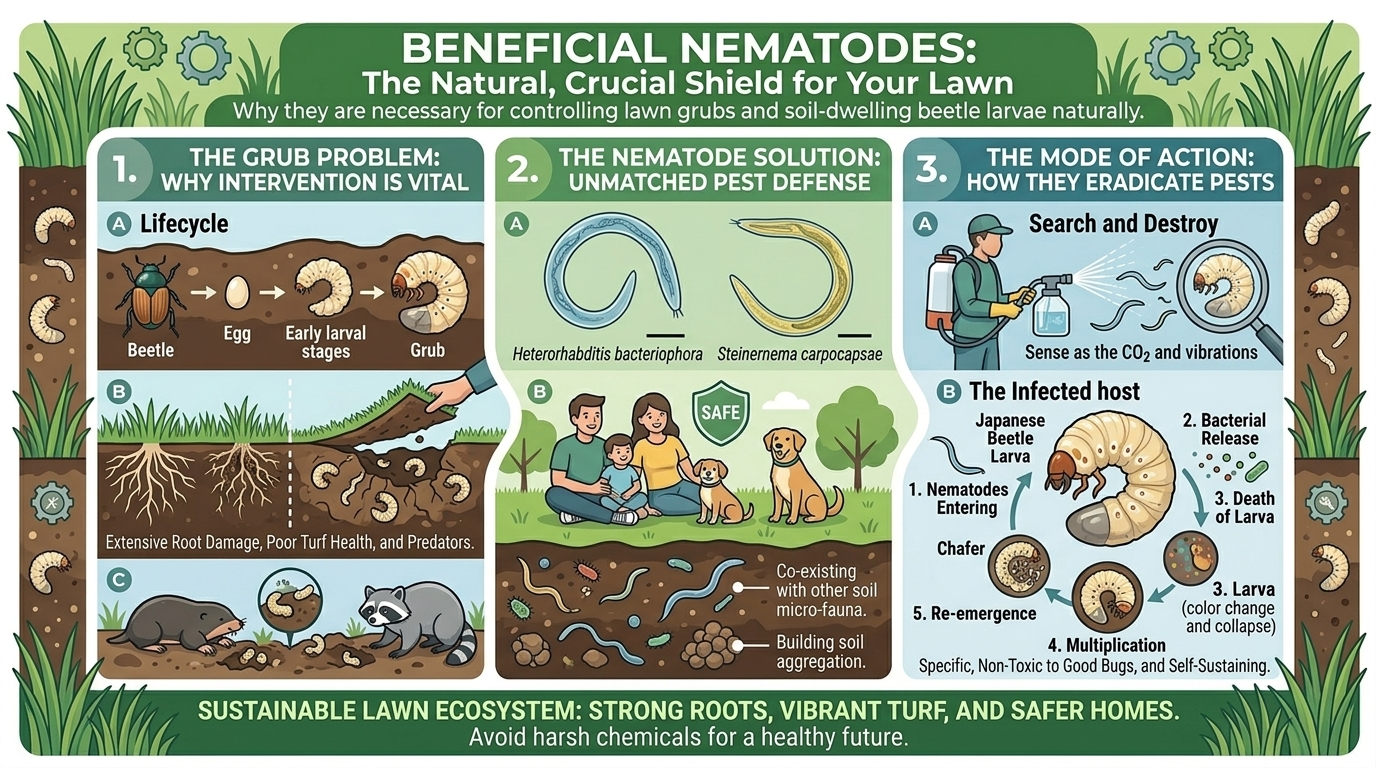
To understand why beneficial nematodes are necessary, you must first identify the enemy. “Lawn grubs” are not a distinct insect species; rather, they are the larval (immature) stage of various scarab beetles, including Japanese beetles, European chafers, June beetles, masked chafers, and Oriental beetles.
+-----------------------------------------------------------------+
|             THE SCARAB BEETLE LIFE-CYCLE DESTRUCTIVE LOOP       |
|                                                                 |
|   [1. Summer Egg-Laying]                                        |
|   - Adult beetles emerge in mid-summer, mate, and lay hundreds  |
|     of tiny white eggs deep in moist, warm garden soil.         |
|              |                                                  |
|              v                                                  |
|   [2. The Voracious Feeding Phase (Fall)]                       |
|   - Eggs hatch into C-shaped white grubs with orange heads that  |
|     begin aggressively devouring grass roots voraciously.       |
|              |                                                  |
|              v                                                  |
|   [3. The Winter Burrow & Spring Resurgence]                    |
|   - Grubs burrow deep into the soil to freeze-protect themselves |
|     over winter, returning to the surface in spring for a final |
|     feeding frenzy before pupating.                             |
+-----------------------------------------------------------------+
When a grub population exceeds 5 to 10 grubs per square foot, the root network is entirely severed. You can literally roll your turf back like a cheap carpet because there are zero roots left anchoring it to the soil. Furthermore, secondary predators like raccoons, skunks, and armadillos will tear your lawn to shreds overnight digging for these plump grub snacks.
2. What Are Beneficial Nematodes? (Nature’s Microscopic Hunters)
When people hear the word “nematode,” they often think of parasitic plant-destroying roundworms that devastate crops. However, nature also engineered a specialized class of microscopic, non-segmented roundworms known as entomopathogenic nematodes (EPNs).
These microscopic organisms are completely harmless to humans, pets, earthworms, beneficial insects, and plant roots. Their sole evolutionary purpose is hunting down and destroying soil-dwelling insect pests.
How Beneficial Nematodes Hunt and Destroy Grubs
- The Quest: Millions of microscopic juvenile nematodes (often species like Heterorhabditis bacteriophora or Steinernema carpocapsae) swim through the moisture films surrounding soil particles, actively searching for grubs.
- The Invasion: Guided by carbon dioxide emissions, body heat, and pest movement vibrations, the nematodes locate a grub and enter its body through natural openings (mouth, anus, or spiracles).
- The Symbiotic Delivery: Once inside the grub’s body cavity, the nematode releases a specialized symbiotic bacteria (Photorhabdus or Xenorhabdus species).
- Rapid Elimination: This bacteria multiplies rapidly, paralyzing and killing the grub within 24 to 48 hours by converting its internal tissues into digestible nutrients.
- Reproduction and Release: The nematodes feed on the liquefied bacteria-broth, breed, and multiply inside the dead grub carcass. When the nutrients are exhausted, millions of newly minted offspring burst out into the soil to hunt down the next pest.
3. Selecting the Right Nematode Species for Lawn Grubs
Not all beneficial nematodes are created equal. Choosing the correct species is critical for targeted grub control:
- Heterorhabditis bacteriophora (Hb): The Ultimate Grub Hunter. This species is an aggressive cruiser that actively searches through soil layers. It possesses a specialized “tooth” to pierce hard grub cuticles, making Hb the gold standard for controlling deep-dwelling lawn grubs like Japanese beetle, chafer, and masked chafer larvae.
- Steinernema carpocapsae (Sc): The Ambush Predator. While Sc can target certain surface-dwelling grubs, they are better suited for ambushing caterpillars, cutworms, webworms, and flea beetle larvae residing in the upper thatch layer.
4. Step-by-Step Application Protocol: Timing and Technique
Beneficial nematodes are living microscopic organisms. If applied incorrectly under harsh conditions, they will perish before reaching your grubs. Follow this strict protocol to guarantee success:
+-----------------------------------------------------------------+
|             THE 4-STEP GOLDEN APPLICATION RULE                  |
|                                                                 |
|   [Step 1: Timing is Everything]                                |
|   - Apply in **late summer/early autumn** (August–September) when|
|     newly hatched grubs are small and actively feeding near the |
|     surface, or in **early spring** as they wake up.            |
|              |                                                  |
|              v                                                  |
|   [Step 2: Moisture Preparation]                                |
|   - Thoroughly water your lawn *before* applying. Nematodes     |
|     cannot swim or move through dry, parched dirt.              |
|              |                                                  |
|              v                                                  |
|   [Step 3: UV Light Protection]                                 |
|   - Ultraviolet (UV) sunlight kills nematodes instantly. Apply  |
|     only at **dawn, dusk, or on a heavily overcast day**.       |
|              |                                                  |
|              v                                                  |
|   [Step 4: Post-Application Irrigation]                         |
|   - Water the lawn immediately *after* application to wash the  |
|     microscopic nematodes off the grass blades down into the    |
|     soil root zone where the grubs live.                        |
+-----------------------------------------------------------------+
How to Mix and Spray
- Activate the Sponge/Pouch: Dissolve your concentrated nematode packet into a small bucket of cool, clean water to create a starter concentrate.
- Transfer to Sprayer: Pour the concentrate into a standard hose-end sprayer or a pump sprayer. Pro Tip: Remove any fine metal mesh filters inside your sprayer nozzle, as they can block microscopic nematodes from passing through.
- Spray Uniformly: Evenly distribute the mixture across your entire lawn area, keeping soil consistently moist for at least two weeks post-application.
5. Regional Considerations Across the United States
Your local climate dictates when and how grub populations peak across America:
San Francisco and New York City
Urban and suburban lawns in these regions face heavy pressure from European chafers and Japanese beetles. In New York, apply nematodes in late August when summer beetle eggs hatch into vulnerable young grubs before the ground freezes. In San Francisco’s mild maritime climate, timing is flexible, but early autumn remains the prime window when soil temperatures are warm and moist.
Washington State
The Pacific Northwest is plagued heavily by European crane flies (leatherjackets) and turf chafers. Frequent autumn rainfall provides an ideal moist soil environment for beneficial nematodes to thrive, making Washington one of the most successful regions for biological nematode integration.
Texas and California
Warm southern and western soils present unique challenges. High summer temperatures can dry out topsoils rapidly. In Texas and California, apply nematodes strictly in the cooler evening hours during early fall or mid-spring, and ensure your irrigation system is running consistently to prevent soil dehydration.
6. Comprehensive Seasonal Lawn Grub Management Schedule
| Timing | Action Item | Primary Objective |
| Late Spring (May) | Soil inspection & monitoring | Check grub population density (threshold: >5 per sq ft) |
| Mid-Summer (July) | Adult beetle monitoring | Track adult Japanese beetle emergence and feeding activity |
| Late Summer (Aug–Sept) | Apply Beneficial Nematodes (H. bacteriophora) | Target and eliminate newly hatched, vulnerable lawn grubs |
| Autumn (Oct–Nov) | Core aeration & overseeding | Repair damaged turf and strengthen root resilience |
7. Frequently Asked Questions (FAQs)
1. What are beneficial nematodes and will they harm my family or pets?
Beneficial nematodes are microscopic, non-segmented roundworms found naturally in healthy soils. They are completely harmless to humans, household pets, birds, earthworms, and plant roots, targeting only insect pests.
2. Can I use chemical fertilizers or weed killers alongside nematodes?
Avoid applying harsh synthetic chemical pesticides or weed-and-feed products simultaneously with nematodes, as strong chemical concentrations can shock or kill living biological organisms. Maintain a 2-week gap between chemical treatments and nematode applications.
3. How long do beneficial nematodes live in the soil after application?
Once released into a moist soil environment with an active food supply (grubs), nematodes hunt, reproduce, and establish a natural population. However, their numbers fluctuate based on pest availability and soil moisture levels.
4. Why did my first nematode application fail to control my grubs?
The most common reasons for failure are UV light exposure (applying in bright midday sun), dry soil (nematodes dried out before reaching the roots), or purchasing expired, improperly stored product. Always buy fresh and apply at dusk.
5. Are beneficial nematodes effective against adult beetles?
No. Nematodes target soil-dwelling juvenile stages (grubs, pupae, and larvae). They cannot fly or reach adult beetles feeding on tree foliage, which require separate organic controls like milky spore or hand-picking.
6. Can I store leftover nematode solution for later use?
No. Once mixed with water, nematodes consume their oxygen supply and perish within a few hours. Mix only what you intend to spray immediately. Unopened packages can be stored in a refrigerator for a limited time per manufacturer instructions.
7. How do beneficial nematodes compare to milky spore powder?
Milky spore (Paenibacillus popilliae) is a bacterium that specifically targets Japanese beetle grubs and takes several years to establish. Beneficial nematodes work much faster (days to weeks) and target a broader range of soil-dwelling beetle larvae.
8. What is the ideal soil temperature for applying nematodes?
Nematodes perform best when soil temperatures are between 50°F and 85°F (10°C to 29°C). Avoid applying them when the ground is frozen solid in deep winter or baked dry during a scorching summer heatwave.
9. Will nematodes eliminate 100% of the grubs in my lawn?
No biological control agent achieves 100% eradication. Instead, nematodes reduce grub populations below the economic injury threshold (fewer than 3 to 5 grubs per square foot), allowing your lawn to recover and thrive naturally.
10. Where can I purchase fresh beneficial nematodes?
Fresh nematodes are available at specialized local nurseries, organic gardening centers, or reputable online biological pest-control suppliers who ship them in insulated, refrigerated packaging.
8. Conclusion
Maintaining a pristine, resilient lawn does not require drenching your soil in toxic synthetic chemicals that disrupt local ecosystems. By harnessing the power of beneficial nematodes, you introduce nature’s elite subterranean hunters into your landscape, establishing a self-sustaining biological defense system against destructive lawn grubs and beetle larvae.