There is a heartbreak familiar to every dedicated home gardener who has ever walked out to inspect their summer vegetable plot. Your tomato plants are towering, lush, and heavy with clusters of green fruit, ready to burst into vibrant red ripening. Then, you spot them: dark, concentric rings forming on the lower leaves, surrounded by a sickly yellow halo. Within days, those leaves turn brown, wither, and drop off, creeping steadily upward until your magnificent tomato plant is stripped bare.
You are witnessing early blight, one of the most aggressive and pervasive fungal diseases plaguing tomato crops worldwide.
For passionate growers managing gardens across diverse regional landscapes—from urban container plots in New York and San Francisco to sprawling backyard homesteads in Texas, California, and Washington State—protecting organic crops from early blight is an ongoing battle. When synthetic chemical fungicides are off-limits for organic certification, gardeners need a reliable, time-tested defense mechanism: copper fungicide sprays. This comprehensive guide explores plant pathology, how copper works as an organic shield, exact application protocols, regional strategies, and expert tips to safeguard your harvest.
1. The Enemy Profile: Understanding Early Blight (Alternaria solani)
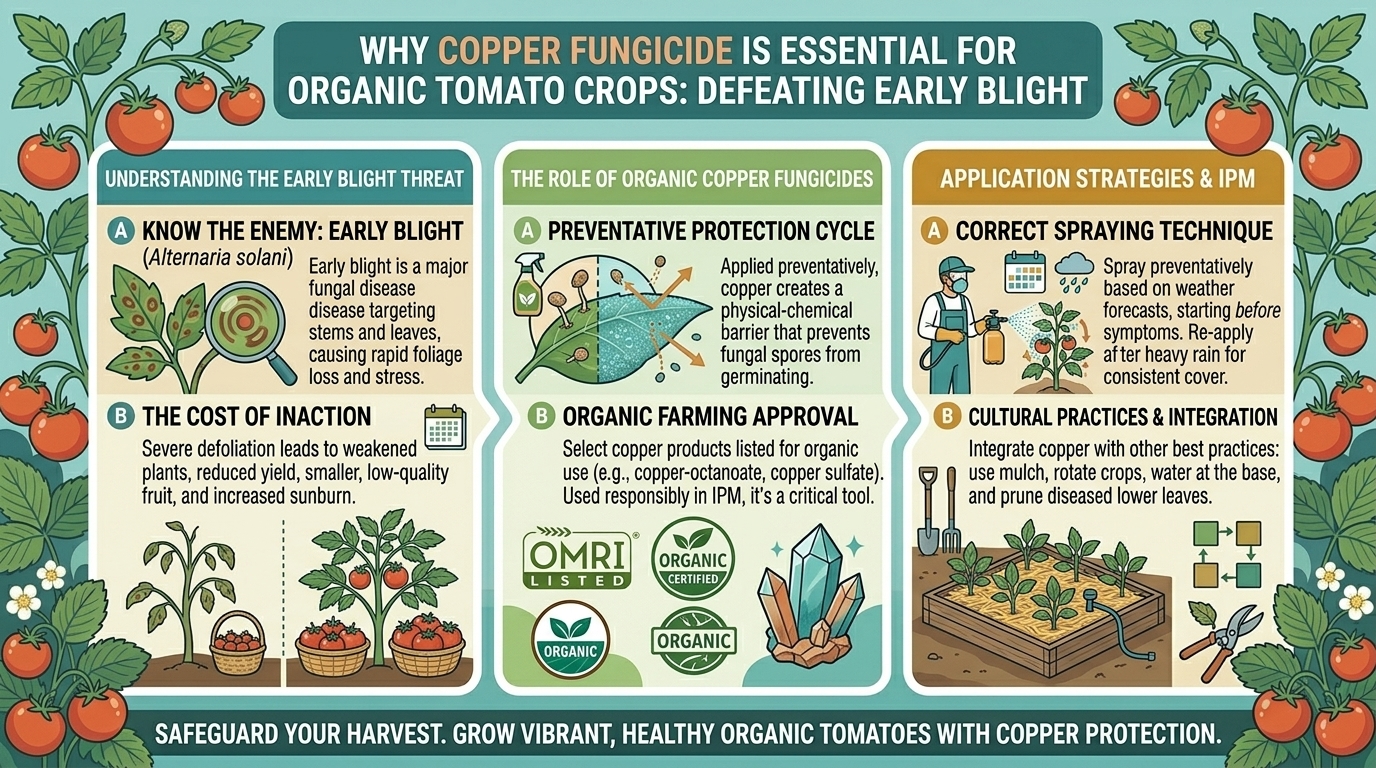
To successfully defend your tomatoes, you must understand the pathogen. Early blight is caused by the fungus Alternaria solani (and occasionally related species). Despite its name, “early” blight can strike at any point during the growing season when environmental conditions align.
+-----------------------------------------------------------------+
|             THE EARLY BLIGHT INFECTION AND SPREAD CYCLE         |
|                                                                 |
|   [1. Overwintering in Debris]                                  |
|   - Fungal spores overwinter silently on infected tomato debris,|
|     staked supports, and weed hosts in the soil.                |
|              |                                                  |
|              v                                                  |
|   [2. Splashing Rain & Air Dispersion]                          |
|   - Heavy rain splashes soil particles containing fungal spores |
|     upward onto the lowest leaves of the tomato plant.          |
|              |                                                  |
|              v                                                  |
|   [3. Germination in Warm, Wet Conditions]                      |
|   - Spores germinate in moisture films on leaf surfaces,        |
|     penetrating cellular tissue within hours.                   |
|              |                                                  |
|              v                                                  |
|   [4. The Bullseye Lesion Progression]                          |
|   - Dark brown spots with concentric "bullseye" rings expand,   |
|     defoliating the plant and exposing fruit to sunscald.       |
+-----------------------------------------------------------------+
2. How Copper Fungicide Works as an Organic Shield
Among the limited arsenal of approved organic treatments, copper-based fungicides (such as copper octanoate, fixed copper hydroxide, or basic copper sulfate) are the gold standard.
The Mode of Action
Copper is a natural elemental mineral. When you spray liquid copper fungicide onto tomato foliage, it dries into an invisible, microscopic protective barrier.
- Contact Eradication: When fungal spores land on the leaf surface and attempt to germinate, they absorb toxic copper ions.
- Cellular Disruption: The copper ions disrupt the fungal spore’s vital enzymatic systems, instantly halting cellular respiration and preventing germination.
Crucial Distinction: Copper fungicide is strictly a preventative contact spray. It cannot cure a leaf that is already infected. Once a spot appears, that tissue is permanently damaged; copper stops the spores from spreading to neighboring healthy leaves and fruit.
3. Best Practices for Applying Copper Fungicide
Applying copper fungicide requires precision to maximize protection while minimizing environmental accumulation in your soil.
+-----------------------------------------------------------------+
|             GOLDEN RULES OF COPPER SPRAY APPLICATION            |
|                                                                 |
|   [Rule 1: Spray Before Rain, Not After]                        |
|   - Apply copper as a preventative barrier *before* forecasted  |
|     rainstorms wash spores around and trigger germination.      |
|              |                                                  |
|              v                                                  |
|   [Rule 2: Complete Foliar Coverage]                          |
|   - Spray both the upper and lower surfaces of every leaf, paying|
|     special attention to lower branches closest to the soil.    |
|              |                                                  |
|              v                                                  |
|   [Rule 3: Adhere to Pre-Harvest Intervals (PHI)]               |
|   - Always check product labels for specific waiting periods    |
|     between your final spray and harvesting ripe fruit.         |
+-----------------------------------------------------------------+
Avoiding Phytotoxicity
While copper is organic, excessive application can lead to phytotoxicity (copper burn), where leaf margins turn dark and crispy. Mix formulations strictly according to label directions and avoid spraying during high heat (above 85°F).
4. Regional Climate Strategies Across the United States
Your local geography and regional weather patterns dictate how aggressively early blight will attack your tomato crops:
New York City and San Francisco
Urban gardens in New York and San Francisco experience humid summer storms (NY) or persistent coastal morning fog and damp marine air (SF). Both environments provide the constant moisture film that Alternaria solani loves. Initiate a regular preventative copper spray schedule every 7 to 10 days starting in early summer.
Washington State
The Pacific Northwest features cool, damp springs and frequent summer rain showers. Because foliage stays wet for extended hours, Washington tomato growers face immense early blight pressure. Combine copper fungicide sprays with overhead rain-shelters or plastic greenhouse covers to keep foliage dry.
Texas and California
In arid or semi-arid sunbelt regions, early blight is less common during scorching summer droughts. However, heavy reliance on automated overhead lawn sprinklers or drip systems that splash soil onto lower leaves will trigger sudden outbreaks. In these zones, copper is best used as a targeted spot-treatment during damp spring months.
5. Cultural Practices to Pair with Copper Sprays
Copper fungicide is most effective when combined with smart cultural management. Relying on sprays alone without modifying your garden layout will yield poor results.
- Prune Lower Leaves: Snip off all lower tomato leaves hanging within 12 inches of the soil line. This eliminates the primary landing zone for rain-splashed fungal spores.
- Mulch Heavily: Apply a 3-inch layer of clean straw, dried leaves, or wood chips around the base of your tomato plants to create a physical barrier preventing soil splash.
- Proper Spacing and Staking: Space tomato plants at least 3 feet apart and use sturdy cages or stakes to keep vines upright and exposed to maximum sunlight and airflow, ensuring leaves dry rapidly after morning dew.
6. Comprehensive Tomato Blight Management Schedule
| Timing | Action Item | Primary Objective |
| Planting Time (Late Spring) | Prune lower leaves; apply thick straw mulch | Eliminate soil splash zones and establish clean ground barriers |
| Early Summer (Pre-Disease) | Begin bi-weekly preventative copper fungicide sprays | Establish an active mineral barrier before spores arrive |
| Peak Season (Mid-Summer) | Monitor lower canopy; remove any infected yellow leaves | Stop local spore reproduction and maintain plant vigor |
| Autumn (Harvest End) | Clear all tomato vines and debris; bag and trash | Destroy overwintering fungal habitat before next season |
7. Frequently Asked Questions (FAQs)
1. Is copper fungicide safe for organic gardening?
Yes. Fixed copper and copper octanoate are approved for use in certified organic agriculture by organizations like OMRI (Organic Materials Review Institute) because copper is a naturally occurring mineral found in earth’s soil.
2. Can copper fungicide cure leaves that already have early blight?
No. Copper is a contact preventative, not a systemic curative. It stops unspores from germinating and spreading, but leaves already showing brown bullseye lesions will not heal and should be pruned off.
3. Will copper fungicide accumulate dangerously in my garden soil?
Heavy, repeated overuse of copper over many decades can lead to a buildup of copper in soil, which can inhibit beneficial earthworms and soil microbes. Follow label instructions carefully and apply only when disease pressure warrants it.
4. Can I eat tomatoes that have been sprayed with copper fungicide?
Yes, provided you follow the product’s specified Pre-Harvest Interval (PHI)—usually 0 to 1 day—and thoroughly wash your harvested tomatoes under clean water before eating.
5. What is the difference between early blight and late blight?
Early blight (Alternaria solani) creates brown spots with concentric “bullseye” rings primarily on lower leaves. Late blight (Phytophthora infestans) is a devastating water mold that creates large, greasy, dark grey-green patches on leaves and stems, turning entire plants to mush in days.
6. Does copper fungicide wash off in the rain?
Yes. Heavy rain or overhead irrigation washes copper residue off leaf surfaces. You will need to reapply your copper spray immediately after heavy rainstorms to maintain continuous protection.
7. Can I mix copper fungicide with other organic sprays?
Never mix copper fungicide with sulfur sprays or highly acidic foliar fertilizers, as chemical reactions can burn plant foliage. Always test tank mixes on a single leaf before spraying an entire crop.
8. Why are my tomato leaves turning blue or green after spraying?
That is completely normal! Copper-based fungicides leave a visible blue-green powdery residue on leaf surfaces, which serves as a helpful visual indicator of where the protective barrier is active.
9. Can I use copper fungicide on container-grown tomatoes on a balcony?
Absolutely. Container tomatoes grown on balconies in New York or San Francisco are still susceptible to airborne fungal spores drifting in on wind currents, making copper sprays a great preventative tool.
10. How do I dispose of leftover diluted copper spray?
Never pour leftover copper spray down indoor drains or into storm sewers, as copper is toxic to aquatic life. Spray it out over non-edible ornamental garden beds according to label safety guidelines.
8. Conclusion
Protecting your organic tomato crops from the devastating onslaught of early blight requires a proactive, multi-layered strategy. By harnessing the proven, OMRI-listed protective power of copper fungicide sprays—combined with diligent lower-leaf pruning, thick straw mulching, and proper plant spacing—you can stop fungal spores in their tracks and secure a bountiful harvest.