There are few culinary delights quite like stepping out into your backyard garden on a warm morning to harvest a handful of sun-warmed, perfectly ripe strawberries. As you kneel down beside your patch, anticipation building, you reach for a glowing red jewel resting against the straw—only to turn it over and discover that the back half has been pecked completely hollow, peck-marked, or stolen entirely by an opportunistic neighborhood bird.
For home gardeners cultivating fruit patches across diverse American landscapes—from urban container balconies in San Francisco and New York to sprawling suburban raised beds across Texas, California, and Washington State—protecting a strawberry harvest from avian thieves is a rite of passage.
While birds are wonderful creatures that play an essential role in your garden’s ecosystem, sharing your hard-earned fruit crop with every passing robin, jay, and finch can test the patience of even the most dedicated plant lover. Fortunately, you don’t need to resort to harsh chemical repellents or harmful synthetic deterrents. By mastering the twin pillars of exclusion and sensory confusion—specifically physical bird netting and reflective tape—you can secure your strawberry patch safely and naturally. This comprehensive guide explores bird behavior, advanced installation techniques, multi-sensory deterrent strategies, and expert tips to guarantee a bountiful, bird-free harvest.
1. Understanding Avian Behavior: Why Strawberries?
To outsmart birds, you must understand what motivates them. Birds do not target your strawberry patch out of malice; they are driven by basic biological survival instincts.
+-----------------------------------------------------------------+
|             THE AVIAN FRUIT FORAGING CYCLE                      |
|                                                                 |
|   [1. High-Sugar Energy Demand]                                 |
|   - Ripening strawberries release powerful sweet volatile esters|
|     that signal an immediate, high-calorie sugar energy source. |
|              |                                                  |
|              v                                                  |
|   [2. Moisture & Hydration Seeking]                             |
|   - Succulent, high-water fruit content provides vital hydration|
|     during warm spring and summer fruiting windows.             |
|              |                                                  |
|              v                                                  |
|   [3. Visual Color Cues]                                        |
|   - Birds possess extraordinary tetrachromatic vision; the      |
|     vivid red contrast against green leaves acts as a beacon.   |
+-----------------------------------------------------------------+
Once a bird discovers your patch, it will return daily and signal flockmates, transforming your garden into a neighborhood feeding station within hours.
2. Strategy One: Physical Exclusion Using Bird Netting
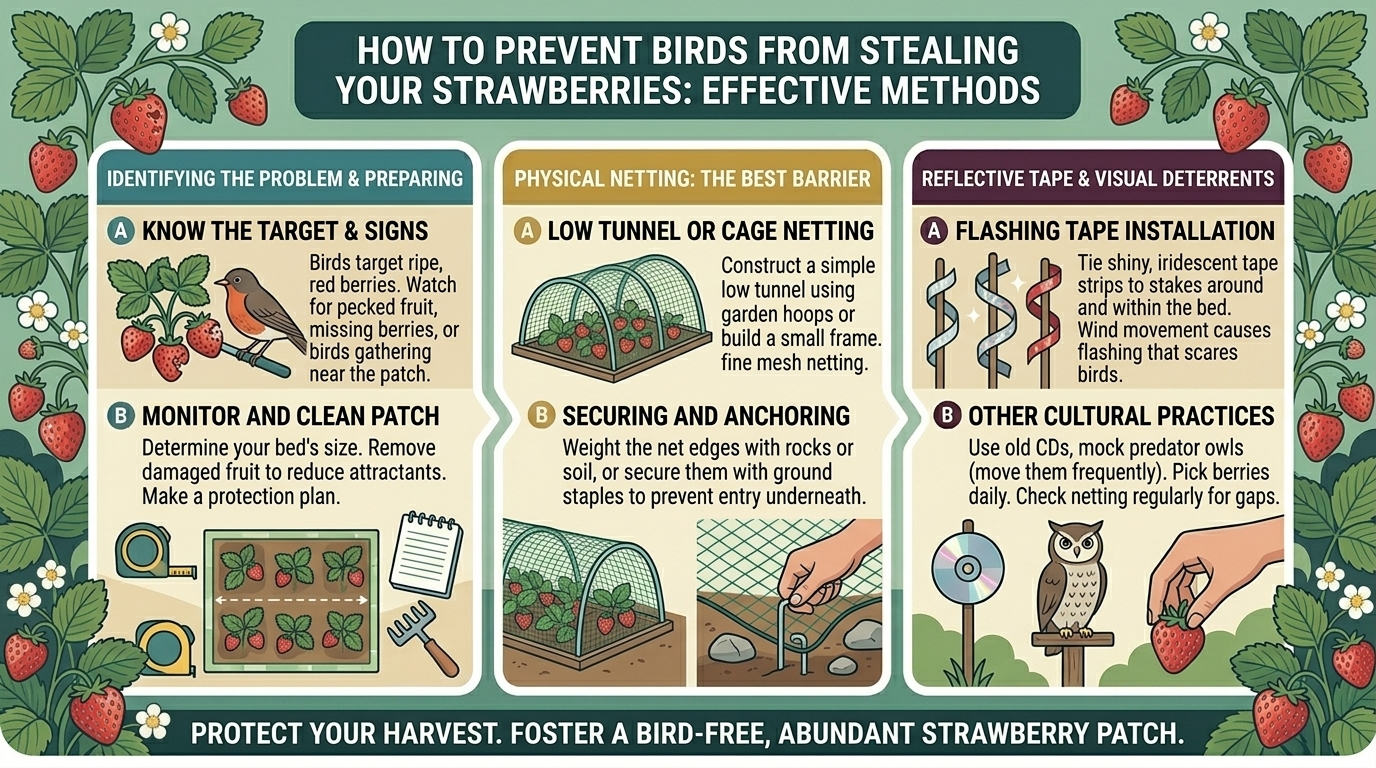
Physical exclusion is the single most reliable, 100% effective way to stop birds from accessing your strawberries. If they cannot physically reach the fruit, they cannot steal it. However, installing bird netting incorrectly can lead to disaster, frequently trapping tangled wildlife or restricting beneficial pollinators.
+-----------------------------------------------------------------+
|             THE GOLDEN RULES OF BIRD NETTING INSTALLATION       |
|                                                                 |
|   [Rule 1: Build a Rigid Support Frame]                         |
|   - Never drape netting directly over strawberry plants. Birds  |
|     will simply peck right through the mesh resting on fruit.   |
|     Build a lightweight PVC or wire hoop frame first.           |
|              |                                                  |
|              v                                                  |
|   [Rule 2: Select Fine Mesh Sizing]                             |
|   - Use fine mesh (1/4 inch to 1/2 inch spacing). Large garden  |
|     nets can trap small birds, lizards, and beneficial snakes.  |
|              |                                                  |
|              v                                                  |
|   [Rule 3: Secure and Anchor Edges]                             |
|   - Pull netting taut over your frame and anchor every single   |
|     edge tightly to the ground using landscape staples or heavy |
|     bricks so birds cannot crawl underneath.                    |
+-----------------------------------------------------------------+
Frame Construction Made Easy
Drive four wooden stakes or bent electrical conduit pipes into the corners of your strawberry raised bed. Slide flexible PVC hoops across them to form a low tunnel framework 2 to 3 feet high. Drape your fine mesh netting over this dome, and you have created an impenetrable fortress.
3. Strategy Two: Sensory Disruption Using Reflective Tape
While physical netting blocks access, reflective scare tape (often called flash tape or holographic ribbon) uses visual and auditory confusion to deter birds before they even approach your patch.
+-----------------------------------------------------------------+
|             HOW REFLECTIVE FLASH TAPE WORKS                     |
|                                                                 |
|   - Holographic Light Flashes: Metallic Mylar tape reflects     |
|     intense beams of sunlight in erratic directions, dazzling   |
|     avian eyes and simulating sudden danger.                    |
|   - Auditory Crackling: In a gentle breeze, the metallic ribbon |
|     emits a crisp, crinkling sound that startles cautious wild  |
|     birds.                                                      |
|   - Motion Disorientation: Hanging strips flutter unpredictably,|
|     creating the illusion of a predator moving nearby.          |
+-----------------------------------------------------------------+
Best Practices for Deploying Reflective Tape
- Hang, Don’t Lay Flat: Tie 2-to-3-foot strips of reflective tape to garden stakes, bamboo poles, or overhead wires so they dangle freely 6 to 12 inches above your strawberry canopy.
- Allow Movement: Ensure the strips are loose enough to twist and catch the wind from multiple angles.
- Move Them Frequently: Birds are surprisingly intelligent. If a flash ribbon remains in the exact same spot for two weeks, local birds realize it is inanimate and ignore it. Shift your ribbons every 4 to 5 days to maintain the illusion of hazard.
4. Regional Climate Strategies Across the United States
Your local climate, weather patterns, and regional bird populations dictate how you approach strawberry protection:
San Francisco and New York City
Urban and suburban gardens in New York and San Francisco often contend with habituated city birds (pigeons, starlings, house sparrows) that are remarkably bold. In these tighter urban footprints, low-profile PVC netting tunnels paired with hanging balcony reflective strips provide clean, highly effective protection without cluttering small yards.
Washington State
The Pacific Northwest features vibrant populations of robins, towhees, and thrushes that descend upon backyard berry patches in early summer. Because Washington springs are often breezy and damp, secure your netting firmly against high winds, and opt for high-grade UV-resistant Mylar tape that won’t degrade under persistent rain.
Texas and California
In sunbelt states, intense solar radiation can degrade cheap plastic garden netting within a single season. Invest in UV-stabilized woven netting. Furthermore, bright sunshine amplifies the power of reflective Mylar tape, making visual flashes exceptionally blinding and effective against local mockingbirds and finches.
5. Multi-Sensory Layering: The Ultimate Deterioration System
Relying on a single method often results in clever birds finding a loophole. Combining physical barriers with sensory disruption creates an unbreakable defense system:
- Hydration Distraction: Birds frequently peck open juicy strawberries simply because they are thirsty. Placing a clean birdbath or shallow water dish filled with fresh water at the opposite end of your yard can satisfy their hydration needs away from your fruit patch.
- Predator Decoys: Moveable plastic owls, hawk silhouettes, or reflective predator eye balloons placed near the garden add a biological threat layer when combined with reflective tape. Remember to reposition decoys weekly so birds don’t pattern their stillness.
- Sacrificial Planting: Interplant early-fruiting wild berries (like serviceberries or wild mulberries) elsewhere on your property to divert foraging flocks away from your prized garden beds.
6. Comprehensive Strawberry Protection Schedule
| Timing | Action Item | Primary Objective |
| Early Spring (Bud & Blossom) | Lay down straw mulch; install low-profile hoop frames | Prepare clean bedding for fruit and establish the netting framework |
| Mid-Spring (Green Fruit Set) | Secure fine-mesh netting over frames; anchor edges | Block physical access before the first berries turn pink |
| Late Spring (Ripening Window) | Hang reflective flash tape strips 6 inches above canopy | Add visual and auditory deterrents to keep bold foragers away |
| Post-Harvest (Summer/Fall) | Remove netting; weed, prune runners, and apply compost | Clear spent foliage and prepare patch for winter dormancy |
7. Frequently Asked Questions (FAQs)
1. Why do birds peck strawberries only when they are half-ripe?
Birds possess exceptional color vision and can detect the transition from green to pink long before humans consider the fruit ready. Pecking half-ripe fruit is their way of taste-testing sugar levels and staking a claim before competitors arrive.
2. Can birds get tangled in bird netting?
Yes, if you use cheap, flexible, wide-mesh agricultural netting (like 1-inch or 2-inch netting) draped loosely on the ground, birds, snakes, and toads can become tragically entangled. Always use fine mesh (1/4 to 1/2 inch) stretched taut over a rigid frame.
3. How do I harvest strawberries if they are trapped under a net?
Design your netting setup with an easy-access entry point. Use binder clips, clothespins, or Velcro strips along one side of your PVC frame so you can quickly unclip a flap, reach inside to harvest ripe berries, and seal it back up.
4. Do plastic owls and hawk decoys actually work on birds?
Decoys work well initially, but smart birds quickly realize they never move. To make decoys effective, you must relocate them every 3 to 4 days so birds maintain a healthy sense of unpredictable danger.
5. Will reflective tape bother my neighbors?
If positioned carelessly, highly reflective Mylar tape can bounce blinding flashes of sunlight into neighboring windows or onto streets. Angle your hanging ribbons so light flashes down toward your garden beds rather than outward toward neighboring properties.
6. Do squirrels and chipmunks respect bird netting?
No. While fine bird netting stops birds, rodents like squirrels, chipmunks, and rats possess sharp teeth and can easily chew through soft plastic mesh to steal strawberries. If you have rodent pressure, you need hardware cloth or wire hardware mesh instead.
7. Why do birds ignore my reflective tape after two weeks?
This is a common phenomenon called avian habituation. Birds quickly learn that static, non-moving objects pose zero real threat. Changing the location of your flash tape or adding auditory movement prevents this adaptation.
8. Can I use human hair or scent sprays to stop birds?
No. Birds rely primarily on exceptional eyesight and hearing rather than a powerful sense of smell. Scent-based repellents (like garlic or predator urine) work on mammals like deer and cats, but do nothing to deter hungry birds.
9. What is the best mesh size for strawberry bird netting?
The absolute best size is 1/4 inch to 1/2 inch. This fine mesh prevents even tiny finches and sparrows from slipping through while allowing bees and beneficial pollinators to access strawberry blossoms earlier in the season.
10. Do strawberry plants need bees for pollination?
Yes! Strawberry flowers are pollinated by bees and wind. If you install your physical netting during early spring when plants are blooming, ensure your mesh is fine enough for bees or remove the net during peak midday pollinator hours until fruit sets.
8. Conclusion
Securing your ripening strawberries from thieving birds doesn’t require complex chemical interventions or sacrificing your delicious harvest. By combining the absolute physical protection of fine-mesh netting stretched over a rigid frame with the dynamic sensory confusion of moving reflective tape, you create an impenetrable barrier that keeps your fruit safe all season long.