Welcome to kcplants.com, your trusted guide for modern, sustainable, and organic horticulture. Whether you are tending an urban orchard in San Francisco, managing backyard fruit trees across New York and Washington, or battling intense regional pests in Texas and California, maintaining a healthy ecosystem is the key to a bountiful harvest.
One of the most powerful, time-tested secrets of organic garden management is companion planting—specifically, placing garlic (Allium sativum) beneath and around the drip line of fruit trees. Far from being just a culinary staple, garlic serves as a multi-purpose biological shield.
The Science of Companion Planting: Why Garlic and Fruit Trees Belong Together
Companion planting is the art of cultivating mutually beneficial relationships among different plants. When integrated into an orchard or backyard fruit setup, garlic acts as a dynamic dynamic accumulator, pest repellent, and natural bio-fungicide.
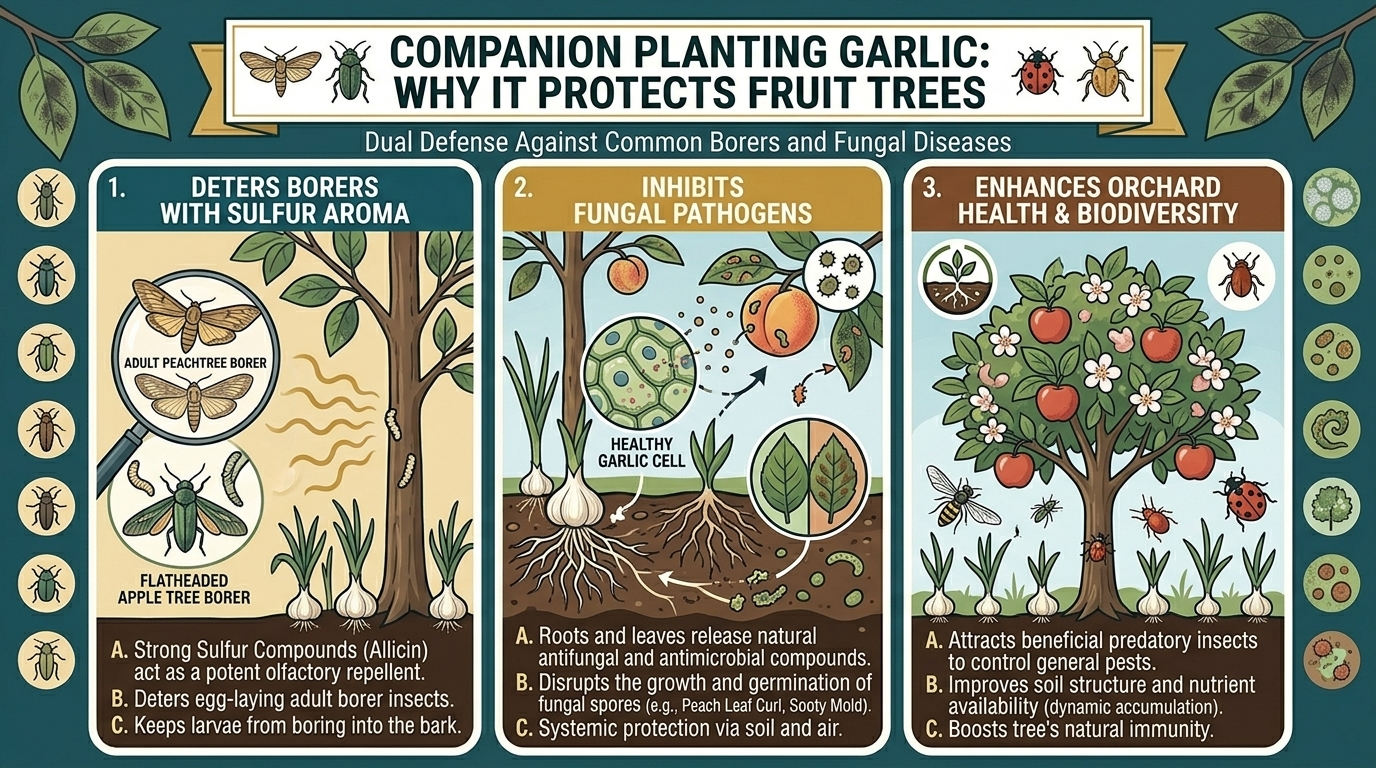
At the microscopic and chemical level, garlic is packed with organosulfur compounds—most notably allicin. Allicin is released when the plant’s cells are crushed, but even in its growing state, garlic continuously emits volatile sulfur-based aromas into the surrounding air and soil. These pungent chemical profiles mask the natural scents of host fruit trees, confusing incoming insect pests and preventing them from laying destructive eggs.
Guarding Against Common Borers
What Are Fruit Tree Borers?
Borers are among the most destructive pests facing fruit tree owners in regions like Texas, California, and New York. These include creatures like the peach tree borer (a clearwing moth whose larvae tunnel into the cambium layer), apple bark beetles, and shot-hole borers. Adult insects are attracted to the volatile compounds and minor stresses of trees, where they deposit eggs directly into bark crevices. Once hatched, the larvae bore straight into the sapwood, cutting off nutrient pathways, weakening structural integrity, and often killing the tree outright.
How Garlic Deters Borers
Because borers rely heavily on olfactory cues to locate vulnerable hosts, the overwhelming, pungent barrier of a garlic ring planted around a tree’s base acts as a natural smoke screen.
- Olfactory Disruption: The intense sulfur odor masks the tree’s natural scent, making it virtually invisible to egg-laying adult beetles and moths.
- Physical Deterrence Zone: Planting a dense circle of garlic cloves just beyond the root flare creates an active biological deterrent zone that pests prefer to avoid entirely.
Stopping Fungal Infections in Their Tracks
Fruit trees—particularly apples, pears, peaches, and stone fruits—are notoriously susceptible to fungal pathogens such as apple scab, powdery mildew, peach leaf curl, and black rot. High humidity, spring rains, and poor air circulation often compound these issues.
The Natural Bio-Fungicide Mechanism
Garlic acts as a systemic and localized antifungal agent:
- Root Exudates: Garlic roots naturally exude sulfur-based compounds into the immediate rhizosphere (soil zone).
- Systemic Absorption: Neighboring fruit tree roots absorb these organic sulfur compounds, which help bolster the tree’s internal resistance against fungal spores trying to colonize vascular tissue.
- Soil Microbiome Regulation: Garlic suppresses harmful soil-borne pathogens and nematodes, ensuring a healthier root system capable of fighting off stress-induced diseases.
Regional Benefits Across Diverse Climates
Different climates present unique challenges for fruit growers. Here is how garlic companion planting optimizes orchard health across major regions:
- Texas & California: Intense heat and drought stress make fruit trees exceptionally vulnerable to borer attacks. Garlic helps stabilize the microclimate right at the soil level while deterring soil-dwelling pests looking for dry, stressed wood.
- New York & Washington: Cool, wet springs frequently trigger fungal epidemics like apple scab and powdery mildew. Garlic’s natural antifungal properties help suppress these ambient spores before they overwhelm new buds and leaves.
- San Francisco: Coastal fog and microclimates create persistent dampness, which invites fungal molds. Integrating alliums helps keep the immediate root zone clear of competing detrimental fungi.
Step-by-Step Guide: How to Plant Garlic Around Fruit Trees
Implementing this strategy takes very little effort and yields massive long-term dividends for your orchard.
      [ Fruit Tree Trunk ]
        /      |      \
   (Garlic) (Garlic) (Garlic)   <- Plant 6 to 12 inches away from the trunk
        \      |      /
      [ Drip Line & Root Zone ]
- Timing: Plant your garlic cloves in the fall (September through November, depending on your hardiness zone). This allows the cloves to establish a strong root system over winter without sending up excessive top growth.
- Selection: Choose healthy, disease-free hardneck or softneck garlic bulbs. Separate them into individual cloves, keeping the protective papery skins intact.
- Placement: Clear a circle about 6 to 12 inches away from the fruit tree’s trunk (avoid crowding the bark directly to prevent moisture retention against the trunk).
- Depth & Spacing: Press cloves about 2 inches deep into the soil, spaced roughly 4 to 6 inches apart in a ring surrounding the tree. Point the sharp end upward.
- Maintenance: Mulch lightly with organic straw or leaves. In spring, green shoots will emerge. You can harvest the edible garlic scapes or leave the plants intact to mature through early summer.
Frequently Asked Questions (FAQ)
1. Will planting garlic stunt the growth of my fruit trees?
No. Unlike shallow-rooted crops such as beans or peas (which can be stunted by alliums), established fruit trees have deep, robust root systems that occupy a completely different soil stratum than garlic. They peacefully coexist without nutrient competition.
2. Can I use store-bought garlic cloves for companion planting?
Yes! Standard grocery store garlic bulbs work wonderfully for orchard companion planting, though you can also purchase certified disease-free seed garlic from local nurseries if preferred.
3. Does garlic replace the need for traditional fungicides entirely?
While garlic significantly reduces the incidence of fungal issues by boosting natural resistance and releasing bio-fungicides, it is part of an integrated pest management (IPM) strategy. Severe, long-standing infections may still require targeted organic treatments.
4. How close to the trunk should I plant the garlic?
Always maintain a small buffer zone of at least 6 inches between the garlic cloves and the tree bark. Planting too close can trap unwanted moisture directly against the trunk, potentially encouraging collar rot.
5. Do hardneck or softneck garlic varieties work better?
Both work exceptionally well. Hardneck varieties thrive in colder regions (like New York and Washington) and produce edible scapes, while softneck varieties excel in milder climates (like California and Texas).
6. Will the garlic flavor my fruit?
Not at all. While the tree absorbs trace sulfur compounds that aid in disease resistance, it does not alter the taste or flavor profile of apples, peaches, cherries, or pears.
7. When is the best time of year to harvest the garlic?
Garlic planted in the fall is typically ready to harvest in early-to-mid summer when the lower leaves begin to turn yellow and dry out. You can also choose to leave some bulbs in the ground to naturalize.
8. Does garlic help deter larger animals like deer or rabbits?
Yes! The potent sulfur scent acts as a mild deterrent for larger herbivores, keeping them from browsing on the tender lower bark and young shoots of developing fruit trees.
9. Can I grow garlic around newly planted saplings?
Absolutely. In fact, young fruit trees are the most vulnerable to borer attacks and shock. Establishing a protective ring of garlic around a sapling from day one provides crucial early-life defense.
10. Do I need to fertilize the garlic separately?
Fruit trees and garlic both appreciate rich, well-draining organic soil. Adding a layer of compost around the tree in early spring will feed both the fruit tree and the developing garlic bulbs simultaneously.
Conclusion
Companion planting garlic near your fruit trees is an elegant, highly effective, and entirely organic way to safeguard your harvest. By harnessing nature’s own chemistry—specifically allicin and volatile sulfur compounds—you create an invisible barrier that confuses wood-boring beetles and suppresses troublesome fungal spores. Whether you are managing an expansive backyard orchard or a compact urban garden layout, integrating garlic is a foolproof step toward a healthier, more resilient landscape.