For plant enthusiasts across the United States—from the freezing winter air of New York, the chilly dampness of Washington, the microclimates of San Francisco, to the sudden cold snaps in California and Texas—winter brings a dramatic shift in indoor environments. The moment you turn on your central heating, home furnaces, or radiators, indoor relative humidity plummets. While humans might just feel dry skin or static electricity, sensitive tropical plants experience a severe environmental shock.
Stunning tropical ferns (like Boston ferns, Maidenhair ferns, and Bird’s Nest ferns) and vibrant prayer plants (Calatheas and Marantas) originate from lush, high-humidity rainforest understories where moisture levels regularly hover between 60% and 80%. When indoor winter humidity drops to 20% or 30%, these humidity-loving divas suffer immediately. Crisping brown leaf tips, curling foliage, dropped leaves, and increased susceptibility to spider mites are classic distress signals.
This comprehensive, SEO-optimized guide explores the science of indoor humidity and provides actionable, proven strategies to protect your tropical ferns and Calatheas during the harshest dry winter months.
1. Understanding Humidity: What Tropical Plants Need vs. Indoor Reality
Before implementing solutions, it is essential to understand the invisible metric that dictates your tropical plants’ health: Relative Humidity (RH).
The Science of Relative Humidity
Relative humidity measures the amount of water vapor present in the air compared to the maximum amount the air can hold at that specific temperature.
- The Summer Standard: During warm months, open windows and natural weather patterns keep indoor humidity around 50% to 60%, which most tropicals tolerate well.
- The Winter Trap: Heated indoor air expands and holds vastly more moisture capacity, which effectively drives relative humidity down to desert-like levels (often 15% to 30%). For a delicate Calathea or Maidenhair fern, this is the equivalent of living in a blowdryer wind tunnel.
2. Measuring Your Indoor Microclimate: The Hygrometer
You cannot manage what you do not measure. The single most important first step in winter plant care is purchasing a digital hygrometer (humidity monitor).
- Placement: Place your hygrometer directly on or near the shelves where your Calatheas and ferns sit. Room-wide humidity gauges across the apartment can be misleading because microclimates vary wildly from room to room.
- Target Zones: For tropical ferns and Calatheas, aim to maintain a local relative humidity of 50% to 60% during winter.
3. Top Methods to Boost Humidity for Winter Houseplants
Implementing multiple strategies in tandem creates a synergistic moisture barrier that keeps tropical foliage lush and green all winter long.
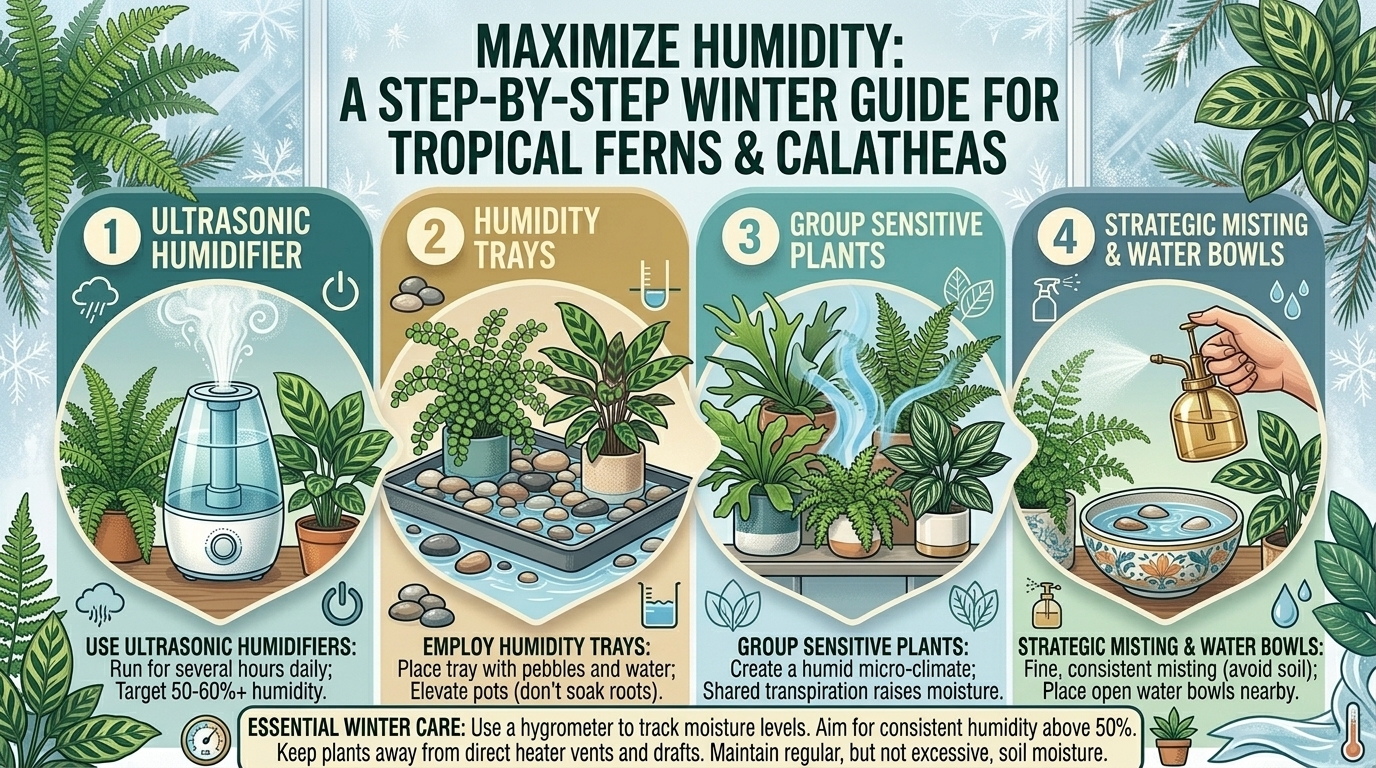
A. Invest in a Quality Ultrasonic Cool-Mist Humidifier
The gold standard for winter tropical plant care is a room humidifier. Unlike warm-mist vaporizers (which can accidentally heat up localized plant zones or pose burn risks), cool-mist ultrasonic humidifiers pump a fine, refreshing mist into the air.
- Strategic Placement: Position your humidifier within 3 to 6 feet of your plant collection. Avoid placing it so close that water droplets continually bead on the leaves, as prolonged water sitting on foliage can encourage fungal leaf spot.
- Water Quality Tip: Use distilled or filtered water in your humidifier to prevent white mineral dust (calcium and magnesium) from coating your furniture and plant leaves.
B. Create Custom Pebble Trays
Pebble trays are a classic, low-tech, and energy-free method for increasing localized humidity.
- How to Build One: Take a shallow tray or saucer, fill it with decorative stones, river rocks, or expanded clay pebbles, and pour water into the tray until it sits just below the top surface of the stones.
- The Physics at Play: Place your potted plant on top of the stones. As water evaporates from the tray, it creates a localized cloud of high humidity directly around the plant’s foliage.
- Crucial Rule: Ensure the bottom of the flower pot or inner nursery pot never sits directly in standing water, or moisture will wick back into the soil and cause root rot.
C. Group Plants Together (The Jungle Effect)
Plants naturally transpire, releasing water vapor through tiny pores in their leaves (stomata) in a process similar to human sweating.
- When you cluster your ferns, Calatheas, monsteras, and prayer plants tightly together, they create a collective microclimate. The moisture transpired by each individual plant raises the humidity for its neighbors, forming a self-sustaining humid oasis.
D. Bathroom and Kitchen Placement (If Light Permits)
Bathrooms and kitchens are naturally the most humid rooms in any home due to daily showers, cooking steam, and boiling water.
- If your bathroom features a bright, indirect window (or if you can supplement with a full-spectrum LED grow light), moving your delicate ferns and Calatheas into the bathroom for the winter months is an effortless way to keep them hydrated.
4. What NOT to Do: Debunking Common Humidity Myths
When desperate to save crisping plants, owners often turn to quick fixes that cause more harm than good.
1. Daily Leaf Misting
While misting leaves with a spray bottle feels satisfying, it is largely ineffective for raising humidity. Misting only raises humidity for a matter of seconds. Worse, leaving water droplets sitting on velvety Calathea leaves or dense fern fronds in a cool room invites fungal pathogens and bacterial leaf spot.
2. Placing Plants Near Heating Vents or Radiators
This is the number one killer of winter indoor tropicals. Blasting hot, dry air directly from a floor vent or a cast-iron radiator onto a Calathea will cause catastrophic leaf curling and crispy browning within 48 hours. Keep plants well away from all heat sources.
5. Regional Winter Challenges Across the U.S.
Different geographical climates introduce unique winter indoor heating profiles:
- New York & Washington (Freezing Winters & Heavy Radiator/Gas Heat): Historic brownstones and apartments relying on dry radiator heat create extremely arid indoor conditions. Humidifiers running continuously are essential.
- Texas & California (Mild to Chilly Winters with Intermittent Heating): While outdoor winters are mild, turning on indoor heating units during sudden cold snaps rapidly dries indoor air. Monitoring your hygrometer during these transitions prevents unexpected leaf drop.
- San Francisco (Cool, Damp Maritime Winters): San Francisco homes often experience high natural outdoor humidity, but indoor heating can still create dry patches. Balancing ventilation with targeted pebble trays or grouping helps maintain optimal balance without inviting mold.
6. 10 Frequently Asked Questions (FAQs)
1. Why are the tips of my Calathea turning brown and crispy in winter?
Crispy brown tips are the universal symptom of low relative humidity combined with tap water sensitivity (excess fluoride, chlorine, or salts). Boosting humidity with a humidifier and switching to distilled water solves this issue.
2. Can I use a regular room humidifier for my plants?
Yes! Any standard cool-mist ultrasonic humidifier designed for home use works brilliantly for tropical houseplants. You do not need expensive commercial greenhouse equipment.
3. Does misting daily actually help raise humidity?
No. Misting only provides a temporary surface moisture spike and evaporates within seconds. It does not meaningfully raise ambient relative humidity and can trigger fungal issues.
4. What is the ideal humidity percentage for ferns and Calatheas?
An ambient relative humidity level between 50% and 60% is the sweet spot. Anything below 40% will cause noticeable leaf stress in delicate tropical species.
5. Will high indoor humidity cause mold growth in my house?
Keeping a room at 50% to 60% relative humidity is generally safe for human living spaces and will not cause structural mold. However, ensure good air circulation with a low-speed ceiling fan or oscillating fan to keep air moving.
6. Can I group non-tropical plants with my Calatheas to boost humidity?
Yes! Any leafy houseplant (pothos, philodendrons, peace lilies) contributes to transpiration and helps build a collective humid microclimate when grouped together.
7. How close should my humidifier be to my plants?
Place the humidifier within 3 to 6 feet of your plants. Avoid aiming the nozzle directly at plant foliage to prevent water saturation and fungal spotting.
8. Why do ferns suffer more from dry winter air than other plants?
Ferns (especially Maidenhairs and Boston ferns) have extremely delicate, paper-thin fronds with high surface-area-to-volume ratios, meaning they lose moisture to dry air much faster than thick, succulent-leaved plants.
9. Should I reduce watering in winter for humidity-stressed plants?
Even though winter air is dry, heating systems slow down plant metabolism. Always check soil moisture before watering; while humidity drops, overwatering can still rot roots if the soil stays wet too long.
10. Can pebble trays really raise humidity enough to make a difference?
Yes, for small to medium-sized plant groupings, pebble trays can raise local relative humidity by 5% to 10% directly around the canopy, which is often just enough to prevent crispy leaf tips.
Conclusion
Surviving the dry winter months with your treasured tropical ferns and Calatheas requires shifting from passive observation to proactive environmental management. By investing in a digital hygrometer, deploying ultrasonic cool-mist humidifiers, utilizing pebble trays, and clustering your plants into lush botanical oases, you can conquer the winter dryness. Protect your indoor jungle from heating vents, maintain a steady 50% to 60% humidity target, and your ferns and Calatheas will reward you with vibrant, unblemished, emerald-green foliage all year long.