When scorching summer temperatures arrive—whether you are enduring the blistering, relentless heatwaves of Texas, navigating the dry, sun-baked microclimates of California, or facing peak summer dry spells in Washington state—keeping your home garden hydrated becomes a daily challenge.
During peak summer, moisture evaporates from your soil at an alarming rate. If your soil lacks adequate water-retention capacity, your plants will suffer from rapid drought stress, resulting in wilted foliage, dropped blossoms, stunted fruit, and scorched leaves.
While many commercial growers turn to synthetic polymer water-retaining gels, these artificial plastics break down slowly and introduce unwanted chemicals into your food-growing ecosystem. Fortunately, nature offers a superior, entirely chemical-free alternative.
By incorporating specific natural, organic soil amendments, you can dramatically boost your soil’s sponge-like capacity, protect delicate plant roots from heat shock, and keep your garden thriving through the hottest months of the year. This comprehensive, expert-backed guide breaks down the absolute best organic moisture-retention amendments, how they work, and how to apply them.
1. Why Do Soils Lose Moisture in the Summer? (The Science of Drought Stress)
To solve summer soil dryness, you must understand why water disappears. When ambient temperatures rise and wind blows across your garden beds or containers, moisture is pulled out of the soil via two primary mechanisms:
- Surface Evaporation: Direct sun heat bakes the top layer of soil, drawing moisture upward into the atmosphere.
- Percolation and Drainage: In sandy or loose soils, water flushes straight down past the root zone too quickly for plant roots to absorb it.
To counteract this, you need organic amendments that act as microscopic sponges, holding onto water molecules and releasing them slowly to plant roots only when needed.
2. The Best Natural Organic Moisture-Retaining Amendments
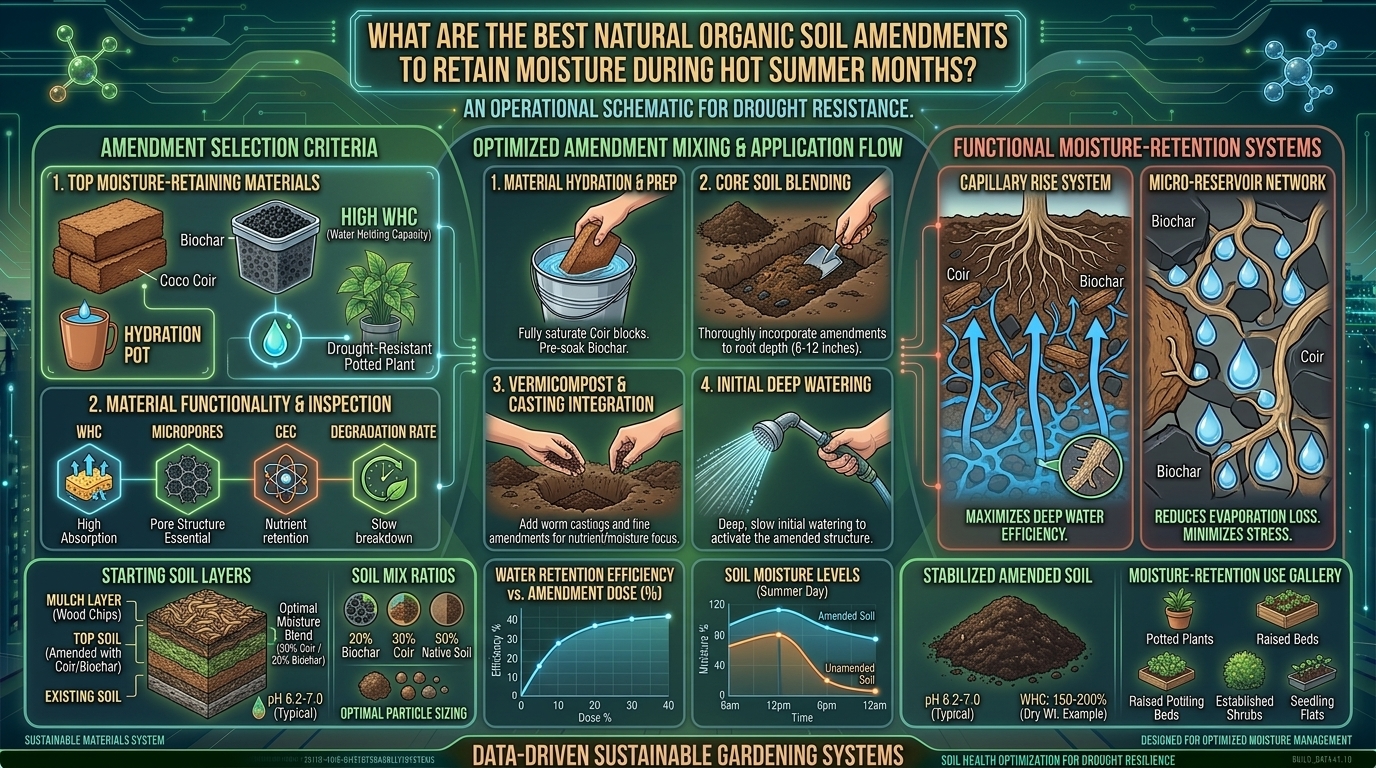
These powerhouse organic materials transform dry, sandy, or fast-draining soils into resilient moisture reservoirs.
A. Coco Coir (The Sustainable Moisture Sponge)
Derived from the fibrous husks of coconuts, coco coir is widely considered the gold standard for eco-friendly container and raised bed gardening.
- How it works: Coco coir can absorb up to 8 to 10 times its dry weight in water. Unlike synthetic sponges, it maintains structural air pockets even when fully saturated, ensuring roots don’t suffocate.
- How to apply: Mix 30% to 40% hydrated coco coir thoroughly into your potting soil or raised bed mix before planting, or work it into the top 6 inches of existing garden soil.
B. High-Grade Organic Compost and Humus
Beyond providing broad-spectrum nutrients, well-aged organic compost is a phenomenal water retainer.
- How it works: Compost is packed with humic substances that bind to water molecules and create a crumbly, aggregate soil structure. Soils rich in organic matter hold significantly more plant-available water than mineral-heavy dirt.
- How to apply: Top-dress your garden beds with a 2-inch layer of finished compost in late spring before the summer heat hits.
C. Sphagnum Peat Moss
A classic organic amendment harvested from ancient peat bogs, peat moss is famous for its exceptional ability to retain moisture.
- How it works: Peat moss holds up to 20 times its weight in water and naturally buffers soil pH by adding mild acidity.
- How to apply: Blend it into sandy, fast-draining garden beds (use sparingly to protect delicate bog ecosystems, or substitute with sustainable coco coir).
D. Biochar (The Ancient Carbon Reservoir)
Biochar is pure, highly porous charcoal produced by burning organic agricultural waste in an oxygen-depleted environment.
- How it works: Under a microscope, biochar resembles a honeycomb network of microscopic pores. It locks onto water and beneficial soil microbes, creating an underground oasis that prevents nutrients and water from leaching away.
- How to apply: Crucial Step: Always “charge” or inoculate raw biochar by soaking it in liquid organic fertilizer, worm tea, or compost for a week before mixing it into your soil (otherwise, raw biochar will temporarily absorb nutrients from your soil).
3. The Ultimate Summer Defense: Organic Surface Mulching
While soil amendments work inside the earth, organic surface mulching is your frontline shield against summer heat. Applying a thick layer of mulch prevents the sun from ever touching your soil directly.
- Shredded Straw or Hay: Excellent for vegetable beds. It reflects sunlight, keeps soil cool, and allows rainwater to pass through easily.
- Chopped Autumn Leaves or Leaf Mold: Breaks down slowly, suppresses weeds, and retains deep subsurface moisture.
- Untreated Wood Chips or Bark: Ideal for perennial beds, bushes, and around larger garden perimeters.
The Golden Rule of Mulching: Apply a 3-to-4-inch layer of organic mulch across your entire garden bed, but leave a small 1-inch breathing ring around the main stems of your plants to prevent stem rot.
4. Frequently Asked Questions (FAQ)
1. Can I use synthetic water-retaining polymer gels in an organic garden?
It is strongly recommended to avoid synthetic polyacrylamide water crystals in organic vegetable gardens. While they absorb water, they are plastic-based polymers that degrade very slowly and can introduce residual acrylic monomers into your soil and food crops. Stick to natural organic options like coco coir and biochar.
2. Does coco coir lower or raise soil pH?
Coco coir is wonderfully pH-neutral (usually hovering around 5.8 to 6.8), meaning it will not drastically alter your soil chemistry unlike acidic peat moss.
3. How often should I water raised beds amended with coco coir during peak summer?
Even with moisture-retaining amendments like coco coir, extreme summer heat (especially in Texas or California) will dry out beds. However, your watering frequency will be reduced by roughly 30% to 50% compared to unamended sandy soil. Always check soil moisture with your finger before watering.
4. Can adding too much organic matter cause root rot in summer?
If your soil holds too much water and lacks proper aeration, it can become waterlogged and suffocate roots. Always balance moisture-retaining amendments (like coco coir or compost) with structural aeration materials like perlite, pumice, or coarse sand.
5. What is the difference between peat moss and coco coir for moisture retention?
Both retain water brilliantly, but coco coir is a renewable, sustainable byproduct of the coconut industry with a neutral pH, whereas peat moss is harvested from slow-growing non-renewable peat bogs and is naturally acidic.
6. How does biochar help plants survive sudden heatwaves?
Biochar acts like an underground sponge and thermal buffer. During a heatwave, the water stored within the microscopic pores of the biochar evaporates slowly, keeping the immediate root zone cooler and hydrated longer.
7. Should I mix mulch into my soil, or leave it on top?
Mulch belongs on top of the soil as a protective blanket. If you mix raw, high-carbon wood chips directly into your soil, soil microbes will consume massive amounts of nitrogen to break down the wood, temporarily starving your plants of nitrogen.
8. Can I use shredded cardboard as a summer moisture barrier?
Yes! Unprinted brown cardboard boxes can be shredded or laid flat under a layer of straw or wood chips as sheet mulch. It suppresses weeds and retains soil moisture effectively while breaking down over the season.
9. Why does dry summer soil sometimes repel water when I try to water it?
When organic soil or peat-based mixes dry out completely, they can become hydrophobic—meaning they repel water, causing it to bead up and run off the sides. Combat this by using a gentle, slow soaking method (or bottom-watering containers) to gradually rehydrate the soil matrix.
10. What are the best summer crops that benefit from moisture-retaining soil?
Leafy greens, shallow-rooted cool-season crops, and heavy-drinking fruiting plants like tomatoes, peppers, and cucumbers benefit immensely from moisture-retaining amendments during intense summer heat.
Conclusion
Surviving blistering summer heatwaves without watching your home garden dry out comes down to proactive soil preparation. By integrating natural, organic moisture-retaining amendments like sustainable coco coir, nutrient-dense compost, charged biochar, and finishing with a protective blanket of organic surface mulch, you can create a resilient, self-regulating soil ecosystem that effortlessly withstands the hottest months of the year.