You check your watering schedule, inspect the soil, and ensure there are no pests in sight. Yet, your plant looks pale, weak, and lifeless. 90% of the time, the hidden culprit behind houseplant decline isn’t overwatering or underwatering—it is insufficient ambient light.
Light is the literal food of plants. Through photosynthesis, indoor tropicals convert light energy into the glucose they need to sustain cellular health, produce new leaves, and maintain vibrant colors. When ambient light levels drop below what a specific species requires, the plant begins to starve quietly.
This comprehensive guide explores the top warning signs of light starvation, how to diagnose lighting issues across different US regional microclimates, and how to fix them before your green friends fade away.
1. The Science of Indoor Light vs. Outdoor Nature
Before diving into symptoms, it helps to understand why indoor light is so deceptive to human eyes.
- The Human Eye Trap: Human eyes naturally adjust to indoor lighting. A living room corner that looks “bright” to us may actually offer less than 50 foot-candles of light—which is pitch black darkness to a sun-loving tropical plant that evolved under an open jungle canopy.
- The Inverse Square Law: Light intensity drops off dramatically the further you move away from a window. A plant sitting right on a south-facing windowsill receives exponential more light than the exact same plant sitting on a bookshelf just 6 feet away.
2. Regional Challenges: Light Availability Across the US
Where you live heavily impacts how much natural ambient light enters your home, especially during seasonal shifts.
New York & Washington (Short Winters & Overcast Skies)
- The Challenge: Winters in the Northeast and Pacific Northwest bring short daylight hours, heavy cloud cover, and weak winter sun angles. Rooms that feel moderately bright in July can become dim caves by December.
- The Solution: Rotate plants closer to glass during winter, wash your windows to maximize light transmission, and supplement with full-spectrum LED grow lights.
San Francisco & California (Coastal Fog & Marine Layers)
- The Challenge: Coastal California and San Francisco frequently deal with morning marine layers and persistent fog that filter out direct sunlight, casting diffused grey light across rooms.
- The Solution: Prioritize East-facing or West-facing windows to catch whatever direct sun breaks through, and choose low-light tolerant plants (like snake plants or pothos) for darker rooms.
Texas (Intense Sun vs. Deep Shade)
- The Challenge: While Texas boasts intense sunshine, modern energy-efficient windows with heavy UV coatings or tinted glass can block significant amounts of usable light, while harsh outdoor heat forces homeowners to keep blinds drawn.
- The Solution: Balance window shading carefully so your plants get bright, indirect ambient light without suffering from afternoon window scorching.
3. Top Signs Your Houseplant Needs More Light
If your plant is starving for photons, it will display distinct biological warning signs. Here are the top indicators to look for:
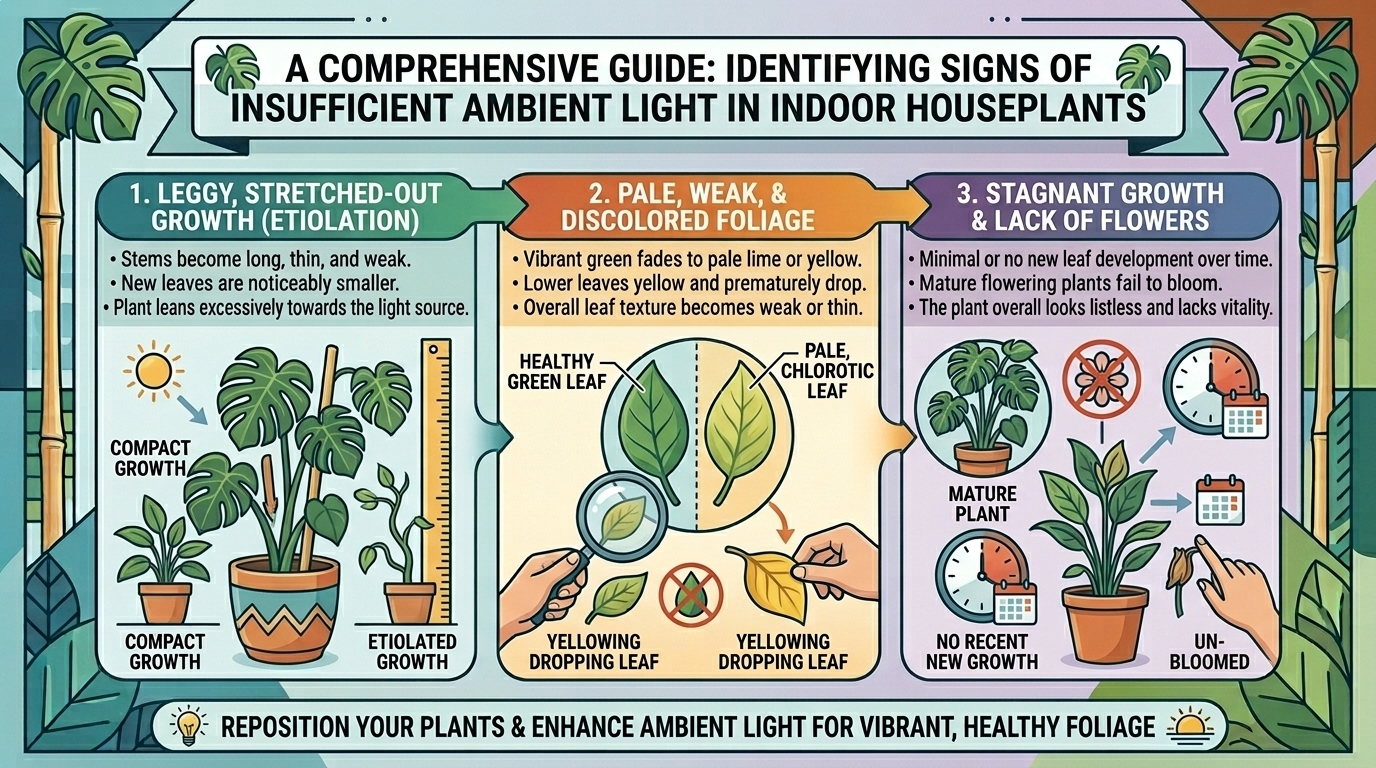
1. Severe Etiolation (Leggy, Stretched Growth)
This is the most classic symptom of low light.
- What it looks like: The stems of your plant stretch out abnormally long, thin, and pale, with unusually large gaps (internodes) between the leaves.
- Why it happens: The plant is desperately trying to reach closer to a light source, sacrificing structural integrity and compact fullness for vertical distance.
2. Loss of Variegation (Reverting to Solid Green)
- What it looks like: Your gorgeous variegated plants—such as Monstera albo, Philodendron birkin, or Syngonium—start pushing out new leaves that are entirely solid green, losing their white, yellow, or pink splashes.
- Why it happens: Variegated patches lack chlorophyll. When light is scarce, the plant desperately needs maximum chlorophyll to survive, so it switches off variegation production to maximize green surface area.
3. Extremely Slow or Stalled Growth
- What it looks like: Spring and summer arrive, but your plant refuses to push out any new leaves, remaining in a permanent state of suspended animation.
- Why it happens: Without adequate light energy, the plant lacks the biological fuel required to trigger cell division and new foliage production.
4. Small, Undersized New Leaves (Microphylla)
- What it looks like: While older leaves are large and robust, newly emerging leaves are tiny, stunted, and weak.
- Why it happens: The plant is conserving energy, building miniature leaves because it lacks the photosynthetic capacity to support full-sized foliage.
5. Excessive Leaf Drop (Especially Lower Foliage)
- What it looks like: Lower leaves turn yellow, droop, and drop off rapidly, leaving a bare, long stem (often called a “palmtree” look).
- Why it happens: The plant is sacrificing its older, shaded lower leaves to preserve energy for the tiny fraction of light hitting the topmost leaves.
6. PALE, Dull, or Washed-Out Foliage
- What it looks like: Vibrant green leaves fade into a sickly, lime-green, or dull matte color.
- Why it happens: Chlorophyll density drops when light levels are too low, stripping the plant of its rich, healthy pigmentation.
7. Chronically Wet Soil (Root Rot Risk)
- What it looks like: Soil that normally dries out in a week stays damp for three weeks, leading to fungus gnats and root rot.
- Why it happens: Low light means the plant’s metabolic rate drops. It drinks very little water because it isn’t actively photosynthesizing, leaving soil waterlogged and stagnant.
4. How to Fix Indoor Lighting Deficiencies
If you spot these signs, don’t panic! Correcting light starvation is straightforward:
- Relocate Closer to Windows: Move plants incrementally closer to unobstructed windows (East or West windows are generally safest for most tropicals).
- Clean Your Windows: Dust and grime on window panes can block up to 10% to 20% of natural light. A quick window washing works wonders.
- Invest in LED Grow Lights: If your home lacks bright natural windows (especially in urban high-rises in New York or San Francisco), affordable full-spectrum LED bulbs provide an instant, energy-efficient lifeline for low-light spaces.
5. Frequently Asked Questions (FAQ)
1. Can a plant get too much light if I move it closer to a window?
Yes, if you move a shade-loving plant (like a Calathea or Fern) straight into a blistering South-facing window, it will suffer from sunburn (as covered in our previous guides at kcplants.com). Always transition plants gradually or use sheer curtains.
2. How do I know the exact light level in my room?
You can download a free lux or foot-candle meter app on your smartphone. While not laboratory-grade, it gives you a fantastic baseline measurement of how much ambient light is reaching your specific plant shelf.
3. Do low-light plants like Snake Plants need any window light?
No indoor plant can survive in pitch-black darkness. While snake plants and ZZ plants tolerate low ambient light better than most, they still stall out and decline if kept in a windowless room with zero natural or artificial light.
4. Why did my variegated Monstera turn completely green after moving it?
Variegation requires high-intensity light to maintain its color patterns. If you moved your plant into a shadier corner, it responded by producing more chlorophyll, causing the white or yellow variegation to fade into green.
5. Can office fluorescent lights keep houseplants alive?
Standard overhead office fluorescent lights can sustain very hardy low-light plants (like Pothos or Cast Iron Plants), but they do not provide the broad-spectrum intensity required for sun-loving tropicals to thrive.
6. How long does it take for a light-starved plant to recover after being moved?
Once moved to a brighter location (or placed under a grow light), a recovering plant typically takes 4 to 8 weeks to adapt, resume normal watering consumption, and push out healthy new growth.
7. Why are my plant’s new leaves turning yellow instead of green?
Yellow new leaves can indicate a few things, but in low-light conditions, it often means the plant’s chloroplasts are failing to develop properly due to an extreme energy deficit.
8. Is window direction important for indoor plants?
Extremely! North-facing windows offer cool, gentle, indirect light. East windows offer soft morning sun. West windows provide strong afternoon light. South windows deliver maximum, all-day intense sunlight. Match your plant’s natural habitat to the correct window direction.
9. Should I fertilize a plant that is suffering from low light?
Never fertilize a light-starved plant. Fertilizer stimulates growth. Without enough light to fuel photosynthesis, forcing growth with nutrients will shock the root system and kill the plant. Fix the light issue first!
10. Can I use a regular household desk lamp as a grow light?
Yes, provided you screw in a high-output, full-spectrum LED bulb (look for 5000K–6500K color temperature). Standard incandescent bulbs produce too much heat and the wrong light spectrum, but modern full-spectrum LEDs work wonderfully.
Conclusion
Recognizing the early signs of light starvation is the single most important skill for keeping your indoor jungle thriving. Whether you are battling short winter days in New York, navigating coastal fog in San Francisco, or maximizing indoor space in Texas, paying attention to leggy stems, fading colors, and stalled growth ensures your plants stay vibrant and healthy.