What Are the Best Indoor Plants That Require Almost Zero Pruning and Low Maintenance Care
Welcome back to kcplants.com! If you are a busy professional, a frequent traveler, or simply someone who loves the vibrant aesthetic of indoor greenery but lacks the time—or the desire—to spend hours shaping, trimming, and fussing over high-maintenance botanical specimens across Texas, New York, California, Washington, or San Francisco, you are in the right place.
There is a common misconception that keeping an indoor jungle requires a pair of pruning shears constantly in hand. Many popular houseplants grow aggressively, shooting out unruly vines, sprawling stems, or heavy top-heavy canopies that demand frequent architectural haircuts to keep them looking neat.
Fortunately, the botanical world also offers remarkable, slow-growing, self-contained powerhouses that require almost zero pruning and minimal maintenance. These resilient species maintain their pristine structural shape naturally for years on end while tolerating erratic watering and dim indoor lighting.
This comprehensive, highly informative guide explores the best low-maintenance, zero-pruning indoor plants, how they survive neglect, and expert care tips tailored for diverse US climates.
1. The Anatomy of Low-Maintenance, Zero-Pruning Plants
To understand why certain plants never need pruning while others require constant maintenance, we must look at their growth habits.
Determinate vs. Indeterminate Growth
- Indeterminate Growers (High Maintenance): Plants like Pothos, Heartleaf Philodendrons, and English Ivy are vining species designed by nature to climb or cascade indefinitely. Their growing tips never stop advancing, meaning they quickly become leggy, sparse at the crown, and require regular pruning to maintain a bushy shape.
- Determinate / Slow-Structural Growers (Zero Maintenance): Plants like the ZZ Plant, Snake Plant, and Cast Iron Plant grow slowly from a centralized basal rosette or underground rhizome. They do not send out sprawling, out-of-control vines. Once they reach their mature indoor height, they maintain their neat, sculptural silhouette naturally with zero pruning required.
2. Top 6 Zero-Pruning, Low-Maintenance Indoor Plants
Here are the absolute best houseplants for busy plant parents that stay perfectly shaped without ever picking up a pair of shears:
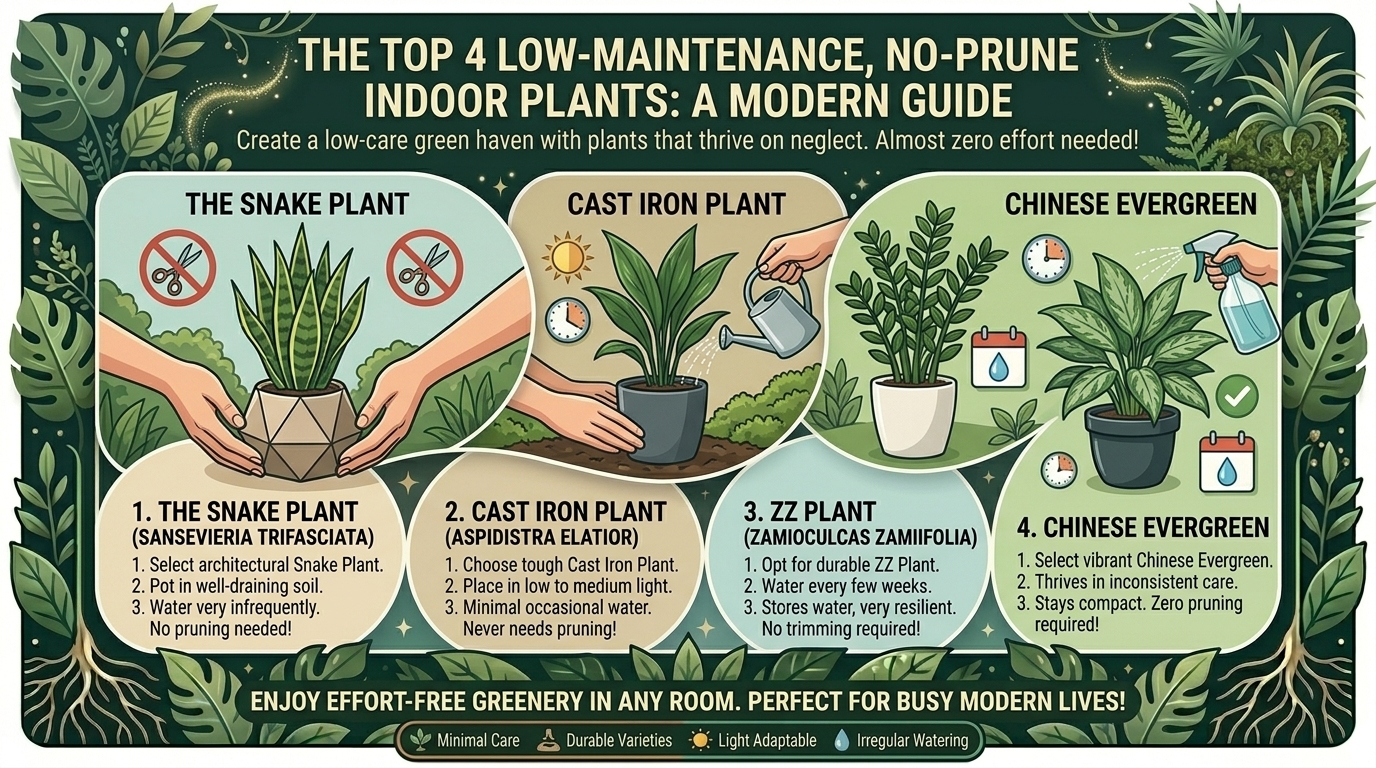
1. The ZZ Plant (Zamioculcas zamiifolia)
- Why it needs zero pruning: The ZZ plant features thick, waxy, emerald-green leaflets arranged symmetrically along sturdy, upright stems that emerge directly from underground potato-like rhizomes. It grows at a leisurely pace and never gets leggy or unruly.
- Maintenance Level: Indestructible. Its subterranean rhizomes store water, meaning it survives months of missed waterings and thrives in low-light office corners or dim rooms.
2. The Snake Plant (Sansevieria / Dracaena trifasciata)
- Why it needs zero pruning: With its rigid, architectural, sword-like leaves shooting straight up from the soil, the snake plant retains a striking, modern silhouette year-round. It never branches out or sprawls.
- Maintenance Level: Legendary. It tolerates pitch-black rooms, erratic watering, and dry indoor air without breaking a sweat.
3. The Cast Iron Plant (Aspidistra elatior)
- Why it needs zero pruning: True to its name, this Victorian parlor favorite is virtually indestructible. It produces broad, dark green, lance-shaped leaves that emerge slowly from the base. It maintains a clean, upright, clumping habit without ever needing trims.
- Maintenance Level: Thrives in deep shade and forgives inconsistent watering schedules effortlessly.
4. The Ponpon Palm / Ponytail Palm (Beaucarnea recurvata)
- Why it needs zero pruning: Despite its common name, the ponytail palm is actually a succulent tree related to agaves. It stores water in a swollen bulbous trunk (caudex) at the base and tops out with a cascading fountain of long, curly, ribbon-like leaves. It grows at a glacial pace, requiring zero trimming.
- Maintenance Level: Loves bright, sunny windows (perfect for California or Texas homes) and demands very infrequent watering.
5. Parlor Palm (Chamaedorea elegans)
- Why it needs zero pruning: If you crave feathery tropical fronds without the high maintenance of a delicate Majesty Palm, the slow-growing Parlor Palm forms a compact, elegant, multi-stemmed clump that stays small and well-behaved indoors for years.
- Maintenance Level: Adapts wonderfully to low-to-medium indoor light and simple watering routines.
6. The Chinese Evergreen (Aglaonema)
- Why it needs zero pruning: Boasting stunning foliage splashed in silver, red, or pink, the Chinese Evergreen grows upright in a compact, bushy cluster. It rarely outgrows its pot and maintains its full, lush shape naturally.
- Maintenance Level: Tolerates low office light and dry indoor air exceptionally well.
3. Regional Indoor Factors Across the US
Your local regional climate and indoor heating/cooling cycles influence how these low-maintenance plants behave:
New York & Washington (Winter Radiators & Low Light)
- The Challenge: Bitter winter weather means dark indoor days and heavy radiator heat that dries out air rapidly.
- The Solution: ZZ plants and Snake Plants handle the dim light and dry winter air of northern apartments with absolute grace, entering a natural semi-dormancy without dropping leaves.
San Francisco & California (Bright Sunlight & Modern Windows)
- The Challenge: Expansive windows and bright coastal sun can scorch delicate shade plants, but slow-growing succulents love it.
- The Solution: Place a Ponytail Palm near a sunny California window, where its swollen trunk stores solar energy and withstands bright, intense light.
Texas (Continuous Summer Air Conditioning)
- The Challenge: Texas homes rely on continuous AC cooling during long summers, which can stress moisture-sensitive tropicals.
- The Solution: Cast Iron Plants and Aglaonemas tolerate fluctuating indoor HVAC drafts and dry spells much better than delicate ferns or thin-leaved vines.
4. Golden Rules for Keeping “Zero-Maintenance” Plants Alive
While these plants require zero pruning and minimal care, they still have one single rule that cannot be broken: Avoid Overwatering.
- The #1 Killer is Too Much Water: Because plants like ZZ Plants and Snake Plants store water in their rhizomes, roots, or succulent leaves, giving them water too frequently leads directly to root rot. Always let the soil dry out 100% between waterings.
- Dust the Leaves Occasionally: Since zero-pruning plants have broad, static leaves (like Cast Iron Plants and Snake Plants), household dust settles on them over time. Wipe them down with a damp cloth once a month so they can breathe and absorb light efficiently.
- Choose the Right Pot: Always plant low-maintenance species in pots with active drainage holes, or pair an inner nursery pot with a decorative ceramic cachepot (following the drainage principles covered in our previous guides at kcplants.com).
5. Frequently Asked Questions (FAQ)
1. Do zero-maintenance plants ever need to be repotted?
Yes, but very infrequently! Because plants like ZZ plants and Snake Plants grow slowly, they only need to be repotted every 3 to 4 years when their roots physically begin to bulge or crack their plastic nursery pots.
2. Can I prune a Snake Plant if it gets too tall?
Snake plants grow from subterranean rhizomes. If you cut the top off a tall snake plant leaf, that specific leaf will stop growing vertically and callous over, but it won’t branch out like a tree. It is best to let them grow naturally in their architectural form.
3. What is the absolute best plant for someone who travels constantly?
The ZZ Plant and the Snake Plant are the ultimate travelers’ plants. They can easily survive 4 to 6 weeks without a single drop of water while you are away on vacation or business trips.
4. Why are the lower leaves of my ZZ plant turning yellow?
Yellowing lower leaves on a ZZ plant are almost always a sign of overwatering and root rot. Cut back on your watering schedule immediately and ensure the soil dries out completely.
5. Do low-maintenance plants need fertilizer?
They require very little! Feeding them with a diluted liquid houseplant fertilizer just once or twice a year (during spring and summer) is more than enough to keep them healthy and green.
6. Can low-maintenance plants survive in windowless rooms?
While no plant can survive in 100% pitch-black darkness forever, Snake Plants and ZZ Plants can thrive entirely under standard office fluorescent or residential LED room lighting without any direct window sunlight.
7. Are low-maintenance plants safe for pets if ingested?
It varies! Cast Iron Plants and Parlor Palms are 100% non-toxic and pet-safe. However, Snake Plants and ZZ Plants contain calcium oxalate crystals and are toxic to cats and dogs if chewed or ingested, so keep them out of reach of curious pets.
8. Why is my Ponytail Palm trunk feeling soft and mushy?
A soft, squishy trunk on a Ponytail Palm indicates severe overwatering and rotting of the internal water storage tissue. Allow the soil to dry out completely, and check for root damage.
9. Do low-maintenance plants attract pests?
Because their leaves are tough, waxy, and thick, pests like spider mites and thrips find it much harder to pierce and feed on ZZ plants and Snake Plants compared to soft, delicate tropicals. However, occasional inspections are still recommended.
10. How do I clean dust off rigid plants like Snake Plants?
Wipe down the long, upright leaves of a Snake Plant using a soft, damp microfiber cloth or sponge. It takes less than a minute and instantly restores their glossy, vibrant appearance.
Conclusion
Finding the best indoor plants that require almost zero pruning and low maintenance care allows you to enjoy a stunning, stress-free indoor jungle no matter how busy your lifestyle is. By choosing resilient, slow-growing architectural powerhouses like ZZ Plants, Snake Plants, Cast Iron Plants, and Ponytail Palms, you get maximum botanical beauty with minimal effort.