How to Start a Miniature Indoor Fairy Garden Inside a Wide Shallow Decorative Ceramic Bowl
Welcome back to kcplants.com! If you are a creative plant enthusiast looking to bring a touch of whimsical magic and living architecture into your home across Texas, New York, California, Washington, or San Francisco, there is no project more charming than crafting a miniature indoor fairy garden.
While traditional gardening requires sprawling outdoor yards, creating an enchanted miniature landscape inside a wide, shallow decorative ceramic bowl allows you to curate an entire micro-ecosystem right on your coffee table, bookshelf, or sunlit entryway console.
Designing a successful fairy garden is more than just sticking tiny figurines into a pot. It is an exercise in botanical scale, specialized soil engineering, and creative interior styling. Because shallow ceramic bowls present unique watering and root-depth challenges, getting the horticultural fundamentals right is crucial for long-term success.
This comprehensive, highly informative guide explores how to select the right container, choose miniature plants that stay in scale, build durable drainage layers, and style your fairy garden like a professional across every US climate zone.
1. The Anatomy of a Shallow Bowl Fairy Garden
Before purchasing plants and accessories, you must understand the unique physical environment of a wide, shallow ceramic bowl.
The Shallow Depth Challenge
Shallow bowls—typically measuring only 3 to 5 inches in depth—offer limited vertical root space compared to standard flower pots.
- Root Restrictions: You cannot plant deep-rooting species or aggressive growers here. Every plant selected must possess a compact, slow-growing root system that thrives in constrained horizontal soil layers.
- Rapid Evaporation: Because shallow bowls expose a wide surface area of soil to the ambient air, moisture evaporates much faster than in deep containers, requiring attentive watering routines tailored to your local climate.
2. Choosing Your Foundation: Containers & Soils
The success of your miniature ecosystem begins with the vessel and the earth inside it.
Selecting the Ideal Bowl
- Material: Glazed ceramic or terracotta bowls work best. Glazed ceramic retains soil moisture longer (ideal for dry indoor AC environments in Texas), while un-drilled decorative bowls require a careful layering approach to prevent water logging.
- Dimensions: Look for a bowl at least 12 to 16 inches in diameter and 4 to 6 inches deep. This provides enough surface area to create distinct topographical zones (hills, pathways, and patios) without feeling overcrowded.
The Custom Potting Soil Mix
Standard heavy garden soil will compact into concrete in a shallow bowl, suffocating miniature roots. Mix your own custom blend:
- 50% High-Grade Organic Potting Mix: For nutrient retention.
- 30% Perlite or Pumice: To ensure maximum aeration and prevent soil compaction.
- 20% Coco Coir or Peat Moss: To retain light, even moisture across the shallow basin.
3. Top Miniature Plants for Indoor Fairy Gardens
Selecting plants that stay small and look like miniature trees or ground cover is the secret to a realistic fairy garden.
1. Baby’s Tears (Soleirolia soleirolii)
- Why it shines: Forms a dense, lush, emerald-green carpet that looks precisely like a miniature lawn rolling across your fairy landscape.
2. Miniature Ferns (e.g., Lemon Button Fern or Button Fern)
- Why it shines: Acts as a miniature weeping willow or towering forest tree, providing gorgeous vertical texture against tiny pathways.
3. Fittonia albivenis (Nerve Plant / Mosaic Plant)
- Why it shines: Features striking veins in electric pink, white, or red, adding vibrant splashes of color that mimic tropical flowering shrubs.
4. Miniature Succulents (e.g., Sedum dasyphyllum or Echeveria rosettes)
- Why it shines: Perfect for bright, sunlit bowls in California or Texas, creating tiny desert-themed succulent gardens.
5. Dwarf Cryptanthus (Earth Stars)
- Why it shines: Low-growing, star-shaped tropical bromeliads featuring dazzling metallic pinks and silvers that add exotic focal points.
4. Regional Indoor Factors Across the US
Your local climate dictates how your indoor miniature garden reacts to household heating and cooling:
New York & Washington (Winter Radiators & Dry Air)
- The Challenge: Winter heating dries out shallow soil bowls within 48 hours, causing mosses and baby’s tears to crisp up.
- The Solution: Mist your fairy garden daily with a fine spray bottle or place a small room humidifier nearby to maintain a moist microclimate.
San Francisco & California (Coastal Light & Airflow)
- The Challenge: Bright natural light streaming through large windows can scorch delicate miniature ground covers if not properly filtered.
- The Solution: Position your ceramic bowl near bright, indirect eastern or northern window light, and use succulent varieties if placing in strong southern window sills.
Texas (Continuous Air Conditioning)
- The Challenge: Indoor AC airflow strips moisture from shallow bowls rapidly, creating dry crusts on the soil surface while lower roots remain damp.
- The Solution: Use fine gravel or decorative moss top-dressings to cap the soil surface and slow down surface evaporation.
5. Step-by-Step Guide: Building Your Fairy Garden
Follow this step-by-step masterclass to construct your miniature landscape.
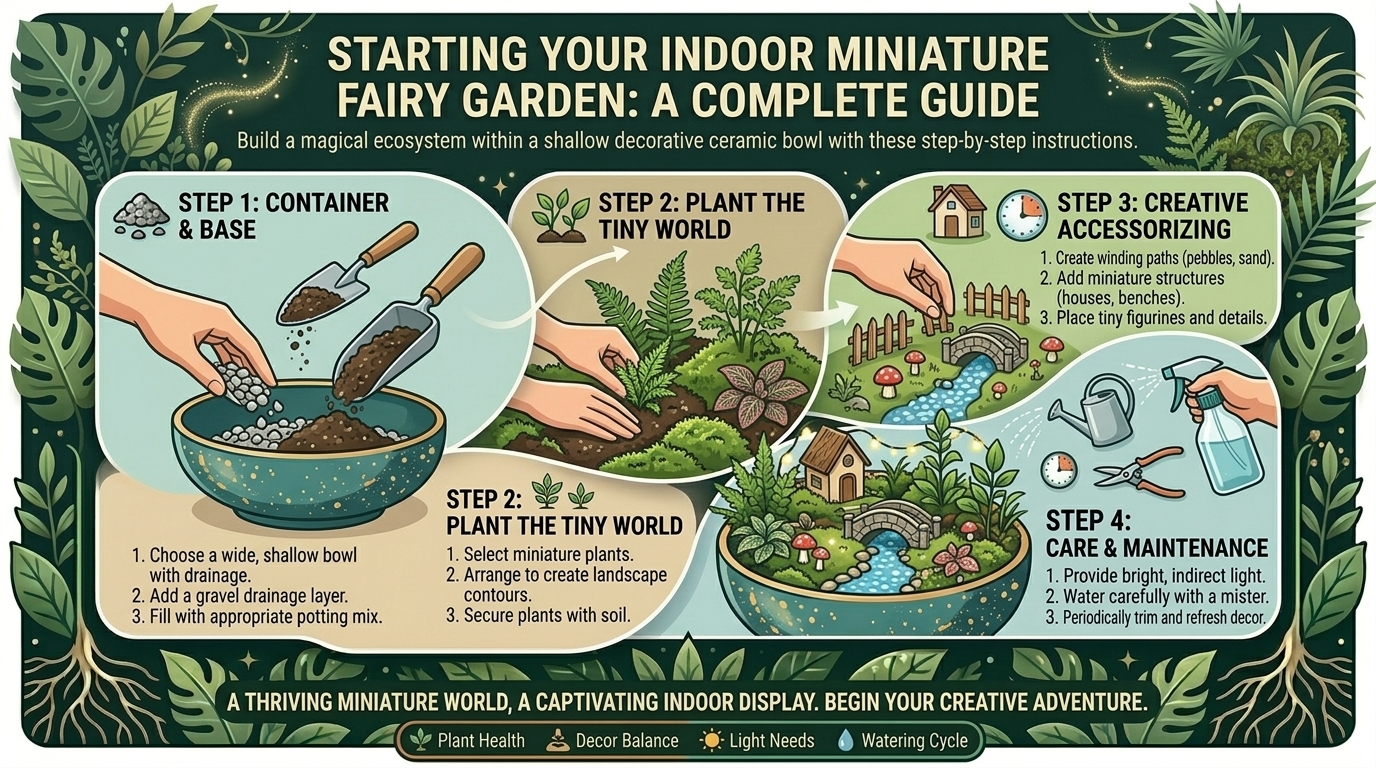
Step 1: Drainage and Foundation Layer
If your decorative ceramic bowl lacks a drainage hole (as many wide decorative bowls do):
- Pour a 1-inch base layer of expanded clay pebbles or horticultural gravel at the bottom of the bowl to act as a hidden reservoir buffer (utilizing principles from our previous guides at kcplants.com).
- Lay a piece of porous landscaping mesh or coffee filter over the pebbles to keep your potting soil from washing down into the rocks.
Step 2: Sculpting Topography
- Fill the bowl with your custom potting soil mix, leaving about an inch of space below the rim.
- Sculpt the soil to create natural rolling hills, slopes, valleys, and flat zones. This creates visual depth, making a small bowl look like an expansive landscape.
Step 3: Installing Hardscaping (Paths and Patios)
Before planting, lay out your hardscaping elements:
- Use flat river stones, crushed slate, or fine sand to carve out winding garden pathways, tiny patios, or dry riverbeds.
- Position miniature architectural elements like tiny wooden benches, stone bridges, fairy doors, or rustic fences.
Step 4: Planting Your Botanical Canopy
- Carefully remove your miniature plants from their nursery pots, gently teasing apart bound root balls.
- Plant your “trees” (ferns or upright shrubs) first to establish height anchors, then fill in open lawns with ground covers like Baby’s Tears or Fittonia.
- Firm the soil gently around each root system.
Step 5: Final Detailing and Top-Dressing
- Cover any exposed bare soil with preserved green moss, fine decorative gravel, or tiny wood chips to lock in moisture and create a polished, professional finish.
- Water the entire arrangement gently using a squeeze bottle or a fine mister to settle the soil around the roots.
6. Frequently Asked Questions (FAQ)
1. What should I do if my ceramic bowl does not have a drainage hole?
If your bowl lacks a drainage hole, use an expanded clay pebble reservoir at the base, and practice extreme caution when watering. Water sparingly using a narrow squeeze bottle so excess moisture never pools dangerously at the roots.
2. How often do indoor fairy gardens need to be watered?
Because shallow bowls dry out much faster than deep pots, check your fairy garden every 3 to 5 days. Feel the soil beneath the moss layer; if it feels dry, water gently.
3. Will miniature fairy garden plants outgrow the bowl?
Yes! Over several months, plants like Baby’s Tears and Fittonia will grow and spread. Regular pruning and trimming with sharp scissors will keep them miniature, neat, and in scale with your accessories.
4. Can I keep a fairy garden outdoors on a patio?
Absolutely! If you live in a mild climate like California or San Francisco, you can place your shallow bowl on a shaded outdoor patio during summer, bringing it indoors when winter temperatures drop.
5. Where can I find miniature fairy garden accessories?
Miniature accessories (tiny furniture, houses, animals, and cobblestones) are widely available at local craft stores, garden centers, and online specialty shops. You can also craft your own using twigs, polymer clay, and smooth river stones!
6. What lighting is best for an indoor miniature garden?
Most fairy garden plants (ferns, mosses, Fittonia) prefer bright, indirect ambient light. Avoid placing your bowl in harsh, direct southern window sunlight unless you are using drought-tolerant succulents.
7. Can I mix tropical plants and desert succulents in the same bowl?
No. Tropical plants require consistent moisture and high humidity, whereas succulents rot if kept damp. Always group plants with identical water requirements together in your bowl.
8. How do I prevent mold from growing on decorative moss?
Mold occurs when the indoor environment lacks air circulation and soil stays waterlogged. Ensure your room has good airflow, let the topsoil dry out slightly between waterings, and remove decaying lower leaves promptly.
9. What is the best way to water a delicate fairy garden without flattening the plants?
Use a narrow-spout watering can, a laboratory wash bottle, or a turkey baster to direct water precisely onto the soil base around the plants without flattening delicate ground covers or washing away gravel paths.
10. Can kids help build and maintain an indoor fairy garden?
Yes! Building a miniature fairy garden is an exceptionally rewarding, hands-on craft project for children, teaching them basic botany, plant care responsibility, and creative storytelling.
Conclusion
Starting a miniature indoor fairy garden inside a wide, shallow decorative ceramic bowl is a delightful way to combine botanical artistry with imaginative home decor. By engineering proper drainage, selecting slow-growing miniature plants suited to your regional indoor climate, and styling your landscape with charming hardscape details, you can create a living masterpiece that brings joy all year round.