What Are the Best Cool-Season Root Vegetables to Plant in Your Home Garden During Early Spring?
When winter frost begins to loosen its grip and the days slowly grow longer, an eager anticipation stirs within every gardener. While summer crops like tomatoes and peppers demand warmth and patience, early spring belongs entirely to a hardy, resilient group of crops: cool-season root vegetables.
Whether you are shaking off a chilly winter in New York, navigating damp spring showers in Washington, tending a backyard in Texas, utilizing urban containers in San Francisco, or planting across the varied microclimates of California, early spring is the premier window to sow root crops.
Root vegetables thrive in crisp, cool weather. In fact, many of them actually convert starches into natural sugars when kissed by early spring frosts, resulting in sweeter, crisper, and more flavorful harvests.
This comprehensive guide explores the best cool-season root vegetables to plant, how to prepare your natural organic soil base, and how to maximize your spring harvest.
Table of Contents
- Introduction to Cool-Season Root Gardening
- Why Root Vegetables Thrive in Early Spring
- The Ideal Organic Soil Base for Root Crops
- Top 6 Best Cool-Season Root Vegetables to Plant
- Regional Early Spring Planting Guide (TX, NY, CA, WA, SF)
- Direct Sowing vs. Transplanting Best Practices
- Watering and Thinning Techniques for Success
- Natural Pest and Disease Management in Spring
- Pro Tips for Massive, Blemished-Free Roots
- Frequently Asked Questions (10 FAQs)
- Conclusion
1. Introduction to Cool-Season Root Gardening
Root vegetables are nature’s hidden treasures. While foliage grows above ground, a miraculous subterranean transformation takes place, storing energy, vitamins, and minerals deep within underground bulbs, taproots, and tubers.
Because root crops develop out of sight, gardeners often wonder how to give them the best possible start. The secret lies in understanding that root vegetables detest compacted, rocky soil and excessive nitrogen, which causes them to grow lots of lush green tops while leaving the actual root stunted and deformed.
2. Why Root Vegetables Thrive in Early Spring
Most cool-season root crops germinate and grow best when soil temperatures range between 45°F and 65°F (7°C to 18°C).
- Frost Tolerance: Tender shoots can easily withstand unexpected late-winter freezes.
- Flavor Development: Cool weather slows down plant metabolism, concentrating natural sugars. Carrots and parsnips harvested in early spring are notably sweeter than those grown in summer heat.
- Pest Evasion: Planting early allows you to harvest your crops before summer pests and intense heat-driven diseases peak.
3. The Ideal Organic Soil Base for Root Crops
Unlike leafy greens or vining plants, root vegetables require a very specific soil texture to expand without obstruction. If a growing carrot hits a clump of heavy clay or an unyielding rock, it splits, forks, or becomes deformed.
The Perfect Root Soil Formula
To build a high-performing organic soil base for your root crops:
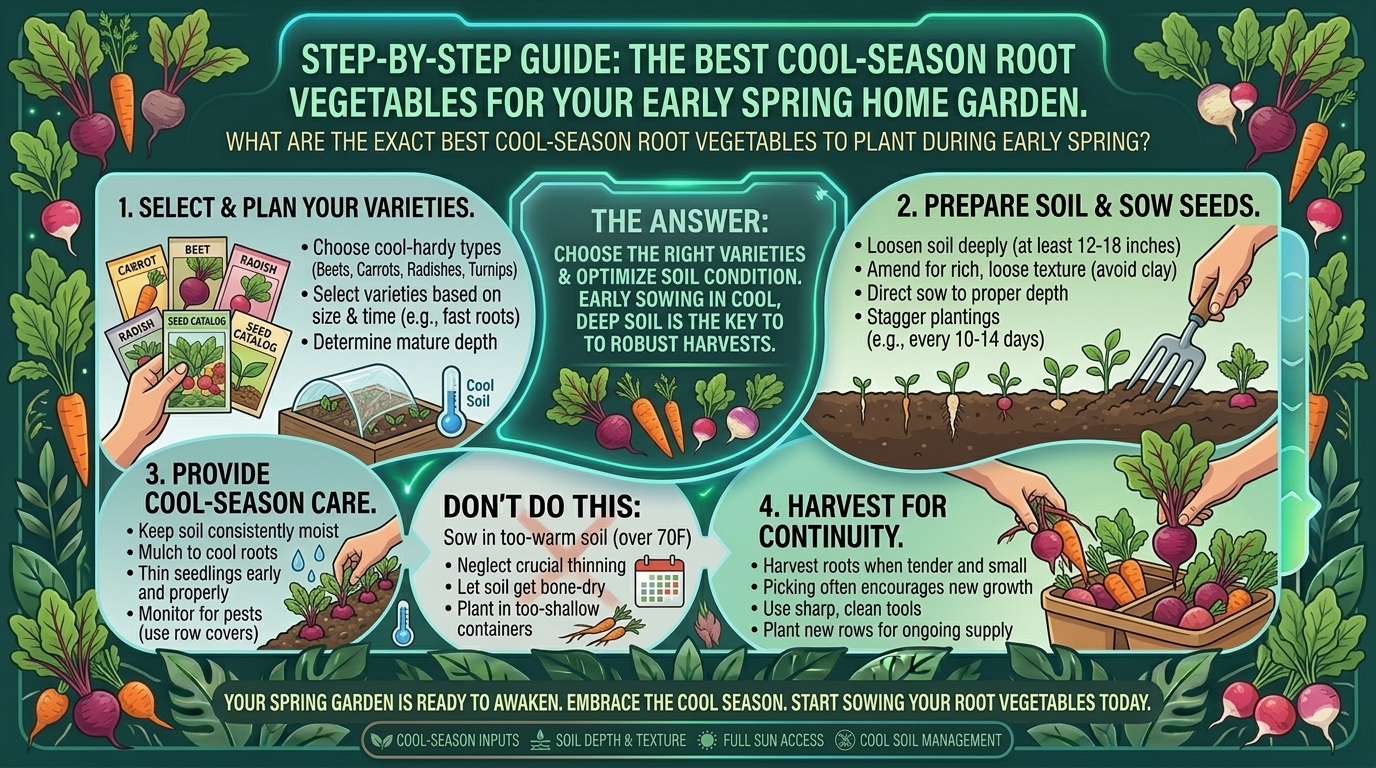
- Loose and Friable: Ensure your soil is fluffy and well-aerated. If using containers or raised beds, blend equal parts fine compost, coconut coir, and coarse horticultural sand or perlite.
- Low Nitrogen, High Phosphorus/Potassium: Avoid heavy blood meal or high-nitrogen fertilizers. Instead, enrich your soil base with bone meal, glacial rock dust, and well-rotted compost. Phosphorus encourages strong root development, while potassium aids overall plant vigor.
4. Top 6 Best Cool-Season Root Vegetables to Plant
1. Radishes (The Speed Champions)
- Days to Maturity: 21 to 30 days.
- Why Grow Them: Radishes are the ultimate instant gratification crop for early spring. They germinate in days and mature before most other seeds have even sprouted.
- Pro Tip: Plant them along the edges of slower-growing root rows as living row markers.
2. Carrots (The Sweet Staples)
- Days to Maturity: 55 to 75 days.
- Why Grow Them: Crisp, sweet, and packed with beta-carotene, early spring carrots tolerate cold soil exceptionally well. Look for shorter, blockier varieties (like Danvers or Chantenay) if your soil is shallow, or long varieties (Nantes) for deep raised beds.
3. Beets (Dual-Harvest Powerhouses)
- Days to Maturity: 50 to 60 days.
- Why Grow Them: Beets offer a double harvest: earthy, nutrient-dense roots below ground and delicious, tender greens above ground that can be sautéed like spinach.
4. Turnips (The Crisp Delicacies)
- Days to Maturity: 40 to 55 days.
- Why Grow Them: Early spring turnips (such as Purple Top White Globe or small salad turnips like Tokyo Cross) are mild, sweet, and juicy when harvested young—far removed from the woody winter turnips of the past.
5. Parsnips (The Long-Term Sweetness)
- Days to Maturity: 100 to 120 days.
- Why Grow Them: Parsnips require a long growing season and taste exceptionally sweet after being touched by frost. Sow them as early as the ground can be worked in spring.
6. Rutabagas (The Hardy Hybrids)
- Days to Maturity: 90 to 100 days.
- Why Grow Them: A cross between a cabbage and a turnip, rutabagas develop dense, rich roots that store extraordinarily well through cold weather.
5. Regional Early Spring Planting Guide (TX, NY, CA, WA, SF)
Climate dictates precisely when “early spring” arrives in your backyard:
Texas (Late Winter to Early Spring Sowing)
- Timing: Sow seeds from January through March before summer heat spikes.
- Adjustment: Mulch lightly to keep soil cool, as sudden warm spells in Texas can cause cool-season crops to bolt (flower and go bitter) prematurely.
New York (Post-Thaw Spring Awakening)
- Timing: Sow seeds as soon as the frost clears and soil can be worked, typically late March through April.
- Adjustment: Use clear plastic cloches or floating row covers in early spring to trap daytime heat and protect sprouting seeds from late snow flurries.
California (Mediterranean Winter-Spring Transition)
- Timing: Plant from February through April (or even autumn-to-spring in milder zones).
- Adjustment: Take advantage of winter rains to germinate seeds naturally, utilizing drip irrigation as spring sun intensifies.
Washington (Cool, Damp Spring Management)
- Timing: Sow seeds in March and April as rains slow down slightly.
- Adjustment: Ensure your soil beds have excellent drainage (high perlite/sand content) so wet spring storms do not waterlog delicate germinating seeds.
San Francisco (Microclimates & Foggy Springs)
- Timing: SF’s mild year-round climate allows for early spring planting as early as February.
- Adjustment: Choose the sunniest microclimate on your patio or raised bed, as cool coastal fog can slow down root bulking.
6. Direct Sowing vs. Transplanting Best Practices
Golden Rule: Never start root vegetables indoors in seed trays to transplant later.
Root crops have a delicate primary taproot. If that taproot is disturbed, bent, or broken when transplanting from a cell tray, the plant will fail to form a proper root.
- Direct Sowing Only: Always plant root vegetable seeds directly into their final growing location in your garden bed or container.
- Sowing Depth: As a general rule of thumb, plant seeds at a depth equal to three times the width of the seed. Tiny carrot seeds should barely be covered with a fine dusting of compost or vermiculite (about 1/4 inch deep).
7. Watering and Thinning Techniques for Success
The Importance of Consistent Moisture
- Germination Phase: Tiny carrot and parsnip seeds take up to 2 weeks to germinate and must not dry out. If the topsoil crusts over into a hard dry shell, weak seedlings cannot break through. Keep the surface damp with a gentle misting daily until sprouts appear.
- Bulking Phase: Once established, water deeply and infrequently to encourage roots to dive downward in search of moisture.
The Crucial Step: Thinning
Because carrot and radish seeds are tiny, gardeners often sow them thickly. When seedlings reach 2 inches tall, you must thin them out:
- Snip or pull excess seedlings so plants have proper spacing (e.g., 2 inches apart for carrots, 3 to 4 inches apart for beets and turnips).
- Failing to thin results in tangled, stunted roots fighting for the same space.
8. Natural Pest and Disease Management in Spring
Early spring crops generally face fewer pests than summer crops, but a few troublemakers warrant attention:
- Flea Beetles: These tiny jumping beetles chew small “shot holes” in early radish and turnip leaves. Protect young seedlings with floating row covers until plants are large enough to withstand minor damage.
- Root Maggots: Fly larvae that tunnel into developing roots. Prevent them by using floating row covers and practicing strict crop rotation.
- Natural Deterrents: Dust soil surfaces lightly with diatomaceous earth if crawling pests become an issue.
9. Pro Tips for Massive, Blemished-Free Roots
- Keep Soil Stone-Free: Screen your raised bed or container soil to remove stones, twigs, and large debris that force roots to fork.
- Avoid Fresh High-Nitrogen Manure: Fresh manure burns tender roots and causes hairy, distorted carrots. Stick to well-aged compost.
- Harvest Test: Gently brush away soil at the top of the root crown to check diameter before harvesting. If they look ready, pull a test root to check flavor and crispness!
10. Frequently Asked Questions (10 FAQs)
Q1: Can I grow carrots and radishes in containers on a balcony?
A: Absolutely! Shallow-rooted radishes and shorter carrot varieties (like Paris Market or Thumbelina) thrive in window boxes, fabric grow bags, or shallow containers at least 10 to 12 inches deep.
Q2: Why are my radishes all leafy green tops with no round root underneath?
A: This is usually caused by excess nitrogen in the soil or growing in temperatures that are too warm, which tricks the plant into going to seed rather than swelling its root base.
Q3: Why did my carrots turn out forked, hairy, and deformed?
A: Forked carrots happen when the taproot hits an obstacle (like a rock, heavy unworked clay, or fresh uncompounded organic debris) or when chemical fertilizers burn the root tip.
Q4: How do I prevent tiny carrot seeds from washing away when I water?
A: Mix your tiny carrot seeds with fine dry sand before scattering them, or cover the seeded row with a thin burlap sheet or wooden board until germination begins, removing it the moment green sprouts emerge.
Q5: Can I eat the greens of all root vegetables?
A: Carrot greens are slightly bitter (though edible), while beet greens, turnip greens, and radish greens are exceptionally tender, nutritious, and delicious when harvested young in spring.
Q6: How do I know when it is time to harvest spring root vegetables?
A: Check the seed packet for days to maturity, look at the top of the root protruding from the soil surface, and gently brush away dirt to inspect the shoulder diameter.
Q7: Do root vegetables need full sun in early spring?
A: Yes! Even though they tolerate cool weather, root crops need at least 6 hours of direct sunlight daily to photosynthesize and build energy reserves in their roots.
Q8: Can I save root vegetable seeds for next year?
A: Most root vegetables are biennials, meaning they complete their vegetative growth in year one and flower/produce seeds in year two. Saving seeds requires overwintering the roots.
Q9: What is the best way to store harvested spring radishes and carrots?
A: Cut off the green tops immediately (greens draw moisture and nutrients away from the roots), wash off excess soil, and store the roots in airtight containers or damp paper towels in your refrigerator crisper drawer.
Q10: Why are my spring turnips tasting bitter or woody?
A: Bitterness in spring turnips is usually caused by erratic watering (letting the soil dry out completely between waterings) or leaving them in the ground too long as late-spring temperatures rise. Harvest them while young and tender!
Conclusion
Planting cool-season root vegetables in early spring is one of the most rewarding ways to kick off your gardening calendar. By prioritizing a loose, aerated organic soil base, sowing seeds directly into the earth, and keeping moisture consistent, you set the stage for a crisp, sweet, and abundant harvest.