Basil (Ocimum basilicum) is arguably the crown jewel of the culinary herb garden. Whether you are muddling it into summer cocktails, whipping up a vibrant, aromatic pesto, or tearing fresh leaves over a wood-fired margherita pizza, having an endless supply of fresh basil is a backyard gardener’s ultimate badge of honor.
Yet, many gardeners experience a frustrating cycle with their basil plants: the plant starts out strong and lush, but within a few weeks, it shoots up a single spindly stalk, forms tiny flower buds at the top, and turns bitter, woody, and tough.
The secret to a prolific, bushy basil plant that produces tender leaves all season long isn’t just watering and fertilizing—it is correct harvesting technique. Basil is a plant that actively rewards precise pruning. Every time you harvest a stem correctly, you trigger a natural hormonal response that forces the plant to branch out, multiplying your future harvest exponentially while delaying the inevitable end-of-life flowering process.
This comprehensive, highly informative guide explores the botany of basil growth, step-by-step harvesting techniques, and regional strategies tailored for growers across Texas, New York, California, Washington, and San Francisco, all proudly brought to you by kcplants.com.
The Botanical Blueprint: Why Basil Responds to Pruning
To harvest basil correctly, you must first understand how the plant grows. Basil belongs to the mint family (Lamiaceae), which is characterized by square stems and opposite leaf arrangement. This means that leaves and new branches emerge from the main stem in pairs, directly opposite one another.
Apical Dominance and the Secret Node
At the very top of a young basil stem sits the main growing tip, driving vertical growth—a phenomenon known in botany as apical dominance. The plant produces a hormone called auxin at this top tip, which travels downward and suppresses the growth of smaller, dormant leaf nodes further down the stem.
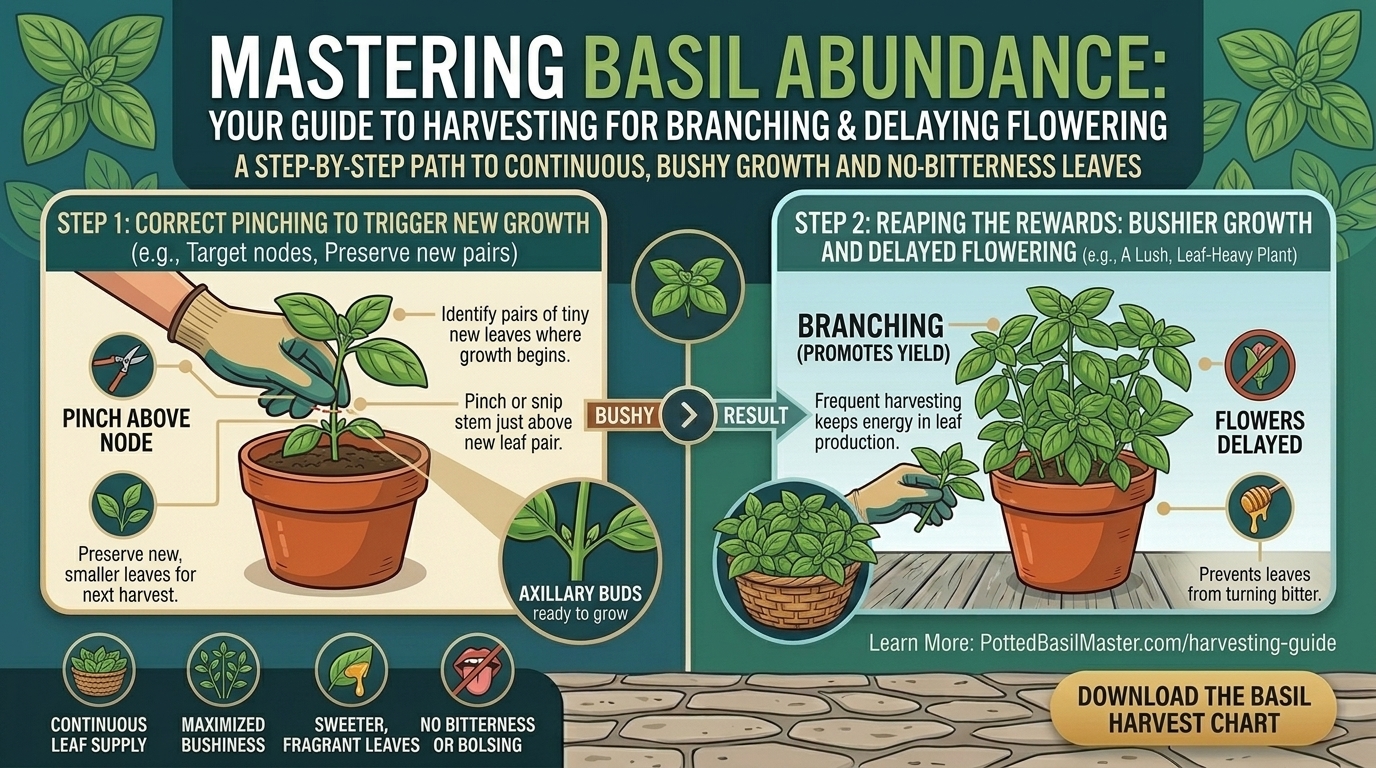
When you pinch or cut off that top growing tip, you instantly remove the source of auxin. This hormonal shift sends an emergency signal to the tiny, dormant shoots nestled at the base of the opposite leaf pairs below the cut. These side shoots (often called “auxiliary buds” or “side nodes”) immediately awaken and begin growing rapidly.
Instead of one single, tall, vulnerable stalk, your basil plant splits into two distinct, vigorous branches. If you repeat this process on those new branches as they grow, your plant multiplies exponentially:
- 1 main stem becomes 2 branches.
- 2 branches become 4 branches.
- 4 branches become 8, and so on, transforming a sparse single sprout into a dense, dome-shaped bush packed with hundreds of usable leaves.
Regional Considerations for kcplants.com Growers
Your local climate dictates how fast your basil grows, how aggressively it tries to flower, and how frequently you need to harvest.
Texas: Managing Intense Heat and Premature Bolting
- The Challenge: Intense Texas heat and long daylight hours during summer trigger basil’s survival mechanism: bolting (flowering). When the plant senses heat stress, it rushes to produce flowers and seeds before it dies.
- The Solution: Harvest more frequently during peak summer months to keep the plant in a continuous vegetative state. Provide afternoon shade with a 30% shade cloth during July and August to cool the plant down and slow heat-induced flowering.
New York: Maximizing the Short Warm Season
- The Challenge: New York features a compressed warm-weather window. Gardeners must make every week count before autumn frosts arrive.
- The Solution: Start harvesting as soon as the plant reaches 6 to 8 inches tall. Regular pruning ensures maximum leaf production before the seasonal temperature drops.
California & San Francisco: Leveraging Microclimates
- The Challenge: Interior California is hot and dry, while San Francisco and coastal zones experience cool, foggy summers and chilly night air. Basil loves warmth and can sulk if temperatures drop too low.
- The Solution: In San Francisco’s cool microclimate, position your basil pots in the sunniest, most wind-protected south-facing spots on your deck. Because growth is slightly slower in the fog, adjust your harvesting volume so you don’t strip the plant faster than it can recover.
Washington: Balancing Moisture and Cool Spring Dynamics
- The Challenge: The Pacific Northwest offers plenty of moisture, but cool, damp conditions can foster fungal leaf spot if basil plants are kept too dense and wet.
- The Solution: Thin-stem harvesting and regular pruning are crucial in Washington to maximize air circulation through the center of the plant, preventing moisture traps and fungal outbreaks.
Step-by-Step Guide: How to Harvest Basil Correctly
Never walk up to a basil plant and simply pluck off individual large leaves from the bottom of the stem. While this seems harmless, it leaves bare stems behind, ruins the plant’s structural integrity, and fails to stimulate branching. Follow this professional harvesting method instead:
Step 1: Wait for the Right Size
Let your young basil plant grow until it is at least 6 to 8 inches tall and has developed at least 4 to 6 sets of true leaves. Harvesting too early stunts the young root system.
Step 2: Locate the Node
Identify the main central stem. Look down from the very top tip until you find the first major set of opposite leaves or side shoots. These tiny bumps or miniature leaves nestled in the junction between the leaf stem and the main stalk are your future branches.
Step 3: Make the Cut Above the Node
Using clean, sharp kitchen shears or bypass pruners, snip the main stem cleanly about one-quarter to one-half inch directly above that pair of side shoots.
- Pro Tip: Never leave a long, naked stub of stem above the node, as that stub will die back and invite fungal infections or pests.
Step 4: Harvest from the Top Down, Not Bottom Up
Always harvest from the top of the plant downward. This immediately stops vertical stretching, exposes lower leaves to direct sunlight, and forces the plant to fill out horizontally.
How to Prevent and Manage Early Flowering (Bolting)
Flowering is the natural end of a basil plant’s life cycle. Once a basil flower spike forms, the plant funnels all its energy into seed production, and the leaves undergo a chemical change: they become sparse, small, tough, and develop a bitter, anise-heavy flavor.
1. The Pinch-and-Discard Method
Inspect your basil plants every few days. If you notice a tight cluster of tiny, light-green or white buds forming at the tips of any branch, pinch them off immediately. Do not wait—even a small bud signals the plant to shift hormones away from leaf production.