How to Grow Sweet Green Peas Up a Teepee Structure Made from Natural Bamboo Poles
There are few sensory experiences in the gardening year quite as grounding and joyful as growing sweet green peas (Pisum sativum). Long before the heavy heat of summer arrives to scorch the earth, these resilient cool-season champions emerge in early spring, unfurling delicate tendrils and bursting into cascades of white or purple blossoms. Within weeks, those blooms transform into plump, crisp pods filled with sweet, sugary emerald pearls that taste nothing like the frozen bags found in grocery stores.
Yet, growing exceptional peas requires more than just dropping seeds into the dirt. Because most garden peas are climbing vining varieties, they desperately need structural support to lift them off the mud, maximize sunlight exposure, and prevent fungal rot.
Enter the timeless charm and elite functionality of the bamboo teepee. Building a natural teepee structure from bamboo poles not only provides an industrial-strength trellis for your climbing vines, but it also transforms your vegetable patch into a stunning architectural focal point.
Whether you are gardening in the unpredictable frost-kissed springs of New York, the maritime chill of Washington, the microclimates of San Francisco, the diverse regions of California, or the warm, early-spring transitions of Texas, this comprehensive, SEO-optimized guide will walk you through everything you need to know to build a bamboo teepee and harvest a massive crop of sweet green peas.
Introduction: The Romance and Science of Growing Peas
Peas are one of the earliest crops a gardener can sow. As legumes, they possess a superpower: through a symbiotic relationship with beneficial soil bacteria (rhizobia), they have the unique ability to “fix” atmospheric nitrogen, capturing it from the air and depositing it directly into the soil. This makes them fantastic companion plants that naturally enrich the earth for whatever you choose to grow next.
However, despite their rugged resilience against cold weather, pea vines have a structural weakness. Lacking woody stems, they cannot hold themselves upright. Without a sturdy trellis system, pea vines collapse into a tangled, muddy heap on the soil surface. Once matted on the ground, lack of airflow and persistent dampness invite powdery mildew, stem rot, and crawling pests.
A natural bamboo teepee solves every single one of these problems. It elevates the vines into the sun and air, making harvest effortless while looking stunningly rustic in any backyard garden.
Selecting Your Pea Variety: Climbing vs. Bush
Before building your structure, you must ensure you are planting the right type of pea. Peas generally fall into three growth habits:
1. Climbing or Pole Peas (Vining Varieties)
- Height: These varieties routinely grow anywhere from 5 to 8 feet tall (and occasionally taller).
- Requirement: They possess vigorous tendrils that actively grab onto supports. This is the exact variety required for a bamboo teepee.
- Examples: Telephone, Alderman, Oregon Sugar Pod (snow pea), and Sugar Snap.
2. Bush Peas
- Height: These compact varieties grow only 18 to 30 inches tall.
- Requirement: They generally do not need tall teepees; a simple low brush or short twig support is sufficient.
Why Choose Natural Bamboo Poles for Your Teepee?
When it comes to building garden structures, you have plenty of choices—metal stakes, plastic-coated wire cages, or dimensional lumber. However, natural bamboo poles remain the gold standard for several distinct reasons:
- Incredible Strength-to-Weight Ratio: Bamboo is deceptively light yet remarkably rigid. It can easily support the heavy weight of lush, moisture-laden pea vines packed with pods.
- Longevity and Weather Resistance: Natural bamboo contains a hard, silica-rich outer layer that resists moisture, rotting, and insect damage far better than softwoods like pine or fir.
- Aesthetic Harmony: Unlike cold wire cages or bright plastic stakes, bamboo blends seamlessly into the natural landscape of a garden, creating an organic, cottage-style aesthetic.
- Eco-Friendly and Sustainable: Bamboo is one of the fastest-growing renewable resources on earth, making it an environmentally conscious choice for sustainable gardeners.
Regional Planting Guide Across the US
Because your garden could be located anywhere from the Pacific Northwest to the Gulf Coast, your planting window will dictate your success:
- New York: Plant in early-to-mid spring (late March to April) as soon as the soil can be worked. Alternatively, some New York gardeners sow seeds in late summer for a brief autumn crop, though spring is prime time.
- Washington: Western Washington gardeners can plant as early as February or March due to mild winter influences, though damp soil requires extra care to prevent seed rot. Eastern Washington growers plant in March through April.
- California & San Francisco: San Francisco’s famously mild, foggy climate and coastal California conditions allow for an extended cool-season growing window. Plant as early as January or February, or even autumn for winter crops.
- Texas: In North and Central Texas, plant in January or February so the vines mature before the fierce Texas summer heat arrives (peas stop producing and turn bitter once temperatures regularly exceed 85°F). In South Texas, plant in late autumn (November) for a winter-into-spring harvest.
Step-by-Step Guide: Building a Natural Bamboo Teepee
Constructing a bamboo teepee is a fun, rewarding DIY project that takes less than an hour.
What You Will Need:
- 5 to 7 bamboo poles (at least 6 to 8 feet long and roughly 1 inch thick at the base).
- Strong garden twine, jute string, or plant ties.
- A mallet or sturdy stake driver.
- A tape measure or pacing steps for accurate spacing.
Step 1: Choose the Right Location
Select a spot in your garden that receives full sun (at least 6 to 8 hours of direct sunlight daily) and has well-draining soil. Avoid low-lying areas where water pools after a heavy spring rain.
Step 2: Mark Out the Circle
Determine the footprint of your teepee. A circle with a diameter of 4 to 5 feet is ideal. Clear away any weeds or debris from this circle and work a generous amount of aged compost into the top 6 inches of soil.
Step 3: Erect the Poles
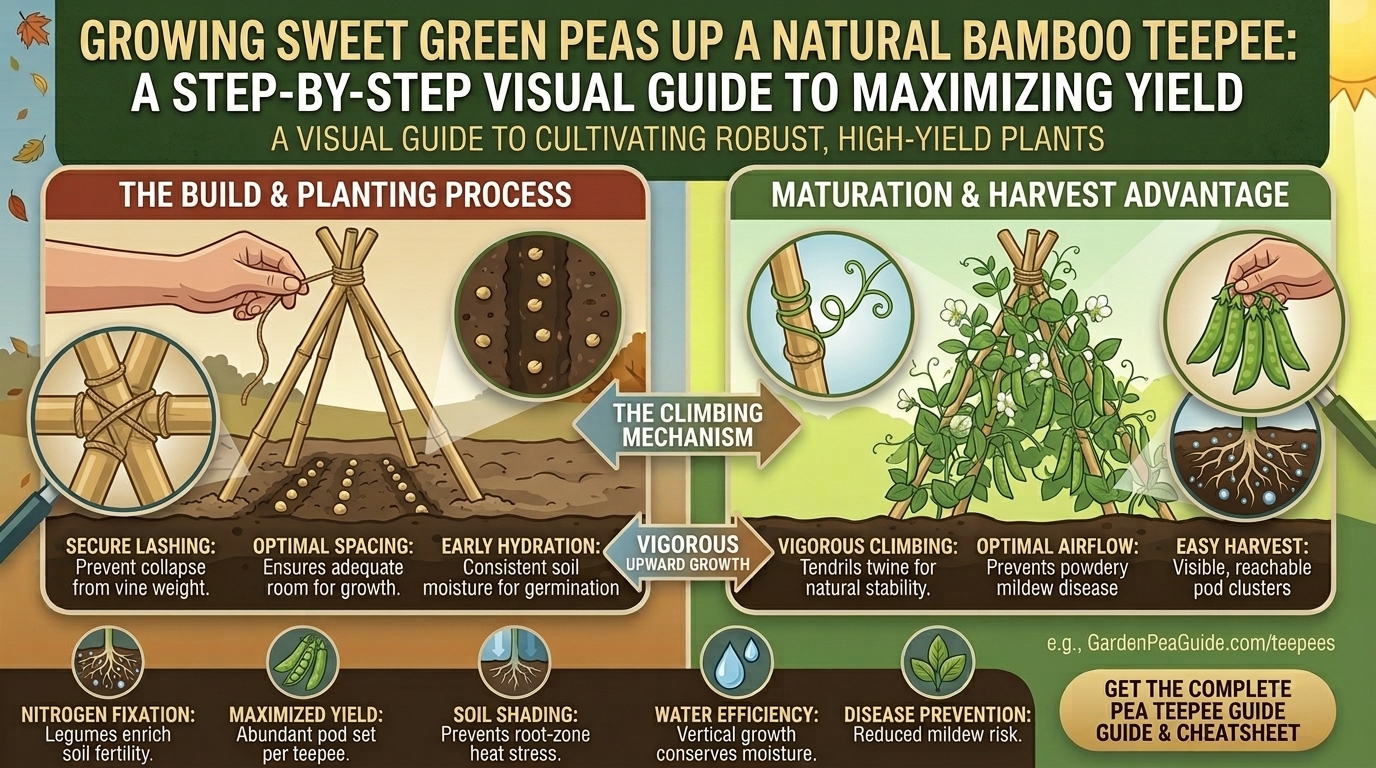
- Push the base of each bamboo pole firmly 6 to 12 inches into the soil around the perimeter of your circle, spacing them evenly.
- Angle the top of each pole inward toward a central point directly above the middle of the circle.
Step 4: Secure the Apex
- Gather the tops of all the bamboo poles together at the peak, roughly 6 to 7 feet off the ground.
- Take your heavy-duty garden twine and wrap it tightly around the intersection of the poles at least 5 to 6 times, weaving the string in and out between the individual poles to lock them into place. Tie a secure knot.
- Pro Tip: For extra stability against heavy spring winds (common in regions like Texas and coastal California), tie a second horizontal loop of twine all the way around the middle of the teepee structure to connect the poles midway up.
Sowing and Training Your Sweet Pea Seeds
With your bamboo architectural masterpiece standing proudly in the garden, it is time to plant your seeds.
Step 1: Pre-Soak Your Seeds (Optional)
To speed up germination, soak your pea seeds in lukewarm water for 12 to 24 hours before planting. This softens the hard outer seed coat and helps them absorb moisture rapidly. Discard any seeds that float to the top, as they are unviable.
Step 2: Planting Depth and Spacing
- Plant the seeds in a circle directly around the base of each bamboo pole, placing 2 to 3 seeds at the base of every leg.
- Push the seeds about 1 inch deep into the soil.
- Space seeds roughly 2 to 3 inches apart from one another.
Step 3: Training the Young Vines
As the pea seedlings emerge and grow past 6 inches tall, they will begin casting out delicate, thread-like tendrils.
- Gently guide the young shoots toward the nearest bamboo pole.
- Once the tendrils make contact with the bamboo, they will naturally wrap around it and begin climbing on their own, scaling the teepee without requiring constant manual tying.
Season-Long Care and Maintenance
Peas are remarkably self-sufficient once established, but keeping them happy requires a few core practices:
- Consistent Watering: Peas have shallow root systems and require about 1 inch of water per week. Keep the soil evenly moist, especially when the plants begin flowering and setting pods. Never let them dry out completely.
- Mulching: Apply a 2-to-3-inch layer of straw or shredded leaves around the base of the teepee. This retains soil moisture, keeps the root zone cool, and suppresses competing weeds.
- Weed Control: Hand-weed gently around the base of the teepee while the plants are young. Once the pea vines grow lush and dense, they will naturally shade out most weeds.
Harvesting Your Sweet Green Peas
The ultimate payoff arrives roughly 60 to 70 days after planting, usually in late spring or early summer depending on your region.
- Check the Pods: Gently squeeze the pea pods. They are ready for harvest when they feel plump, firm, and completely filled out, but still vibrant bright green. If the pods look yellowish or bloated with oversized seeds inside, they have stayed on the vine too long and will taste starchy rather than sweet.
- Harvesting Technique: Never yank or pull the pods off the vine, as this can snap the delicate stem or uproot the plant. Instead, hold the vine steady with one hand and snap or snip the pea pod stem cleanly with your thumb and forefinger or garden shears.
- Harvest Frequently: The more you pick, the more the plant produces! Regular harvesting signals the vine to continue setting new blossoms.
10 Essential FAQs About Growing Peas on a Bamboo Teepee
1. Can I grow bush peas on a bamboo teepee?
No, it is not recommended. Bush peas only grow 18 to 30 inches tall and lack the climbing tendrils needed to scale a tall structure. You must use climbing or pole pea varieties (such as snap or snow peas) designed to reach heights of 5 to 8 feet.
2. How do I keep my bamboo teepee from blowing over in high winds?
To ensure stability against strong spring gusts (common in open regions like Texas or coastal Washington), drive the base of each bamboo pole at least 8 to 12 inches deep into firmly tamped soil. Additionally, tying a horizontal loop of twine midway up the poles creates a rigid structural brace.
3. Do I need to tie the pea vines to the bamboo poles with string?
Usually, no. Pea vines feature specialized curling tendrils that naturally reach out and grab onto nearby vertical supports. You may only need to gently tuck stray shoots toward a bamboo pole during their initial weeks of rapid growth.
4. What is the best time of year to plant peas in my region?
In cold-winter climates like New York and Washington, plant in early spring (March–April) as soon as the soil thaws. In milder climates like San Francisco and parts of California or Texas, plant in late winter (January–February) or even autumn to catch the cool-weather growing season before summer heat hits.
5. Why are my pea plants turning yellow and dying in spring?
Yellowing foliage is usually caused by overwatering, poor soil drainage, or root rot. Peas despise sitting in waterlogged soil. Ensure your garden bed drains exceptionally well, and avoid heavy, compacted clay without added organic compost.
6. Can I reuse my bamboo teepee poles next year?
Yes! Natural bamboo is exceptionally durable and weather-resistant. At the end of the season, simply pull the poles out of the ground, brush off any clinging vine debris, and store them in a dry shed or garage. They can easily last for 5 to 10 years of continuous garden use.
7. How do I know when my green peas are ready to pick?
Gently squeeze a pod. If it feels firm, plump, and filled with distinct green rounds, it is ready. If the pod is flat, the peas inside are underdeveloped; if the pod is turning pale green or yellow with hard, dull peas, it has over-ripened and will taste starchy.
8. Do I need to fertilize my pea plants?
Generally, no. As legumes, peas fix their own nitrogen via root nodules. Over-fertilizing them with nitrogen-rich fertilizers will actually backfire, causing the plant to grow massive, lush green foliage at the expense of flowers and pea pods. A light application of compost at planting time is all they need.
9. Can I grow sugar snap peas and snow peas on the same teepee?
Yes, you can! However, make sure both varieties you select share similar climbing heights (ideally pole varieties) so one does not completely overpower or shade out the other.
10. What happens to my pea plants when summer weather arrives?
Peas are strictly cool-season crops. Once daytime temperatures consistently climb above 85°F (29°C), pea plants will stop flowering, turn brown, and finish their life cycle. At that point, you can cut the vines down at the soil level—leaving the nitrogen-rich root system underground to enrich your soil—and pull up your bamboo teepee for the season.
Conclusion
Growing sweet green peas up a natural bamboo teepee is one of the most rewarding rituals of the spring garden. It marries rustic craftsmanship with agricultural productivity, turning a simple patch of earth into a vertical wonderland of vibrant green vines and sugary pods.
Whether you are navigating the brisk springs of New York and Washington, enjoying the mild maritime air of San Francisco and California, or timing your harvest before the warmth of Texas arrives, the bamboo teepee provides the ultimate structural support your vines need to thrive. Build your teepee, drop your seeds into the earth, and get ready to enjoy the crisp, sweet taste of homegrown peas straight from the vine! Happy gardening!