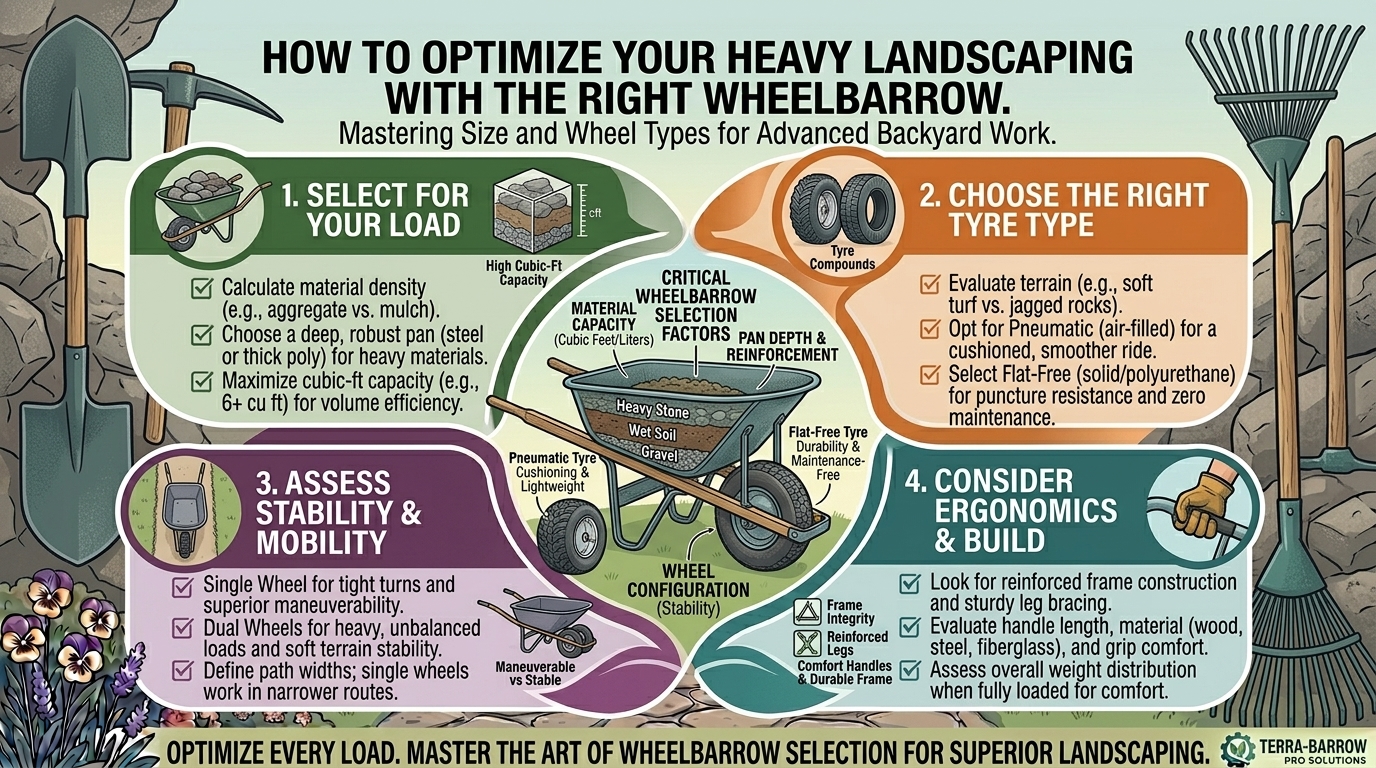
Whether you are hauling half a ton of crushed gravel, moving rich garden compost, transporting dense clay sod, or clearing fallen tree branches after a severe seasonal storm, one tool stands above all others as the absolute workhorse of the yard: the wheelbarrow.
To the untrained eye, a wheelbarrow is simply a bucket on a wheel. But to an experienced landscaper, homestead builder, or dedicated DIY gardener, choosing the wrong wheelbarrow size or wheel configuration can mean the difference between a smooth weekend project and a debilitating back injury. When you are managing heavy backyard landscaping work across diverse regional terrains—from the rocky caliche soil of Texas, the urban-suburban plots of New York, the sprawling properties of California, the wet forest floors of Washington, to the steep, hilly microclimates of San Francisco—having the right hauling equipment is non-negotiable.
This comprehensive guide breaks down everything you need to know to choose the exact wheelbarrow size, tray material, and wheel type required to tackle heavy landscaping work efficiently and safely.
1. Why Choosing the Right Wheelbarrow Matters
Investing in the correct wheelbarrow directly impacts your productivity, physical stamina, and long-term joint health. Landscaping materials are deceptively heavy:
- Wet soil and compost weigh roughly 100 to 120 pounds per cubic foot.
- Crushed gravel and stone can weigh up to 100 to 150 pounds per cubic foot.
- Wet concrete scales upward of 150 pounds per cubic foot.
If your wheelbarrow is too small, you will spend exhausting extra hours making dozens of unnecessary trips. If it is too large or unbalanced, you risk tipping over on a slope, straining your lower back, or losing control on rough terrain.
2. Tray Size and Capacity Guide
Wheelbarrow capacities are measured in cubic feet for volume and pounds for weight limits. Understanding these measurements prevents structural overloading.
Small Capacity (3 to 4 Cubic Feet)
- Best For: Light gardening, weeding, spreading a bag or two of mulch, or transporting small potted plants.
- Weight Limit: Typically handles up to 150–200 pounds.
- Pros/Cons: Lightweight and easy to maneuver, but deeply inadequate for major heavy landscaping projects like hauling gravel or stone.
Medium Capacity (5 to 6 Cubic Feet)
- Best For: Standard residential landscaping, moving yard waste, spreading topsoil, and general backyard maintenance.
- Weight Limit: Handles 300–400 pounds.
- Pros/Cons: The “Goldilocks” size for most homeowners. It provides ample volume without becoming overwhelmingly heavy to push when full.
Large Capacity (7 to 10+ Cubic Feet / Contractors’ Wheelbarrows)
- Best For: Heavy-duty construction, moving massive volumes of mulch or gravel, transporting boulders, and professional landscaping.
- Weight Limit: 500+ pounds.
- Pros/Cons: Incredible capacity, but heavy and bulky. It requires significant physical strength to balance and steer, especially when navigating tight garden gates or uneven terrain.
3. Tray Materials: Poly, Steel, or Wood?
The material of the bucket (tray) dictates durability, weight, and resistance to rust.
Polyethylene (Heavy-Duty Plastic)
- Pros: Rust-proof, lightweight, dent-resistant, and easy to clean. Soil, wet concrete, and fertilizers will not corrode the surface.
- Cons: Can crack or degrade over decades if left exposed to intense, unshielded UV rays (a consideration in sunny regions like Texas and California).
Seamless Steel
- Pros: Incredibly rugged, puncture-proof, and fire-resistant. Excellent for hauling sharp rocks, broken concrete, and hot embers.
- Cons: Heavy even when empty. If the protective paint or powder coating scratches, steel will quickly rust when exposed to moisture (a critical factor in rainy Washington or coastal San Francisco).
Wood (Traditional)
- Pros: Classic aesthetic, durable shock absorption, and customizability.
- Cons: High maintenance, prone to rotting if left wet, and significantly heavier than modern poly alternatives.
4. Wheel Configurations: Single Wheel vs. Dual Wheels
The choice between a single-wheel and a dual-wheel (two-wheel) barrow fundamentally changes how the tool handles loads.
Single-Wheel Wheelbarrows (The Maneuverability Champion)
- How it Works: All weight is concentrated on one central front wheel.
- Best For: Tight spaces, winding garden paths, navigating narrow wooden planks, and dumping loads with pinpoint accuracy by tipping the barrow sideways.
- Regional Fit: Perfect for urban yards in New York or hilly, winding properties in San Francisco where agility around tight corners matters most.
- The Catch: Requires significant upper-body strength and core balance to keep the barrow upright, especially on uneven terrain or slopes.
Dual-Wheel Wheelbarrows (The Stability Champion)
- How it Works: Features two side-by-side wheels at the front.
- Best For: Heavy, unbalanced loads. The dual-wheel design supports up to 80% of the load weight, meaning you do most of the pushing rather than balancing.
- Regional Fit: Ideal for flat, expansive suburban yards in Texas or wide-open rural and semi-rural properties in Washington and California.
- The Catch: Wider footprint means it cannot squeeze through narrow gates, and dumping requires a more deliberate, two-handed heave.
5. Tire Types: Pneumatic Air vs. Flat-Free Solid
Nothing halts a weekend landscaping project faster than a flat tire in the middle of hauling stone. Choosing the right tire type is critical.
Pneumatic (Air-Filled) Tires
- How it Works: Traditional rubber tire inflated with air, featuring an inner tube.
- Pros: Provides a smooth, cushioned ride that absorbs shock when rolling over rocks, roots, and bumps. Protects delicate lawns from heavy compaction.
- Cons: Prone to punctures from thorns, nails, sharp gravel, and jagged wood fragments. Requires regular air pressure checks.
Flat-Free (Solid Polyurethane / Foam) Tires
- How it Works: Made of solid micro-cellular polyurethane foam. It feels and acts like a rubber tire under load, but it can never be punctured.
- Pros: Total peace of mind. No air checks, no punctures, zero flat tires ever.
- Cons: Slightly heavier than air-filled tires and provides a firmer, less cushioned ride over rocky ground.
6. Regional Terrain Considerations
Your local geography dictates which features your wheelbarrow needs most:
- Texas: Focus on UV-resistant poly trays and flat-free tires to survive searing sun and sharp, rocky limestone caliche.
- New York: Opt for rust-resistant coatings or poly trays to handle seasonal winter salt storage and wet spring mud.
- California: Choose large-capacity barrows with dual wheels for sprawling ranch properties or fire-clearing brush haul-offs.
- Washington & Pacific Northwest: Prioritize rust-proof trays (poly or stainless steel) and deep tread patterns to grip slick, rain-soaked clay and forest loam.
- San Francisco: Select a nimble single-wheel design to navigate steep hills, terraced gardens, and narrow urban side-gates.
7. Top 10 Expert Tips for Using and Maintaining Your Wheelbarrow
- Load with the Center of Gravity in Mind: Place the heaviest materials (like stones or dense soil) directly over or slightly in front of the wheel. If you load too much weight toward the handles, you will bear the brunt of the load with your arms and back.
- Keep Tires Properly Inflated: If using pneumatic tires, check pressure before every heavy project. Low tire pressure makes a moderate load feel twice as heavy.
- Wash After Every Use: Never let wet concrete, fertilizer, or mud dry inside the tray. Rinse steel trays immediately to prevent rust formation.
- Oil Moving Axles Regularly: Apply a drop of multi-purpose machine oil or silicone spray to the wheel axle annually to prevent squeaking and seizing.
- Store Out of the Elements: Hang your wheelbarrow on a wall bracket or store it upside down under a shed or patio roof. Direct sun degrades plastic poly trays, and standing rain rusts steel frames.
- Use a Board for Soft Ground: When wheeling heavy loads across wet lawns or loose garden beds, lay down plywood boards to distribute weight and prevent deep ruts.
- Lift with Your Legs, Not Your Back: When tipping or lifting a heavy barrow, bend your knees and keep your back straight. Let your leg muscles drive the motion.
- Upgrade to Flat-Free: If you frequently haul over thorny brush or sharp construction debris, swap out standard pneumatic inner-tube tires for a solid polyurethane replacement wheel.
- Tighten Fasteners Annually: Heavy vibrations loosen bolts over time. Go over your wheelbarrow frame once a year with a wrench to tighten all nuts and bolts.
- Know Your Personal Limit: Never overload a wheelbarrow beyond your physical comfort level. It is far better to make two half-loads than risk a spilled load or a pulled muscle on a slope.
10 Frequently Asked Questions (FAQ)
1. What size wheelbarrow is best for general residential landscaping?
A 6-cubic-foot medium-to-large capacity wheelbarrow strikes the best balance, holding enough material for efficient work without becoming excessively heavy or unwieldy.
2. Are two-wheel barrows better than single-wheel barrows?
Two-wheel barrows offer superior stability and take the weight off your arms, making them great for straight-line hauling. Single-wheel barrows offer unmatched maneuverability on narrow paths and slopes.
3. How do I stop my wheelbarrow tire from going flat?
You can replace a standard pneumatic tire with a solid polyurethane flat-free tire, or inject commercial tire sealant (slime) into the inner tube to automatically seal small punctures.
4. Is a steel tray or poly tray better?
Poly (plastic) trays are lightweight, rust-proof, and ideal for soil, mulch, and fertilizer. Steel trays are heavy-duty, puncture-proof, and better for hauling jagged rocks and hot debris.
5. Why is my wheelbarrow so hard to push?
Usually, this is caused by low tire air pressure, an unlubricated rusted axle, or an improperly balanced load where too much weight is shifted backward toward the handles.
6. Can I leave my wheelbarrow outside year-round?
It is not recommended. Prolonged exposure to rain causes steel parts to rust, while intense UV rays can make plastic trays brittle over time. Store it under cover or upside down.
7. How much weight can a standard contractor wheelbarrow hold?
Heavy-duty contractor models can safely support between 400 and 600 pounds, provided the structural frame and tire are rated for commercial loads.
8. How do I clean dried concrete out of a metal wheelbarrow?
Tap gently on the outside of the poly or steel tray with a rubber mallet; dried concrete often cracks and pops free. You can also use a vinegar solution to weaken stubborn residue.
9. What is the best wheelbarrow for steep hills or tight spaces?
A single-wheel wheelbarrow with a narrow tray design and a flat-free tire is best for navigating steep, narrow, or winding garden pathways.
10. How do I prevent my wheelbarrow from tipping over on slopes?
Keep your center of gravity low, avoid overfilling the tray with high-piled loose material, move slowly, and consider using a dual-wheel model if your pathways are wide enough.
Conclusion
Choosing the right wheelbarrow size and wheel type is an investment in your efficiency, comfort, and physical well-being during heavy landscaping projects. By matching your equipment to your regional terrain—whether navigating San Francisco hills, Washington dampness, or Texas heat—you turn a grueling chore into a smooth, manageable task. Assess your yard’s specific needs, select the correct capacity and tire setup, and equip yourself to handle any backyard landscaping challenge with confidence.