Why Beneficial Mycorrhizal Fungi Are Necessary for Establishing Strong Root Systems in Young Garden Transplants
Moving a young plant from a cozy nursery container into the unpredictable environment of a garden bed or a large patio pot is a massive shock. In the nursery, conditions are pristine, water is delivered on a precise schedule, and nutrients are readily available. Once transplanted into your garden—whether you are dealing with the scorching, alkaline soils of Texas, the humid urban microclimates of New York, the sun-baked clay of California or San Francisco, or the damp, acidic earth of Washington—young plants must fend for themselves.
Without a strong foundation, transplants often suffer from transplant shock, nutrient lockout, drought stress, and root rot. The secret weapon that successful gardeners use to bypass these hurdles is mycorrhizal fungi.
This comprehensive guide explores why these microscopic underground allies are essential for establishing robust root systems, how they work, and how you can seamlessly integrate them into your gardening routine at kcplants.com.
What Are Mycorrhizal Fungi?
The word “mycorrhiza” comes from Greek roots meaning “fungus” ($\text{mykes}$) and “root” ($\text{rhiza}$). Far from being harmful plant parasites, mycorrhizal fungi form a mutually beneficial (symbiotic) relationship with plant roots.
- The Plant’s Role: Through photosynthesis, the plant manufactures sugars and carbon compounds. It shares a portion of these vital energy sources with the fungi.
- The Fungi’s Role: In exchange, the underground fungal network (the mycelium) acts as an extension of the plant’s root system, vastly increasing its surface area to forage for water and immobile nutrients like phosphorus, zinc, and iron.
In nature, undisturbed forest and grassland soils are teeming with native mycorrhizae. However, cultivated garden soil, bagged commercial potting mixes, and areas subjected to tilling, chemical fertilizers, or heavy sterilizations are often completely devoid of these critical organisms. Reintroducing them is vital for young transplants.
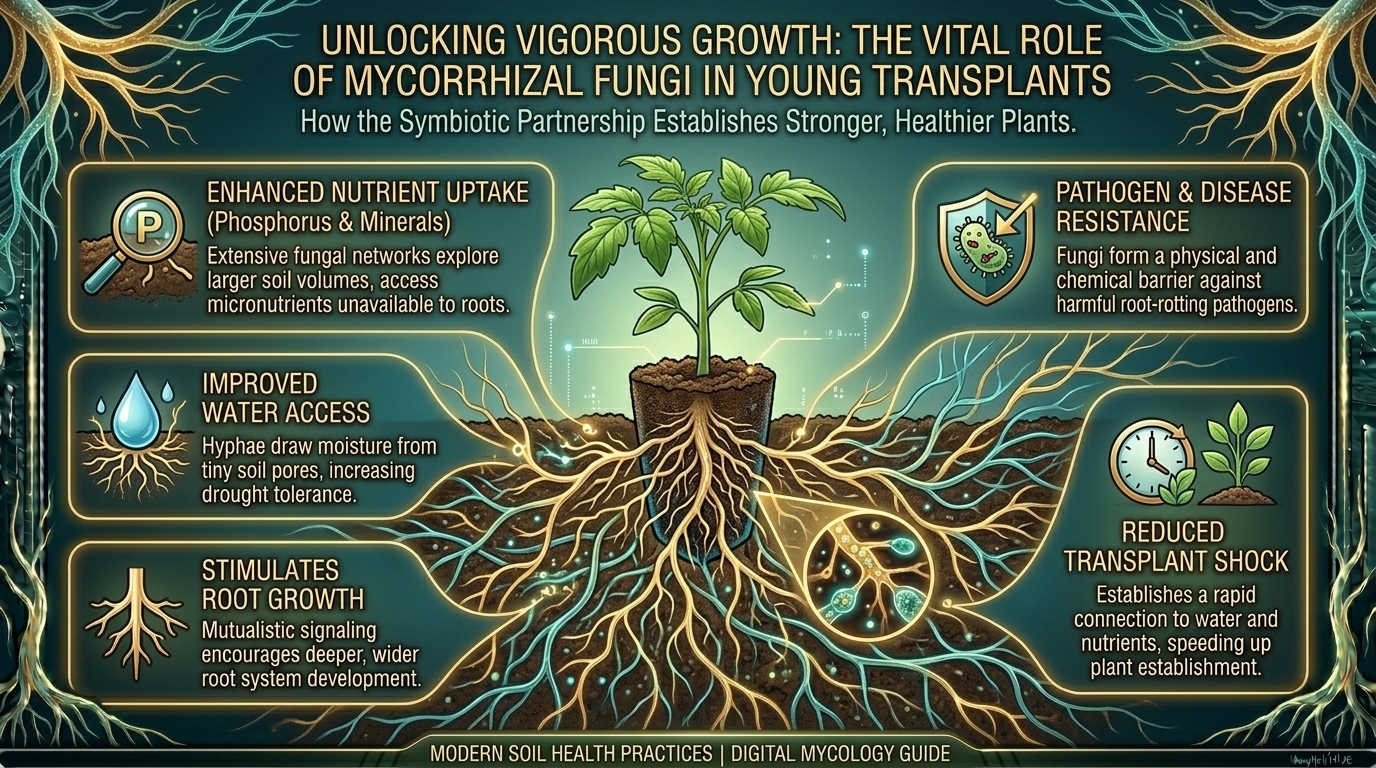
How Mycorrhizae Transform Young Root Systems
When you apply mycorrhizal inoculants directly to the root zone of a young transplant, a microscopic transformation takes place over the course of a few weeks.
1. Exponential Expansion of Root Surface Area
A typical plant root can only reach so far into the surrounding soil. Mycorrhizal hyphae (fine, thread-like fungal filaments) are microscopic—often narrower than a human hair—allowing them to slip into tiny soil pores and crevices that roots cannot physically enter. This can expand a young plant’s effective root absorption area by 100 to 1,000 times.
2. Enhanced Phosphorus and Nutrient Uptake
Phosphorus is notoriously immobile in soil; it binds tightly to mineral particles and stays put, making it difficult for immature roots to access. Mycorrhizal fungi secrete specialized enzymes that unlock bound phosphorus, converting it into a bio-available form for the plant. This directly promotes explosive root growth and early flower development.
3. Protection Against Root Pathogens
Mycorrhizal fungi physically crowd out harmful pathogens like Pythium, Fusarium, and Rhizoctonia by occupying all available root surface real estate. Furthermore, colonized roots often trigger systemic acquired resistance (SAR), prompting the plant to produce natural antifungal and antibacterial compounds.
4. Superior Drought Resilience
Because the fungal web reaches much deeper and wider than the plant’s physical roots, it acts like an underground sponge. Transplants inoculated with mycorrhizae suffer significantly less moisture stress during dry spells—a major asset for gardeners in arid parts of California or heat-intensive areas of Texas.
Regional Soil Challenges and Mycorrhizal Solutions
Different parts of the country present unique challenges for young transplants. Mycorrhizae act as a biological buffer against these regional environmental stresses:
- Texas & California: High temperatures and dry summer winds can bake soil dry in hours. Mycorrhizal networks maintain moisture pockets around roots, preventing rapid wilting and drought shock.
- New York & San Francisco: Urban gardening often relies heavily on container culture and bagged soils. Because sterile potting mixes lack natural biology, adding mycorrhizae replaces the missing microbial ecosystem essential for container-grown vigor.
- Washington: Frequent heavy rains can leach vital nutrients out of the topsoil and saturate root zones, inviting root rot. Mycorrhizae help anchor soil structure and improve plant resilience against excessive moisture-borne pathogens.
Types of Mycorrhizal Fungi: Which Do You Need?
There are two major categories of mycorrhizal fungi, but gardeners generally focus on just one for ornamentals, vegetables, and most trees:
Endomycorrhizae (Arbuscular Mycorrhizae)
- What they do: These fungi penetrate inside the root cell walls of the plant.
- Who benefits: Over 85% of all plant families, including almost all vegetables (tomatoes, peppers, squash), annual flowers, fruit trees, turfgrasses, and shrubs.
- Application: This is the universal strain most home gardeners need.
Ectomycorrhizae
- What they do: These form a protective sheath around the outside of the roots rather than penetrating the cells.
- Who benefits: Specific woody trees and conifers, such as pine, oak, beech, birch, and fir.
Step-by-Step Guide: How to Apply Mycorrhizae to Transplants
Applying mycorrhizal fungi is simple, but execution is critical. The golden rule is direct root contact. Because these fungi are living organisms, they must physically touch the bare roots of the transplant to establish symbiosis.
Step 1: Dig the Planting Hole
Dig your hole twice as wide as the root ball of your transplant, but no deeper than the root ball itself. Loosen the surrounding soil so new roots can easily push outward.
Step 2: Apply the Inoculant Directly to the Roots
Dust the planting hole and the root ball directly with a concentrated mycorrhizal powder or granular inoculant. Ensure the powder makes direct contact with the roots. Avoid mixing the powder into deep water buckets beforehand unless using a specialized soluble formula, as direct dry or paste contact yields the fastest colonization.
Step 3: Set and Backfill
Place your transplant into the hole at the exact same depth it was growing in its nursery container. Backfill with native soil, gently tamping down to eliminate large air pockets.
Step 4: Water in Thoroughly
Water the transplant deeply right after planting to settle the soil around the roots and activate the fungal spores. Keep the soil moderately moist for the next 2 to 3 weeks to encourage rapid hyphal growth.
Common Mistakes to Avoid When Using Mycorrhizae
- Using High-Phosphorus Synthetic Fertilizers: Excess soluble phosphorus signals the plant that it doesn’t need help finding nutrients, causing it to reject the fungal partnership. Stick to low-phosphorus, slow-release organic fertilizers during establishment.
- Heavy Tillage: Aggressive digging or roto-tilling breaks up the fragile underground fungal networks (mycelium) once they have formed. Minimize tilling in established garden beds.
- Delayed Application: Waiting weeks after transplanting to apply mycorrhizae is ineffective; they must be present while the root system is actively growing and looking for partners.
Frequently Asked Questions (FAQ)
1. Do I need to reapply mycorrhizal fungi every year?
No. Unlike annual fertilizers that wash away or get used up, mycorrhizal fungi are living organisms that establish a permanent relationship with perennial plants. Once established, they grow and multiply alongside the root system for the life of the plant.
2. Can I use chemical fertilizers with mycorrhizal fungi?
You should avoid high-phosphorus synthetic fertilizers, as they inhibit fungal colonization. Gentle, slow-release organic fertilizers, compost, and worm castings work harmoniously with mycorrhizae.
3. Are mycorrhizal fungi safe for organic vegetable gardens?
Yes, absolutely. They are naturally occurring soil microorganisms, completely non-toxic, safe for pets and children, and a cornerstone of certified organic and regenerative farming practices.
4. How long does it take for mycorrhizae to colonize a transplant?
Visible root colonization typically begins within 7 to 14 days under optimal soil temperatures ($60^\circ\text{F}$ to $80^\circ\text{F}$) and moisture conditions. Full integration expands outward as the plant grows.
5. Will store-bought potting mix already contain mycorrhizae?
Most standard commercial potting mixes are sterilized to prevent weed seeds and gnats, meaning they are completely devoid of live mycorrhizal fungi. Always check the ingredient label or add your own inoculant.
6. Can I use mycorrhizal fungi for indoor houseplants?
Yes! Houseplants grown in indoor containers in places like New York apartments or San Francisco flats benefit immensely from mycorrhizae, which protect against overwatering stress and nutrient depletion in small pots.
7. What happens if the soil temperature is too cold?
Mycorrhizal fungi become dormant in cold winter soils. For best results, apply them during spring or early fall when soil temperatures are warm enough to support active biological growth.
8. Can I overdose or use too much mycorrhizal powder?
There is no risk of “burning” your plants with excess mycorrhizae (unlike synthetic chemical fertilizers). However, using more than the recommended package rate is generally unnecessary and economically wasteful.
9. Do established, mature trees need mycorrhizal treatments?
While established trees often have native fungal populations, injecting or applying mycorrhizae around the drip line can revitalize stressed, urban, or compacted trees struggling with environmental stress.
10. How should I store leftover mycorrhizal inoculant?
Store unused powder or granules in a cool, dark, dry place tightly sealed in its original packaging. Heat, moisture, and direct UV sunlight can kill the live spores, reducing their shelf life and effectiveness.
Conclusion
Establishing strong root systems in young garden transplants is the single most important factor determining whether your garden thrives or merely survives. By introducing beneficial mycorrhizal fungi to your planting routine, you provide your plants with an advanced biological support system that enhances nutrient uptake, guards against root disease, and guarantees superior drought resistance. Whether you are planting warm-season vegetables in Texas, designing container layouts in San Francisco, or managing backyard raised beds in Washington, mycorrhizae are the ultimate catalyst for long-term garden success.