How to Manage Indoor Plant Temperature Drops Near Air Conditioning Vents During Hot Summers
Welcome back to kcplants.com! If you are a passionate houseplant collector keeping your indoor jungle cool across the sweltering summers of Texas, the sun-baked suburbs of California, or the high-rise apartments of New York, Washington, and San Francisco, you are likely relying heavily on your air conditioning system.
When summer temperatures skyrocket outdoors, blasting the AC is an absolute necessity for human comfort. We crave that crisp, chilled blast of air the moment we step inside. However, while you are cooling off, your tropical houseplants may be suffering from a hidden horticultural hazard: severe cold temperature shock and dry draft stress near AC vents.
Tropical houseplants—such as Monsteras, Fiddle Leaf Figs, Alocasias, and Calatheas—evolved in warm, humid, stable jungle understories where temperatures rarely fluctuate drastically. When an air conditioning vent blows a continuous stream of 55°F (13°C) chilled, dehumidified air directly onto a tropical plant sitting 5 feet away, it triggers immediate physiological stress.
This comprehensive, highly informative guide explores the science of temperature shock, how AC drafts damage indoor foliage, and step-by-step strategies to protect your plants while keeping your home comfortably cool across every US climate zone.
1. The Science of AC Draft Stress: Why Chilled Air Harms Tropicals
To understand why your plants wilt or drop leaves near AC vents, we must look at how plants respond to sudden thermal changes.
Cellular Shock and Stomatal Closure
- Thermal Imbalance: When a blast of cold AC air hits a warm plant leaf, the plant’s cellular metabolism slows down abruptly. The sudden drop in temperature causes water within the vascular tissues to contract, disrupting efficient water and nutrient transport.
- Dehydration via Dehumidification: AC units do not just cool the air; they pull massive amounts of humidity out of the air. A cold draft blowing across a plant rapidly evaporates moisture from the leaf surfaces faster than the roots can absorb it, mimicking severe drought conditions even when the soil is wet.
2. Recognizing the Symptoms of AC Vent Damage
How do you know if your indoor plants are suffering from air conditioning draft stress? Look for these tell-tale signs:
- Sudden Leaf Drop: Green leaves dropping unexpectedly from the stem without yellowing first (common in Ficus species).
- Crispy, Curled Edges: Leaves developing dry, crispy edges or curling inward to protect themselves from moisture loss.
- Stunted Growth: New leaves emerging deformed, small, or turning brown before they even fully unfurl.
- Wilting Despite Moist Soil: The plant appears limp and thirsty, even though you watered it thoroughly a day ago, because the cold draft has shocked the root uptake system.
3. Regional Summer AC Challenges Across the US
Your regional climate dictates how aggressively your air conditioning works during summer, directly impacting your indoor plant microclimate:
Texas (The 100-Degree Marathon)
- The Challenge: Texas summers are brutal, forcing air conditioning systems to run virtually non-stop from May through September. The temperature differential between the outdoor heat and the indoor AC blast is massive.
- The Solution: Walk your rooms with your hand held out near your vents. If you feel a strong stream of air within 6 to 8 feet, any plant sitting in that zone must be relocated immediately.
California & San Francisco (Microclimate Shifts)
- The Challenge: While coastal San Francisco enjoys mild summers, inland California cities experience intense heat waves where AC units cycle furiously, creating sudden, sharp indoor temperature drops.
- The Solution: Monitor portable AC units and window AC units closely; their directional louvers often blast freezing air in a concentrated beam directly onto nearby tabletops and plant stands.
New York & Washington (Humid Heat and Central Air)
- The Challenge: High summer humidity combined with heavy urban building AC creates a volatile indoor atmosphere where plants swing wildly between muggy stagnant air and freezing artificial drafts.
- The Solution: Ensure your plants have a buffer zone of at least 6 feet away from direct ceiling vents or wall-mounted mini-split units.
4. Step-by-Step Strategies to Protect Plants From AC Drafts
You don’t have to choose between a cool home and a thriving indoor jungle. Implement these practical strategies to protect your plants:
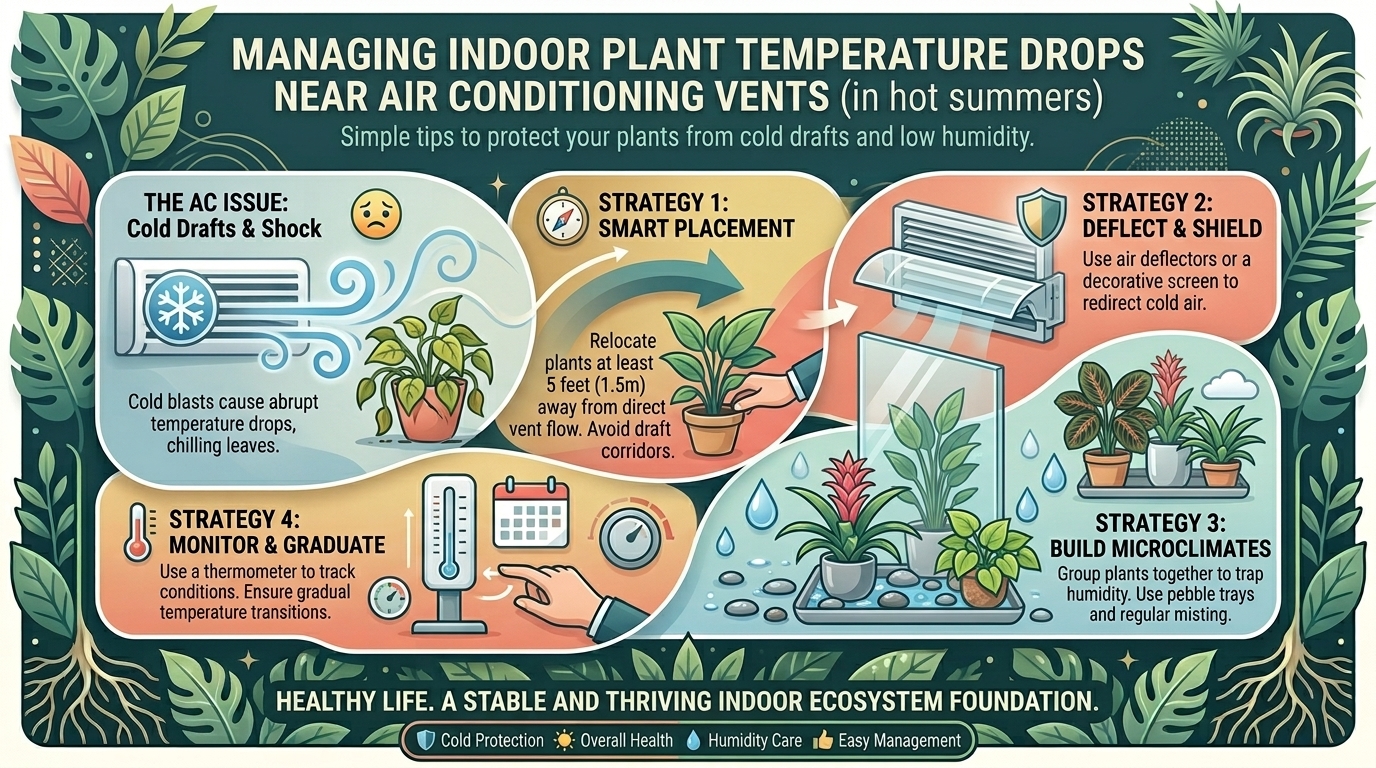
Step 1: The “Hand Test” Audit
Turn on your air conditioning and walk through your plant spaces. Hold your hand out at plant level near every vent, register, ceiling diffuser, and window unit. If you feel moving air, you are in the AC Danger Zone.
Step 2: Relocate Vulnerable Tropicals
Move sensitive tropicals (like Calatheas, Ferns, Alocasias, and Anthuriums) completely out of the direct path of airflow. Place them along interior walls or corners where air circulates gently rather than blowing directly.
Step 3: Install Deflector Vents (Clear Plastic Air Diverters)
If moving the plant is impossible due to floor space or heavy furniture layout, purchase magnetic or adhesive AC vent deflectors. These clear plastic shields snap over floor or wall registers, redirecting the stream of chilled air horizontally across the ceiling or floor rather than straight up into your plant canopy.
Step 4: Group Plants to Create a Humidity Buffer
Cluster your houseplants closely together. Grouping plants creates a shared micro-climate, trapping a cushion of higher humidity and ambient warmth between the leaves that buffers against sudden cold drafts.
Step 5: Increase Local Ambient Humidity
Because AC units strip moisture from the air, counteract the dryness by running a small ultrasonic cool-mist humidifier near your plant collection, or set pots on pebble trays filled with water.
5. Frequently Asked Questions (FAQ)
1. Can air conditioning kill a healthy houseplant?
Yes, prolonged exposure to a direct, freezing AC draft can severely shock tropical plants, leading to massive leaf drop, root dysfunction, and eventual plant death if not corrected.
2. What are the most AC-sensitive houseplants?
Thin-leaved tropicals are the most vulnerable, including Calatheas, Ferns, Fiddle Leaf Figs (Ficus lyrata), Alocasias, and Banana Plants. Thicker, hardier succulents and snake plants tolerate drafts much better.
3. How far away should my plants be from an active AC vent?
As a general rule of thumb, keep delicate tropical plants at least 5 to 8 feet away from direct floor registers, window AC units, or commercial mini-split blowers.
4. Are ceiling fans just as dangerous to plants as AC vents?
Ceiling fans create gentle, circulating ambient air movement, which is actually beneficial for strengthening plant stems. However, if a high-speed fan combines with a cold AC draft, it can rapidly dehydrate leaves. Keep fans on low speed.
5. Why are the leaves on my Fiddle Leaf Fig dropping right after turning brown near the AC?
Fiddle Leaf Figs are notoriously dramatic about environmental changes. A cold AC draft shocks their vascular system, causing them to shed lower leaves in protest. Relocate the tree immediately.
6. Can I use a humidity dome or greenhouse cabinet to protect plants from AC?
Yes! Placing sensitive tropical propagations or humidity-loving terrarium plants inside glass cabinets or clear greenhouse tents completely shields them from harsh HVAC drafts and dryness.
7. Should I water my plants less often when the AC is running?
Not necessarily. While the air is drier, soil evaporation rates can vary. Always check soil moisture with your finger before watering, ensuring you don’t underwater a plant whose roots are healthy.
8. Do mini-split AC units pose a higher risk than central air?
Yes, wall-mounted mini-split units often blow a concentrated, high-velocity stream of chilled air directly across a specific zone in a room. Never place a plant stand directly underneath or opposite a mini-split blower.
9. What should I do if my plant has already suffered cold shock from an AC vent?
Prune away severely damaged, dead, or yellowing leaves to redirect the plant’s energy, move it to a warm, draft-free spot with bright indirect light, and avoid fertilizing until it shows signs of active new recovery.
10. Do outdoor plants brought indoors for summer face AC shock?
Absolutely! If you bring patio tropical plants back indoors to escape a heatwave, placing them straight into an ice-cold AC draft will shock them doubly. Acclimate them gradually over a few days.
Conclusion
Managing indoor plant temperature drops near air conditioning vents during hot summers is essential for maintaining a lush, vibrant indoor jungle. By understanding how thermal shock and dry AC drafts impact tropical foliage, auditing your room layouts, and utilizing vent deflectors and humidifiers, you can enjoy a cool, comfortable home while keeping your plants safe and thriving.