Living in a stunning urban apartment comes with many perks, but it often introduces a major botanical challenge: limited natural light. Whether you reside in high-rises blocking the horizon in New York or San Francisco, dense neighborhoods in Washington or Los Angeles, or shaded architectural canyons across Texas, finding greenery that survives—let alone thrives—in a dim, north-facing room can feel impossible.
North-facing windows receive the weakest, most indirect natural light in any building. They never catch direct sunbeams, and sunlight levels drop off drastically just a few feet away from the glass.
However, dim doesn’t mean dead. Many resilient tropical understory and shade-adapted plants have evolved to flourish in environments where sunlight is scarce. This comprehensive guide explores the absolute best low-light indoor houseplants for dark north-facing apartments, along with essential care tips to keep your indoor jungle thriving.
1. Understanding North-Facing Light Dynamics
Before selecting your plants, it is crucial to understand what “low light” actually means for a houseplant.
- The North-Facing Reality: Light from a north-facing window is cool-toned and weak. Plants placed directly on the windowsill receive diffuse, indirect daylight, while plants placed more than four feet back are effectively living in deep shade.
- The Danger of Overwatering in Low Light: Because low-light spaces lack intense solar energy, plants transpire and dry out much slower than they would in a south- or west-facing room. The single biggest killer of low-light apartment plants is root rot caused by maintaining a regular watering schedule meant for bright sun.
2. The Absolute Best Low-Light Houseplants for North-Facing Rooms
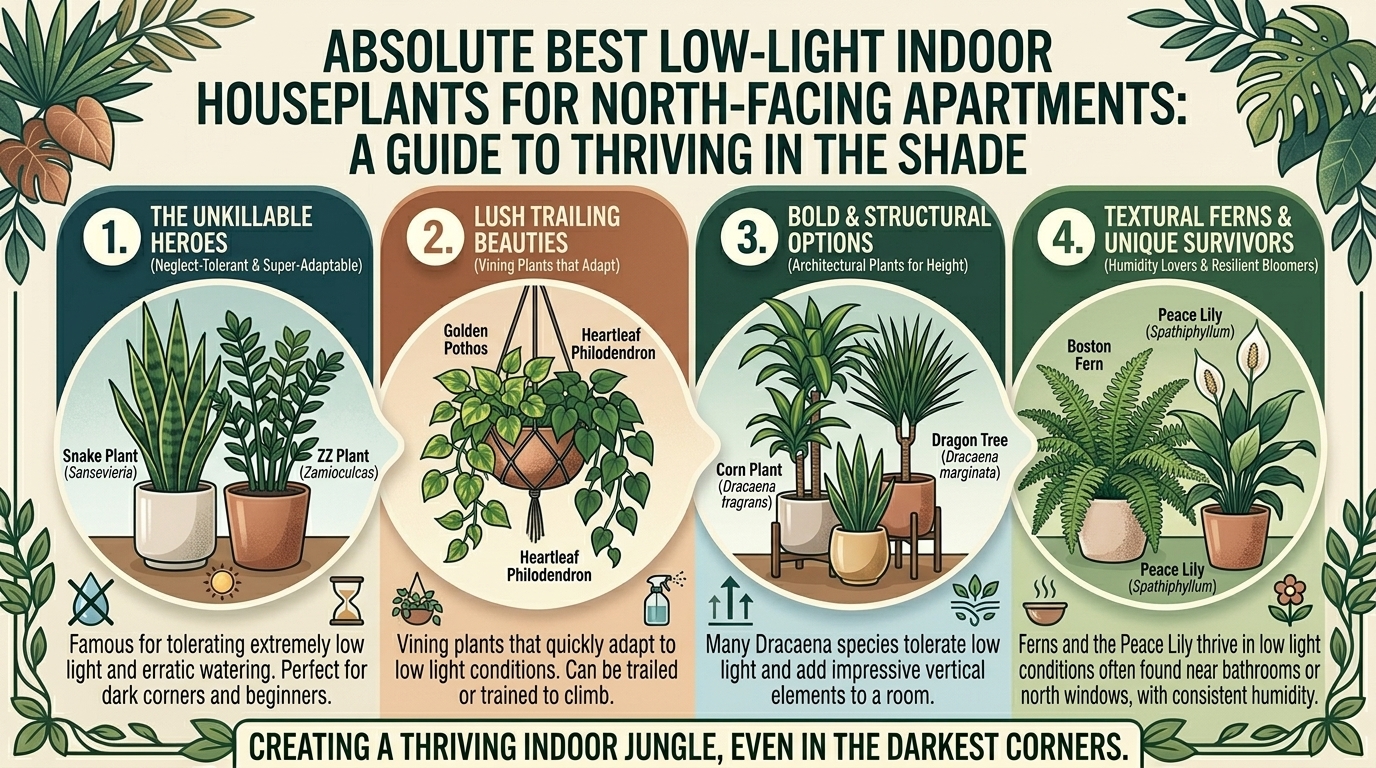
I. The ZZ Plant (Zamioculcas zamiifolia)
Widely regarded as the ultimate low-light champion, the ZZ plant is virtually indestructible. Native to the dry regions of eastern Africa, it stores water in thick underground potato-like rhizomes. Its glossy, waxy leaves naturally reflect what little light is available in a dim room.
- Why it thrives in north rooms: It tolerates deep shade, ignores irregular watering, and handles office or apartment fluorescence with ease.
- Pro Tip: Water only once every 3 to 4 weeks once the soil is bone-dry.
II. Snake Plant (Sansevieria / Dracaena trifasciata)
Featuring striking, architectural, sword-like leaves, snake plants are architectural marvels that handle low-light apartments effortlessly. They are also legendary air-purifiers, converting carbon dioxide into oxygen at night.
- Why it thrives in north rooms: Their succulent nature means they require minimal energy and water to maintain their striking upright posture.
- Pro Tip: Let the soil dry out completely for 4 to 6 weeks between waterings. Overwatering is the only way to ruin a snake plant.
III. Golden Pothos (Epipremnum aureum)
If you want trailing vines to drape across bookshelves or kitchen cabinets, the Golden Pothos is your best option. It is exceptionally forgiving and adapts rapidly to low-light corners.
- Why it thrives in north rooms: While heavily variegated cultivars need brighter light to maintain their bright patterns, solid green or slightly marbled pothos adapt seamlessly to northern exposures.
- Pro Tip: Pinch back trailing stems periodically to encourage bushier growth rather than long, leggy vines.
IV. Cast Iron Plant (Aspidistra elatior)
Named for its legendary resilience, the Cast Iron plant was a Victorian-era favorite for dimly lit corridors and parlors. It features dark green, strap-like leaves that withstand profound neglect, dust, and dark corners.
- Why it thrives in north rooms: It evolved on the dark floors of dense Asian forests, making it uniquely adapted to almost zero direct sunlight.
- Pro Tip: Wipe its broad leaves with a damp cloth every month to clear away dust and maximize light absorption.
V. Chinese Evergreen (Aglaonema)
Chinese evergreens are exceptionally adaptable and offer a splash of color for dark apartments, with varieties featuring silver, pink, or deep red markings.
- Why it thrives in north rooms: They tolerate dim indoor spaces far better than most other colored foliage plants and forgive irregular watering cycles.
- Pro Tip: Choose darker green cultivars for the lowest-light corners, as heavily pink or white varieties prefer a bit more ambient brightness to maintain their vibrant coloration.
3. Essential Maintenance Tips for Dark Apartments
- Slow Down Your Watering Cadence: In north-facing rooms, soil stays damp much longer. Always test soil moisture with your finger or a wooden moisture meter 2 to 3 inches deep before watering.
- Clean Dust Frequently: Dust acts as a physical solar panel blockage. Wipe leaves clean regularly to help your plants capture every available photon.
- Rotate Your Pots Every Month: Because light comes exclusively from one direction in a north-facing window, plants tend to lean sideways. Rotate pots 90 degrees monthly to maintain a balanced, upright shape.
- Consider Supplemental Grow Lights: If your apartment faces deep interior courtyards or brick walls blocking all sky views, supplementing with a full-spectrum LED grow bulb in a standard desk lamp will keep your plants looking lush and vibrant.
Frequently Asked Questions (FAQ)
1. Can any plant survive in a room with zero windows (like an interior hallway or bathroom)?
No living plant can survive indefinitely without some light source. In windowless rooms, you must rely on full-spectrum LED grow bulbs left on for 8 to 12 hours a day, or choose artificial silk plants.
2. Why are the leaves on my Pothos turning solid green and losing their variegation?
Variegated plants need light energy to maintain their white or yellow patterns. In a dark north-facing room, a plant may revert to solid green to maximize its chlorophyll production.
3. How often should I fertilize plants in a north-facing apartment?
Fertilize much less frequently—typically just once or twice a year during spring and summer. Because low light slows down plant metabolism, excess fertilizer builds up in the soil and burns the roots.
4. Will my low-light plants grow as fast as plants in south-facing rooms?
No. Low light means slower growth rates. Your plants will survive and maintain their health, but they will produce new leaves much more slowly.
5. Are low-light plants safe for cats and dogs?
It depends on the species. ZZ plants and snake plants are toxic if ingested by pets, whereas Cast Iron plants and certain palms are pet-safe. Always verify toxicity if you have curious pets.
6. Why is the soil staying wet for over a month in my apartment?
North-facing rooms have lower evaporation rates, and standard potting mixes often hold too much moisture. Repotting into a fast-draining mix blended with perlite or orchid bark solves this issue.