Why Growing Marigolds Around the Perimeter of Your Garden Naturally Deters Harmful Nematodes and Bugs
Welcome back to kcplants.com, your definitive online hub for smart, sustainable, and science-backed gardening strategies. From cultivating backyard vegetable patches under the intense sun of Texas and California, to setting up high-yield urban raised beds in New York, San Francisco, and the misty, moisture-rich valleys of Washington, every grower shares a common goal: protecting a harvest from destructive pests without dousing the soil in harsh synthetic chemicals.
Few plants capture the imagination of home gardeners quite like the humble marigold (Tagetes species). Bright, cheerful, and remarkably resilient, marigolds are frequently touted across gardening books and websites as the ultimate companion plant—a living protective perimeter that keeps bugs at bay and cleanses the soil. But how much of this is garden folklore, and how much is hard science?
This comprehensive guide explores the fascinating mechanisms behind marigolds, what science actually says about their ability to deter harmful nematodes and bugs, and how you can strategically deploy them to transform your garden ecosystem.
Part 1: The Legend vs. The Reality of Marigold Companion Planting
Walk into any plant nursery in spring, and you will find flats of vibrant yellow, orange, and red marigolds marketed as natural pest-repellent shields. While older gardening lore suggests that simply scattering marigolds randomly around your vegetable garden creates an impenetrable “scented force field” against all insects, modern horticultural science reveals a more nuanced truth.
What Marigolds Do Not Do
- They are not an all-purpose insect repellent: Simply planting marigolds next to your tomatoes will not magically stop airborne pests like aphids or loopers from finding your crops. In fact, certain varieties can occasionally attract spider mites if conditions become too dry.
- They don’t repel by scent alone: While crushed marigold foliage releases a pungent, distinct aroma containing compounds like limonene and alpha-terthienyl, casual breezes blowing across a border of flowers will not deter mobile, flying insects from crossing into your garden beds.
What Marigolds Do Exceptionally Well
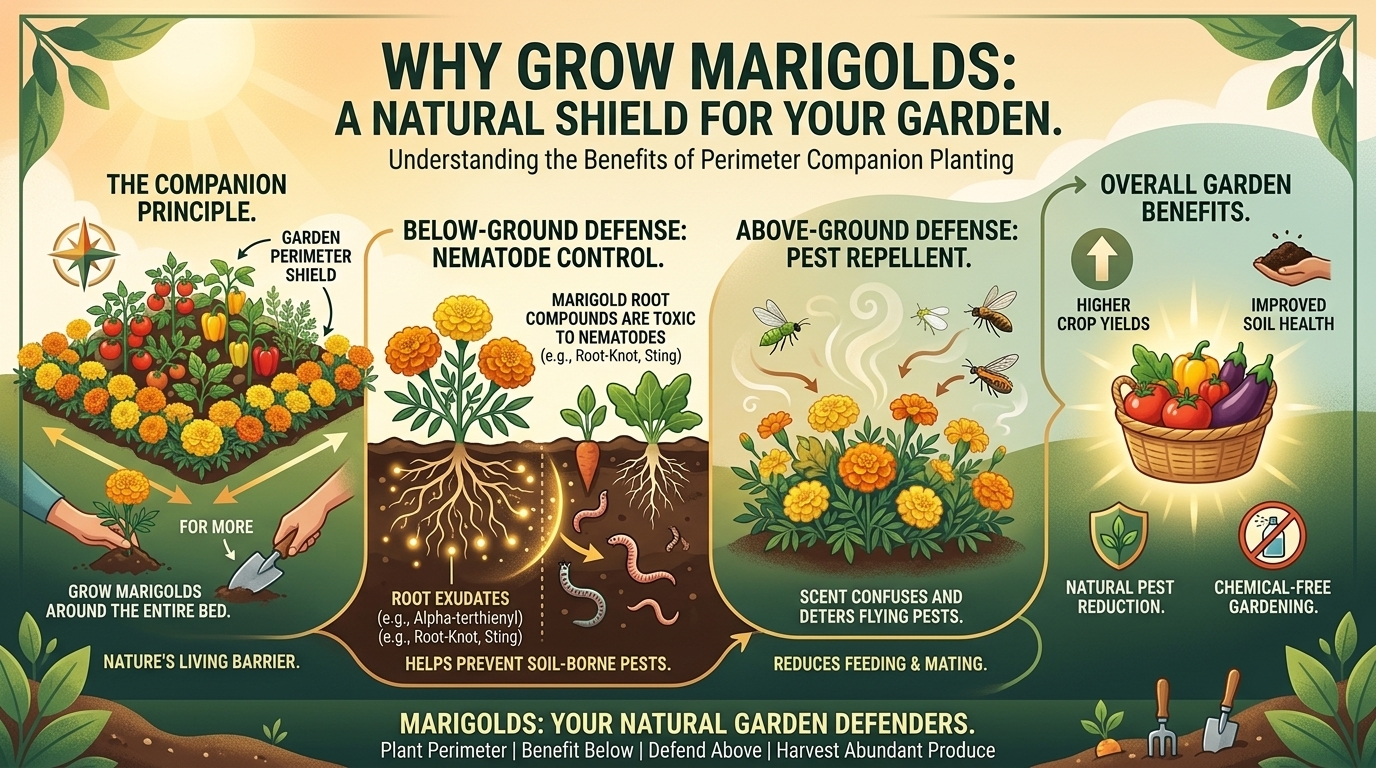
Where marigolds truly shine—and where science backs up their legendary status—is underground. Specific species of marigolds are biological powerhouses when it comes to suppressing parasitic root-knot nematodes and attracting beneficial predatory insects above ground.
Part 2: The Underground Weapon—How Marigolds Combat Harmful Nematodes
Root-knot nematodes (Meloidogyne species) are microscopic, unsegmented roundworms that live in the soil. They are among the most frustrating soil-borne pests for vegetable gardeners across California, Texas, and southern microclimates. These stealthy pests tunnel into plant roots, injecting secretions that cause galls, knots, and blockages, effectively starving tomatoes, peppers, carrots, and potatoes of water and nutrients.
This is where marigolds perform their most famous magic trick, driven by root chemistry:
1. The Natural Nematicide (Alpha-Terthienyl)
Active roots of specific marigold varieties synthesize and exude a natural biochemical compound called alpha-terthienyl into the surrounding soil. This compound is toxic to plant-parasitic nematodes, suppressing their populations and disrupting their life cycles.
2. The Trap Crop Mechanism
Marigolds act as a specialized “trap crop”. Root-knot nematodes are naturally attracted to the roots of the marigold and will migrate toward them and burrow inside. However, once inside the marigold root tissue, the plant’s internal chemistry and natural nematicides prevent the nematodes from feeding, developing, or reproducing. The pest enters, gets trapped, and dies out, breaking the infestation cycle.
Crucial Catch: Species Matter
Not all marigolds are created equal. If your goal is nematode control, standard African marigolds (Tagetes erecta) or ornamental triploid hybrids are largely ineffective. You must plant French marigolds (Tagetes patula), particularly proven cultivars bred for high alpha-terthienyl production such as ‘Nema-gone’, ‘Sparky’, or ‘Petite Gold’.
Part 3: Above-Ground Benefits—Bugs, Pollinators, and Beneficial Predators
While perimeter marigolds may not act as an invisible chemical fence against every flying insect, they provide vital ecological support that keeps your garden balanced through Integrated Pest Management (IPM).
- Attracting Beneficial Predators: The bright, open-faced blossoms of single-petal marigolds are absolute magnets for beneficial insects. Ladybugs, lacewings, hoverflies, and tiny parasitic wasps feed on marigold nectar and pollen. Once established in your perimeter, these predatory beneficial insects launch counter-offensives against destructive above-ground pests like aphids, thrips, and scale.
- Pollinator Powerhouses: Essential pollinators like native bees and butterflies are drawn to your garden by the vibrant colors of your marigold borders, improving the fruit set and yield of neighboring tomatoes, squash, cucumbers, and peppers.
- Sacrificial Trap Cropping for Slugs: In regions with damp springs—like Washington and coastal California—slugs and snails are notorious for attacking tender greens. Planting a low border of marigolds can sometimes draw slugs away from prized vegetables, acting as a sacrificial barrier where pests can be hand-picked at night.
Part 4: How to Strategically Design a Marigold Perimeter
To maximize the benefits of marigolds, you need to move beyond the “polka-dot mistake” (randomly scattering a few seeds here and there) and execute an intentional layout:
- Build a Solid Border: Plant your French marigolds in a dense, continuous line or double-row around the entire perimeter of your raised beds or garden plots. Spacing them roughly 7 to 10 inches apart ensures their root systems form an overlapping subterranean net.
- Commit to True Cover Cropping for Nematodes: If you are dealing with a severe root-knot nematode infestation, simple border planting won’t be enough. Professional growers utilize a “marigold cover crop” strategy: plant a dense bed entirely with French marigolds (‘Nema-gone’) for 2 to 3 months, letting them saturate the soil with root exudates before chopping and turning them into the soil.
- Match Your Climate:
- In warm southern zones (Texas, California), plant marigolds early in spring to establish deep root systems before summer heat peaks.
- In cooler northern zones (New York, Washington), start seeds indoors 4 to 6 weeks before your final frost date so mature, blooming plants can go straight into the ground once soil temperatures warm up.
Part 5: Frequently Asked Questions (FAQ)
1. Do marigolds repel all garden pests?
No. Marigolds are specific in their deterrent capabilities. While they help suppress root-knot nematodes and attract beneficial predators that eat aphids, they do not repel every insect. In fact, spider mites are frequently attracted to stressed marigolds and can spread to nearby crops.
2. Which marigold variety is best for controlling nematodes?
French marigolds (Tagetes patula) are scientifically proven to be the most effective species for nematode control. Specific cultivars like ‘Nema-gone’, ‘Sparky’, and ‘Petite Gold’ produce the highest concentrations of root-exuded nematicides.
3. Will planting marigolds around the edge of a raised bed protect the entire bed?
Perimeter planting is fantastic for establishing a beneficial insect habitat and adding visual beauty, but for subterranean root-knot nematodes, a border only protects the soil immediately surrounding those specific plant roots. For total soil treatment, interplanting or solid block rotation is required.
4. Can I use marigold flowers and leaves to make a DIY bug spray?
Yes. Some gardeners steep crushed marigold leaves and flowers in water with a drop of mild dish soap to create a homemade botanical spray. While it can act as a mild deterrent for certain soft-bodied insects, always test it on a single leaf first to prevent foliar burn.
5. Do marigolds repel rabbits and deer?
Marigolds possess a strong, pungent scent that most rabbits and deer dislike, making them a moderately successful deterrent when planted as a border. However, if wildlife populations are starving, hungry deer will readily munch on marigold blooms.
6. Do I need to deadhead marigolds to keep them working?
Deadheading (removing spent, dying flowers) is not strictly required for pest control, but it encourages the plant to continuously produce fresh blooms through autumn, keeping beneficial pollinators visiting your garden for months.
7. Can marigolds grow well in containers and pots?
Yes! Marigolds thrive in pots, window boxes, and containers. If you are gardening on a sunny apartment balcony in San Francisco or New York, planting marigolds around larger container vegetables adds color while drawing beneficial insects to your limited space.
8. Are marigolds edible?
Yes, certain varieties of marigolds—specifically signet marigolds (Tagetes tenuifolia)—produce edible flowers and leaves with a citrusy, slightly peppery flavor. Always verify that your seeds are grown organically and free from synthetic pesticides before consuming them.
9. What vegetables benefit the most from marigold companions?
Tomatoes, eggplants, potatoes, and peppers—crops heavily susceptible to soil nematodes and whiteflies—benefit the most from being grown near or alongside French marigolds.
10. Do marigolds come back every year, or do I need to replant them?
Marigolds are tender annuals in most climate zones, meaning they complete their lifecycle in a single season. They do, however, drop plenty of seeds at the end of autumn, often resulting in a cheerful surprise crop of volunteers the following spring.
Conclusion
Marigolds are far more than just a colorful addition to a garden border. While they may not function as an all-powerful magic shield against every bug in your zip code, their unique subterranean chemistry makes them an exceptional, science-backed tool for managing harmful root-knot nematodes and welcoming beneficial predators into your yard. By choosing the right French varieties, establishing intentional perimeters, and practicing smart soil management, you can harness the power of nature to protect your harvest from coast to coast.