When you pick up a bag of standard potting mix or seed-starting soil from your local garden center, you are almost certainly buying a product dominated by sphagnum peat moss. For decades, peat moss has been hailed as the golden standard of horticulture. It is lightweight, holds massive amounts of moisture, and creates fluffy, workable garden beds.
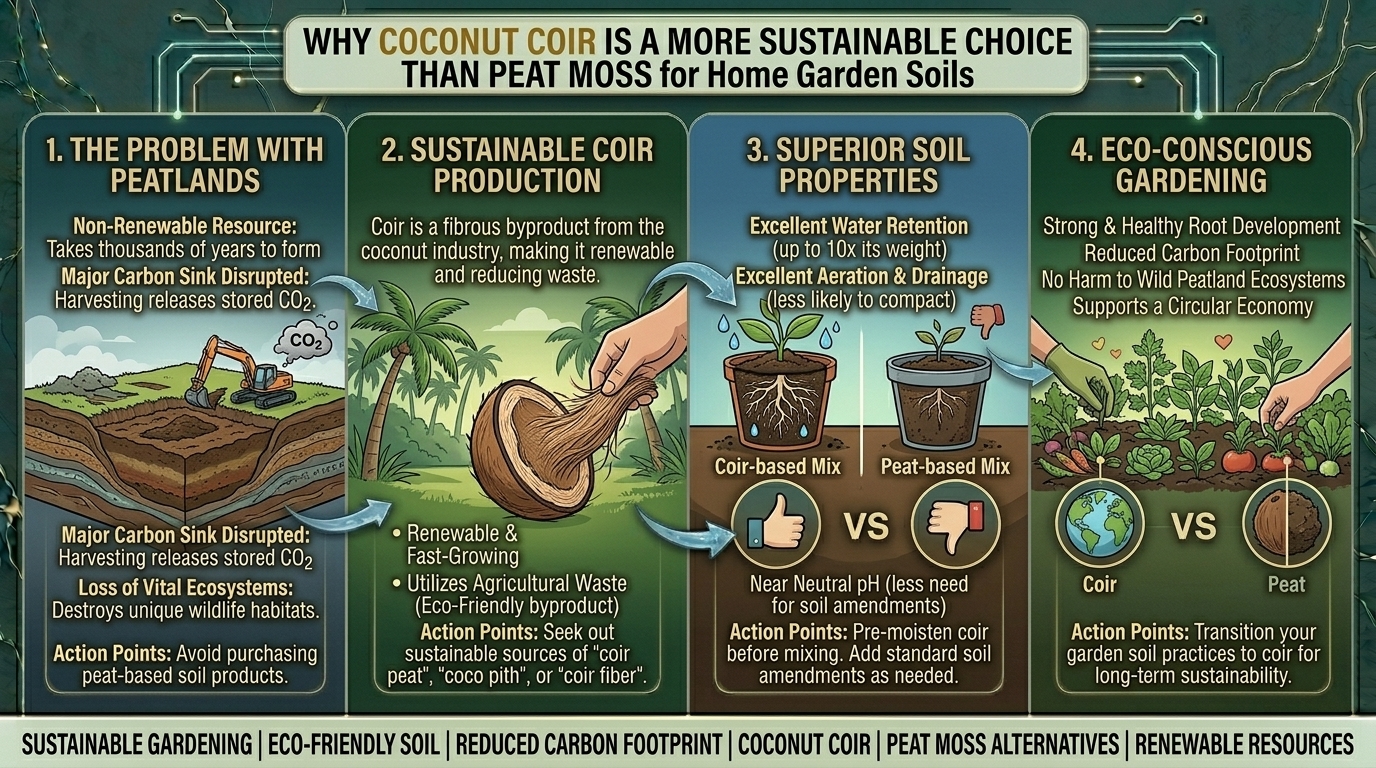
However, behind its clean, innocent brown appearance lies a profound ecological contradiction. Peat moss is mined from ancient peat bogs—fragile, wetland ecosystems that act as the Earth’s most efficient carbon sinks. Harvesting peat destroys these habitats in minutes and releases millennia of trapped carbon dioxide back into the atmosphere, accelerating global climate change.
As modern home gardeners wake up to this ecological reality, the search for sustainable alternatives has taken center stage. Among them, coconut coir has emerged as the reigning champion.
Whether you are mixing soil for raised beds in Texas, managing container plants on a New York apartment balcony, cultivating drought-smart gardens in California, protecting wet-winter beds in Washington, or terracing urban garden spaces in San Francisco, switching to peat-free alternatives like coco coir is a game-changer.
This comprehensive, masterclass-grade guide explores why peat moss alternatives are superior for sustainable home garden soil mixtures, how they perform scientifically, and how you can integrate them into your own landscape.
Chapter 1: The Hidden Environmental Cost of Peat Moss
To understand why alternatives are necessary, we must first look at what peat moss actually is and how it is harvested.
1. What is Peat Moss?
Peat moss is not just regular moss; it is a complex accumulation of partially decayed organic plant material (primarily Sphagnum species) that builds up over thousands of years in oxygen-poor, waterlogged bog environments.
- The Formation Timeline: Peat bogs accumulate at a agonizingly slow rate—roughly 0.5 millimeters to 1 millimeter per year. A single foot of peat represents 300 years of planetary history; a deep bog represents millennia. Because it regenerates at a fraction of the speed at which it is commercially harvested, peat moss is classified as a non-renewable resource.
2. The Carbon Bomb in the Bogs
Peatlands cover only about 3% of the Earth’s land surface, yet they store an estimated 30% of all global soil carbon.
- When commercial harvesters drain a peat bog to access the dry peat layers beneath, the exposed organic matter oxidizes rapidly.
- Millions of tons of ancient carbon dioxide and methane are released directly into the atmosphere, turning a vital carbon sink into a net carbon source. Furthermore, the destruction of these bogs obliterates rare wetland biodiversity and natural water filtration buffers.
Chapter 2: Enter Coconut Coir: The Sustainable Powerhouse
If peat moss is environmentally unsustainable, what makes coconut coir (coco coir) the premier alternative?
1. A True Byproduct of the Global Coconut Industry
Coconut coir is manufactured from the coarse fibrous material found between the hard internal shell and the outer coating of a coconut.
- Historically, these massive piles of coconut husks were discarded as agricultural waste, clogging landfills or burning openly.
- Today, recycling these husks into horticultural coir transforms industrial waste into a high-performance growing medium. Coconuts are harvested annually from living palms that bear fruit year after year, making coir a genuinely renewable, sustainable resource.
2. Physical and Chemical Advantages of Coco Coir
Beyond its stellar ecological credentials, coco coir often outperforms traditional peat moss in day-to-day gardening applications:
[Side-by-Side Property Comparison]
  ├── pH Level:
  │     ├── Coco Coir: 5.5 to 6.5 (Naturally Near-Neutral / Plant-Friendly)
  │     └── Peat Moss: 3.5 to 4.5 (Highly Acidic / Requires Lime Adjustment)
  ├── Rehydration:
  │     ├── Coco Coir: Spongy & Hydrophilic (Re-wets effortlessly when dry)
  │     └── Peat Moss: Hydrophobic (Becomes water-repellent when completely dry)
  └── Aeration & Structure:
        ├── Coco Coir: Maintains natural air pockets; resists long-term compaction
        └── Peat Moss: Tends to pack down tightly over time, suffocating root zones
- Natural pH Balance: Peat moss is aggressively acidic (pH 3.5 to 4.5), which means gardeners must constantly add agricultural lime to raise the pH for standard vegetables and flowers. Coco coir sits comfortably at a near-neutral pH of 5.5 to 6.5, right in the sweet spot for almost all common garden plants.
- The Rehydration Factor: Anyone who has let a bag of dry peat moss dry out knows the frustration of pouring water over it, only for the water to bead up and run off the surface (hydrophobicity). Coco coir absorbs water instantly upon contact, even when bone dry.
Chapter 3: Regional Gardening Realities: Texas, New York, California, Washington, and San Francisco
Soil amendment choices carry unique regional implications across our core communities:
1. Texas (Beating Summer Heat and Managing Heavy Native Clay)
- The Challenge: Texas gardeners deal with intense summer heat waves that bake soils and dry out containers instantly, alongside heavy, sticky native clay that suffocates plant roots.
- The Coir Solution: Blending coco coir into Texas container and raised bed soils creates a resilient moisture reservoir that buffers plants against scorching triple-digit temperatures. Unlike peat—which can form a hard, baked crust when dry—coir stays crumbly, porous, and receptive to irrigation.
2. New York (Container Gardening and Urban Rooftop Spaces)
- The Challenge: New York gardeners rely heavily on pots, raised containers, and rooftop setups where soil weight and long-term compaction are major concerns.
- The Coir Solution: Coco coir is lightweight and maintains structural air pockets over multiple seasons without breaking down or compacting into a dense brick. This gives urban root systems the oxygen they need in tight container environments.
3. California (Water Conservation and Drought-Smart Landscaping)
- The Challenge: California’s strict water conservation mandates mean every drop of irrigation water counts. Gardeners need soil amendments that maximize moisture retention without waterlogging.
- The Coir Solution: Coco coir holds up to 8 to 10 times its weight in water while maintaining superior aeration, drastically reducing runoff and helping plants survive dry spells during municipal watering restrictions.
4. Washington (Balancing Wet Winters and Drainage)
- The Challenge: Western Washington experiences months of heavy, continuous winter rain. Soil mixes that retain too much stagnant water cause root rot in delicate perennial plants.
- The Coir Solution: Coco coir strikes the ideal balance: it holds internal moisture for summer while shedding excess gravitational water freely during winter downpours, preventing soggy, waterlogged root zones.
5. San Francisco (Microclimate Container Growing and Urban Ecology)
- The Challenge: San Francisco’s cool maritime climate, rolling fog, and varied urban microclimates require soils that resist fungal stagnation and adapt to diverse container crops.
- The Coir Solution: By choosing peat-free coco coir, San Francisco gardeners align their home horticulture with the city’s rigorous zero-waste and environmental protection ethos, all while giving urban balcony plants a disease-resistant, pH-stable root medium.
Chapter 4: Other Noteworthy Peat-Alternative Soil Amendments
While coco coir is the star alternative, sustainable gardening thrives on diversity. Consider incorporating these complementary peat-free ingredients into your custom soil mixes:
1. Compost and Worm Castings
- The Role: Provides rich, biological life, diverse micro-nutrients, and slow-release fertility. Compost acts as the living engine of your soil mixture.
2. Rice Hulls
- The Role: An agricultural byproduct of the rice milling industry, parboiled rice hulls are a fantastic, sustainable substitute for perlite. They improve soil drainage and aeration, breaking down slowly over several years.
3. Aged Wood Fiber and Bark Fines
- The Role: Shredded wood fiber and fine composted pine bark add structural longevity to potting mixes, creating permanent macro-pore channels that allow oxygen to circulate deep around plant roots.
Chapter 5: How to Mix and Buffer Coco Coir for Your Garden
Because coco coir is completely inert and sometimes retains natural salts from coastal processing, proper preparation is essential before mixing it into your garden.
[Step-by-Step Coir Preparation Protocol]
  ├── Step 1: Rehydrate compressed coco coir bricks with warm water.
  ├── Step 2: Rinse thoroughly (if unwashed) to flush out excess potassium/sodium.
  ├── Step 3: Buffer with Cal-Mag (Calcium-Magnesium) if required.
  └── Step 4: Blend with 30% compost, 20% perlite/rice hulls, and native soil.
Step-by-Step Preparation Protocol:
- Rehydration: Place your compressed coco coir brick in a large wheelbarrow or storage bin and add warm water. Watch it expand 4 to 5 times its original size within minutes.
- Rinsing (Crucial for Low-Quality Coir): If your coir was processed near seawater, it may contain high levels of sodium and potassium. Place the rehydrated coir in a porous mesh bag or colander and rinse it thoroughly with fresh water.
- Buffering: High-quality commercial coir is pre-buffered with calcium and magnesium. If using raw or unbuffered coir, soak it in a weak solution of a Cal-Mag supplement to prevent the coir from locking up vital calcium in your soil.
- The Ultimate Sustainable Soil Recipe:
- 40% Coco Coir (for moisture retention and structure)
- 30% Finished Compost or Worm Castings (for microbial life and nutrients)
- 20% Perlite or Rice Hulls (for maximum aeration and drainage)
- 10% Native Garden Soil (to bridge biology and acclimate plants)
Chapter 6: 10 Frequently Asked Questions (FAQs)
1. Is coconut coir really more sustainable than peat moss?
Yes. Coconut coir is a renewable annual byproduct of the global coconut farming industry, turning agricultural waste into a valuable resource. Peat moss is harvested from non-renewable ancient bogs whose destruction releases massive amounts of carbon dioxide into the atmosphere.
2. Does coco coir hold as much water as peat moss?
Coco coir holds slightly less total water by extreme volume than fresh peat moss, but it strikes a vastly superior balance between water retention and root aeration. It holds ample moisture while preventing the waterlogged, compacted conditions common to wet peat.
3. What is the pH difference between coir and peat moss?
Coco coir is naturally near-neutral with a pH of 5.5 to 6.5, which is ideal for almost all vegetables, herbs, and flowers. Peat moss is highly acidic with a pH of 3.5 to 4.5, requiring heavy applications of lime to neutralize for general gardening.
4. Can dried coco coir rehydrate easily if I forget to water my pots?
Yes. Unlike peat moss—which becomes hydrophobic (water-repellent) when allowed to dry out completely—coco coir re-wets effortlessly, absorbing water instantly upon your next watering cycle.
5. Does coco coir contain any natural plant nutrients?
Coco coir is largely an inert growing medium, meaning it does not supply significant nitrogen, phosphorus, or potassium on its own. You must supplement your mix with organic compost, worm castings, or balanced organic fertilizers.
6. Do I need to rinse or buffer raw coco coir before using it?
If you purchase unwashed bulk coir, rinsing is recommended to remove residual sodium and potassium salts. Premium horticultural coir is usually pre-washed and pre-buffered with calcium and magnesium for immediate use.
7. How long does coco coir last in a garden bed or container?
Coco coir resists physical breakdown significantly longer than peat moss. While peat collapses and compacts within 1 to 2 seasons, coco coir maintains its fibrous structural integrity for 3 to 4 years or more in pots and raised beds.
8. Are there any plants that prefer peat moss over coco coir?
Acid-loving plants—such as blueberries, azaleas, rhododendrons, and camellias—thrive in the low pH environment of peat moss. However, you can easily grow these in coco coir by adding elemental sulfur to lower the pH naturally.
9. Why do commercial potting soils still use so much peat moss?
Traditional commercial soil manufacturers rely on peat moss out of legacy habit, established supply chain logistics, and low upfront raw material costs, despite the severe environmental degradation associated with its extraction.
10. Can I mix coco coir directly into heavy native clay soil?
Yes. Blending coco coir into clay soils breaks up dense mineral particles, improves oxygen penetration, and creates the micro-porosity required for healthy, sprawling root development.
Conclusion: Make the Switch to Peat-Free Gardening
Switching from non-renewable peat moss to sustainable alternatives like coconut coir is one of the most impactful choices an eco-conscious home gardener can make. Not only does it protect ancient wetland carbon sinks from destruction, but it also provides your plants with a superior growing environment featuring a natural pH balance, effortless rehydration, and long-lasting aeration.