How to Get Rid of Fungus Gnats Buzzing Around Your Indoor Potted Plants Using Hydrogen Peroxide
Welcome to kcplants.com, your trusted guide for cultivating a thriving indoor jungle. Whether you are nurturing delicate ferns in a humid apartment in Washington, managing a sprawling collection of tropicals in New York or San Francisco, or keeping your potted greens vibrant through warm seasons in California and Texas, there is one pesky nuisance that every plant parent encounters sooner or later: fungus gnats.
You know the drill. You walk past your favorite Monstera or Peace Lily, brush against the pot, and suddenly a small cloud of irritating, tiny black bugs flutters up, dancing annoyingly around your face. While adult fungus gnats are harmless creatures that do not bite or damage foliage directly, they are a loud, obnoxious sign of an underground crisis. Their transparent, worm-like larvae are living in your potting mix, chewing away at tender root hairs and organic matter.
If you are looking for a fast, inexpensive, chemical-free, and science-backed solution hiding right in your medicine cabinet, look no further than standard household hydrogen peroxide. This comprehensive guide will show you how to safely use hydrogen peroxide to wipe out fungus gnat larvae, protect your plant roots, and reclaim your indoor oasis.
Part 1: Anatomy of an Infestation (Why Do You Have Fungus Gnats?)
To beat the gnats, you have to understand their life cycle and what draws them indoors. Fungus gnats (Sciaridae family) thrive in environments where soil stays consistently wet and rich in organic matter.
The 4-Stage Life Cycle
- The Egg: Female adult gnats lay up to 200 tiny white eggs in the top 1 to 2 inches of moist, nutrient-rich potting soil.
- The Larva (The Real Culprit): Within a few days, eggs hatch into translucent, legless larvae with shiny black heads. They feed voraciously on soil fungi, decaying organic matter, and most dangerously, the tender root hairs of your houseplants.
- The Pupa: After about two weeks, larvae spin cocoons in the soil to pupate.
- The Adult: Fully formed gnats emerge from the soil. Adults live for only about a week, but their sole purpose during that brief lifespan is to mate and lay hundreds of new eggs, keeping the vicious cycle spinning.
Why Indoor Homes Are Prime Real Estate
- Overwatering: The number one cause of fungus gnats is keeping potting soil damp all the time.
- Heavy Organic Soil: Peat-heavy or compost-rich soils hold onto moisture longer, creating a breeding heaven for gnat larvae.
- Winter Climate Controls: During chilly months in northern regions like New York and Washington, indoor heating keeps soil damp and warm concurrently, allowing gnats to reproduce uninterrupted year-round.
Part 2: How Hydrogen Peroxide Destroys Fungus Gnats
Standard household hydrogen peroxide (the common 3% brown bottle found in pharmacies) is an unstable compound consisting of water ($H_2O_2$) with an extra oxygen atom attached.
When you apply a diluted hydrogen peroxide solution to your potted plant’s soil, a fascinating chemical reaction occurs:
- Oxidation and Effervescence: The peroxide immediately fizzes upon contact with organic matter, bacteria, and catalase enzymes present in the soil.
- Targeted Destruction: This fizzing action creates micro-oxidation that instantly punctures and destroys the soft, unprotected cell membranes of fungus gnat larvae on contact.
- Root Aeration Bonus: Once the peroxide breaks down, it safely degrades into plain water ($H_2O$) and pure oxygen ($O_2$). That extra burst of oxygen actually aerates the root zone, helping suffocate anaerobic bacteria while energizing plant roots!
Part 3: Step-by-Step Guide to Treating Potted Plants with Hydrogen Peroxide
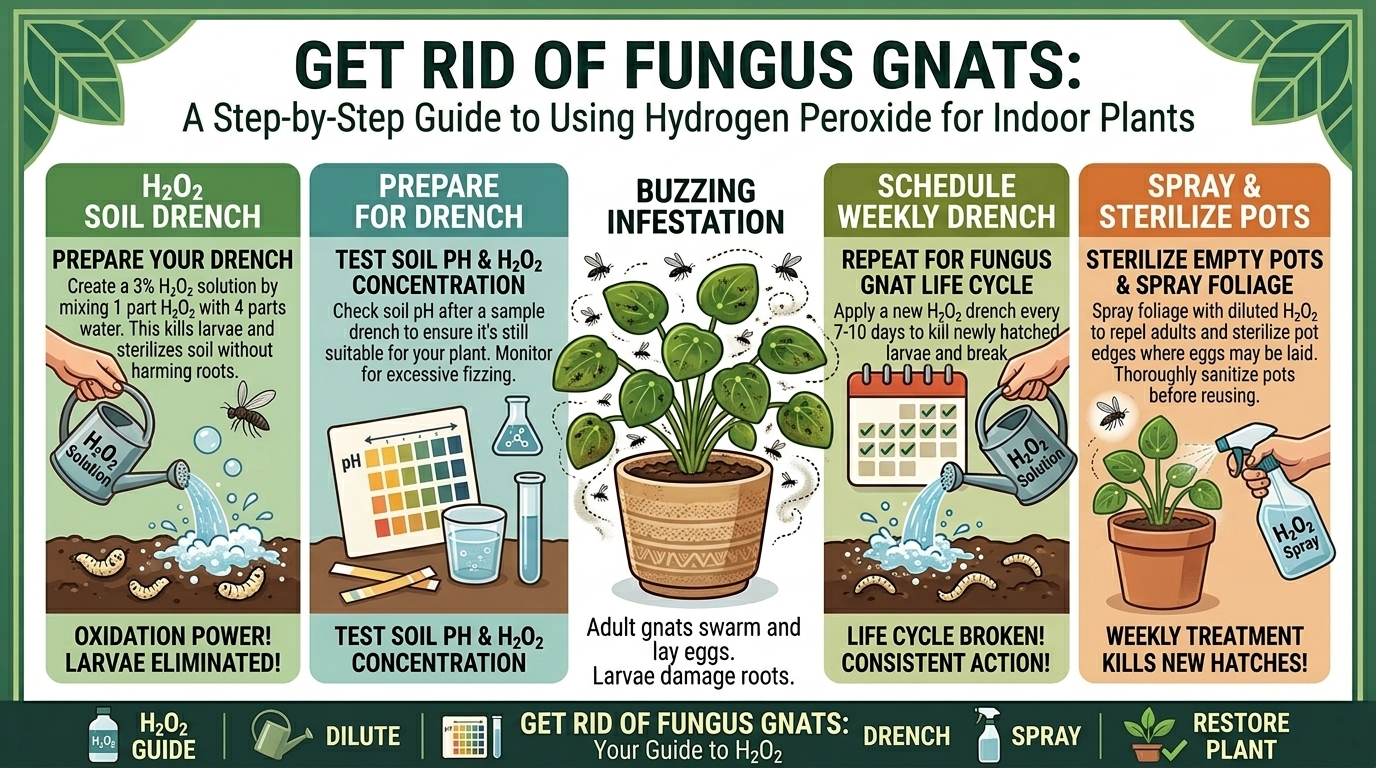
Before pouring liquids into your pots, you need to follow a strict dilution formula. Never use 3% hydrogen peroxide straight out of the bottle, as it can shock or burn delicate plant roots.
Step 1: Mix the Proper Dilution
The golden ratio for killing fungus gnat larvae without harming your plants is 1 part 3% hydrogen peroxide to 4 parts room-temperature water.
- Example Formula: Mix 1 cup of 3% hydrogen peroxide with 4 cups of water in a clean watering can or pitcher.
Step 2: Let the Soil Dry Out Partially
Do not apply peroxide to soaking wet soil, as the liquid will simply run right out the drainage holes without penetrating. Let the top 1 to 2 inches of your potting mix dry out completely so the soil is hungry to absorb the solution.
Step 3: Drench the Soil Thoroughly
Slowly pour your hydrogen peroxide mixture over the entire surface of the potting soil until it begins to trickle out of the bottom drainage holes.
- The Fizzing Sound: You will hear an audible fizzing and bubbling sound. Do not panic! This is completely normal; it is the peroxide reacting with organic matter and destroying gnat larvae.
Step 4: Catch the Flying Adults
Hydrogen peroxide targets soil-dwelling eggs and larvae, but it won’t instantly zap flying adult gnats. Pair your soil drench with yellow sticky traps placed directly on the soil surface to catch adult flyers before they lay a fresh batch of eggs.
Step 5: Repeat as Needed
Because single eggs or dormant pupae might survive the initial treatment, repeat this peroxide drench every 7 to 10 days for about 3 weeks to completely break the gnat life cycle.
Part 4: Proactive Prevention Tips for a Gnat-Free Indoor Jungle
Once you have cleared your collection of gnats, implement these preventative habits to keep them from returning:
- Adopt the “Soak and Dry” Method: Never water your houseplants on a strict rigid calendar. Always check the top 2 inches of soil with your finger. If it still feels damp, wait a few days before watering again.
- Switch to Coarser Soil Amendments: When repotting your plants, mix perlite, pumice, or orchid bark into your potting mix. This improves drainage and ensures the soil surface dries out quickly between waterings.
- Bottom Watering: Instead of pouring water over the top of the soil, place your nursery pots in a basin of water for 20 minutes and let the roots drink from the bottom up. This leaves the top 2 inches of soil bone dry, discouraging female gnats from laying eggs.
- Store Soil Properly: Keep bags of potting soil tightly sealed in indoor storage containers. Leaving soil bags open on a damp garage or balcony floor is an invitation for wild fungus gnats to lay eggs inside your bag before you even pot your plants.
Part 5: Frequently Asked Questions (FAQ)
1. Will hydrogen peroxide kill my houseplant?
No, when diluted properly (1 part 3% peroxide to 4 parts water), hydrogen peroxide is completely safe for healthy houseplants. In fact, the extra oxygen molecule released during the reaction can stimulate root respiration and growth.
2. Can I use higher concentrations of hydrogen peroxide like 10% or 35%?
Never use food-grade or high-concentration hydrogen peroxide (such as 10% or 35%) on houseplants. High-concentration peroxides are highly caustic, dangerous to handle, and will instantly burn and destroy plant roots and foliage on contact. Stick exclusively to standard 3% pharmacy hydrogen peroxide.
3. Does hydrogen peroxide kill beneficial soil microbes?
Yes, hydrogen peroxide is a strong oxidizer and can temporarily reduce beneficial microbial populations in living organic soils. Once the peroxide breaks down into harmless water and oxygen (usually within 24 hours), you can safely reintroduce beneficial bacteria or mycorrhizal fungi if desired.
4. How long does the fizzing reaction take?
The effervescent fizzing typically lasts between 3 to 5 minutes. Once the bubbling stops, the chemical reaction is complete, and the peroxide has fully neutralized into water and oxygen.
5. Why do fungus gnats come back after treatment?
If you only treat one plant while leaving neighboring infected pots untreated, adult gnats will simply migrate across your collection. You must treat every single plant in the room simultaneously and use sticky traps to catch remaining flying adults.
6. Are fungus gnats dangerous to human health?
No. Fungus gnats do not bite humans or pets, nor do they transmit diseases. They are strictly an aesthetic nuisance and a sign of overly wet soil conditions. However, heavy larval infestations can weaken young or fragile plants.
7. Can I spray hydrogen peroxide on the leaves to kill gnats?
No. Spraying peroxide on foliage is unnecessary for fungus gnats because they live and breed in the soil, not on the leaves. Furthermore, direct exposure to peroxide on thin leaves can cause chemical leaf scorch.
8. What is the difference between fruit flies and fungus gnats?
Fruit flies are plump, light brown, and attracted to fermenting sugars, ripe fruit, or garbage cans in your kitchen. Fungus gnats are slender, darker, smaller, and hover exclusively around damp houseplant soil and pots.
9. Will letting my soil dry out completely kill the gnats without chemicals?
Allowing the soil to dry out completely for extended periods will kill many larvae by depriving them of moisture, but hardy larvae can sometimes survive deep in the root ball. Combining dry soil cycles with a hydrogen peroxide drench guarantees a thorough kill.
10. What should I do if my plant is too large to move to a sink for a drench?
For large floor plants (like a towering Ficus or massive Monstera), you can mix your peroxide solution in a large watering can and pour it evenly over the topsoil right where it sits, placing a shallow tray or saucer underneath to catch any runoff.
Conclusion
Battling fungus gnats does not require toxic chemical insecticides or expensive commercial treatments. With a simple brown bottle of 3% hydrogen peroxide from your bathroom cabinet, you can safely eliminate gnat larvae, aerate your plant roots, and restore peace to your indoor green collection. Stay consistent with your watering habits, keep your topsoil dry, and enjoy a pristine, buzzing-free indoor jungle from coast to coast.