How to Safely Clear Out Mealybugs Hiding in the Tight Crevices of Your Succulent Plant Collection
There is a distinct, sinking dread that every succulent collector experiences when inspecting their prized collection. You lean in close to admire the tight, geometric rosette of an echeveria or the plump, trailing stems of a burro’s tail, only to spot a tiny patch of what looks like miniature cotton balls tucked deep inside a leaf axil.
You have been invaded by mealybugs.
These soft-bodied, sap-sucking agricultural pests are among the most persistent nightmares for indoor and outdoor succulent enthusiasts. Because succulents feature densely packed rosettes, overlapping leaves, and intricate stem joints, they provide the ultimate fortress for mealybugs to hide, breed, and feed completely undisturbed.
For passionate plant parents managing collections across diverse regional climates—from drafty high-rise apartments in New York and San Francisco to sunny urban sunrooms and patios in Texas, California, and Washington State—eradicating mealybugs requires precision, patience, and eco-friendly techniques. This comprehensive guide explores mealybug biology, targeted manual removal methods, organic treatment protocols, and expert prevention tips to keep your succulent collection pristine.
1. The Enemy Profile: Understanding Mealybugs
To defeat mealybugs, you must understand their lifecycle and habits. Mealybugs are closely related to scale insects and aphids. They are small, wingless insects covered in a powdery, waxy white secretion that acts as an armor against moisture and many standard contact sprays.
+-----------------------------------------------------------------+
|             THE MEALYBUG DESTRUCTIVE CYCLE                      |
|                                                                 |
|   [1. Hidden Egg Masses]                                        |
|   - Females lay hundreds of eggs tucked away in cottony, woolly |
|     oaks deep inside tight stem crevices and root zones.        |
|              |                                                  |
|              v                                                  |
|   [2. The Mobile "Crawler" Stage]                               |
|   - Tiny, unshielded nymphs hatch and crawl actively across the |
|     plant to find a tender feeding site.                        |
|              |                                                  |
|              v                                                  |
|   [3. Sap-Sucking & Honeydew Secretion]                         |
|   - Adults settle down, insert piercing mouthparts into plant   |
|     tissue, drink vital sap, and excrete sticky "honeydew."     |
|              |                                                  |
|              v                                                  |
|   [4. Sooty Mold & Secondary Decline]                           |
|   - Honeydew attracts black sooty mold and ants, severely       |
|     weakening or killing the succulent.                         |
+-----------------------------------------------------------------+
Because succulent leaves store precious water and nutrients, mealybug infestations cause leaves to yellow, distort, shrivel, and eventually drop off.
2. Why Succulents Are Prime Targets
Succulents are uniquely vulnerable to mealybugs for several structural reasons:
- Tight Rosette Crevices: Species like Echeveria, Sempervivum, and Graptopetalum grow with leaves tightly overlapping. This creates dark, humid micro-pockets where mealybugs can hide out of reach of casual observation.
- Fleshy Nutrient Stores: The high concentration of sugars and water in succulent tissue provides a rich, effortless food source for piercing mouthparts.
- Underground Root Mealybugs: A specialized sub-species of mealybugs attacks plant roots below the soil line, making detection even trickier.
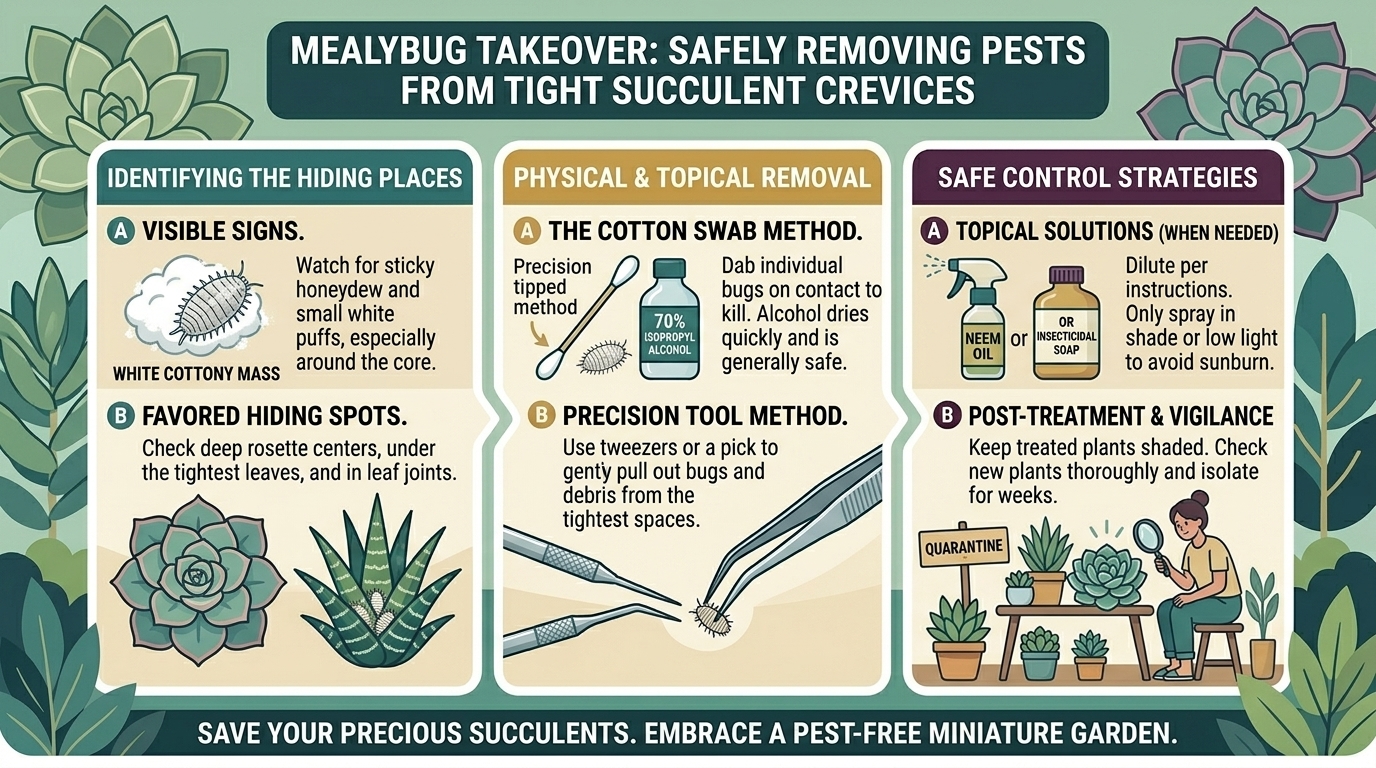
3. Targeted Manual Extraction: The Cotton Swab Technique
Because mealybugs are protected by a waterproof, waxy coating, simply misting a plant from afar with water is entirely useless. You must practice direct, targeted physical removal.
+-----------------------------------------------------------------+
|             STEP-BY-STEP MANUAL EXTRACTION PROTOCOL             |
|                                                                 |
|   [Step 1: Isolate the Infected Plant]                          |
|   - Immediately move the infested succulent away from your      |
|     healthy collection to prevent mealybugs from crawling over. |
|              |                                                  |
|              v                                                  |
|   [Step 2: Prepare Your Precision Tool]                         |
|   - Dip a standard cotton-tipped Q-tip into pure **70% isopropyl |
|     rubbing alcohol** (do not use higher percentages, as they   |
|     can burn plant tissue instantly).                           |
|              |                                                  |
|              v                                                  |
|   [Step 3: Spot-Treat Every Crevice]                            |
|   - Dab the alcohol-soaked swab directly onto every visible     |
|     bug, cotton nest, and egg mass. The alcohol instantly     |
|     dissolves their waxy protective coating and kills them on   |
|     contact.                                                    |
+-----------------------------------------------------------------+
Pro Tip for Deep Rosettes
For extremely tight rosettes where a Q-tip cannot fit, use a wooden toothpick dipped in rubbing alcohol to gently pry open the leaves and extract pests hiding deep in the center growth tip.
4. Organic Treatment Sprays for Heavy Infestations
If an infestation has spread across multiple stems and rosettes, manual swabbing alone may not catch microscopic crawlers hidden in the foliage. Deploy these safe, organic sprays:
- The Insecticidal Soap & Alcohol Blend: Mix 1 quart of water, 1 tablespoon of pure castile soap, and 2 tablespoons of 70% isopropyl alcohol in a spray bottle. Mist the entire plant thoroughly, ensuring the liquid penetrates deep into leaf joints.
- Horticultural Neem Oil Spray: Dilute raw, cold-pressed neem oil according to package instructions (typically 1 to 2 teaspoons per gallon of warm water with a few drops of dish soap as an emulsifier). Spray the plant in the evening. Warning: Never spray neem oil on succulents in direct sunlight, or the oil combined with solar radiation will cook and burn the leaves.
5. Dealing with Underground Root Mealybugs
If your succulent looks chronically dehydrated, wobbly in its pot, or fails to perk up despite watering, you may be dealing with root mealybugs. These pests live entirely underground, coating roots in a white, powdery wax.
- Unpot and Clean: Gently slide the succulent out of its container and shake away all old soil. Wash the root ball under a gentle stream of lukewarm water.
- Trim and Sterilize: Snip away dead or heavily infested roots with sterilized shears.
- Root Soak: Dip the clean root ball into a mild solution of insecticidal soap or a 10% hydrogen peroxide wash for 60 seconds to kill remaining eggs.
- Repot in Fresh Soil: Discard the old contaminated potting medium, sterilize the pot with bleach water, and repot into fresh, dry, fast-draining succulent mix.
6. Regional Considerations Across the United States
Your local climate and indoor growing environment dictate how mealybugs behave in your collection:
New York City and San Francisco
Urban indoor environments in New York and San Francisco feature stable indoor heating during winter, which creates a warm, dry microclimate. This artificial indoor climate allows mealybugs to breed uninterrupted 365 days a year without natural outdoor frost checks. Inspect indoor windowsill collections monthly.
Washington State
The Pacific Northwest features prolonged, overcast indoor periods during winter. Reduced light weakens succulent cell walls, making them more susceptible to pest outbreaks. Avoid over-fertilizing with high-nitrogen liquid feeds during dark winter months, as soft, succulent growth invites mealybugs.
Texas and California
In warmer sunbelt states, succulent collections frequently spend spring, summer, and autumn outdoors on patios and balconies. Outdoor collections are easily exposed to wandering ants, which farm mealybugs for their sweet honeydew secretions and protect them from predators. If you notice ants running across your succulent pots, check immediately for mealybugs.
7. Comprehensive Succulent Pest Management Schedule
| Timing | Action Item | Primary Objective |
| Monthly Inspection | Examine leaf rosettes and stem joints with a magnifying glass | Catch early solitary mealybugs before an outbreak occurs |
| Seasonal Repotting (Spring) | Inspect root balls, refresh soil mix, add perlite | Prevent hidden root mealybug colonies from establishing |
| Immediate Quarantine | Isolate any newly purchased nursery plants for 14 days | Stop incoming pests from contaminating your main collection |
| Preventative Maintenance | Light preventative spray with insecticidal soap | Maintain an inhospitable surface for visiting crawlers |
8. Frequently Asked Questions (FAQs)
1. What do mealybugs look like on succulents?
Mealybugs look like tiny, soft-bodied insects covered in a white, cottony, powdery wax. They often congregate in clusters inside tight leaf joints, stem forks, and at the base of rosettes.
2. Will rubbing alcohol damage or burn my succulent leaves?
Using standard 70% isopropyl alcohol straight on a cotton swab is completely safe for most succulents. However, avoid higher concentrations (like 91% or 99%) and never spray pure rubbing alcohol over the entire plant in direct sunlight, as it can strip protective epicuticular wax and burn foliage.
3. Can I use neem oil on delicate succulents with powdery coating (farina)?
Be very cautious! Many succulents (like Echeveria and Pachyphytum) feature a delicate, powdery, chalky coating called farina that acts as their natural sunscreen and waterproofing. Applying oils (like neem oil) will permanently dissolve and rub off this farina, leaving unsightly dark smudges. Use alcohol spot-treatment instead.
4. How did mealybugs get onto my indoor succulents?
Mealybugs can be introduced via newly purchased nursery plants, cut flowers, infested potting soil, or open windows where crawlers drift in on air currents or hitch a ride on clothing.
5. Why do ants hang around my mealybugs?
Ants practice “farming.” They protect mealybugs from natural predators and herd them like livestock to harvest the sugary “honeydew” waste that mealybugs secrete. If you see ants on your plants, eliminate the ants alongside the mealybugs.
6. Are root mealybugs different from regular mealybugs?
Yes and no. They belong to the same family, but root mealybugs specialize in living underground, feeding on roots and forming white, waxy egg sacs against the inner walls of flower pots.
7. How long do I need to quarantine an infected succulent?
Keep any treated plant isolated from your main collection for at least 3 to 4 weeks. This allows you to monitor for newly hatched crawlers emerging from hidden eggs that survived the initial treatment.
8. Will letting the soil dry out completely kill mealybugs?
No. While drought stresses plants, mealybugs feed directly on plant sap, meaning dry soil will not starve them. In fact, stressed, dehydrated succulents are even more vulnerable to pest damage.
9. Can beneficial insects help control mealybugs in greenhouses?
Yes! In large greenhouse setups or enclosed sunrooms, releasing biological control agents like ladybugs, green lacewing larvae, or parasitic wasps (Cryptolaemus montrouzieri, famously known as the “mealybug destroyer”) works exceptionally well.
10. Should I throw away a succulent that has a severe mealybug infestation?
If the mealybugs have hollowed out the stem, caused total root rot, and turned the plant into mush, it is best to bag and trash it. However, if the top rosette is still firm, you can often behead the plant, discard the infected roots and lower stem, let the clean cutting callous over, and reroot a healthy new plant.
9. Conclusion
Clearing out mealybugs from the tight crevices of your succulent collection requires diligence, precision, and an understanding of pest biology. By abandoning harsh chemical shortcuts and adopting targeted manual extraction methods—such as alcohol-dusted Q-tips, strategic organic soaps, and careful root inspections—you can successfully purge these persistent pests without harming your delicate plants.