Every home gardener eventually faces the sinking realization that their pristine vegetable patch has been discovered by insect pests. Among the most destructive and fast-moving culprits are garden caterpillars—such as cabbage loopers, imported cabbageworms, and diamondback moths—which can reduce a flourishing brassica crop or prized ornamental bed to a skeletal lacework of veins in a matter of days.
For conscious gardeners managing landscapes across diverse American microclimates—from urban container plots in San Francisco and New York to sprawling suburban homesteads in Texas, California, and Washington State—reaching for synthetic chemical pesticides is rarely an ideal solution. Chemical sprays kill beneficial pollinators, disrupt local soil food webs, and leave toxic residues on edible harvests.
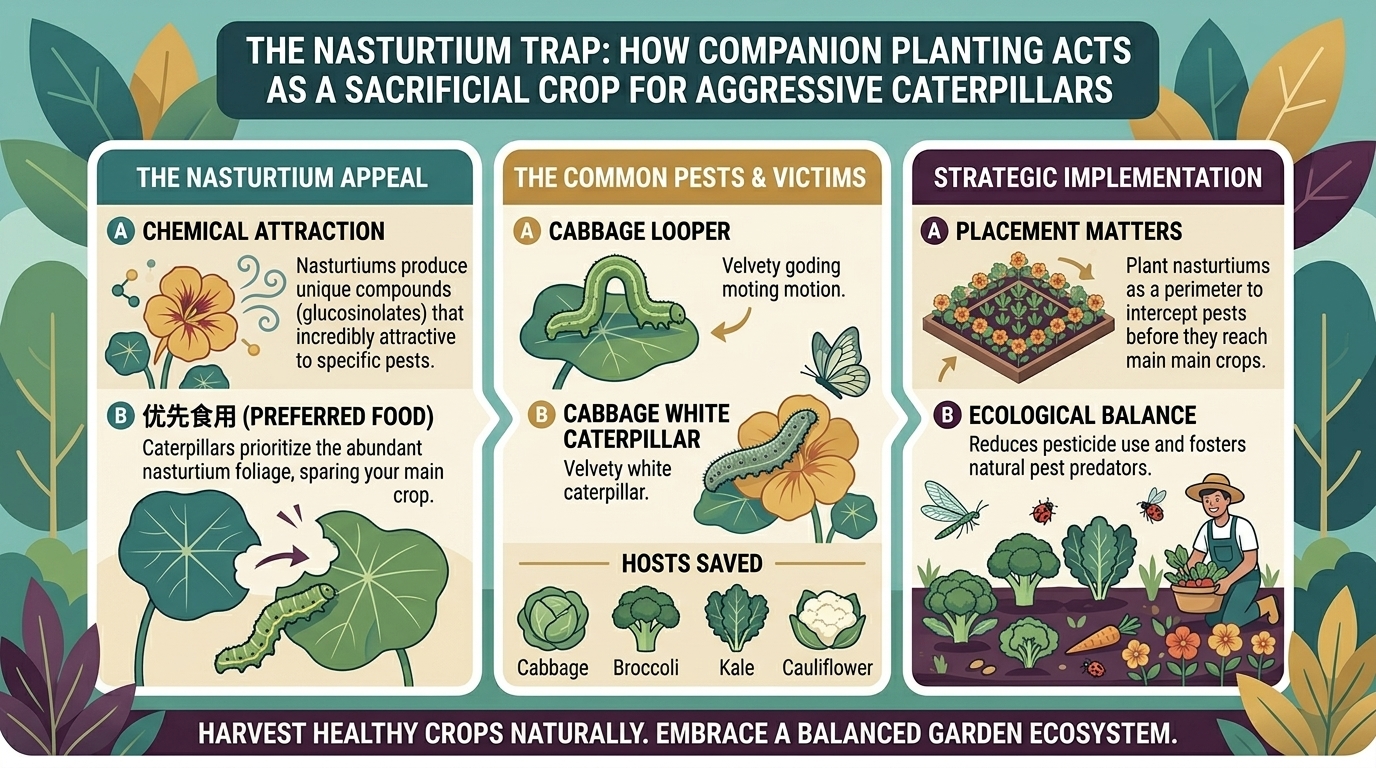
Fortunately, nature provides a brilliant, elegant biological defense mechanism: companion planting with nasturtiums (Tropaeolum majus) as a sacrificial trap crop. This comprehensive guide explores insect behavioral ecology, how trap cropping works, planting protocols, regional strategies, and expert tips to naturally safeguard your garden.
1. The Ecological Principle: What Is a Trap Crop?
To understand why nasturtiums are legendary in organic gardening, you must first understand the concept of a trap crop. A trap crop is a plant species that is significantly more attractive to specific insect pests than your primary cash crop (your valuable vegetables or ornamental flowers).
+-----------------------------------------------------------------+
|             THE TRAP CROP DIVERSION MECHANISM                   |
|                                                                 |
|   [1. Pest Arrival & Olfactory Attraction]                      |
|   - Female butterflies and moths search for host plants using   |
|     specialized chemical receptors detecting volatile organic   |
|     compounds (glucosinolates).                                 |
|              |                                                  |
|              v                                                  |
|   [2. The Super-Attractive Magnet]                              |
|   - Nasturtiums emit intense, highly concentrated mustard oils  |
|     that overpower neighboring vegetables, drawing pests directly |
|     to the nasturtium foliage.                                  |
|              |                                                  |
|              v                                                  |
|   [3. The Sacrificial Outcome]                                  |
|   - Pests lay hundreds of eggs on the nasturtiums. The emerging |
|     caterpillars devour the expendable trap crop, leaving your  |
|     cabbages, kale, and tomatoes completely unharmed.           |
+-----------------------------------------------------------------+
2. Why Nasturtiums Are Irresistible to Pests
Nasturtiums (Tropaeolum majus) possess a unique biochemical makeup that makes them a supreme magnet for destructive garden pests:
- High Glucosinolate Content: These sulfur-containing compounds give nasturtiums their characteristic peppery, mustard-like scent and flavor. Herbivorous insects evolved to seek out these exact chemical signatures because they indicate a suitable food source.
- Tender, Succulent Foliage: The broad, shield-shaped leaves and bright, edible blossoms provide an abundant, tender food source that caterpillars and aphids prefer over tougher or fibrous garden crops.
- The Aphid Magnet: Beyond caterpillars, nasturtiums act as a powerhouse trap crop for black bean aphids and green peach aphids, drawing them away from precious peppers and fruit trees.
3. Key Target Pests Diverted by Nasturtiums
When you interplant nasturtiums around your vegetable garden, you effectively intercept several major pest families:
- Cabbage Loopers (Trichoplusia ni): Pale green caterpillars with a characteristic looping motion that chew massive irregular holes in leaves.
- Imported Cabbageworms (Pieris rapae): The velvety green larvae of the common white cabbage butterfly, notorious for tunneling deep into heads of broccoli, kale, and cabbage.
- Diamondback Moths: Tiny, voracious larvae that skeletonize brassica foliage.
- Aphids: Sucking insects that crowd tender stems, causing distortion and yellowing.
4. Strategic Placement: How to Design a Trap Crop System
Planting nasturtiums randomly around your garden will not yield optimal results. To function as an effective trap crop, placement must be strategic:
+-----------------------------------------------------------------+
|             STRATEGIC PERIMETER DEPLOYMENT                      |
|                                                                 |
|   [1. The Perimeter Shield]                                     |
|   - Plant a dense border or "moat" of nasturtiums around the    |
|     outer perimeter of your raised beds, specifically facing    |
|     prevailing wind directions where flying pests approach.     |
|              |                                                  |
|              v                                                  |
|   [2. The Spatial Buffer Zone]                                  |
|   - Keep your trap crop nasturtiums separated by at least 3 to  |
|     5 feet from your vulnerable cash crops (broccoli, kale). If |
|     they are too close, pests overflowing from the nasturtiums  |
|     may easily crawl onto your main crop.                       |
|              |                                                  |
|              v                                                  |
|   [3. Active Management & Culling]                              |
|   - Regularly inspect nasturtium leaves. When heavy clusters    |
|     of eggs or caterpillars accumulate, simply prune away and   |
|     dispose of the heavily infested leaves.                     |
+-----------------------------------------------------------------+
5. Regional Climate Strategies Across the United States
Your local climate dictates how nasturtiums behave and how long your trap crop remains active throughout the growing season:
San Francisco and New York City
In San Francisco’s mild, maritime climate, nasturtiums often behave as sprawling perennials, thriving year-round in coastal fog and cool temperatures. In New York, nasturtiums are grown as vigorous annuals from late spring through autumn. Plant them alongside brassicas in May to catch the first wave of imported cabbageworms.
Washington State
The Pacific Northwest features cool, damp springs and summers. Nasturtiums flourish in these conditions, growing lush and sprawling. Use them as a protective border around raised kale and Brussels sprout beds to divert heavy pest pressure during damp months.
Texas and California
In hot southern and western regions, nasturtiums thrive during cooler shoulder seasons (spring and autumn). Intense summer heatwaves can cause nasturtiums to wilt or slow down production. To maintain an active trap crop in Texas or interior California, plant them in partial afternoon shade where they receive morning sun and protection from scorching midday solar radiation.
6. Comprehensive Companion Planting & Pest Management Schedule
| Timing | Action Item | Primary Objective |
| Early Spring (Apr–May) | Direct sow nasturtium seeds around bed perimeters | Establish the trap crop barrier before primary spring pests emerge |
| Late Spring (June) | Monitor foliage for butterfly eggs and tiny caterpillars | Track pest migration from trap crop to main vegetable beds |
| Summer (July–Aug) | Prune heavily infested nasturtium leaves; water deeply | Remove concentrated pest populations and maintain trap vigor |
| Early Autumn (Sept–Oct) | Harvest remaining edible blooms; clear spent vines | Clear garden debris and prepare beds for winter cover crops |
7. Frequently Asked Questions (FAQs)
1. Are nasturtiums entirely edible for humans?
Yes! Every single part of the nasturtium plant—including the leaves, stems, bright flowers, and green seed pods—is 100% edible. They have a delightfully spicy, peppery kick similar to watercress and make a stunning, colorful addition to summer salads.
2. Will the caterpillars on my nasturtiums migrate to my vegetables?
If nasturtiums are planted directly touching your main vegetable crops, overcrowding can cause caterpillars to crawl over. However, if planted as a distinct perimeter border (3 to 5 feet away), pests prefer to stay and feed on the nutrient-dense nasturtiums.
3. Do nasturtiums repel pests or attract them?
Nasturtiums do both depending on the insect! They act as a repellent for squash bugs, cucumber beetles, and whiteflies due to their strong scent, but they act as an attractant (trap crop) for caterpillars and aphids.
4. Can I plant nasturtiums in containers and pots?
Absolutely. Nasturtiums have a trailing habit that makes them phenomenal choices for hanging baskets, whiskey barrels, and balcony pots, making them ideal for urban gardeners in San Francisco and New York.
5. Do nasturtiums require rich, heavily fertilized soil?
No! Paradoxically, nasturtiums thrive in poor, rocky, well-drained soil. If you plant them in overly rich, high-nitrogen soil, they will produce an explosion of lush green foliage at the expense of their vibrant flowers and concentrated pest-attracting essential oils.
6. How do I harvest and destroy pests on my trap crop?
When you notice clusters of velvety green caterpillars or yellow egg batches under nasturtium leaves, simply snip off the affected leaves with shears and drop them into a bucket of soapy water.
7. Are nasturtiums perennial or annual plants?
In frost-free tropical climates, nasturtiums are tender perennials. However, across most of the United States, they are grown as fast-growing annuals that complete their lifecycle in a single season.
8. Will companion planting with nasturtiums eliminate 100% of pests?
No biological method achieves 100% eradication. Instead, trap cropping serves as a powerful management tool that significantly reduces pest pressure, keeping damage on your cash crops below economic injury thresholds.
9. Do bees and beneficial pollinators like nasturtiums?
Yes! While caterpillars love the leaves, bees, hummingbirds, and beneficial predatory insects adore the nectar-rich trumpet flowers, bringing helpful pollinators right into your garden ecosystem.
10. How deep should I plant nasturtium seeds?
Push large nasturtium seeds about 1/2 inch to 1 inch deep into warm soil. Soaking the hard seed coats in warm water for 24 hours prior to planting helps speed up germination significantly.
8. Conclusion
Companion planting with nasturtiums is one of the most effective, elegant, and rewarding strategies in organic gardening. By transforming a simple, beautiful flower into a strategic sacrificial trap crop, you can successfully outsmart aggressive garden caterpillars, protect your high-value vegetables, and maintain a balanced, chemical-free ecosystem.