What Are the Top Natural Plants You Can Grow Indoors to Repel Mosquitoes and House Flies
There is little that disrupts the serene, relaxing atmosphere of an indoor living space quite like the persistent buzz and itchy bites of mosquitoes or the obnoxious, unsanitary hovering of house flies. While synthetic chemical sprays, plug-in insecticides, and aerosol bug killers offer temporary relief, they often introduce harsh chemical fumes, artificial fragrances, and toxins into your indoor environment—a major concern for households with children, pets, or individuals with respiratory sensitivities.
Fortunately, nature provides an elegant, aromatic, and highly decorative solution. By cultivating specific botanical powerhouses on your windowsills, kitchen counters, and patio doors, you can harness natural plant defense mechanisms to keep flying pests at bay.
Whether you are battling humid indoor environments in Texas, managing urban apartment pests in New York, optimizing natural light in California, dealing with damp indoor humidity in Washington, or keeping breezy, open-air city flats fresh in San Francisco, growing natural pest-repelling indoor plants is a sustainable, beautiful upgrade to your home.
This comprehensive masterclass explores the science of botanical repellency, the top indoor plants for mosquitoes and house flies, optimal indoor placement, and expert care tips to keep your green guardians thriving.
The Science of Botanical Repellency: How Plants Defend Themselves
Plants cannot pack up and move when insects attack. Over millions of years of evolution, they have developed complex chemical arsenals to survive. Many of these defensive compounds are secondary metabolites—volatile organic compounds (VOCs) and essential oils stored in specialized leaf glands, hairs, or resin ducts.
When these leaves are gently brushed, warmed by sunlight, or ruptured, they release strong aromatic scents into the surrounding air. To flying insects like mosquitoes and house flies, these powerful chemical profiles are deeply unpleasant, disorienting, or toxic, causing them to actively avoid the area. By placing these plants strategically around your home, you create natural invisible barriers that pests refuse to cross.
The Top Indoor Plants to Repel Mosquitoes
Mosquitoes rely heavily on their acute sense of smell to locate hosts (detecting carbon dioxide, lactic acid, and skin odor). Pungent, aromatic foliage disrupts their olfactory receptors, masking your presence.
1. Lemon Grass (Cymbopogon citratus)
- The Repellent Mechanism: Contains high concentrations of citronella oil, the active botanical ingredient in many natural bug sprays.
- Indoor Care Tip: Lemon grass is a tropical grass that requires bright, direct sunlight (at least 6 hours daily) and consistently moist soil. Place it on a sunny south-facing windowsill.
2. Lemon Balm (Melissa officinalis)
- The Repellent Mechanism: A member of the mint family packed with high levels of citronellal, geraniol, and lemon-scented essential oils that mosquitoes despise.
- Indoor Care Tip: Lemon balm grows rapidly. Plant it in a wide container with excellent drainage, keep the soil moderately moist, and pinch back growing tips frequently to encourage bushy growth.
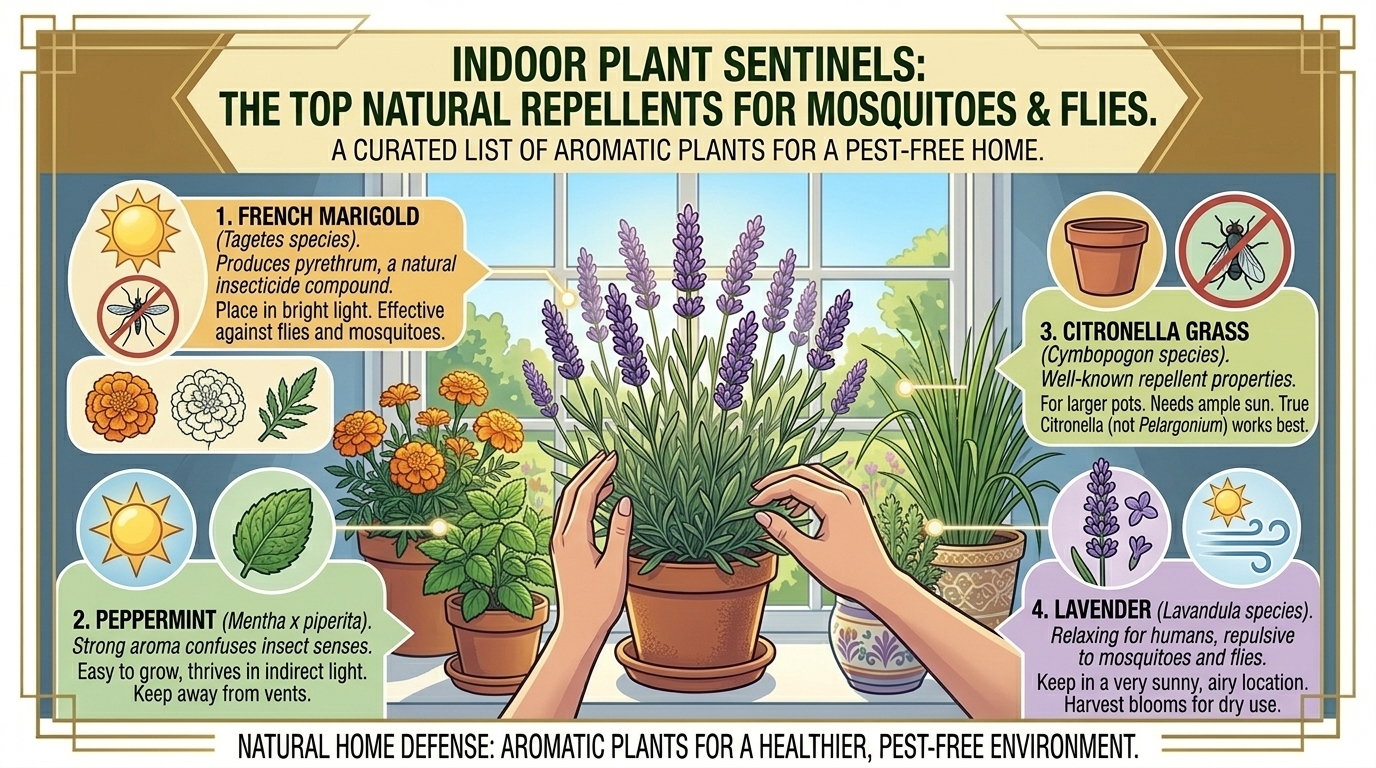
3. Peppermint (Mentha piperita)
- The Repellent Mechanism: The sharp, cooling aroma of menthol is overwhelmingly strong for mosquitoes, effectively scrambling their navigational sensors.
- Indoor Care Tip: Peppermint thrives in bright indoor light with regular watering. Because it spreads aggressively via underground runners, keeping it in an indoor pot prevents it from overtaking other plants.
4. Rosemary (Salvia rosmarinus)
- The Repellent Mechanism: Woodsy, pine-like aromatic oils repel mosquitoes, gnats, and cabbage moths while adding culinary value to your kitchen.
- Indoor Care Tip: Rosemary requires maximum sunlight and well-draining, sandy soil. Allow the top two inches of soil to dry out completely between waterings to prevent root rot.
The Top Indoor Plants to Repel House Flies
House flies are driven primarily by decaying organic matter, food odors, and moisture. Plants that emit sharp, camphoraceous, or herbal scents act as powerful olfactory deterrents for flies.
5. Basil (Ocimum basilicum)
- The Repellent Mechanism: Sweet basil emits a potent aroma containing estragole, linalool, and eugenol, which house flies and stable flies find intensely irritating.
- Indoor Care Tip: Basil loves warmth and sunlight. Position pots near your kitchen sink or dining window where flies frequently congregate, ensuring 6 to 8 hours of light daily.
6. Lavender (Lavandula angustifolia)
- The Repellent Mechanism: While humans adore the calming fragrance of lavender, flies, mosquitoes, and fleas are repelled by its rich concentration of linalyl acetate and linalool.
- Indoor Care Tip: Lavender is notoriously sensitive to over-watering indoors. Use a terracotta pot, a fast-draining potting mix, and place it in the brightest sunny spot in your home.
7. Catnip (Nepeta cataria)
- The Repellent Mechanism: Catnip contains nepetalactone, an essential oil that research shows is significantly more effective at repelling mosquitoes and flies than chemical DEET (though it will attract every feline in your household!).
- Indoor Care Tip: Catnip is remarkably hardy. It thrives in standard indoor potting soil with moderate watering and partial to full sunlight.
8. Mint-Marigold / Mexican Mint Marigold (Tagetes lucida)
- The Repellent Mechanism: Unlike standard marigolds that require outdoor garden beds, certain perennial marigold varieties emit an intense anise-and-citrus scent that keeps flies and mosquitoes away from indoor entryways.
- Indoor Care Tip: Place marigolds near exterior doors or drafty windows where flying insects attempt to enter the house.
Comprehensive Indoor Pest-Repelling Plant Reference Guide
| Plant Name | Primary Target Pest | Active Repellent Compound | Light Requirement | Watering Frequency |
| Lemon Grass | Mosquitoes | Citronella oil | Full Sun (6+ hours) | Keep soil consistently moist |
| Lemon Balm | Mosquitoes & Gnats | Citronellal, Geraniol | Bright, Indirect Light | Medium (allow surface to dry) |
| Peppermint | Mosquitoes & Ants | Menthol | Bright Light / Partial Shade | Medium (keep slightly moist) |
| Sweet Basil | House Flies & Mosquitoes | Eugenol, Linalool | Full Sun | Medium (water when dry) |
| Lavender | Flies & Moths | Linalool, Linalyl Acetate | Maximum Sun Exposure | Low (let dry out thoroughly) |
| Catnip | Mosquitoes & Flies | Nepetalactone | Bright Light | Moderate |
| Rosemary | Mosquitoes & Flies | Camphor, Cineole | Full Sun | Low (drought tolerant) |
Strategic Indoor Placement for Maximum Pest Defense
Growing these plants is only half the battle; where you position them inside your home dictates how effectively they protect your living space.
1. Kitchen Windowsills and Prep Counters
Kitchens naturally attract house flies due to food prep, fruit bowls, and waste bins. Placing pots of sweet basil, rosemary, and mint directly on your kitchen window sill creates an aromatic shield around your primary food zones.
2. Entryways and Mudrooms
Flying insects frequently hitch a ride indoors when front and back doors open. Position marigolds, lavender, or lemon grass in decorative planters near entryways so that every time someone brushes past the foliage, protective essential oils are released into the air.
3. Living Room and Patio Door Corners
During warm summer evenings, sliding glass doors leading to balconies or backyards are prime entry points for mosquitoes. Flank these doors with taller potted plants like lemon grass or rosemary to intercept incoming pests.
Indoor Care and Maintenance Tips for Aromatic Herbs
Aromatic herbs used for pest control evolved outdoors under intense sunlight and natural airflow. Recreating these conditions indoors requires careful attention:
- Supplement with Grow Lights: Most repellent herbs (lavender, rosemary, basil, lemon grass) require high light levels. In northern or overcast regions (like Washington or New York apartments), supplement natural window light with full-spectrum LED grow lights for 10 to 12 hours a day.
- Ensure Superior Drainage: Indoor pots must have drainage holes. Stagnant water at the bottom of a pot causes root rot, killing the plant before it can repel a single fly.
- Activate the Scents: Plants release more repellent oils when their leaves are slightly disturbed. Gently brush your hands against your basil or mint plants when walking past them to release a fresh wave of protective scent into the room.
Regional Considerations for Indoor Pest Plants
Climate and regional housing styles dictate how your indoor repellent plants behave:
- Texas: High indoor air-conditioning use can dry out ambient humidity, but intense outdoor heat makes mosquitoes aggressive near windows. Keep moisture-loving herbs like lemon balm adequately watered indoors.
- New York and the Northeast: Urban apartments often feature lower winter light levels. Rotate your herb pots weekly and use desktop grow lights to prevent them from becoming leggy.
- California: Abundant natural sunlight makes California ideal for growing sun-worshipping repellent plants like lavender and rosemary on bright indoor windowsills.
- Washington and the Pacific Northwest: Damp, cool indoor air can slow evaporation in soil. Use terracotta pots and lightweight potting mixes to prevent root rot in humidity-sensitive plants like lavender.
- San Francisco: Frequent coastal fog and cool breezes mean indoor plants require draft-free sunny spots. A south-facing kitchen window is the ultimate San Francisco location for basil and mint.
Troubleshooting Common Indoor Herb Plant Issues
- Issue: My indoor basil or mint is getting tall, spindly, and weak.
- Solution: The plant is starving for light. Move it to a brighter south-facing window or install an LED grow light overhead, and trim the top stems to encourage branching.
- Issue: Tiny fungus gnats are hovering around the soil of my repellent plants.
- Solution: Over-watering is causing organic matter in the soil to break down, attracting fungus gnats. Let the top 2 inches of soil dry completely between waterings, and top-dress pots with horticultural sand.
- Issue: My indoor lavender is turning brown and dying at the roots.
- Solution: Lavender despises wet feet. You are likely watering too frequently. Switch to a sandy, well-draining cactus mix and let the soil dry out entirely between drinks.
Frequently Asked Questions (FAQ)
1. Do indoor repellent plants actually eliminate mosquitoes and flies completely?
While these plants significantly reduce pest activity by masking scents and repelling insects, they work best as part of an integrated pest management strategy (alongside screens on windows and sealing food waste).
2. Which indoor plant is most effective against mosquitoes?
Lemon grass (due to high citronella content) and catnip (due to nepetalactone) are scientifically recognized as some of the most potent natural mosquito repellents.
3. Can I use these plants in a home with cats or dogs?
Most herbs like basil, rosemary, and lemon balm are safe for pets. However, note that catnip will attract felines, and certain essential oils in large quantities can upset pet stomachs, so research individual plant safety if pets love to nibble.
4. How do these plants actually keep flies away?
Flies possess highly sensitive olfactory receptors. The strong volatile organic compounds emitted by herbs like basil, lavender, and mint overwhelm their senses, making the area unappealing to navigate.
5. Do indoor repellent plants need direct sunlight?
Yes. Most aromatic repellent plants (lavender, rosemary, basil, lemon grass) are sun-loving herbs that require at least 6 hours of bright sunlight or supplemental grow light exposure daily.
6. Can I crush the leaves to make a quick bug spray?
Yes! Crushing leaves of mint, lemon balm, or basil and rubbing the bruised foliage on exposed skin provides a short-term natural deterrent against mosquitoes (though test a small patch of skin first for sensitivities).
7. Why are my indoor herbs dropping leaves?
Leaf drop is usually caused by sudden temperature changes, drafty windows, over-watering, or insufficient light. Ensure stable indoor temperatures and adequate sun exposure.
8. How often should I water my indoor pest-repelling herb pots?
Watering frequency depends on the plant: lavender and rosemary prefer dry soil between waterings, while basil and lemon grass prefer evenly moist soil. Always check soil moisture with your finger before watering.
9. Will indoor mint plants take over my entire house?
Unlike outdoor garden beds where mint spreads aggressively via roots, growing mint in a dedicated indoor container restricts its root system, keeping it safely contained.
10. Where can I find more expert indoor plant care guides and gardening tips?
For comprehensive horticultural advice, plant care guides, and expert tips tailored to indoor and outdoor cultivation, visit kcplants.com.
Conclusion
Transforming your indoor living space into a pest-free sanctuary doesn’t require toxic chemicals or artificial aerosols. By growing natural, aromatic powerhouses like basil, lavender, rosemary, lemon grass, and mint on your windowsills, you introduce living beauty, culinary utility, and powerful organic pest defense into your home. Whether you are managing bright apartments in California or cozy urban spaces in San Francisco and New York, these resilient plants offer a fragrant, eco-friendly solution to flying pests.