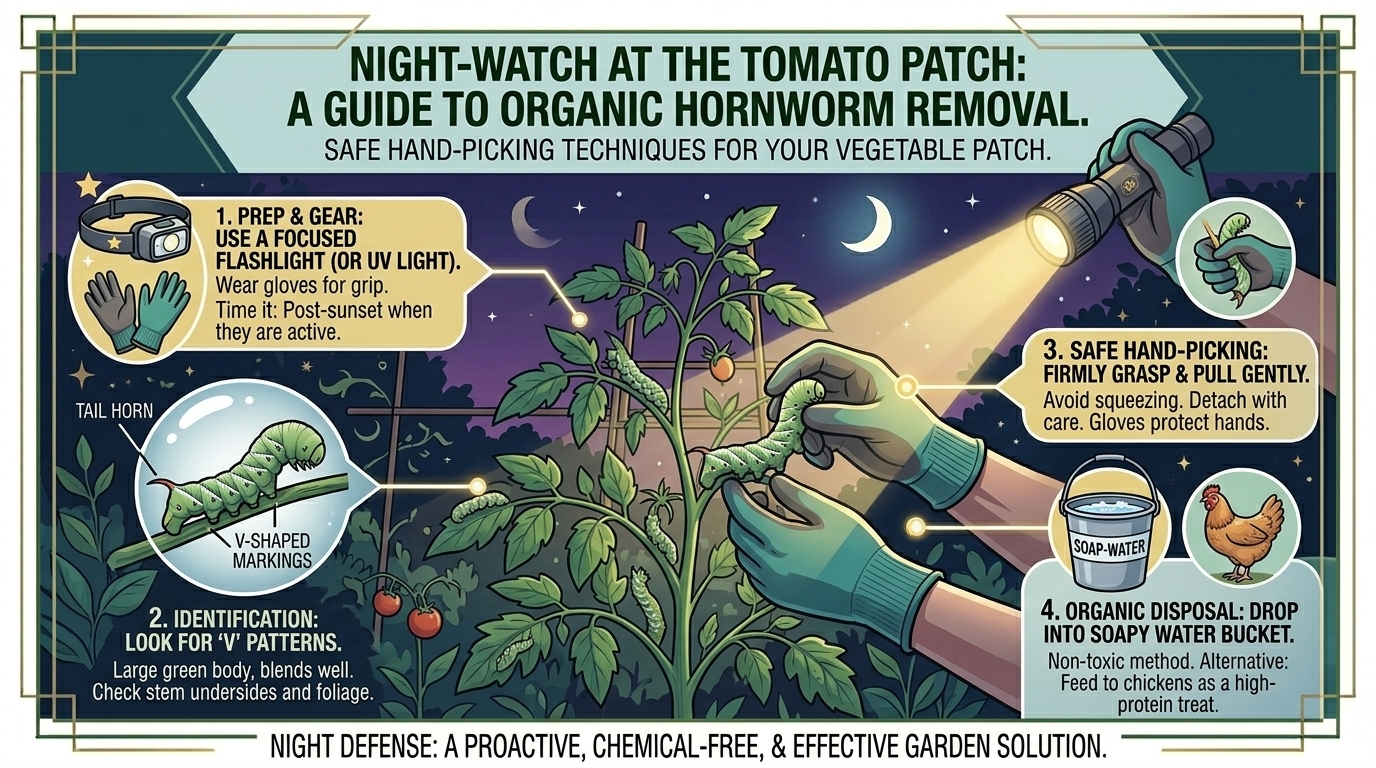
For any organic gardener who has invested months nurturing prize tomato plants, stepping out into the garden only to find sudden, severe defoliation is a heart-stopping moment. Entire branches stripped bare of leaves, chewed green tomatoes with ragged holes, and dark, pellet-like frass scattered across mulch beds point to one notorious culprit: the tomato hornworm (Manduca quinquemaculata) or its close relative, the tobacco hornworm (Manduca sexta).
These voracious caterpillars are masters of camouflage during daylight hours. Their vibrant lime-green bodies blend seamlessly with tomato stems and foliage, making them nearly invisible to the human eye under direct sunlight. However, waiting until daytime to find them often means losing half your harvest.
The most effective, chemical-free strategy used by master organic gardeners across major growing regions—from the scorching sun of Texas and the humid summers of New York, to the diverse microclimates of California, the damp gardens of Washington, and the urban backyards of San Francisco—is nighttime hand-picking using ultraviolet (UV) light.
This comprehensive masterclass explores the biology of tomato hornworms, why nighttime is the ultimate time for extraction, essential tools, a step-by-step removal guide, and expert preventative tips to protect your organic vegetable patch.
Understanding the Enemy: The Biology and Habits of Tomato Hornworms
Before executing your nighttime eradication campaign, understanding your adversary ensures higher efficiency and long-term garden protection.
- The Scale of Destruction: Tomato hornworms are the larvae of large, nocturnal sphinx moths (often called hummingbird moths). A single hornworm can grow up to 4 to 5 inches in length and can consume entire leaves, stems, and green fruits in a matter of hours.
- Host Plants: While they heavily target tomatoes, hornworms also aggressively attack eggplants, peppers, potatoes, and related solanaceous weeds like horse nettle and jimsonweed.
- Daytime Cryptpsis (Camouflage): During the day, hornworms remain completely motionless along the underside of stems, matching the vascular lines and green pigment of the plant with astonishing precision.
Why Nighttime Hand-Picking is Superior
While hand-picking hornworms during the day is possible, it is tedious, inefficient, and often results in missed caterpillars that continue their destruction overnight. Nighttime hand-picking offers distinct biological and technological advantages:
- Nocturnal Feeding Behavior: Sphinx moths lay eggs at dusk, and hornworms become active foragers exclusively after sunset. They emerge from deep inside the canopy to feed on outer leaves and fruit.
- The UV Fluorescence Secret: Tomato hornworms contain natural organic compounds in their cuticles that fluoresce brilliantly under ultraviolet (UV-A) blacklight. When scanned with a 395nm UV flashlight in total darkness, green hornworms glow a distinct, bright neon blue-white against the dark green foliage.
- Reduced Stress on Plants: Nighttime harvesting allows you to inspect, prune, and tend to your vegetable patch during the coolest hours of the day without disrupting beneficial daytime pollinators like bees and beneficial wasps.
Complete Tools and Equipment Checklist
Equipping yourself properly ensures a fast, painless, and highly successful nocturnal hunting session.
| Category | Item | Recommended Specification | Purpose |
| Illumination | UV-A Blacklight Flashlight | 395nm wavelength LED flashlight | Instantly causes hornworms to glow neon in the dark |
| Illumination | Headlamp (Red or White Light) | Dual-mode adjustable headlamp | Provides ambient light for navigating garden paths safely |
| Containment | Deep Bucket with Lid | 1-to-2-gallon bucket filled with soapy water | Safe disposal receptacle for harvested caterpillars |
| Safety | Thick Gardening Gloves | Nitrile-coated or durable fabric gloves | Protects hands from sticky tomato sap and garden thorns |
| Protection | Sturdy Footwear | Closed-toe boots or garden shoes | Essential for navigating nocturnal garden pests (slugs, spiders) |
Step-by-Step Guide: The Nighttime Hornworm Hunt
Executing a successful night hunt requires a methodical approach to ensure every corner of your solanaceous patch is cleared.
Phase 1: Preparation and Timing
- Wait for Total Darkness: Begin your hunt at least one hour after sunset. Twilight is insufficient; ambient daylight interferes with UV fluorescence.
- Arm Your Gear: Equip your 395nm UV flashlight, headlamp, and a bucket filled with warm water mixed with a few drops of liquid dish soap.
- Check High-Risk Zones: Focus heavily on indeterminate tomato varieties, large sprawling bushes, and plants showing early signs of defoliation or dark frass pellets on lower leaves.
Phase 2: The UV Scan and Detection
- Sweep the Canopy: Turn on your UV flashlight and sweep the beam slowly across the tomato plants from top to bottom, moving leaves gently aside.
- Spot the Neon Glow: While standard foliage appears dark or dull under a 395nm UV light, tomato hornworms will stand out as vibrant, glowing neon blue-white beacons.
- Inspect the Frass and Stems: If you spot dark green cylindrical droppings on the mulch below a branch, scan directly upward along that stem; a hornworm is guaranteed to be feeding nearby.
Phase 3: Safe Extraction and Disposal
- Grasp Firmly: Use your gloved fingers to grip the hornworm gently around its midsection. Hornworms do not bite or possess venom, though their rear horn is sharp (yet harmless).
- Detach and Drop: Pull the caterpillar straight out. They have strong prolegs that grip plant stems tightly, so a firm, steady tug may be required. Drop them immediately into your soapy water bucket.
- Check for Parasitic Wasps (Crucial Step!): Before dropping a hornworm into soapy water, check its back. If you see white, rice-like cocoons protruding from its skin, do not kill it. These are pupae of the beneficial Braconid wasp. Leave these parasitized hornworms in the garden; the wasp larvae will hatch and destroy future pest generations naturally.
Regional Considerations for Hornworm Management
Climate conditions heavily influence hornworm life cycles and generation counts across different regions:
- Texas: High heat and long growing seasons allow for multiple generations of hornworms per year. Night hunts should be conducted weekly throughout spring, summer, and fall.
- New York and the Northeast: Hornworm pressure peaks during mid-summer. Focus intensive nighttime scouting in July and August when larvae reach peak size and appetite.
- California: From the Central Valley to Southern California, warm Mediterranean climates extend pest windows. Combine nighttime hand-picking with drip irrigation management to deter excess foliage growth.
- Washington and the Pacific Northwest: Milder summers mean slightly lower population pressure, but backyard gardeners in western Washington should still inspect vines closely during warm August evenings.
- San Francisco: Urban microclimates and evening fog can suppress massive insect booms, but backyard tomatoes grown in sunny microclimates (like the Mission or Potrero Hill) still require vigilant nocturnal checks.
Long-Term Organic Prevention Strategies
While nighttime hand-picking solves immediate infestations, combining it with organic cultural controls prevents future outbreaks:
- Encourage Beneficial Predators: Plant umbelliferous flowers (dill, fennel, yarrow) and native flowering herbs nearby to attract beneficial insects like paper wasps, ladybugs, and braconid wasps that prey on hornworm eggs.
- Apply Bacillus thuringiensis (Bt): If infestations are overwhelming, spray plants with Bt kurstaki, a natural soil-dwelling bacterium. When caterpillars ingest treated leaves, it paralyzes their digestive system. (Note: Apply Bt in late afternoon, as UV sunlight degrades it quickly).
- Fall Tillage and Cleanup: Till your garden soil deeply in late autumn or early winter. Hornworms overwinter as brown, hard pupae buried 2 to 4 inches underground; disturbing the soil exposes them to freezing temperatures and hungry birds.
- Crop Rotation: Never plant tomatoes, peppers, or eggplants in the exact same garden bed two years in a row. Rotate solanaceous crops to starve out lingering pupae.
Troubleshooting Common Night Hunting Issues
- Issue: I am shining my UV flashlight, but nothing is glowing.
- Solution: Verify your flashlight wavelength. Standard household blacklights or cheap novelty blacklights operate at 385nm or 400nm, which will not trigger hornworm fluorescence. You must use a true 395nm to 405nm UV-A LED flashlight.
- Issue: Hornworms keep reappearing every single night.
- Solution: You may have missed unhatched eggs on the undersides of leaves. Inspect leaves closely for tiny spherical green-white eggs, wipe them off manually, and check for incoming adult moths around dusk.
- Issue: The hornworms are blending in with fruit clusters, making them hard to pull.
- Solution: Use clean garden shears to snip the small stem holding the fruit or leaf rather than pulling forcefully, preventing accidental damage to your prize tomato clusters.
Frequently Asked Questions (FAQ)
1. Why do tomato hornworms glow under UV light?
Tomato hornworms contain natural organic compounds in their exoskeleton and bodily fluids that absorb ultraviolet-A radiation and re-emit it as visible fluorescence, causing them to glow neon blue-white in the dark.
2. What wavelength of UV light do I need to find hornworms?
You need a true 395nm UV-A LED flashlight. Wavelengths above 400nm or standard fluorescent blacklight bulbs lack the specific energy needed to make hornworms fluoresce brightly against dark foliage.
3. Are tomato hornworms venomous or dangerous to touch?
No. Tomato hornworms do not bite, sting, or possess venom. The prominent horn on their rear end looks intimidating, but it is completely harmless and used only for defense or misdirection against predators.
4. Should I kill a hornworm covered in white cocoons?
No! Those white, rice-like cocoons belong to the beneficial Braconid wasp. The wasp larvae feed inside the hornworm and emerge to pupate. Leaving parasitized hornworms in your garden helps control future pest populations naturally.
5. Can I use Bt (Bacillus thuringiensis) instead of hand-picking?
Yes. Bacillus thuringiensis (specifically the kurstaki strain) is an OMRI-listed organic spray that kills caterpillars when ingested. However, it must be ingested, whereas nighttime hand-picking provides immediate mechanical removal.
6. What time of night is best to hunt for tomato hornworms?
Begin your hunt at least one hour after sunset. Complete darkness is required so that ambient daylight does not interfere with the UV fluorescence of the caterpillars.
7. How much damage can a single hornworm cause?
A single tomato hornworm can consume multiple large leaves, chew deep holes into green tomatoes, and strip entire branches bare in less than 24 hours due to their massive appetite during their final larval instar stage.
8. Do tomato hornworms eat plants other than tomatoes?
Yes. While they heavily favor tomatoes, they also feed on peppers, eggplants, potatoes, and related solanaceous weeds such as horse nettle and jimsonweed.
9. How do hornworms survive the winter?
After finishing their larval stage, hornworms drop to the ground, burrow 2 to 4 inches into the soil, and transform into dark brown pupae to overwinter before emerging as adult sphinx moths in spring.
10. Where can I find more organic pest control tips and backyard gardening guides?
For comprehensive horticultural advice, regional gardening strategies, and expert plant care tips tailored to your backyard, visit kcplants.com.
Conclusion
Safely hand-picking and removing tomato hornworms from your organic vegetable patch at night using a UV light is a game-changing technique that bridges science and practical horticulture. By bypassing daytime camouflage and leveraging hornworm fluorescence, you can protect your harvest efficiently without resorting to harsh chemical pesticides. Whether you are tending urban raised beds in San Francisco or sprawling suburban gardens in Texas, nighttime scouting ensures a healthy, flourishing tomato crop all season long.