Designing durable, clean, and visually pleasing pathways is a foundational element of functional garden design. While synthetic landscape fabrics, plastic barriers, and concrete pavers are often marketed as quick fixes for weed control, they frequently degrade into environmental pollutants or trap soil moisture unnaturally. Natural wood chips offer an eco-friendly, highly effective alternative for defining footpaths while keeping weeds at bay.
One of the most persistent myths in home gardening is that using raw wood chips on garden pathways will “leach” chemicals into neighboring beds or strip the surrounding soil of essential nitrogen. In reality, when applied correctly as a topical surface mulch on pathways, natural wood chips suppress opportunistic weed seeds entirely through light deprivation while actively supporting healthy soil microbiology.
Whether you are designing pathways through vegetable beds in Texas and California, navigating damp soils in Washington, managing seasonal freezes in New York, or building compact backyard garden trails in San Francisco, natural wood chips provide long-term weed suppression without harming neighboring plant roots.
At KC Plants, we advocate for organic garden infrastructure methods that work in harmony with natural soil ecology across every growing zone.
1. The Science of Weed Suppression: How Wood Chips Stop Weeds
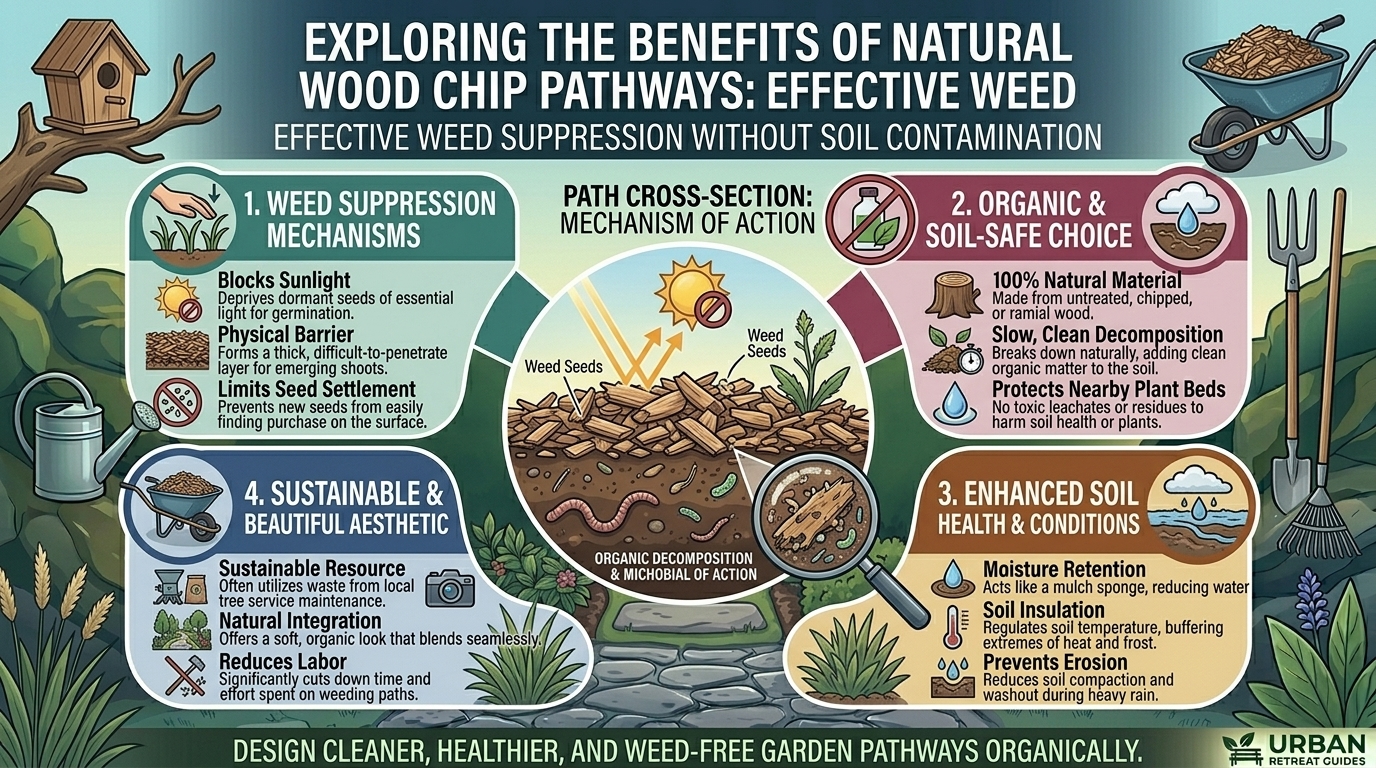
Weed seeds are present in almost every outdoor environment, resting quietly in the top layers of soil waiting for two key triggers: light and atmospheric exposure. Natural wood chips act as a physical barrier that interrupts these triggers in three distinct ways:
- Complete Light Deprivation: A 3 to 4-inch layer of coarse wood chips completely blocks solar radiation from reaching the underlying soil surface. Without light, germinating weed seeds cannot photosynthesize and die off beneath the mulch line.
- Physical Growth Barrier: Even if deep-seated perennial weed seeds manage to germinate beneath the wood chips, the weight and irregular interlocking structure of coarse arborist chips make it physically difficult for fragile hypocotyls to reach open air.
- Dry Top Layer: Wood chips dry out quickly on their topmost surface after rainfall or irrigation. Because airborne weed seeds landing on top of the pathway lack constant surface moisture, they fail to take root and germinate.
2. Debunking the Soil Contamination and Nitrogen Immobilization Myths
A common concern among home gardeners is whether wood chip pathways will negatively alter soil chemistry or rob nearby crops of nutrients. Understanding the difference between incorporating wood into soil versus laying it on top solves this confusion.
The Nitrogen Tie-Up Myth
It is true that carbon-rich materials (like wood chips) require nitrogen to break down. However, nitrogen immobilization occurs only at the exact point of contact—a microscopic layer where the bottom of the wood chip touches the top of the soil.
Soil microbes pulling nitrogen to decompose pathway wood chips cannot reach horizontally into adjacent growing beds or penetrate deeper than a fraction of an inch into the soil profile.
Chemical Leaching vs. Organic Decomposition
Un-dyed, natural arborist wood chips do not introduce toxic chemicals into the ground. As wood chips decompose over 2 to 3 years, they release beneficial humic compounds, trace minerals, and organic matter into the subsoil, improving water filtration and feeding beneficial mycorrhizal fungi without contaminating adjacent plants.
| Pathway Material | Weed Suppression | Impact on Soil Biology | Microplastic Risk | Long-Term Cost |
|---|---|---|---|---|
| Natural Wood Chips | High (3–4 in. depth) | Enhances fungal networks & soil organic matter | Zero | Low to Free (Arborist drops) |
| Landscape Fabric | Temporary | Compacts soil; starves beneficial worms | High (Degrades into plastics) | Moderate |
| Gravel / Crushed Stone | Moderate (Weeds grow in debris) | Neutral to compacting; alters pH over time | Zero | High |
| Synthetic Rubber Mulch | Moderate | Contaminates soil with zinc & chemical runoff | High | High |
3. Best Practices for Installing Wood Chip Garden Pathways
Building a low-maintenance, weed-free wood chip pathway requires simple surface preparation to ensure longevity and drainage.
1
Clear and Level the Pathway Subgrade
Avoid deep tilling which brings up dormant seeds
1.Clear and Level the Pathway Subgrade:Avoid deep tilling which brings up dormant seeds.
Scalp existing grass or surface weeds down to the soil line using a flat shovel or string trimmer. Do not rototill the pathway, as tilling brings thousands of dormant weed seeds to the surface.
2
Lay a Biodegradable Cardboard Sheet Barrier
Use cardboard as a natural temporary smother layer
2.Lay a Biodegradable Cardboard Sheet Barrier:Use cardboard as a natural temporary smother layer.
Place overlapping layers of non-glossy, unprinted brown corrugated cardboard directly over the cleared soil. This extra layer smothers stubborn turf grass and perennial weeds while decomposing naturally into organic carbon over 6 to 12 months.
3
Apply 3 to 4 Inches of Coarse Arborist Wood Chips
Ensure adequate depth for light blockage
3.Apply 3 to 4 Inches of Coarse Arborist Wood Chips:Ensure adequate depth for light blockage.
Spread un-dyed, mixed-conifer or hardwood arborist chips evenly over the cardboard base. Maintain a uniform depth of 3 to 4 inches to guarantee complete light suppression.
4
Edging and Annual Maintenance Refresh
Maintain clear boundaries for adjacent beds
4.Edging and Annual Maintenance Refresh:Maintain clear boundaries for adjacent beds.
Install clean timber, stone, or metal edging along pathway borders to keep wood chips from spilling into vegetable or flower beds. Top-dress the pathway with a fresh 1-inch layer of wood chips once a year to replenish settling material.
10 Frequently Asked Questions (FAQ)
1. Will wood chip pathways attract termites or carpenter ants to my garden?
Dry, exposed pathway wood chips rarely attract termites. Termites prefer large, buried logs or constantly damp wood structural timbers. Arborist chips dry out on top and decay via fungal breakdown rather than insect nesting.
2. Should I use landscape fabric under my wood chip pathways?
No. Landscape fabric eventually disintegrates, shedding microplastics into the soil while weeds take root on top of the fabric inside decomposing organic matter. Cardboard or thick painter’s paper is a superior, fully biodegradable alternative.
3. Where can I get free natural wood chips for garden paths?
Local arborists and tree trimming services are often eager to dump loads of freshly chipped tree trimmings for free. Services like ChipDrop connect homeowners with local arborists needing disposal sites.
4. How long do wood chip pathways last before needing replacement?
A 4-inch deep wood chip pathway typically lasts 2 to 3 years before breaking down into rich organic humus. Applying