Few culinary rewards rival the taste of a homegrown, sun-ripened tomato fresh off the vine. Yet, every home gardener across regions as diverse as Texas, New York, California, Washington, and San Francisco knows the heartbreak of tending a tomato plant all summer, only to find the bottom of a prime fruit sunken, black, and leathery. This frustrating condition—known as blossom-end rot—sends gardeners scrambling for solutions, and the internet is flooded with one ubiquitous, time-tested home remedy: crushed eggshells.
For decades, garden lore has championed eggshells as the ultimate organic fix for calcium deficiency in vegetable patches. But can these kitchen scraps truly serve as a permanent, reliable natural calcium source for healthy tomatoes, or is this practice more myth than horticulture?
This comprehensive guide dives deep into the soil science of calcium, evaluates the true efficacy of crushed eggshells, examines how regional soil profiles across the U.S. impact calcium uptake, and provides an actionable blueprint for maximizing your tomato harvest.
1. The Critical Role of Calcium in Tomato Growth
To evaluate whether eggshells can solve calcium deficiencies, we must first understand why tomato plants need calcium so desperately and how they process it.
Why Tomatoes Demand High Calcium
Calcium is a foundational building block for plant biology. In tomatoes, calcium is responsible for:
- Cell Wall Integrity: Calcium pectate binds plant cells together. Without adequate calcium, cellular walls fail to form properly, resulting in structural breakdown—manifested visibly as blossom-end rot.
- Root and Shoot Development: New tissue growth at the tips of roots and shoots requires a constant, steady supply of calcium.
- Enzyme Activation and Signaling: Calcium helps regulate internal enzymatic reactions and protects plants against environmental stress and disease.
The Catch: It is a Transport Problem, Not Just a Supply Problem
Here is the most crucial realization for tomato growers: blossom-end rot is rarely caused by a total lack of calcium in the soil.
More often than not, the soil contains plenty of calcium, but the plant cannot transport it to the developing fruit. Calcium moves through a plant exclusively via water transpiration pulled upward from the roots. If your watering schedule fluctuates wildly—ranging from bone-dry to waterlogged—the plant’s vascular system cannot pump calcium efficiently to the distal ends of the fruit, leading to tissue collapse.
2. The Truth About Crushed Eggshells: Science vs. Myth
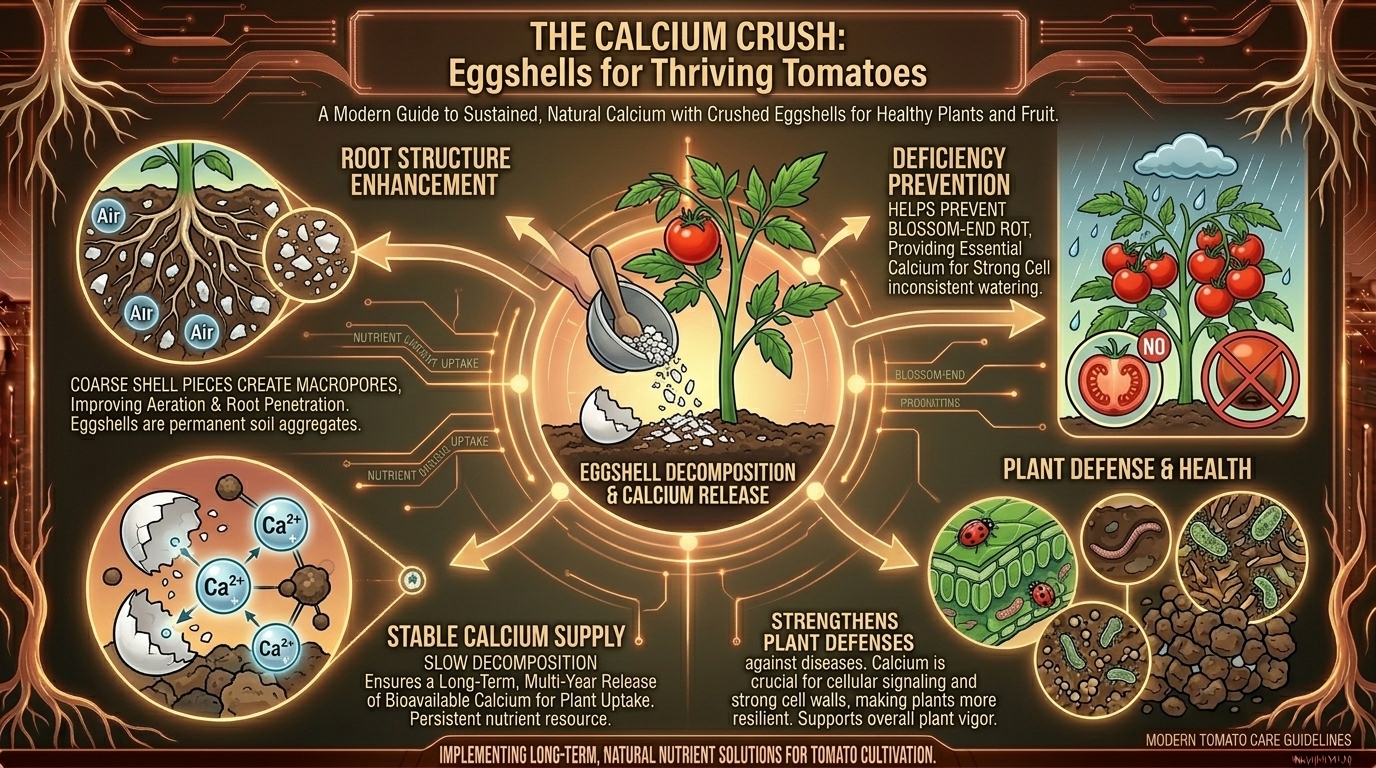
Eggshells are composed almost entirely of calcium carbonate (roughly 95%), with the remainder consisting of proteins and trace minerals. Since calcium carbonate is the primary ingredient in agricultural lime, it seems logical that tossing eggshells into a planting hole would instantly feed calcium-hungry tomatoes.
Unfortunately, raw, coarsely crushed eggshells do not work this way in the short term.
The Breakdown Barrier
- Extremely Slow Decomposition: Eggshells are durable, tough structures designed to protect developing chicks. When you crush them by hand or throw whole shells into the dirt, they take years to break down naturally in native soil microbes.
- Inaccessible Calcium: For calcium carbonate to become available to plant roots, it must first be broken down by soil acids and microbial activity into water-soluble calcium ions ($Ca^{2+}$). Coarse chunks of eggshells provide minimal surface area, meaning the release rate of calcium is glacially slow.
- The “Permanent Source” Verdict: Can eggshells act as a permanent natural calcium source? Yes, in the geological sense. Over several years, they will slowly dissolve and enrich the soil. However, they cannot act as an immediate or reliable fix for an active tomato plant struggling with blossom-end rot during the current growing season.
3. How to Make Eggshells Work: Preparation is Everything
If you want your eggshells to actually benefit your tomatoes rather than sitting inert in the soil, you must drastically alter how you process them.
Step 1: Clean and Save
Rinse used eggshells thoroughly to remove any lingering organic residue (egg white or yolk), which can attract pests like ants, rodents, or raccoons to your garden beds. Store them in a dry container until you have accumulated a large batch.
Step 2: Bake and Sterilize
Bake the clean eggshells in an oven at 200°F (93°C) for about 15 to 20 minutes. This accomplishes two goals:
- It kills any potential food-borne pathogens (like Salmonella).
- It makes the shells brittle and completely dry, making them infinitely easier to pulverize.
Step 3: Ultra-Fine Pulverization
This is the turning point. Toss the baked shells into a high-powered blender, food processor, or coffee grinder and process them until they resemble a fine, talcum-like powder or flour. By maximizing the surface area, you allow soil biology and mild acids to convert the calcium carbonate into a plant-available form much faster—though still over months rather than weeks.
4. Regional Soil Realities Across the United States
Soil chemistry varies dramatically depending on where your garden is located. How your tomatoes respond to calcium amendments depends heavily on your local geography:
Texas
- Soil Profile: Often heavy alkaline clay with high mineral content, though rainfall leaching can create localized nutrient imbalances.
- Calcium Dynamic: Many Texas soils actually have high total calcium, but high pH (alkalinity) or salt content locks it up. Adding raw eggshells won’t help alkaline soils much; consistent moisture management is the true key to preventing blossom-end rot here.
New York & Washington
- Soil Profile: Typically naturally acidic forest soils with lower natural pH levels.
- Calcium Dynamic: Acidic soils naturally break down calcium carbonate faster, making finely powdered eggshells a welcome long-term buffer against acidity while gently supplying calcium over time. However, heavy spring rains can leach nutrients quickly, requiring careful watering practices.
California & San Francisco
- Soil Profile: Highly diverse microclimates, ranging from coastal sandy loams to inland clay and alkaline valley soils. In urban settings like San Francisco, garden soil is often amended heavily with imported organic compost.
- Calcium Dynamic: In coastal or sandy microclimates where water drains rapidly, calcium can wash away. Finely powdered eggshells mixed into rich compost bins months before planting help build a resilient, long-term soil structure.
5. Alternative and Faster Acting Natural Calcium Sources
If your tomato plants are showing active signs of deficiency, or if you want a guaranteed nutrient boost without waiting years for eggshells to dissolve, consider these faster-acting natural alternatives:
- Bone Meal: A classic organic amendment made from ground animal bones. It is rich in both phosphorus (for root development and fruiting) and readily available calcium. It breaks down much faster than eggshells.
- Gypsum (Calcium Sulfate): An incredible natural mineral amendment that provides immediate soluble calcium without altering your soil’s pH level. It is especially useful for breaking up heavy Texas and California clay soils while feeding the plant.
- Ag Lime (Agricultural Limestone): Best used in acidic soils (like parts of New York and Washington), agricultural lime quickly neutralizes acidity and floods the root zone with bio-available calcium.
- A Balanced Liquid Organic Fertilizer: Look for organic liquid fertilizers containing calcium chelate, which can be applied directly to the soil or as a foliar spray for rapid absorption during critical fruiting windows.
6. Comprehensive FAQ: Everything You Need to Know
1. Will putting whole eggshells at the bottom of a tomato planting hole stop blossom-end rot?
No. Whole or coarsely crushed eggshells placed at the bottom of a planting hole take years to break down. By the time the calcium becomes available, your tomato plant will have completed its life cycle. It is a common gardening myth that offers virtually no immediate protection against blossom-end rot.
2. How long do ultra-fine powdered eggshells take to work?
Even when ground into a fine powder, eggshells take anywhere from a few months to a full year to completely break down and release their calcium into the soil solution. They are best viewed as a brilliant long-term soil conditioner rather than an emergency cure.
3. Do I need to bake eggshells before putting them in my garden?
Yes, baking is strongly recommended. It sterilizes the shells, removing any lingering protein residue that attracts unwanted pests like ants, flies, or rodents, and dries the shells out so they can be ground into a fine dust easily.
4. Can I add eggshells directly to my compost pile instead of the garden?
Absolutely! Adding crushed eggshells to your compost bin is one of the best ways to process them. The heat, moisture, and intense microbial activity inside a healthy compost pile help break down the calcium carbonate much faster than native garden soil. Once the compost is finished, the calcium is securely integrated into rich humus.
5. Is blossom-end rot always caused by a lack of calcium in the soil?
No. In fact, most cases of blossom-end rot are caused by inconsistent watering rather than a true calcium deficiency. When soil swings wildly between dry and wet, the plant cannot transpire water effectively, preventing calcium from reaching the developing fruit tips.
6. Can I make liquid “eggshell tea” for my tomatoes?
Yes, many gardeners steep finely powdered eggshells in water for a week or two to create a liquid extract. While this extracts a minor amount of soluble calcium into the water, the concentration is usually quite low compared to commercial water-soluble calcium fertilizers. It acts as a nice organic boost, but should not be relied upon as a sole fix for severe deficiencies.
7. Do eggshells change the pH of garden soil?
Because eggshells are primarily calcium carbonate (the same active ingredient in agricultural lime), they are mildly alkaline. However, unless you are dumping massive, industrial quantities into a very small garden bed, a normal home gardener’s supply of kitchen eggshells will have a negligible impact on overall soil pH.
8. Are there any garden plants that dislike eggshells?
Plants that thrive in highly acidic environments—such as blueberries, azaleas, rhododendrons, and hydrangeas—prefer lower pH levels. While a small amount of eggshell powder won’t hurt them, heavy applications can raise the pH over time, which may stress acid-loving species.
9. Can I use eggshells from any type of bird (like duck or quail)?
Yes! Quail, duck, goose, and chicken eggshells all share a nearly identical chemical composition (primarily calcium carbonate) and can be cleaned, baked, and pulverized using the exact same methods.
10. What is the absolute best way to use eggshells for tomatoes?
The most effective method is to collect your household eggshells throughout the winter, bake and grind them into an ultra-fine powder, and mix that powder directly into your compost pile or work it deeply into your garden beds several months before spring planting so soil microbes can begin converting the calcium into a plant-usable form.
Conclusion
Crushed eggshells are a fantastic, sustainable way to recycle kitchen waste, feed your soil microbes, and add a slow-release stream of calcium to your garden over the long term. However, they are not a magic, permanent, or immediate fix for preventing blossom-end rot in active tomato plants.