How to Grow Crisp Cucumbers Vertically on Wire Cattle Panels to Save Garden Floor Space
Few things capture the refreshing, crisp essence of a summer afternoon quite like a freshly harvested cucumber (Cucumis sativus). Sliced into salads, infused into drinking water, or preserved into crunchy dill pickles, homegrown cucumbers taste infinitely superior, sweeter, and more vibrant than the wax-coated specimens found in grocery store aisles.
Yet, traditional gardening wisdom often deters people with limited space from growing them. Left to their natural habits, cucumber plants are sprawling, aggressive vines. A single bush variety can easily occupy 15 to 20 square feet of precious garden floor space, tangling across paths, smothering neighboring plants, and creating a humid, damp microclimate that invites powdery mildew and rotting fruit.
If you are gardening on a compact urban plot, a raised bed, or a backyard where every square inch counts, there is a masterclass solution: vertical gardening using heavy-duty wire cattle panels.
By forcing cucumbers to climb upward rather than sprawl outward, you completely transform your garden’s layout. Whether you are cultivating your crop under the blazing sun of Texas, navigating the variable seasonal shifts of New York, exploring the diverse microclimates of California, working the maritime air of Washington, or tending a cozy backyard in San Francisco, growing cucumbers vertically on cattle panels is a game-changer.
This comprehensive, SEO-optimized guide explores everything you need to know to build an industrial-strength cattle panel trellis and harvest a massive, blemish-free crop of crisp cucumbers.
Introduction: The Vining Nature of Cucumbers and the Problem with Ground Sprawling
To understand why vertical cattle panel trellises are so revolutionary, we first need to look at how cucumbers grow in the wild. Cucumbers are natural climbing vines equipped with specialized spiral structures called tendrils. In their native habitats, they naturally scramble up shrubs, trees, and brush to reach sunlight.
When forced to grow flat on the ground in a typical garden bed, several structural and pathological problems arise:
- Massive Space Consumption: Sprawling vines eat up valuable square footage that could otherwise be used for tomatoes, peppers, or greens.
- Fruit Rot and Soil Staining: Cucumbers resting directly on damp soil quickly develop yellow, water-logged bottoms, fungal infections, and blemishes favored by soil-dwelling insects.
- Fungal Diseases: When foliage mats together on the ground, air circulation drops to zero. Morning dew and watering trap moisture against the leaves, rapidly triggering devastating fungal outbreaks like powdery mildew and downy mildew.
- Curved and Misshapen Fruit: Cucumbers left dangling or pressing against dirt often grow crooked or distorted. Vertical growth allows gravity to pull the developing fruit straight, smooth, and uniform.
Why Wire Cattle Panels Are the Ultimate Trellis Material
When it comes to building a vertical cucumber support, gardeners have plenty of options: plastic netting, flimsy tomato cages, string lines, or wood lattice. None of them compare to a galvanized wire cattle panel.
Originally designed for livestock fencing, cattle panels are heavy-duty welded wire structures typically measuring 16 feet long by 50 inches tall, constructed from thick 4-gauge galvanized steel wire (roughly 1/4 inch thick).
Here is why they are the absolute gold standard for vertical cucumber growers:
- Indestructible Strength: Cucumber vines grow surprisingly heavy when loaded with dozens of water-dense fruits. Flimsy tomato cages buckle under this weight; cattle panels will easily support hundreds of pounds of vines without bending or sagging.
- Large Grid Openings: The grid squares on a cattle panel are typically 6 inches by 8 inches. This is wide enough for you to easily slide your hands through to harvest mature cucumbers, yet small enough for the plant’s natural tendrils to weave through and anchor themselves securely.
- Multi-Season Durability: Made of heavy galvanized steel, a cattle panel will not rust, rot, or degrade under harsh weather. A single panel will easily last for 20 to 30 years of continuous garden use.
- Zero Maintenance: Once secured into place, it requires no tightening, restringing, or seasonal replacement.
Regional Growing Strategies Across the US
Your local climate determines your planting window and how you manage moisture and heat for your vertical cucumber crop:
- Texas: Texas summers feature intense, punishing heat. While cucumbers love warmth, extreme triple-digit temperatures can cause plants to drop blossoms and slow production. Plant early in spring (March–April) or plant a second crop in late summer (August) for an autumn harvest. Ensure your cattle panel faces east-west or is positioned to offer slight afternoon shade during peak July heat waves.
- New York: New York’s spring arrives late, and soil must warm up thoroughly before seeds are sown (typically late May). Vertical trellising is exceptionally beneficial here because lifting vines off damp northern soils prevents cold-weather fungal spores from overtaking early growth.
- California & San Francisco: San Francisco’s cool, foggy maritime summers can challenge heat-loving cucumbers. To compensate, position your cattle panel against a south-facing fence or wall that absorbs thermal heat during the day. In interior California valleys, cucumbers thrive wildly on cattle panels as long as they receive deep, consistent irrigation.
- Washington: Western Washington’s damp springs require well-draining soil at the base of your trellis. Because the vertical panel maximizes airflow, it helps dry out leaves rapidly after cool morning dews and light maritime rain showers.
Step-by-Step Guide: Building and Installing a Cattle Panel Trellis
You do not need to be an expert carpenter or welder to set up a cattle panel trellis. The simplest, most popular design for a garden bed is the arch trellis or the vertical flat-wall trellis. For space-saving efficiency on a narrow garden bed, the vertical flat wall is supreme.
What You Will Need:
- One standard cattle panel (16 feet long x 50 inches tall; can be cut in half with bolt cutters if you want two 8-foot sections).
- 2 to 3 heavy-duty T-posts (metal fence posts, 6 to 7 feet tall).
- A post driver or heavy mallet.
- Heavy-duty zip ties, galvanized wire, or U-bolts to secure the panel to the posts.
Step 1: Position the Trellis Bed
Select a spot running north-to-south if possible, ensuring that your tall vertical panel does not cast unwanted shade on shorter neighboring vegetable crops. Amend the soil along the base of the trellis with generous amounts of aged compost, as cucumbers are heavy feeders.
Step 2: Drive the Support Posts
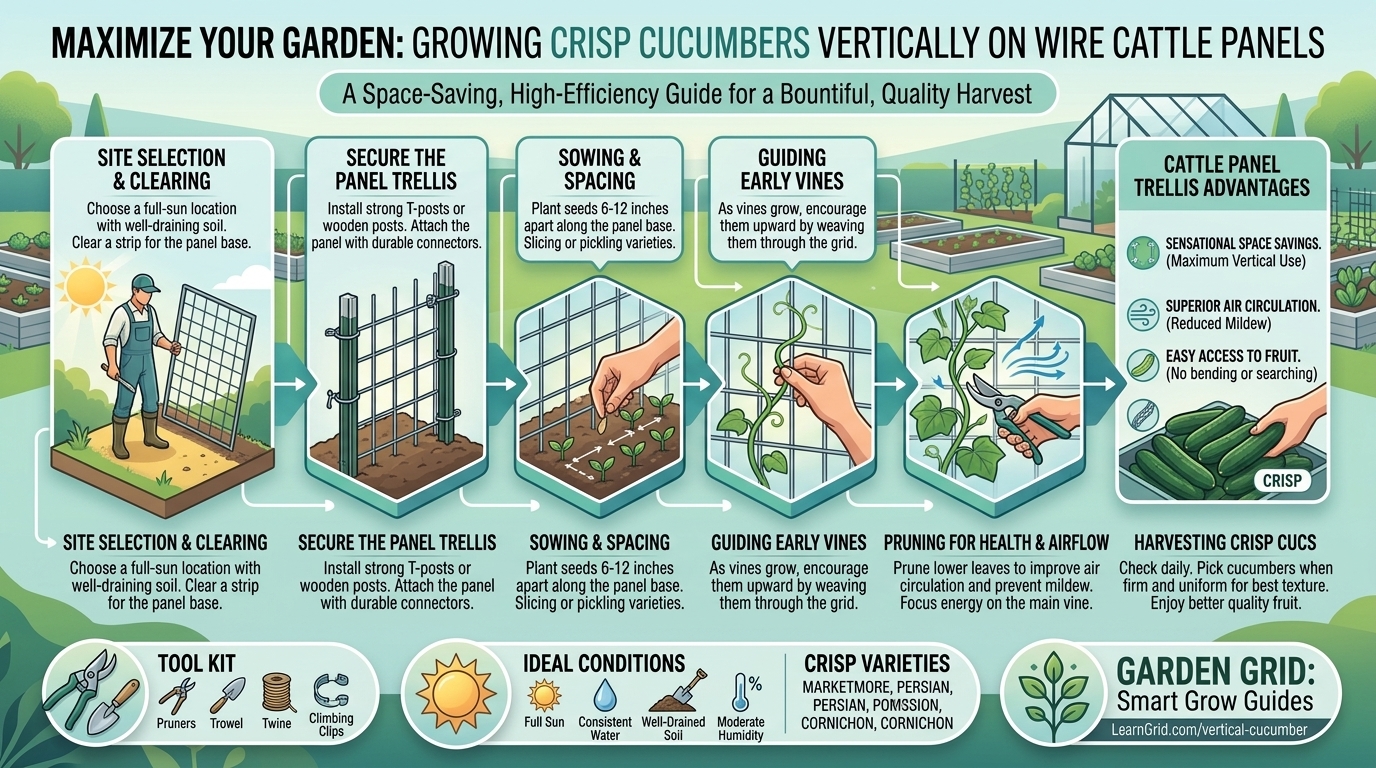
Drive your metal T-posts firmly 1 to 2 feet deep into the ground along a straight line at the back of your garden bed, spacing them about 6 to 8 feet apart.
Step 3: Mount the Cattle Panel
- Stand the cattle panel upright against the flat face of the metal T-posts.
- Using heavy-duty galvanized wire or thick UV-resistant outdoor zip ties, lash the wire panel tightly to the T-posts at the top, middle, and bottom.
- Ensure the bottom edge of the panel sits right at the soil surface or elevated an inch or two above it so you can easily plant directly underneath.
Sowing, Training, and Caring for Vertical Cucumbers
With your industrial-strength cattle panel standing tall, it is time to establish your crop.
Step 1: Choosing Cucumber Varieties
While you can grow bush cucumbers on a trellis, climbing or vining (indemonstrate) varieties are vastly superior for vertical systems. Look for slicing cucumbers (Marketmore 76, Straight Eight) or pickling varieties (Boston Pickling, National Pickling).
Step 2: Planting at the Base
- Direct-sow your cucumber seeds about 1 inch deep directly along the base of the cattle panel, spacing them roughly 6 to 8 inches apart.
- Once the seedlings emerge and grow their first set of true leaves, thin them out so that the strongest plants are spaced about 12 inches apart.
Step 3: Training the Young Vines
In their earliest stages, young cucumber vines may need a gentle nudge. As the main stems reach 12 to 18 inches tall, gently weave the tips and their curling tendrils into the lower openings of the cattle panel grid. Once the plant recognizes the wire as a support structure, it will take over completely, autonomously winding its tendrils upward and anchoring itself tightly.
Step 4: Watering and Heavy Feeding
- Watering: Cucumbers are roughly 95% water and have shallow root systems. They require a consistent 1 to 2 inches of water per week. Water deeply at the base using drip irrigation or a soaker hose beneath the trellis.
- Feeding: As heavy feeders, they need a mid-season boost. Side-dress with aged compost or apply an organic liquid fish emulsion and kelp fertilizer every 2 to 3 weeks during peak summer production.
Harvesting and Maximizing Yields
Vertical growing makes harvesting an absolute joy. Instead of crawling on your hands and knees searching through a jungle of prickles, you can simply walk up to your cattle panel wall and pluck hanging fruits at eye level.
- Harvest Frequently: Check your vertical vines every other day during peak summer. Picking cucumbers promptly stimulates the vine to continue producing new blossoms and setting more fruit.
- Use Clean Shears: Avoid yanking or twisting cucumbers off the vine, which can tear the main stem. Use clean garden snips or scissors to cut the stem cleanly.
10 Essential FAQs About Growing Cucumbers Vertically on Cattle Panels
1. Can cattle panels really support the heavy weight of large cucumbers?
Yes, absolutely! Cattle panels are constructed from thick 4-gauge steel wire designed to contain livestock. They easily support hundreds of pounds of heavy vining foliage and large slicing cucumbers without sagging or buckling.
2. Do I need to physically tie the cucumber vines to the wire panel?
Only during their initial growth stage (when the vines are 1 to 2 feet tall) might you need to tuck the tips into the wire grid. Once the plant’s natural tendrils make contact with the steel wire, they will wrap around it tightly and climb entirely on their own.
3. How much floor space does a cattle panel trellis actually save?
A vertical flat-wall cattle panel trellis condenses a plant footprint that would normally require 15 to 20 square feet of horizontal ground space into a narrow, vertical strip just 6 to 12 inches wide, saving over 90% of your garden floor space!
4. What is the best cucumber variety for vertical cattle panel trellises?
Vining or indeterminate slicing and pickling varieties—such as Marketmore 76, Straight Eight, and Boston Pickling—are ideal because they produce long, vigorous vines that easily scale tall structures.
5. Will the metal cattle panel burn or damage the cucumber leaves in hot weather?
No. While metal can absorb heat, standard galvanized cattle panels do not heat up enough to burn plant tissues, especially once the vigorous green foliage of the cucumber canopy grows dense enough to shade the wire structure.
6. How do I prevent powdery mildew when growing cucumbers vertically?
Vertical growing is already your best defense because lifting vines off the ground maximizes airflow and sunlight penetration. To further prevent mildew, water only the soil at the base (never overhead wetting the leaves) and ensure proper spacing between plants.
7. How do I harvest heavy slicing cucumbers so they don’t break the vine?
Support the cucumber with one hand while cutting the stem cleanly with sharp garden shears or scissors. Never pull or yank downward, as this can snap the supporting vine or damage the cattle panel attachments.
8. Can I cut a cattle panel down to fit a smaller garden bed?
Yes! Cattle panels are large (usually 16 feet long), but you can easily cut them down to smaller dimensions (such as 6-foot or 8-foot sections) using heavy-duty bolt cutters or an angle grinder.
9. How do I store my cattle panel trellis at the end of the season?
You don’t even have to take it down! Because heavy galvanized steel panels are completely rust-resistant and weatherproof, many gardeners leave their cattle panel trellises standing permanently in their garden beds year-round, simply clearing away dead annual vines in late autumn.
10. Can I grow other vegetables on a cattle panel trellis besides cucumbers?
Yes! Cattle panels are versatile garden powerhouses. They are equally fantastic for supporting climbing pole beans, sugar snap peas, winter squash, passion fruit, and even heavy heirloom tomatoes.
Conclusion
Growing cucumbers vertically on heavy-duty wire cattle panels is one of the smartest, most efficient upgrades you can bring to your backyard garden. By trading messy, space-hogging horizontal sprawl for clean, organized vertical architecture, you maximize your square footage, protect your fruit from rot, improve air circulation, and make harvesting an effortless pleasure.