Why Planting Bush Beans Instead of Pole Beans Saves Time and Eliminates Trellis Requirements
There is a quiet, universal rhythm to the spring gardening season. You prepare your soil, map out your rows, and eagerly drop seeds into the earth, dreaming of the lush harvests to come. Yet, for many home gardeners, the excitement of planting green beans quickly turns into a logistical headache when reality sets in: building tall, complex structural supports, wrestling with tangled vines, tying up drooping stems, and spending hours untangling end-of-season cordage.
If you want the incredible culinary reward of crisp, tender, fresh-picked green beans without the construction project attached to it, there is a brilliant, low-maintenance alternative: bush beans.
Unlike their sprawling, high-flying pole bean cousins, bush beans are self-supporting, compact champions that grow into neat, upright little shrubs. By choosing bush beans over pole varieties, you completely eliminate the need for trellises, stakes, and teepees, saving you precious hours of labor while maximizing your garden’s efficiency.
Whether you are gardening under the blazing sun of Texas, navigating the variable seasonal shifts of New York, exploring the diverse microclimates of California, managing the maritime air of Washington, or tending a compact urban plot in San Francisco, planting bush beans is a game-changer.
This comprehensive, SEO-optimized guide explores why bush beans save time, eliminate trellising requirements, and deliver a massive, hassle-free harvest for home gardeners.
Introduction: The Great Bean Divide (Bush vs. Pole)
Before diving into the mechanics of bush beans, it helps to understand the fundamental biological difference between the two primary categories of common garden beans (Phaseolus vulgaris):
- Pole Beans: These are vigorous, indeterminate climbers. They throw out searching tendrils that spiral upward, scaling fences, poles, and nets to heights of 6 to 10 feet (or more). While they are exceptionally productive over a long season, they cannot stand on their own; they demand heavy-duty vertical infrastructure.
- Bush Beans: These are determinate growers. They grow compactly to a height of 15 to 24 inches, branching outward into a sturdy, self-supporting bush. Once they reach their mature size, they flower uniformly, set a massive concentrated flush of pods, and complete their productive life cycle within a tight window.
For time-pressed gardeners, urban balcony growers, or anyone looking for a streamlined vegetable patch, bush beans offer unmatched convenience.
Why Bush Beans Save Immense Amounts of Time
Time is often a gardener’s most precious and limited resource. Choosing bush beans alters your garden labor equation across multiple phases of the growing season:
1. Zero Structural Construction Time
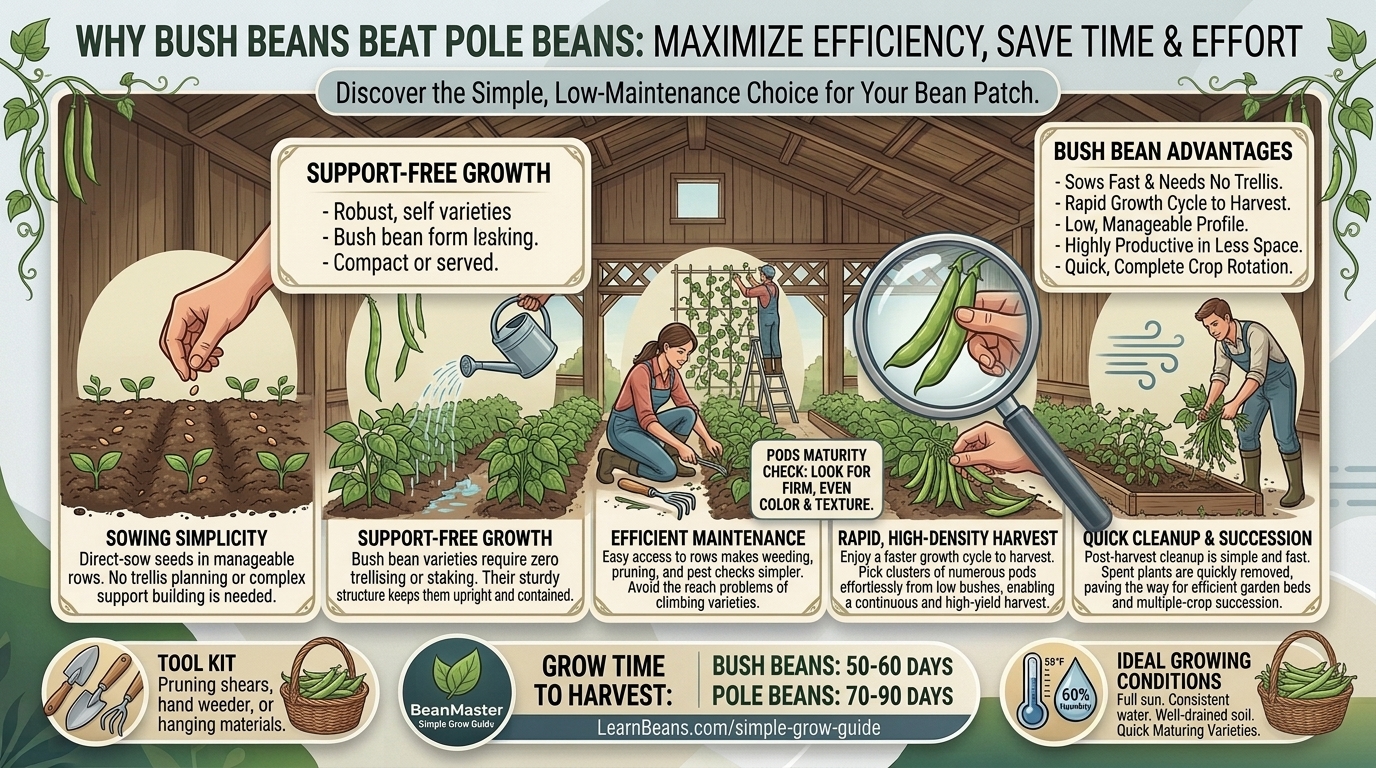
Building a sturdy trellis system for pole beans requires sourcing lumber, bamboo poles, or metal netting, measuring dimensions, hammering stakes, and securing lines. For bush beans, this entire step is permanently deleted from your to-do list. You simply sow the seeds directly into flat soil or raised beds.
2. Elimination of Mid-Season Training and Tying
Pole bean vines do not climb on their own volition; they need human intervention to guide them onto strings, weave them through netting, or retie stray shoots during high winds. Bush beans require zero training, zero tying, and zero maintenance once they emerge from the ground. They stand proudly on their own.
3. Streamlined, Concentrated Harvesting
Because bush beans are determinate, a vast majority of their pods ripen simultaneously over a concentrated 2-to-3-week harvest window. Instead of making daily, meandering searches through a towering jungle of vertical vines for hidden pods, you can harvest entire rows efficiently in a single pass.
The Agronomic Benefits: Beyond Just Saving Time
While saving time and skipping trellises are massive perks, bush beans offer several distinct biological and spatial advantages for backyard growers:
- Compact Footprint: Because they only grow about 2 feet tall and wide, bush beans fit into spaces where pole beans would never work—including small raised beds, wide containers, and tight urban patio plots.
- Early Harvest Windows: Bush beans generally mature faster than pole beans, often going from seed to harvest in just 50 to 60 days. This makes them ideal for short-season northern climates or succession planting.
- Wind Resistance: Towering pole bean trellises act like sails in heavy summer storms, making them prone to blowing over in regions prone to high winds (such as open plains in Texas or coastal gusts in Washington and California). Low-profile bush beans hug the earth and withstand heavy weather with ease.
Regional Performance: Growing Bush Beans Across the US
Your local environment dictates how you integrate bush beans into your seasonal planting schedule:
- Texas: In Texas, timing is everything. Plant bush beans in early spring (March–April) to harvest before the searing summer heat arrives, or plant a second crop in late summer (August–September) for a productive autumn harvest. Because bush beans mature quickly, they easily beat the worst of peak summer temperature stress.
- New York: New York’s distinct spring means waiting until all danger of frost has passed (typically mid-to-late May) before direct-sowing bush beans, as cold, wet soil causes seeds to rot. Their rapid 50-day maturity guarantees a heavy harvest well before autumn chills return.
- California & San Francisco: San Francisco’s cool, foggy maritime summers can slow down heat-loving crops, but bush beans perform remarkably well in sunny backyard microclimates. In interior California valleys, direct-sow in early spring for abundant yields.
- Washington: Western Washington’s damp springs require patience. Wait until soil temperatures warm to at least 60°F (15°C) before planting. Use well-draining raised beds to prevent seed rot during lingering spring rains.
Step-by-Step Guide: How to Grow a Bumper Crop of Bush Beans
Growing bush beans successfully is refreshingly straightforward. Follow this step-by-step framework to maximize your harvest:
Step 1: Direct Sow, Never Transplant
Beans possess extremely delicate root systems that deeply resent being disturbed. Never start bean seeds indoors in small pots to transplant later. Always direct-sow your seeds straight into the garden soil where they will permanently live.
Step 2: Prepare the Soil
- Bush beans prefer loose, well-draining soil with a pH between 6.0 and 7.5.
- Pro Tip on Nitrogen: Like all legumes, beans form a symbiotic relationship with soil bacteria (rhizobia) that capture atmospheric nitrogen and fix it directly into the soil. Do not over-fertilize with high-nitrogen fertilizers, or your bush beans will grow a massive, beautiful green jungle of leaves while producing zero bean pods! A light application of compost at planting is plenty.
Step 3: Planting Depth and Spacing
- Depth: Push seeds about 1 inch deep into moist soil.
- Spacing: Space seeds roughly 2 to 3 inches apart in rows spaced 18 to 24 inches apart. Unlike pole beans that require dense crowding along a vertical line, bush beans need breathing room around their perimeter to ensure good airflow and prevent fungal leaf spots.
Step 4: Watering and Mulching
- Water the soil gently after planting. Avoid soaking the soil immediately before germination, as soggy earth causes seeds to split and rot.
- Once seedlings emerge, apply a 2-to-3-inch layer of clean straw or shredded leaves around the base of the bushes. This suppresses weeds, retains soil moisture, and prevents mud from splashing onto the lower pods during rainstorms.
Succession Planting for a Continuous Harvest
Because bush beans produce their entire crop in a concentrated window (unlike pole beans which trickle out a few pods every day for months), a single planting will finish producing after 3 weeks.
To enjoy fresh green beans all summer long, practice succession planting:
- Plant your first batch of bush bean seeds in spring.
- Plant a second batch 3 weeks later.
- Plant a third batch 3 weeks after that.
This staggered schedule ensures that as one batch finishes its heavy fruiting cycle, the next batch is coming into full bloom, giving you a continuous, effortless supply of tender beans without ever building a single trellis.
Top Heirloom and Traditional Bush Bean Varieties
If you want superior flavor in your backyard garden, skip generic commercial bush beans and try these celebrated varieties:
- ‘Blue Lake Bush’: The undisputed classic. It produces heavy yields of dark green, tender, stringless pods with a rich, sweet, traditional bean flavor.
- ‘Contender’: Famous for its resilience against cooler spring temperatures and early planting stress. It yields thick, juicy, crisp pods and is widely regarded as one of the best-tasting early bush beans.
- ‘Tendergreen Improved’: An heirloom favorite producing round, fleshy, completely stringless green pods that remain tender even if left on the bush a day or two too long.
- ‘Golden Wax’: A stunning yellow wax bean featuring bright golden pods that offer a buttery, mild flavor profile and stand out vividly against dark green foliage during harvest.
10 Essential FAQs About Planting Bush Beans
1. Do bush beans really never need any support or trellising?
Correct! Bush beans grow into self-supporting, sturdy little shrubs standing 15 to 24 inches tall. They do not climb, vine, or flop over extensively, meaning you never need to build a trellis, set up stakes, or tie them to strings.
2. How long do bush beans take from seed to harvest?
Most bush bean varieties are remarkably fast producers, maturing in just 50 to 60 days from the day you plant the seed. This rapid turnaround makes them one of the most rewarding vegetables for home gardeners.
3. Why are my bush bean plants growing huge green leaves but no beans?
This is almost always caused by excess nitrogen in the soil. Because beans fix their own nitrogen, heavy applications of high-nitrogen chemical fertilizers or fresh manure trick the plant into thinking it should prioritize massive vegetative leaf growth over flowering and pod production.
4. How do I get a continuous harvest all summer if bush beans finish all at once?
Use succession planting. Sow a new small batch of bush bean seeds every 3 weeks from spring through mid-summer. This staggers your harvests so that fresh plants are always entering their peak production phase.
5. Can I grow bush beans in containers or pots on a patio?
Yes, they excel in containers! Because of their compact, bushy growth habit, you can easily plant 3 to 5 bush bean seeds in a 12-inch wide pot or fabric grow bag on a sunny patio, balcony, or courtyard in San Francisco, New York, or anywhere else.
6. Why did my direct-sown bush bean seeds rot in the ground?
Seed rot happens when seeds are planted in soil that is too cold and waterlogged (common in early New York or Washington springs). Wait until soil temperatures consistently reach at least 60°F (15°C), and ensure your planting beds drain exceptionally well.
7. How should I harvest bush bean pods without damaging the plant?
Always use two hands or hold the stem steady with one hand while snapping or snipping the bean pod cleanly off with the other. Never yank or pull downward on a pod, as you can easily tear the delicate branch and damage the plant.
8. Are bush beans susceptible to pests and diseases?
They can occasionally be affected by Mexican bean beetles, aphids, or fungal issues like powdery mildew if planted too densely. Ensure proper spacing (2–3 inches apart in rows) and water the soil directly rather than wetting the foliage overhead to prevent fungi.
9. Can I save seeds from bush beans for next year?
Yes! Unlike hybrid varieties, open-pollinated heirloom bush beans breed “true to type.” Simply let a few pods dry completely brown and brittle on the bush at the end of the season, shell the hard seeds, and store them in a cool, dry glass jar.
10. What is the main disadvantage of bush beans compared to pole beans?
The only real “disadvantage” is their shorter harvest window. While pole beans produce a steady trickle of beans over a long 3-to-4-month season, bush beans produce almost all their fruit at once over 2 to 3 weeks. However, this is easily solved by succession planting!
Conclusion
Choosing bush beans over pole beans is one of the smartest, most time-saving decisions a backyard gardener can make. By eliminating the frustrating chore of building, maintaining, and dismantling complex trellis structures, you free up hours of labor while enjoying a compact, high-yielding, and resilient crop.