Every dedicated home gardener experiences that sinking feeling: walking out to inspect your prize-winning tomato vines or sprawling squash plants, only to discover brown, water-soaked blight lesions, powdery mildew dusting the leaves, or wilting stems signaling a vicious fungal infection.
Your immediate instinct is often to panic and rip the infected plants out of the ground. But then the major dilemma arises: What do you do with the diseased plant waste?
Traditional gardening dogma strictly warns against ever putting diseased plant material into your home compost pile. Generations of gardeners were told that tossing blighted foliage into compost bins would preserve the pathogens, allowing them to lie in wait like microscopic landmines until you spread the finished compost across your vegetable beds next spring, reigniting the exact same disease.
However, modern composting science reveals that you can safely compost diseased plant material—provided you understand thermal biology, microbial activity, and proper composting protocols.
Whether you are managing humid garden plots in New York, handling fungal pressures in Washington State, dealing with summer blights in Texas, or managing compact urban yards and raised beds across California and San Francisco, this comprehensive guide explores how to harness hot composting to destroy pathogens safely and recycle disease waste into rich organic gold.
1. The Science of Pathogen Destruction: How Heat Neutralizes Disease
To understand how diseased plant tissue transforms into safe, sterile compost, you must look at the physics and biology of hot composting (thermophilic composting).
The Thermal Thresholds
Pathogenic fungi, bacteria, weed seeds, and insect eggs are living biological organisms with strict temperature tolerance thresholds. Most common plant pathogens—including early blight (Alternaria solani), late blight (Phytophthora infestans), powdery mildew spores, and bacterial wilt vectors—cannot survive sustained high temperatures.
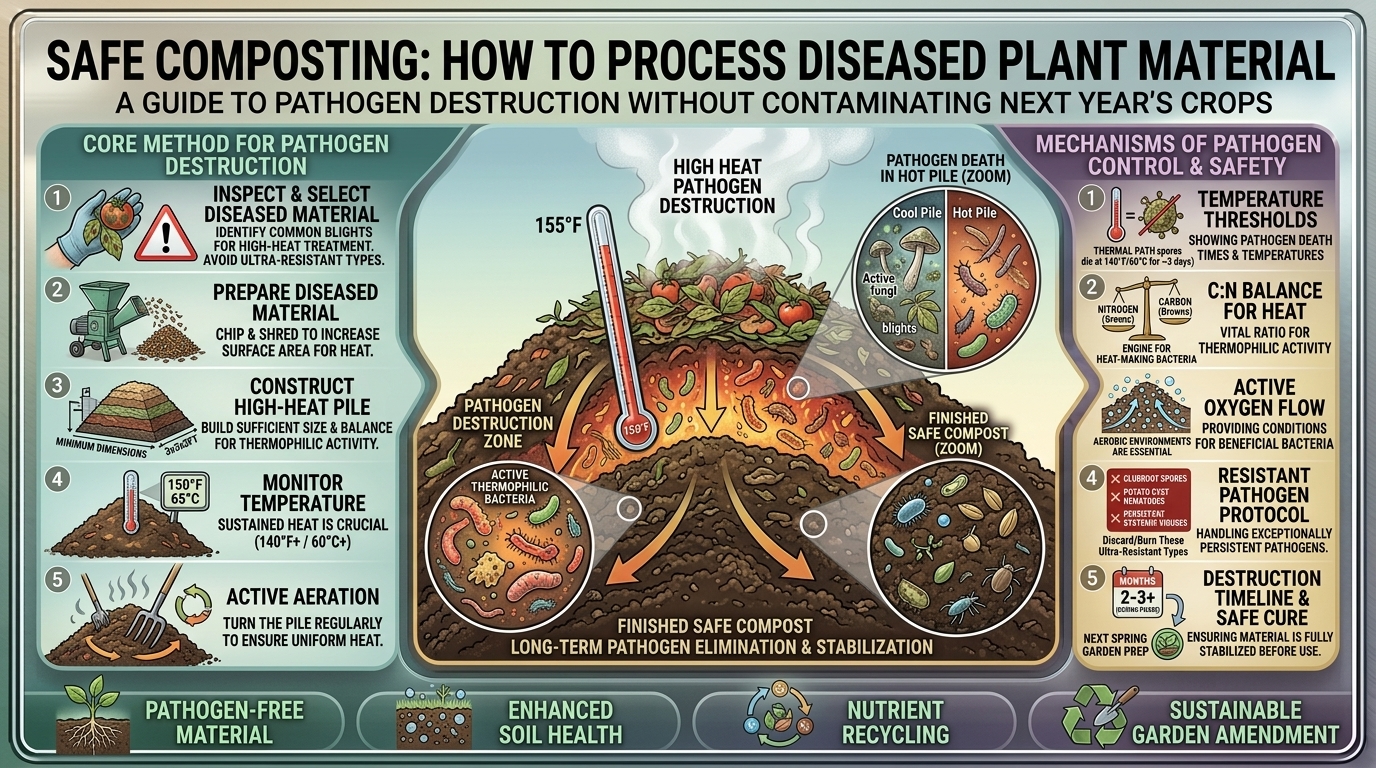
- The 131°F to 160°F Sweet Spot: When a compost pile is built with the correct balance of materials, aerobic bacteria multiply exponentially, driving internal pile temperatures up into the thermophilic range of 131°F to 160°F (55°C to 71°C).
- The Pasteurization Window: If your compost pile maintains an internal temperature of at least 131°F for a continuous 3 to 5 days while being thoroughly turned to expose outer edges to the center heat zone, plant pathogens, fungal spores, and weed seeds are effectively denatured and killed.
2. What CAN vs. CANNOT Be Composted: The Diseased Waste Sorting Guide
Not all garden diseases are created equal. Before tossing infected debris into your bin, you must categorize the pathogen type.
[ Diseased Plant Waste Assessment ]
       │
       ├──> CAN BE COMPOSTED (Via Hot Composting)
       │      ├── Fungal Leaf Spots & Blights (Early/Late Blight)
       │      ├── Powdery & Downy Mildews
       │      └── Common Rusts & Leaf Molds
       │
       └──> DO NOT COMPOST (Discard or Burn)
              ├── Persistent Viral Infections (Tobacco Mosaic Virus)
              ├── Hardwood Gall / Crown Gall Bacteria
              └── Systemic Nematodes & Persistent Soil-Borne Root Rots
Safe for Hot Composting
- Fungal Foliar Diseases: Tomato and potato blight, powdery mildew, downy mildew, black spot on roses, and anthracnose. Once exposed to intense thermophilic heat and microbial antagonism, these fungi break down completely.
Strictly Avoid (Do Not Compost)
- Persistent Plant Viruses: Viruses like Tobacco Mosaic Virus (TMV) or Tomato Spotted Wilt Virus do not rely on living cellular hosts to survive and can remain dormant and infectious in dry plant debris for years, surviving standard backyard compost piles.
- Systemic Bacterial Wilts and Root Rots: Pathogens like Ralstonia solanacearum (bacterial wilt) or clubroot in brassicas produce hardy resting structures or spores that can survive low-heat compost piles and reinfect future crops. Dispose of these via municipal green waste, trash, or burning where permitted.
3. Step-by-Step Protocol for Hot Composting Diseased Material
If you want to safely process common blighted garden waste, you cannot use a lazy, passive cold-composting pile tucked in the corner of your yard. You must execute an active hot composting regimen.
[ Active Hot Composting Workflow ]
       │
       ├──> Step 1: Chop Diseased Material into Small Fragments
       │
       ├──> Step 2: Build a Balanced Carbon-to-Nitrogen (C:N) Ratio
       │
       ├──> Step 3: Monitor Internal Temperatures (Target 131°F+)
       │
       └──> Step 4: Turn and Cure the Pile Completely
Step 1: Chop and Shred Material
Do not throw massive, whole blighted tomato stalks into your pile. Chop diseased stems and leaves into small 1-to-2-inch pieces using pruning shears or a machete. Smaller particle sizes vastly increase the surface area available for beneficial bacteria to attack.
Step 2: Build a Balanced “Recipe” (The 30:1 Ratio)
A hot compost pile requires a precise balance of carbon-rich “browns” (dry leaves, straw, shredded paper) and nitrogen-rich “greens” (grass clippings, fresh vegetable scraps, and your chopped diseased plant waste). Aim for a roughly 30:1 carbon-to-nitrogen ratio and ensure the pile is thoroughly moistened to the dampness of a wrung-out sponge.
Step 3: Bury Diseased Material in the Core
Never leave diseased leaves sitting exposed on top of your compost pile where spores can blow away in the wind. Bury diseased plant waste deep in the center (core) of your compost pile, covering it with at least 6 to 12 inches of clean carbon material and finished compost. The center of the pile is where the highest thermal temperatures occur.
Step 4: Monitor, Turn, and Cure
- Insert a long-stem compost thermometer into the core daily. Once temperatures peak between 131°F and 160°F and hold for a few days, use a pitchfork to turn the pile completely inside out, bringing outer unheated material into the hot center.
- Repeat this turning process 3 to 4 times over a 4-to-6-week period. Once the pile stops heating up and cools down to ambient air temperature, let it cure for an additional 4 weeks before applying it to your garden beds.
4. Alternative Disposal Methods for Incurable Pathogens
When dealing with systemic viruses, herbicide-contaminated plants, or stubborn root rots that should never enter a backyard compost bin, utilize these alternative safe disposal methods:
- Municipal Green Waste Collection: Many municipal yard-waste programs operate industrial commercial composting facilities. These industrial sites easily achieve sustained temperatures exceeding 165°F for weeks, safely destroying stubborn plant pathogens that backyard bins cannot handle.
- Deep Burial: Burying infected root balls or viral plant debris at least 2 to 3 feet deep in an out-of-the-way area of your property prevents insects from dragging spores back to the surface.
- Solarization: In sunny regions, sealing diseased plant waste inside heavy-duty black plastic bags and leaving them baking in direct sunlight for 4 to 6 weeks harnesses solar thermal energy to sterilize the material.
5. Regional Realities: Composting Disease Across U.S. Climates
Regional humidity and weather patterns dictate how easily plant diseases spread and how well compost piles retain heat:
Washington State & Pacific Northwest
- Climate Challenge: Cool, damp springs and autumns create persistent fungal pressures (like late blight and downy mildew), while ambient cold weather can make keeping backyard compost piles hot difficult.
- Management Strategy: Insulate your compost bins using straw bales or wooden pallet enclosures to trap heat, and mix in high-nitrogen green grass clippings to fuel thermophilic bacterial activity during chilly damp months.
New York & Northeast
- Climate Challenge: Humid summer rainstorms trigger explosive fungal outbreaks across vegetable gardens, resulting in massive volumes of blighted foliage at season’s end.
- Management Strategy: Construct large, batch-style hot compost bins in autumn using end-of-season blighted tomato and potato vines, ensuring active turning to achieve complete pasteurization before winter freeze.
Texas
- Climate Challenge: Intense summer heat makes outdoor composting fast, but dry air can cause compost piles to dry out prematurely, halting microbial decay.
- Management Strategy: Monitor compost moisture levels closely during scorching Texas summers, watering the pile regularly to keep microbial decomposition active and prevent spontaneous dust ignition.
California & San Francisco
- Climate Challenge: Coastal fog in San Francisco provides persistent surface moisture that fosters powdery mildew on squash and roses, while urban yards require compact composting solutions.
- Management Strategy: Utilize enclosed tumbling composters or insulated bin systems to maintain internal heat without taking up excessive urban yard space.
6. Frequently Asked Questions (FAQ)
1. Can tomato blight survive in compost and infect next year’s crops?
If tomato plants infected with early or late blight are thrown into a cold, unmanaged compost pile, the fungal spores can survive the winter and reinfect your garden. However, if those same plants are processed through a properly managed hot compost pile that reaches 131°F+ for several days, the blight fungus is completely destroyed.
2. How do I know if my compost pile got hot enough to kill pathogens?
The only foolproof way to know is by using a long-stem compost thermometer. Eyeballing the pile or assuming it is warm inside is risky. If the thermometer reads 131°F to 160°F in the core, your thermal pasteurization is working.
3. Can I compost plants that were treated with chemical pesticides or weed killers?
No. If your plants were sprayed with persistent systemic herbicides (like aminopyralid or clopyralid) or heavy synthetic pesticides, those chemical residues do not break down easily in compost. They will persist through the composting process and can severely stunt or kill sensitive vegetable crops when applied as fertilizer.
4. What is the difference between hot composting and cold composting?
Cold composting is a passive method where you simply toss yard waste into a pile and let nature take its course over 6 to 12 months. Hot composting is an active, managed method where you balance browns and greens, monitor moisture, and turn the pile to accelerate biological decay and generate pathogen-killing heat.
5. Are earthworms safe in a hot compost bin with diseased plants?
Earthworms and composting worms (red wigglers) cannot survive the high temperatures of an active hot compost pile (they will flee or die if temperatures exceed 95°F). However, worms naturally populate the cooler outer edges of the bin and will move into the core after the hot thermophilic phase cools down during the curing stage.
6. Can I put powdery mildew-infected leaves in my compost?
Yes. Powdery mildew fungi are obligate parasites that require living plant tissue to survive. Once the infected leaves are chopped, buried in a hot compost core, and subjected to biological competition and heat, powdery mildew spores perish rapidly.
7. How long should I let my compost cure before using it on vegetables?
After your hot compost pile stops heating up and cools down to ambient temperature, always allow it to cure for 3 to 4 weeks. During curing, beneficial microorganisms stabilize the nutrients and eliminate any temporary phytotoxic compounds, making the compost safe for delicate seedlings.
8. Can root-knot nematodes be killed in a home compost pile?
Root-knot nematodes are microscopic parasitic roundworms that form galls on plant roots. While extreme commercial composting heat can kill them, home compost piles rarely maintain uniform heat across every single pocket. It is best to discard nematode-infested root balls in the trash rather than risking your compost.
9. Should I cover my compost pile during heavy rainstorms?
Yes. While moisture is necessary for composting, torrential rainstorms can flood your pile, drowning aerobic bacteria, washing away soluble nutrients, and dropping internal temperatures below the pathogen-destruction threshold. Cover your pile with a tarp or lid during heavy downpours.
10. What is the safest way to handle diseased plants if I don’t want to compost them?
If you are uncomfortable composting diseased material or suspect persistent viral infections, double-bag the plant waste in heavy-duty trash bags and place it out for municipal yard waste collection, or check local regulations regarding safe garden waste burning.
Conclusion
Composting diseased garden plant material does not have to be a forbidden practice. By moving away from passive cold-piling and mastering the art of active thermophilic hot composting, you can harness natural microbial heat to destroy blights, mildews, and fungal spores safely.