Every gardener knows the heartbreak of falling in love with a delicate perennial flower bush—whether it is a sophisticated hydrangea, a vibrant peony, an elegant azalea, or a moody hellebore—only to watch it wilt, turn yellow, and slowly perish just weeks after planting.
More often than not, the culprit isn’t a lack of love, fertilizer, or sunlight. The silent killer of perennial bushes is poor drainage.
When you plant perennial bushes, you are making a multi-year investment in your landscape. Unlike annuals that complete their life cycle in a single season, perennials establish deep root systems. If your backyard suffers from poor drainage, those roots will sit in stagnant, oxygen-depleted soil. This creates the ultimate breeding ground for root rot (Phytophthora, Pythium, and Rhizoctonia fungi), suffocates root cells, and ultimately kills the plant.
Different regions present completely different soil and weather challenges. Whether you are battling heavy, sticky clay in parts of Texas, managing urban compacted soils in New York, navigating the diverse microclimates of California, dealing with heavy winter rainfall in Washington, or working with the rolling, variable terrain of San Francisco, understanding your backyard’s drainage before putting a shovel in the dirt is the single most important step you can take.
In this exhaustive, masterclass-level guide, we will break down everything you need to know about testing, diagnosing, and fixing drainage issues in your backyard so your delicate perennial flower bushes thrive for decades.
Chapter 1: The Science of Soil Drainage and Perennial Roots
To understand drainage, you must first understand how water moves through soil. Soil is composed of solid mineral particles (sand, silt, and clay) and pore spaces. These pore spaces hold a delicate balance of air and water.
1. Gravitational vs. Capillary Water
- Gravitational Water: After a heavy rain or deep watering, excess water drains downward through the soil pores due to gravity. This is ideal because it pulls fresh oxygen down into the root zone.
- Capillary Water: This is the moisture that clings to soil particles after gravitational water has drained away. Delicate perennials rely on this moisture between watering cycles.
When drainage fails, gravitational water has nowhere to go. It fills the pore spaces entirely, pushing out oxygen. Perennial roots need oxygen to respire and grow. Without it, root cells suffocate within 24 to 48 hours, shutting down nutrient uptake and causing the plant to collapse.
2. How Soil Textures Affect Drainage
- Sandy Soils: Composed of large particles with massive pore spaces. Water drains through them almost too fast, often leaching away essential nutrients before roots can absorb them. (Common in coastal California pockets).
- Silty Soils: Medium-sized particles that hold moisture well but can easily compact if walked on when wet.
- Clay Soils: Tiny, flat particles packed tightly together with microscopic pore spaces. Water moves through clay at a snail’s pace, leading to waterlogging and compaction. (Common across vast regions of North Texas and parts of New York).
- Loam: The holy grail of gardening—a balanced mix of sand, silt, and clay that retains moisture while draining excess water efficiently.
Chapter 2: The Two Essential DIY Drainage Tests
Before buying a single perennial bush, you need to conduct hands-on tests to evaluate your soil’s permeability.
Test 1: The Classic Percolation Test (The “Perc” Test)
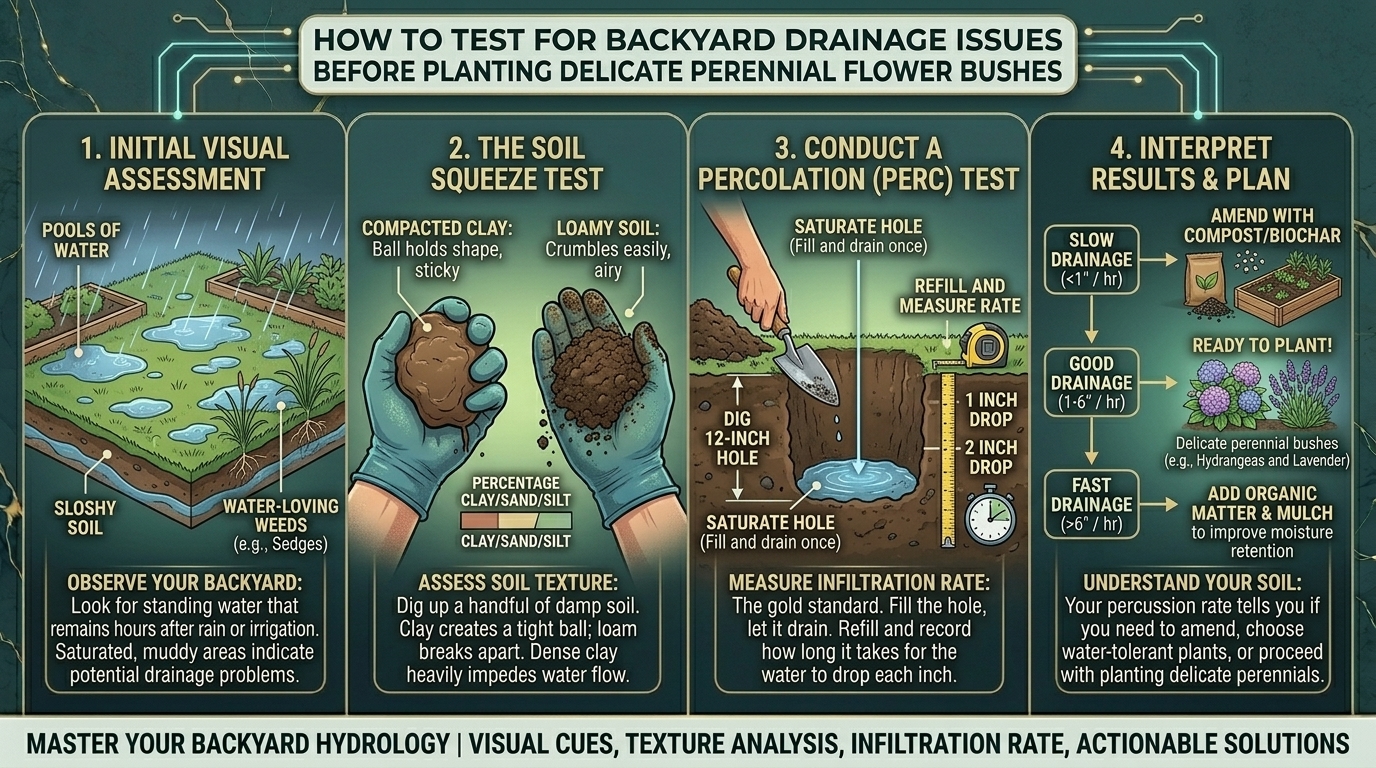
This is the gold standard for measuring how fast water drains through your planting bed.
- Select Your Locations: Dig test holes in the specific areas where you plan to install your perennial flower beds. Dig them about 12 inches deep and 12 inches wide—the approximate depth and width of a mature perennial root ball.
- Prep the Holes: Smooth out the sides and bottoms of the holes. Remove any loose debris.
- Fill with Water: Fill each hole completely with water and let it drain out entirely. This step saturates the surrounding soil so you are testing true drainage, not dry soil absorption.
- Refill and Measure: Fill the hole with water a second time. Place a straight stick or ruler across the top opening of the hole. Measure the water level from the bottom of the stick down to the water surface.
- Time the Drop: Check the water level every hour for several hours, or track how many inches it drops per hour.
Interpreting Your Percolation Test Results:
- Fast Drainage (More than 3 inches per hour): Your soil is likely too sandy or loose. Water and nutrients will rush past your delicate perennials too quickly, requiring frequent amending with organic matter to retain moisture.
- Ideal Drainage (1 to 3 inches per hour): Perfect! This indicates a healthy loamy soil structure that retains enough moisture for delicate roots while draining excess water away efficiently.
- Slow Drainage (Less than 1 inch per hour): Warning sign. Your soil is heavy clay, compacted, or sits above an impermeable sublayer (hardpan). Water will pool, putting your perennials at high risk of root rot.
- Stagnant Drainage (Water remains after 24 hours): Severe drainage failure. You have a high water table, heavy impermeable clay, or a backyard structural drainage defect that must be corrected before planting.
Test 2: The Simple “Squeeze” (Ribbon) Textural Test
If you want a quick read on your soil composition without digging a deep hole, use the tactile ribbon test.
- Grab a handful of moist soil from your garden bed.
- Roll it into a ball in the palm of your hand.
- Push the ball gently between your thumb and forefinger, squeezing it upward to form a thin ribbon of soil.
- Observe the result:
- If it falls apart immediately and feels gritty, you have sand.
- If it forms a short, fragile ribbon that breaks quickly, you have loam or silt.
- If it forms a long, flexible, shiny ribbon that doesn’t break easily, you have heavy clay.
Chapter 3: Regional Drainage Realities: Texas, New York, California, Washington, and San Francisco
Soil and drainage conditions vary drastically across different climates and geographies. Tailoring your drainage strategy to your specific region is vital.
1. Texas (The Clay and Flash-Flood Challenge)
- The Challenge: Much of Texas (from North Texas blackland prairies to Central Texas clay belts) features heavy, expansive clay soils. When it rains heavily, Texas soils swell up, seal shut, and hold water like a bathtub. Conversely, during scorching summer dry spells, the clay bakes hard as concrete, cracking open and tearing delicate roots.
- Drainage Strategy: Never plant perennial bushes directly into native clay without amendment. Build raised garden beds (8 to 12 inches high) filled with a balanced mix of native soil, expanded shale, and compost. Expanded shale is a game-changer in Texas because it creates permanent micro-pores in clay that never break down.
2. New York (Urban Compaction and Freeze-Thaw Cycles)
- The Challenge: New York gardens—whether in suburban Long Island, Westchester, or urban brownstone lots—often suffer from heavy foot traffic compaction or building debris buried just beneath the topsoil. Furthermore, winter freeze-thaw cycles cause water trapped in the soil to expand and contract, lifting shallow-rooted perennials right out of the ground (frost heaving).
- Drainage Strategy: Focus heavily on mechanical aeration and deep organic tilling prior to planting. Incorporate coarse compost and aged leaf mold to improve soil aggregation. Ensure planting holes are wide rather than deep to prevent water from pooling in a bowl-shaped clay pocket.
3. California (Mediterranean Microclimates and Variable Soils)
- The Challenge: California features incredible microclimate diversity. From the sandy coastal soils of Southern California to the dense adobe clay of the interior valleys, drainage is rarely uniform. Many gardeners also face municipal watering restrictions, making efficient water distribution critical.
- Drainage Strategy: Conduct local percolation tests for every major bed. In heavy clay regions, use organic mulch layers to prevent surface crusting. In sandy coastal zones, incorporate heavy compost to slow down drainage and lock in moisture for sensitive roots during dry months.
4. Washington (Pacific Northwest Wet Winters)
- The Challenge: Western Washington is famous for its lush beauty, driven by months of persistent, heavy autumn and winter rainfall. While summer is gorgeous, winter soil saturation is relentless. Delicate perennial bushes like rhododendrons, azaleas, and hydrangeas love moisture, but they despise sitting in waterlogged soil for weeks on end during the cold dormant season.
- Drainage Strategy: Slope management and raised planting are non-negotiable in western Washington. Plant your delicate perennials slightly high (with the top 1 to 2 inches of the root ball sitting above the surrounding soil grade) so that winter rains shed away from the crown rather than pooling around the stem.
5. San Francisco (Fog, Slopes, and Micro-Terrain)
- The Challenge: San Francisco’s famous hills mean that backyard drainage is heavily influenced by gravity and slope position. Homes at the bottom of a slope frequently receive runoff from uphill neighbors, creating chronically soggy bottom-of-slope pockets. Additionally, sandy dune soils mingle with imported urban fill.
- Drainage Strategy: Install French drains or interceptor swales across slopes to redirect surface and subsurface runoff before it reaches your delicate perennial beds. Terracing sloped yards also helps control water velocity and ensures even soil moisture distribution.
Chapter 4: Step-by-Step Guide to Fixing Backyard Drainage Issues
If your perc test or regional assessment reveals poor drainage, do not despair. You can remediate almost any backyard drainage issue using one or a combination of the following engineered solutions.
1. Amending Soil Structure Organically
For moderate drainage issues (slow percolation, heavy clay, or compacted earth):
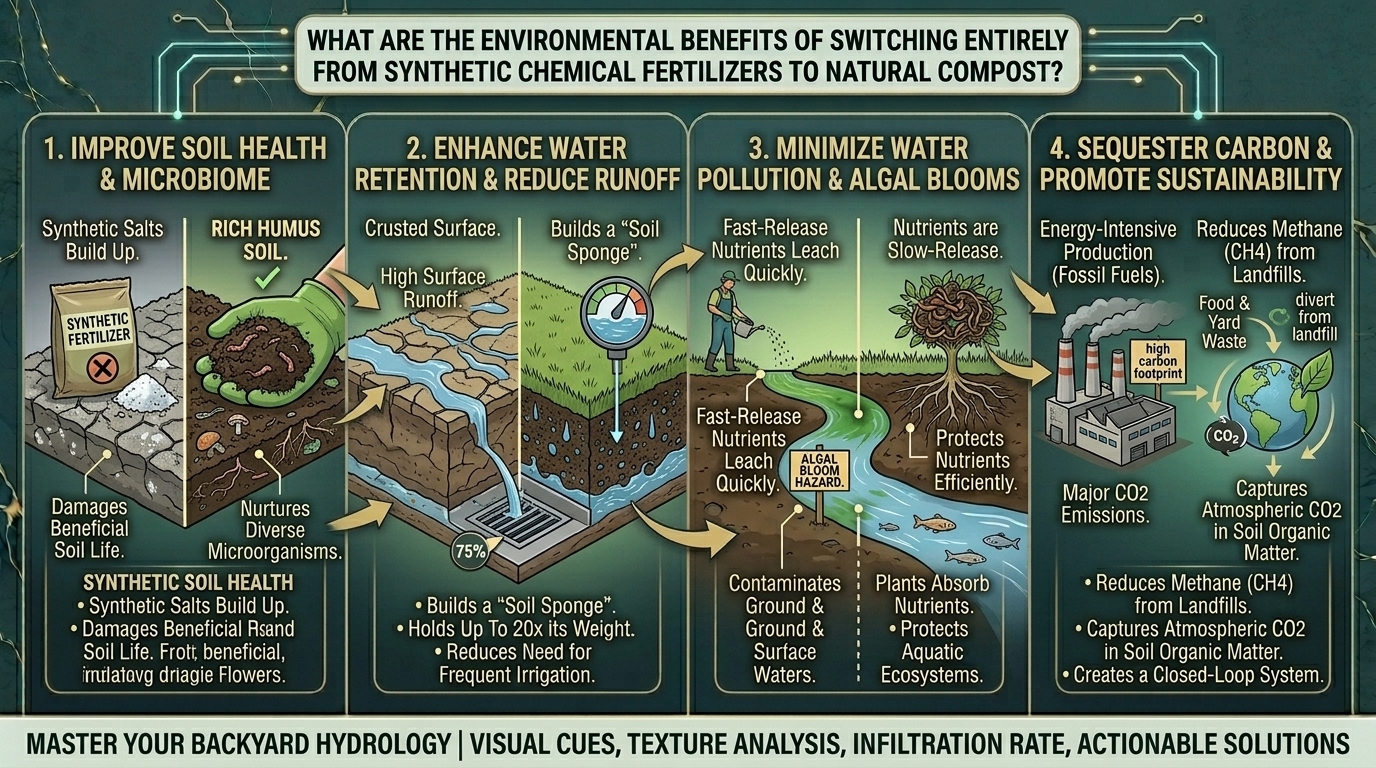
- Incorporate Organic Matter: Mix 3 to 4 inches of well-rotted compost, aged manure, or leaf mold into the top 8 to 12 inches of your planting bed. Organic matter feeds beneficial soil microbes, which bind microscopic clay particles into larger crumbs (aggregates), creating natural drainage channels.
- Avoid Sand in Clay: A common rookie mistake is adding pure sand to clay soil. Unless you mix in massive quantities (often over 50% by volume), mixing sand and clay creates a mixture with the consistency of concrete. Instead, rely on organic matter and expanded shale.
2. Building Raised Beds
If your native backyard soil is completely impermeable (heavy wet clay or bedrock close to the surface):
- Build raised beds ranging from 8 inches to 24 inches high.
- Fill them with a loose, high-performance soil blend (40% topsoil, 30% compost, 20% coarse sand or perlite, 10% peat moss or coco coir).
- Raised beds elevate delicate perennial roots entirely out of the problematic native zone, ensuring perfect drainage year-round.
3. Installing French Drains
For severe backyard water pooling or properties receiving heavy runoff:
- A French drain consists of a trench filled with gravel or rock containing a perforated pipe that redirects surface and subsurface water away from your garden beds.
- Dig a trench 12 to 18 inches deep sloping gently away from your planting zones (at least a 1-inch drop every 10 feet).
- Line the trench with non-woven geotextile fabric to prevent silt from clogging the system.
- Lay your perforated PVC pipe, surround it with clean washed gravel, fold the fabric over the top, and top with decorative stone or turf.
4. Creating Dry Creeks and Swales
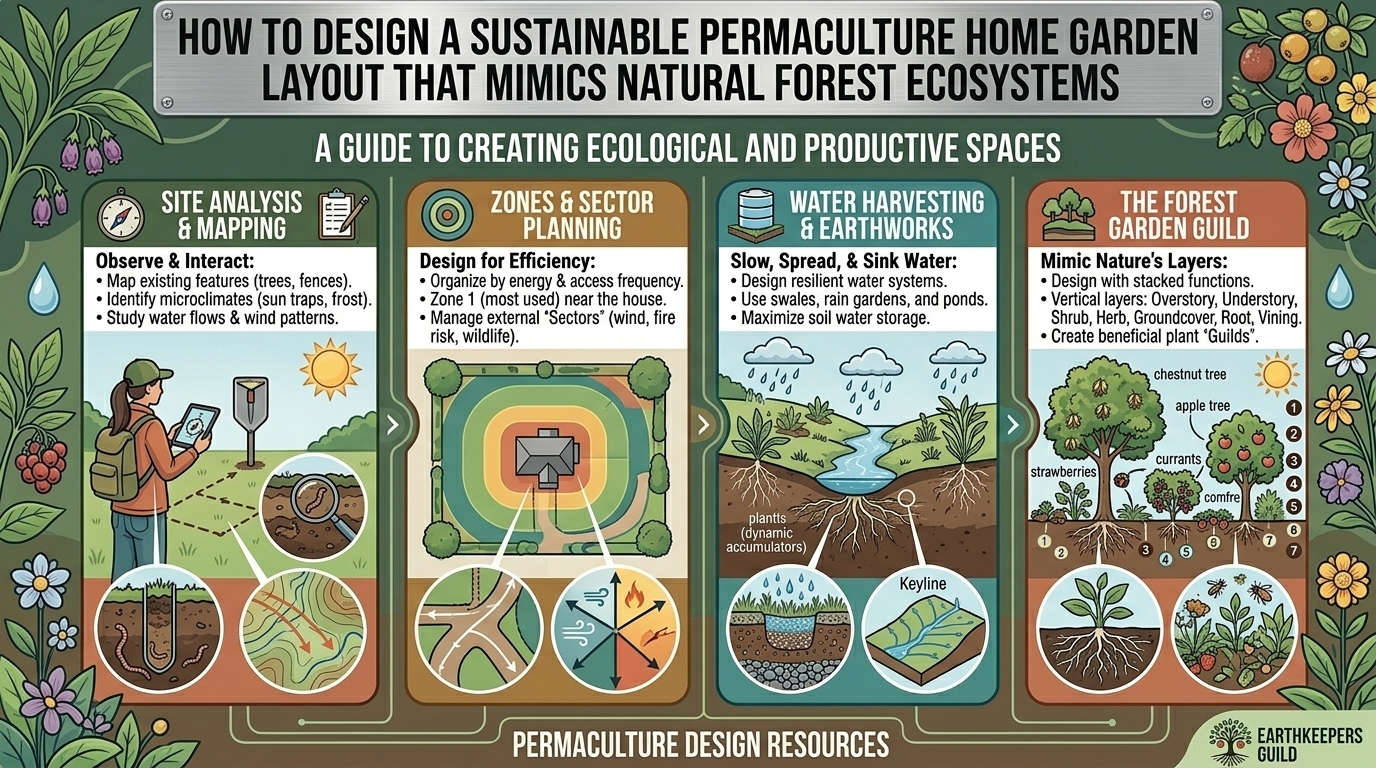
- A swale is a shallow, wide, grass- or rock-lined ditch designed to slow down and capture stormwater runoff, allowing it to infiltrate slowly into the ground away from delicate plants.
- A dry creek bed mimics a natural stream, using attractive river rocks and boulders to channel excess water gracefully through your landscape during heavy storms.
Chapter 5: Choosing and Planting Delicate Perennials for Challenging Drainage Zones
Even with the best drainage adjustments, certain delicate perennials have specific tolerances. Knowing your plants ensures long-term success.
Sensitive Perennials That Demand Excellent Drainage:
- Peonies (Paeonia): If their fleshy tubers sit in soggy soil for even a short period, they rot instantly and fail to bloom.
- Lavender (Lavandula): Absolutely intolerant of “wet feet.” They require sharp, gravelly, fast-draining soil.
- Garden Roses: Prone to black spot and root rot if soil stays waterlogged.
- Hellebores (Lenten Roses): While they tolerate shade, they require well-draining soil to prevent crown rot.
- Salvia and Coneflowers (Echinacea): Thrive in moderate-to-fast draining garden beds.
Planting Techniques for Maximum Survival:
- Dig a Wide, Shallow Hole: Dig your planting hole 2 to 3 times wider than the nursery pot, but no deeper than the root ball. The loose soil in the wide hole encourages horizontal root expansion.
- Plant High: Set the perennial bush so the top of the root ball sits roughly 1 to 2 inches above the surrounding soil level. Mound soil gently up to the edges. This ensures that as the soil settles and rain falls, water drains away from the delicate stem crown.
- Apply Coarse Mulch: Apply a 2-inch layer of organic mulch (like shredded hardwood bark) to retain moisture and regulate soil temperature, keeping mulch a half-inch away from the direct plant stem to prevent rot.
Chapter 6: 10 Frequently Asked Questions (FAQs)
1. Can I plant delicate perennials directly in heavy clay without fixing the drainage?
No. Most delicate perennial bushes (like peonies, lavender, and delicate hydrangeas) will develop root rot and die within a single season if planted directly into unamended heavy clay. You must amend the soil broadly, build raised beds, or choose clay-tolerant native species.
2. How long does a percolation test take?
A standard percolation test takes anywhere from 2 to 24 hours. You must first saturate the soil for a few hours (or overnight), fill the hole again, and measure how many inches the water drops over several hours.
3. What is the difference between surface drainage and subsurface drainage?
Surface drainage deals with water pooling on top of the ground (managed via grading, swales, and sloping). Subsurface drainage deals with water moving through or trapped beneath the soil layers (managed via French drains, soil aeration, and organic amendments).
4. Why are my perennial bush leaves turning yellow if I water them regularly?
Yellow leaves are the classic symptom of overwatering or poor drainage. When soil is waterlogged, roots suffocate, stop absorbing nutrients (like nitrogen and iron), and begin to rot, causing foliage to yellow and drop prematurely.
5. Is sand a good quick fix for clay soil drainage?
Surprisingly, no. Adding small amounts of sand to clay creates a dense mixture resembling mortar or concrete. To truly improve clay drainage, use organic compost, aged manure, and expanded shale.
6. How deep should I dig my drainage test hole?
Dig your test hole 12 inches deep, which matches the standard root depth of most nursery-grown perennial flower bushes in 1-gallon to 3-gallon containers.
7. What regions face the highest risk of winter root rot in perennials?
Regions with heavy winter precipitation combined with freezing temperatures—such as the Pacific Northwest (Washington), parts of the Northeast (New York), and heavy clay regions in Texas—pose the highest risk because dormant roots cannot process standing water.
8. Can raised beds completely solve backyard drainage problems?
Yes. Raised beds are the ultimate shortcut for severe drainage issues. By elevating your growing medium 8 to 24 inches above grade, you completely bypass native clay, compaction, or high water tables.
9. How do I know if my backyard has a high water table?
If you dig a test hole and water fills up into the hole from the bottom even without any recent rain, you likely have a high water table. In this scenario, surface grading and raised beds are mandatory before planting.
10. What are the best mulch types for poorly draining yards?
Use coarse, chunky organic mulches such as shredded bark or pine nuggets. Avoid fine, powdery mulches or rubber mulch, as fine mulches can compact into a dense mat that seals the soil surface and blocks evaporation.
Conclusion: Set Your Garden Up for Lasting Success
Testing and correcting your backyard drainage before planting delicate perennial flower bushes is the ultimate secret weapon of master gardeners. Taking a few hours to run percolation tests, assess your regional soil profile, and engineer proper drainage solutions (whether through organic amendments, raised beds, or French drains) will save you countless hours of frustration, protect your financial investment, and reward you with breathtaking, robust blooms year after year.