Gardening is a journey of patience, observation, and continuous improvement. Every season, gardeners across the country search for the ultimate amendment—something that not only feeds plants today but permanently improves the underlying structure of the earth for decades to come. Enter biochar: the ancient agricultural secret that is rapidly becoming the modern gardener’s favorite tool for long-term soil fertility.
Whether you are battling the baking heat and dense clay of Texas, managing compact urban plots in New York and San Francisco, working with variable soils across California, or navigating heavy, leaching rainfall in Washington, biochar offers a permanent solution to declining soil health.
This comprehensive guide explores what biochar is, how it works miracles in home gardens, and why it is transforming sustainable growing practices at kcplants.com.
What Exactly Is Biochar?
At its core, biochar is a specialized, highly porous form of charcoal created specifically for agricultural and horticultural use. Unlike the charcoal briquettes you toss into a backyard barbecue (which often contain chemical accelerants, lighter fluid, and synthetic binders), horticultural biochar is produced through pyrolysis—the thermal decomposition of organic plant biomass (such as clean wood scraps, orchard prunings, or agricultural waste) in an oxygen-starved environment.
The result is a stable, pure carbon matrix filled with an astonishingly dense network of microscopic pores, cracks, and tunnels. While ordinary wood ash breaks down and disappears into the soil chemistry within a season, biochar is chemically recalcitrant. Once added to your garden bed, it remains stable in the soil for hundreds, if not thousands, of years.
How Biochar Works: The Soil Sponge
To understand why biochar is so revolutionary for long-term fertility, you have to look at what happens at a microscopic level when you mix it into your dirt.
1. The Ultimate Nutrient Hotel
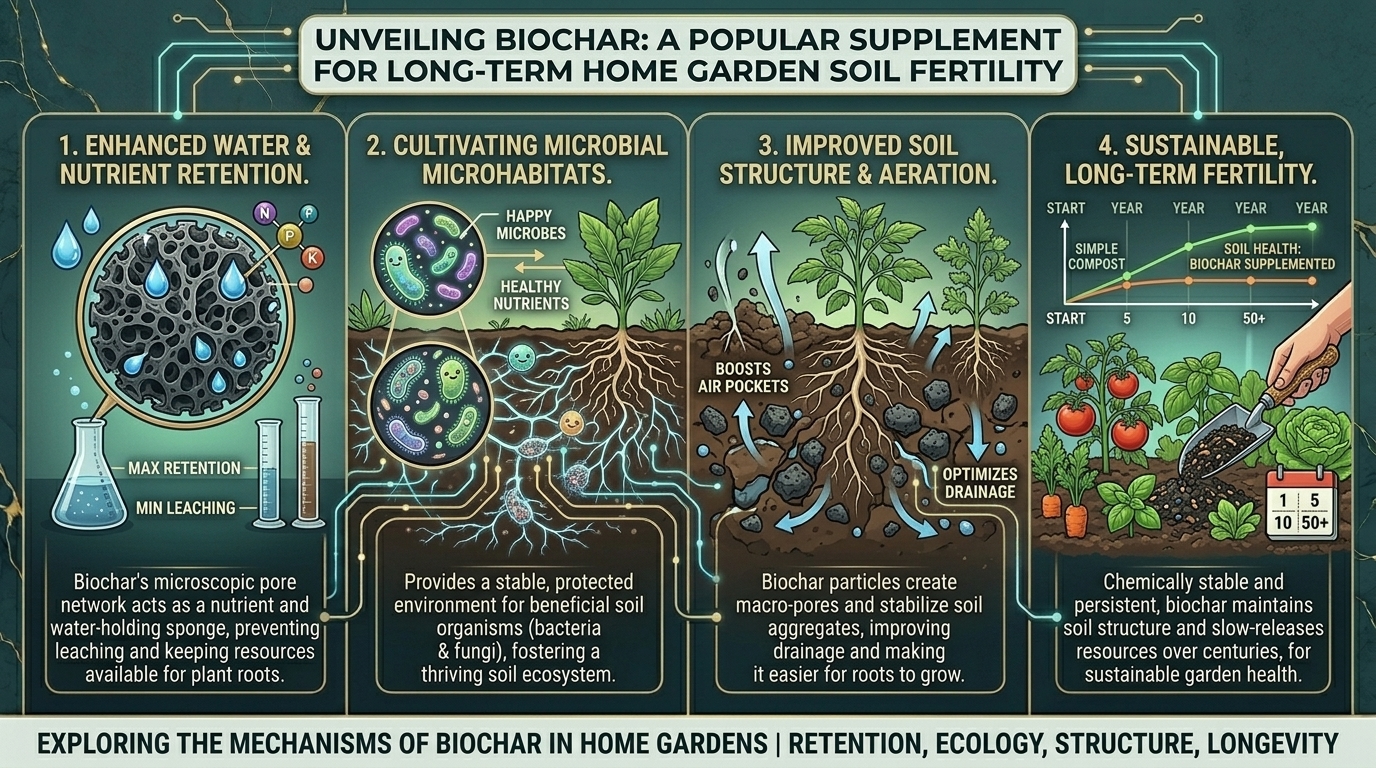
Raw biochar is essentially a carbon sponge. Its internal surface area is staggering—a single gram of high-quality biochar can have a surface area equivalent to several tennis courts. These microscopic cavities possess a high cation exchange capacity (CEC), meaning they carry a negative electrical charge that attracts and holds onto positively charged nutrient ions (cations) like calcium, magnesium, potassium, and ammonium.
Without biochar, heavy rains or irrigation water easily wash these vital plant nutrients deep down past the root zone (a process known as leaching). With biochar in place, nutrients are safely locked into the soil sponge, ready to be released to plant roots on demand.
2. A Microscopic Haven for Soil Biology
Beneficial soil microbes, bacteria, and mycorrhizal fungi need a safe home to colonize and multiply. The microscopic pores in biochar are the perfect size to protect these beneficial microorganisms from predatory protozoa and extreme moisture fluctuations. By providing a permanent neighborhood for soil biology, biochar supercharges the living ecosystem of your garden.
3. Structural Transformation (Water Retention & Aeration)
- In Sandy Soils (Common in parts of California and coastal zones): Biochar acts like a microscopic water reservoir, holding onto moisture and dissolved nutrients that would otherwise drain right through loose sand.
- In Heavy Clay Soils (Prevalent across Texas and interior California): Biochar particles create tiny pockets of air and space, breaking up compacted clay matrices to improve root penetration and oxygen flow.
Regional Garden Benefits: Coast to Coast
Different growing regions face vastly different soil stressors. Biochar acts as an environmental equalizer across the diverse climates served by kcplants.com:
- Texas & California: Scorching summer temperatures rapidly dry out soils and deplete organic matter. Biochar helps retain critical irrigation water and buffers plant roots against heat stress.
- New York & San Francisco: Urban gardeners working in limited-space raised beds or containers benefit from biochar’s lightweight structure, which prevents soil compaction and keeps container media light and responsive over multiple growing seasons.
- Washington: High annual rainfall can leach essential nutrients out of the topsoil. Biochar’s high cation exchange capacity anchors fertilizers and minerals in place, preventing nutrient runoff during heavy downpours.
The Golden Rule: Why You Must “Charge” Your Biochar First
If you take one crucial lesson away from this guide, let it be this: Never add raw, uncharged biochar directly to your garden soil.
Because biochar is so exceptionally porous and hungry for nutrients, dumping raw biochar straight into a garden bed will temporarily suck all the available nutrients and moisture out of the surrounding soil to satisfy its own empty carbon sites. This starves your plants for the first few months.
How to Charge (Inoculate) Biochar
Before applying biochar to your garden, you must fill its carbon pores with nutrients and biology. This process is called charging or activation:
- Compost Integration: Mix raw biochar directly into an active, high-nutrient compost pile or worm-casting bin at a ratio of 10% to 20% biochar by volume. Let it sit for 2 to 4 weeks.
- Liquid Nutrient Soak: Soak dry biochar in a liquid organic fertilizer, fish hydrolysate, or seaweed extract solution for a few days so it absorbs the rich mineral solution before hitting the soil.
Step-by-Step Application Guide
Once your biochar is fully charged and inoculated, incorporating it into your home garden beds is straightforward.
Step 1: Determine the Right Ratio
For most vegetable gardens and flower beds, the ideal target is to incorporate biochar so that it makes up roughly 5% to 10% of the total soil volume in the root zone (top 6 to 8 inches). Going higher than 20% is generally unnecessary.
Step 2: Spread and Incorporate
Evenly distribute your charged biochar-compost mix across the surface of your garden beds. Use a garden fork or rake to gently work the amendment into the top 4 to 6 inches of soil. Avoid aggressive deep rototilling if you have established perennial plants or fungal networks you wish to preserve.
Step 3: Water In and Plant
Water the amended bed thoroughly to settle the soil particles. You are now ready to plant your seeds or transplants into a permanently upgraded, highly fertile growing medium.
Frequently Asked Questions (FAQ)
1. Is biochar a fertilizer?
No. Biochar itself is primarily pure carbon and contains very few nutrients. Instead, it is a soil amendment that acts as a permanent sponge to hold fertilizers, compost nutrients, and water, making them far more efficient for your plants.
2. Do I need to reapply biochar every year?
No! This is the greatest advantage of biochar. Unlike organic compost that gets consumed by soil microbes and disappears within a single season, biochar is permanent. You only need to apply it once to a garden bed.
3. Can I make my own biochar at home?
Yes, you can make biochar by burning clean wood scraps inside a specialized pyrolytic metal barrel or kiln with restricted airflow. However, many gardeners prefer purchasing commercial horticultural biochar that is already screened and sized for ease of use.
4. What is the difference between charcoal and biochar?
While both are made by burning wood without oxygen, regular BBQ charcoal contains chemical additives, lighter fluid, petroleum byproducts, and synthetic binders that are toxic to plants. Biochar is 100% pure, unadulterated organic carbon meant strictly for soil health.
5. Will biochar raise or lower my soil pH?
Most quality biochars are slightly alkaline (pH 7.5 to 8.5) due to residual mineral ash left in the pores during production. If you are gardening in naturally alkaline soils (like parts of Texas), ensure your biochar is rinsed or neutralized, or use it in modest quantities blended with acidic compost.
6. Can I use biochar in container gardens and pots?
Yes. Biochar is fantastic for potted plants and indoor container setups in places like New York apartments or San Francisco townhomes. It keeps potting soil light, prevents compaction, and reduces the frequency of required watering.
7. Does biochar help sequester carbon?
Yes! By burying stable carbon in your garden soil, biochar locks atmospheric carbon dioxide away for hundreds of years, making it one of the simplest and most effective carbon-negative gardening practices available.