What Are the Benefits of Using Aged Horse Manure in Your Vegetable Home Garden Soil Mix?
Every serious home gardener eventually embarks on a quest for the ultimate soil amendment—a substance that simultaneously feeds plants, feeds the underground soil food web, improves water retention, and transforms heavy clay or sandy dirt into rich, crumbly loam. Across diverse growing regions—from the scorching, sun-baked clay of Texas and the variable urban plots of New York and San Francisco to the moist, fertile soils of Washington and California—experienced horticulturists consistently turn to one time-tested agricultural treasure: aged horse manure.
Often referred to by old-school growers as “stable gold,” aged horse manure is a phenomenal organic amendment. When properly managed and cured, it delivers an incredible balance of macro-nutrients, micronutrients, and stable carbon organic matter.
For growers seeking to maximize their garden productivity on kcplants.com, this comprehensive, expert-level guide explores the soil science behind aged horse manure, its profound long-term benefits, critical safety precautions (such as herbicide awareness), and a step-by-step masterclass on how to safely integrate it into your vegetable garden soil mix.
1. The Science of Manure: Why “Aged” Matters
To understand why horse manure is so beneficial, we must first look at what goes into a horse’s diet and why raw, fresh manure is disastrous for a vegetable garden.
The Raw Danger
Fresh horse manure is extremely “hot.” It is packed with raw urea, high concentrations of uncomposted ammonia, and volatile salts. If you apply fresh manure directly to your vegetable beds:
- Root Burn: The high ammonia and salt content will chemically scorch plant roots, instantly killing seedlings and damaging mature crops.
- Oxygen Depletion: Fresh manure undergoes rapid bacterial decomposition that temporarily strips oxygen out of the surrounding soil, suffocating plant roots.
- Pathogen Risks: Fresh waste can contain harmful pathogens that have not yet been broken down by internal thermal composting.
The Magic of Aging and Composting
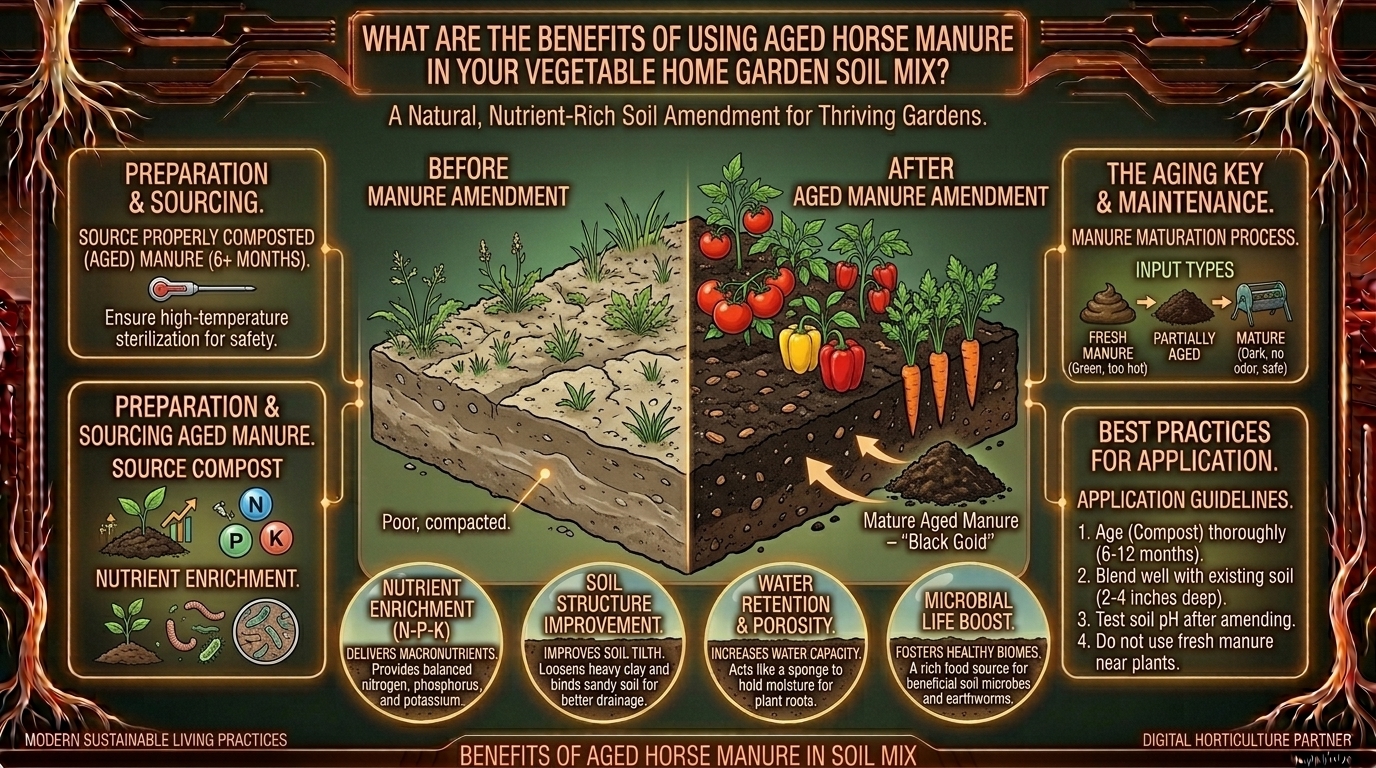
When horse manure (mixed with its stable bedding of straw or wood shavings) is piled up and allowed to age and cure for 6 to 12 months, nature works its magic. Thermophilic (heat-loving) bacteria break down the raw compounds, neutralizing ammonia, eliminating weed seeds, killing pathogens, and converting the harsh waste into a dark, earthy, sweet-smelling soil conditioner.
2. The Comprehensive Benefits of Aged Horse Manure
Incorporating well-aged horse manure into your vegetable garden mix yields compounding benefits across your entire ecosystem:
A. A Balanced, Slow-Release Nutrient Profile
Unlike synthetic chemical fertilizers that dump a massive, unnatural shock of nitrogen into the soil all at once (leading to weak, sappy plant growth and water pollution), aged horse manure releases nutrients slowly over several months. Because horses are herbivores whose digestive tracts break down grasses and grains imperfectly, their manure retains a rich array of organic nitrogen, phosphorus, potassium, calcium, magnesium, and essential trace minerals.
B. Transforming Soil Structure (Clay and Sand)
- In Heavy Clay Soils (Texas, California): The fibrous organic matter and partially decomposed bedding (straw/shavings) in aged horse manure physically wedge apart tight, compacted clay particles, creating permanent air passages and drainage channels.
- In Sandy Soils (Coastal Regions, San Francisco): Sandy soils let water and nutrients rush straight through before roots can drink. Aged horse manure acts like a dense organic sponge, dramatically increasing the soil’s cation exchange capacity (CEC) and moisture-holding capacity.
C. Fueling the Soil Food Web
Soil fertility is driven by biology. Aged horse manure is a massive buffet for earthworms, beneficial bacteria, actinomycetes, and mycorrhizal fungi. As these organisms consume the manure, they transform it into stable humus—the dark, rich substance that gives healthy soil its wonderful earthy fragrance and structural resilience.
3. Regional Adaptations Across the U.S.
Climate and regional soil chemistry dictate how and when you should apply organic amendments:
Texas
- Climate Challenge: Intense summer heat, high evaporation rates, and heavy alkaline clay.
- Application Strategy: Work aged horse manure deeply into your clay beds in late autumn or early winter. The winter rains and cooler temperatures allow the manure to integrate smoothly. By spring, your heavy Texas clay will be remarkably looser, cooler, and better equipped to retain moisture through scorching summer months.
New York & Washington
- Climate Challenge: Freezing winters, heavy spring rains, and naturally acidic soils.
- Application Strategy: Apply aged horse manure as a thick top-dress layer or till it lightly into vegetable plots in autumn. The organic matter insulates perennial root zones against harsh winter freezes. Because horse manure is slightly alkaline to neutral, it also helps gently buffer naturally acidic northern soils toward an ideal neutral pH.
California & San Francisco
- Climate Challenge: Mediterranean dry summers, water restrictions, and urban microclimates.
- Application Strategy: In California’s water-conscious climate, aged horse manure is an elite water-saving tool. Mix it generously into raised beds and container mixes. Its sponge-like texture holds onto drip irrigation water efficiently, keeping plant roots hydrated through long, dry summers.
4. The Critical Safety Check: The Aminopyralid Hazard
Before you source horse manure from a local stable or farm, there is one modern agricultural danger every gardener must know: persistent herbicide contamination (commonly known as “killer compost”).
What is the Risk?
Many commercial hay and pasture fields are sprayed with systemic, persistent herbicides (such as aminopyralid, clopyralid, or picloram) to kill broadleaf weeds without harming grass crops.
- Horses eat this treated hay, and the chemical passes completely unaffected through their digestive systems, remaining potent in their manure.
- If you put contaminated manure into your vegetable garden, it will permanently deform, twist, and kill sensitive garden crops—especially tomatoes, potatoes, beans, peas, and peppers.
How to Protect Your Garden
- Source Locally and Inquire: Ask the horse owner directly: Are the horses fed hay from pastures treated with persistent herbicides?
- Perform the Bean Bioassay Test: Always perform a simple test before using a large batch of manure on your main crops. Plant a few fast-growing bean seeds in a small pot filled with a 50/50 mix of your suspect manure and potting soil. If the emerging bean seedlings grow normally with flat, green leaves, the manure is safe. If the leaves curl, twist, turn white, or display rubbery, distorted growth, reject the manure immediately.
5. Step-by-Step Masterclass: How to Apply Aged Horse Manure
Follow this expert framework to integrate aged horse manure safely and effectively into your vegetable beds:
Step 1: Verify the Age and Safety
Ensure the manure has been aging in a pile for at least 6 to 12 months (it should look dark brown, feel crumbly like potting soil, and have no pungent ammonia smell). Complete the bean bioassay test if you have any doubts about herbicide contamination.
Step 2: Timing Your Application
- Best Time: Late autumn or early winter. This gives the manure several months to mellow further and integrate with native soil biology before spring planting begins.
- Alternative Time: Early spring, at least 3 to 4 weeks before sowing seeds or transplanting heavy feeders.
Step 3: Application Rates
- For Established Garden Beds: Apply a uniform 2-to-3-inch layer directly across the surface of the bed.
- For New Beds or Heavy Clay: Spread a 4-to-6-inch layer over the topsoil and gently fork or till it into the top 6 to 8 inches of earth.
Step 4: Watering In
Give the amended bed a thorough watering. Moisture stimulates native earthworms and soil microbes to move up into the manure layer, immediately beginning the process of incorporating the organic matter into the deeper soil strata.
6. Comprehensive FAQ: Everything You Need to Know
1. Will aged horse manure introduce weed seeds into my vegetable garden?
Yes, to some degree. Horses eat grass and weed seeds, and while the heat of composting kills many of them, some resilient seeds (like grass seeds or wild grains) can survive and sprout in your garden beds. Be prepared to pull a few stray weed seedlings in spring—the immense soil benefits far outweigh this minor inconvenience!
2. Can I plant vegetables directly into 100% pure horse manure?
No! Even fully aged horse manure is far too rich, dense, and concentrated to be used as a standalone growing medium. It must always be mixed into native soil, compost, or potting mixes at a ratio of roughly 20% to 30% manure to 70% soil/compost.
3. Is horse manure acidic or alkaline?
Aged horse manure typically has a neutral to slightly alkaline pH (ranging from 6.8 to 7.8). This makes it fantastic for balancing and buffering naturally acidic soils, but use it sparingly if your native soil is already heavily alkaline.
4. How long does horse manure need to age before it is safe to use?
Horse manure should age and cure in a managed pile for a minimum of 6 months, though 9 to 12 months is ideal. This ensures that internal temperatures have neutralized ammonia, killed pathogens, and broken down raw wood shavings or straw bedding.
5. Are wood shavings or straw better as bedding in horse manure?
Both are great. Straw breaks down quickly and adds wonderful nitrogen-rich organic matter. Wood shavings (pine or cedar) take a bit longer to break down because they are high in carbon; if your manure pile contains lots of wood shavings, let it age a bit longer so it doesn’t temporarily tie up soil nitrogen.
6. Can I use aged horse manure in container gardens and raised beds?
Yes! When mixed thoroughly with high-quality topsoil, compost, and perlite, aged horse manure adds incredible water retention and nutrient density to raised beds and large containers.
7. Will aged horse manure attract pests like flies or rodents?
Properly aged, earthy-smelling horse manure does not attract flies or household pests any more than standard garden compost does. Avoid using fresh manure, which attracts flies instantly.
8. Does horse manure smell bad?
Well-aged horse manure does not smell like a barn. Because the ammonia and urea have broken down during the curing process, aged manure has a pleasant, earthy, woodland-floor aroma that dissipates entirely shortly after being worked into the soil.
9. What is the difference between cow manure and horse manure?
Cow manure is “cooler” and denser, with higher moisture retention, but lower fiber content. Horse manure is “hotter” initially, but because it is mixed with fibrous bedding (straw/shavings), it is vastly superior for aerating heavy clay soils and building long-term soil structure.
10. How do I find free or cheap aged horse manure near me?
Check local classifieds (like Craigslist, Facebook Marketplace, or local equestrian groups). Many boarding stables, horse trainers, and riding academies produce mountains of manure daily and are thrilled to give it away for free to gardeners who are willing to haul it away themselves!
Conclusion
Aged horse manure is one of the most powerful, sustainable, and cost-effective amendments available to home gardeners. By transforming stable waste into rich organic humus, you dramatically improve your soil’s structure, boost water retention, and supply a steady stream of vital nutrients to your vegetables.