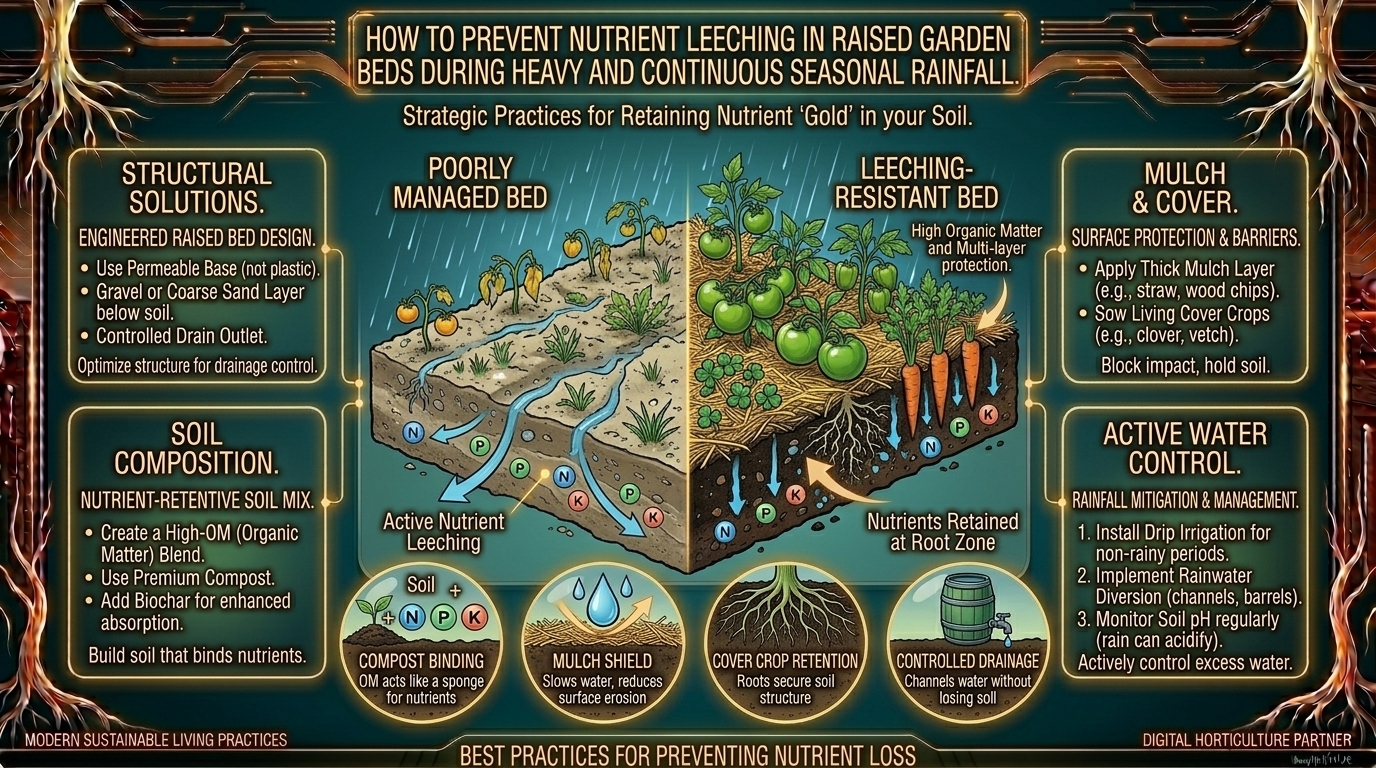
How to Prevent Nutrient Leaching in Raised Garden Beds During Heavy and Continuous Seasonal Rainfall
Raised garden beds are among the best investments a home gardener can make. They offer effortless ergonomic access, eliminate the back-breaking misery of tilling native ground, and allow absolute control over your growing medium. However, growers across regions as diverse as New York, Washington, California, San Francisco, and the unpredictable downpours of Texas quickly learn that raised beds come with a hidden vulnerability: extreme susceptibility to nutrient leaching during heavy and continuous seasonal rainfall.
When relentless autumn storms, winter deluges, or spring cloudbursts saturate a raised bed, water pulls downward by gravity. As that water flushes through the loose, porous soil, it strips away soluble plant nutrients—especially nitrogen, potassium, calcium, and magnesium—washing them out of the root zone and leaving your soil starved.
For horticulturists building vibrant, high-yield plots on kcplants.com, understanding how to protect your soil chemistry from heavy rain is the ultimate key to season-long success. This comprehensive, expert-level guide explores the science of nutrient leaching, regional climate challenges, and proven masterclass techniques to lock fertility into your raised beds permanently.
1. The Science of Nutrient Leaching
To combat leaching, we must first understand how water interacts with soil chemistry inside an elevated wooden or metal frame.
What is Leaching?
Leaching occurs when water-soluble plant nutrients (nutrients dissolved in the soil water solution) are carried downward past the root zone by percolating water.
- The Anion Problem: Negatively charged nutrients—such as nitrates ($NO_3^-$) and boron—do not bind well to soil particles because most soil particles also carry a negative charge. Consequently, these nutrients float freely in soil water and are washed away rapidly during heavy rains.
- Cation Retention: Positively charged nutrients (cations like calcium, magnesium, and potassium) bind better to negatively charged organic matter and clay (known as the soil’s Cation Exchange Capacity or CEC). However, when torrential rains continuously flush the soil, even these buffered reserves can be overwhelmed and stripped away.
The Raised Bed Vulnerability
Because raised beds are deliberately engineered to have excellent drainage (often filled with loose topsoil, compost, and perlite), water drains through them much faster than native ground. While this prevents root rot, it also acts like a giant kitchen colander during prolonged storms, rapidly flushing out your hard-earned fertilizers.
2. Regional Rainfall Challenges Across the U.S.
Weather patterns dictate how aggressively your raised beds will experience leaching:
Washington & New York
- Climate Challenge: Prolonged autumn/winter rainy seasons, heavy snowmelts, and saturated spring soils.
- Impact: Continuous light-to-moderate rain over weeks can leach nearly all available soil nitrogen before spring planting even begins, leaving beds completely depleted.
San Francisco & Coastal California
- Climate Challenge: Mediterranean climate featuring intense, concentrated atmospheric river rain events during winter months.
- Impact: Sudden, massive downpours dump inches of rain in hours, aggressively washing away surface organic matter and soluble nutrients from loose raised bed mixes.
Texas
- Climate Challenge: Flash floods and sudden, torrential downpours following prolonged dry spells.
- Impact: Hard, sudden rainfalls hit dry, hydrophobic raised bed soils, washing nutrients straight over the edges or flushing them rapidly out the bottom before the soil can absorb the moisture.
3. Proven Strategies to Stop Nutrient Leaching
Preventing nutrient loss requires a proactive, multi-layered approach that combines physical covers, biological anchors, and smart amendments.
A. Plant Winter Cover Crops
Instead of leaving your raised beds empty and exposed to winter rains, plant deep-rooting cover crops (such as field peas, crimson clover, or oats).
- How It Works: Cover crop roots act as a biological sponge, absorbing soluble nutrients and locking them safely inside living plant tissue. When terminated in spring, those nutrients are returned gently to the soil.
B. Protect Beds with Impermeable or Breathable Covers
During prolonged, destructive storm systems, physical barriers save your soil chemistry:
- Silage Tarps or Heavy Plastic: Securely anchor heavy-duty black plastic or waterproof tarps over your raised beds during continuous multi-day downpours to halt leaching entirely.
- Low Tunnels / Hoop Houses: Install clear greenhouse plastic over PVC hoops to let light in while keeping torrential rain out.
C. Boost Soil Cation Exchange Capacity (CEC) with Organic Matter
Sandy or purely compost-based raised beds leach rapidly. To fix this, mix high-capacity organic matter into your soil mix:
- Aged Compost and Leaf Mold: Act as sponges that hold onto cations (calcium, potassium, magnesium).
- Biochar: Pyrolyzed carbon acts like an atomic sponge, possessing microscopic pores that permanently trap nutrients and beneficial microbes, preventing them from washing away.
D. Use Slow-Release Organic Amendments
Avoid dumping quick-release synthetic chemical fertilizers right before heavy rainy seasons, as they dissolve instantly and wash away. Instead, rely on slow-release organic inputs:
- Bone Meal, Feather Meal, and Kelp Meal: Break down slowly over months through microbial activity, releasing nutrients steadily as plants need them rather than all at once.
4. Step-by-Step Masterclass: Rain-Proofing Your Raised Beds
Follow this seasonal checklist to protect your raised beds before heavy weather strikes:
Step 1: Audit Your Soil Structure
Ensure your raised bed soil mix contains at least 30% to 40% high-quality organic matter (compost, aged manure, leaf mold) blended with native loam. Avoid mixes that are overly sandy or fluffy, as water rushes through them unchecked.
Step 2: Apply a Protective Surface Mulch
Never leave raised bed soil completely bare. Apply a 2-to-3-inch layer of shredded autumn leaves, clean straw, or compost mulch. Mulch cushions the impact of heavy raindrops, preventing soil compaction, surface crusting, and topsoil erosion.
Step 3: Implement No-Till Management
Refrain from tilling your raised beds in late autumn. Tilling exposes fresh soil aggregates to pounding rain, shattering structure and accelerating nutrient washout. Leave root systems intact underground to hold the soil matrix together.
Step 4: Top-Dress with Biochar and Compost in Early Autumn
Work a handful of charged biochar and a 1-inch layer of finished compost into the top few inches of your soil before the rainy season begins. This supercharges your soil’s ability to hold onto nutrients against heavy percolation.
5. Comprehensive FAQ: Everything You Need to Know
1. Which specific nutrients are lost fastest during heavy rain?
Nitrogen (specifically in the form of nitrates) is by far the most water-soluble and washes away the fastest. Boron and potassium also leach easily, while phosphorus and calcium tend to bind more tightly to soil minerals and organic matter.
2. Can I use plastic sheeting over my raised beds all winter?
Yes, covering beds with a weighted black plastic tarp prevents heavy rains from soaking and leaching your soil. However, keep in mind that completely sealing the bed cuts off natural air exchange; remove the tarp periodically on dry days or when spring arrives.
3. Do raised beds leach worse than in-ground garden beds?
Yes. Because raised beds are elevated and bounded by walls, water drains rapidly out of the bottom and sides. In-ground beds are buffered by surrounding subsoil, whereas raised beds act as independent, highly permeable containers.
4. How do I replenish leached nutrients in spring before planting?
The best way is to top-dress your raised beds with a 2-inch layer of rich, finished organic compost, accompanied by a slow-release organic fertilizer blend like blood meal, bone meal, and greensand.
5. Will adding more fertilizer solve a nutrient-leached bed?
Simply dumping more synthetic fertilizer into waterlogged soil is counterproductive. It burns plant roots, lowers soil pH, and creates a cycle where excess chemicals are immediately washed out by the next rainstorm. Focus on building soil structure and CEC instead.
6. Are there specific cover crops that handle heavy winter rain well?
Yes! Winter rye, hairy vetch, and austrian winter peas are exceptionally resilient. They tolerate waterlogged, saturated soils, survive cold northern winters, and aggressively scavenge nutrients to prevent leaching.
7. Does straw mulch prevent nutrient leaching?
Straw mulch primarily prevents surface soil erosion, crusting, and weed germination. While it does not stop water from percolating through the soil profile below, it helps maintain overall soil biology, which indirectly aids in nutrient retention.
8. What is biochar and how does it stop leaching?
Biochar is pure, stable carbon created by burning organic waste in an oxygen-deprived environment. Its microscopic honeycomb structure locks onto water-soluble nutrients and beneficial microbes, preventing them from washing away during heavy downpours.
9. Can heavy rain change my raised bed soil pH?
In regions with acidic rainfall, continuous heavy downpours can slowly leach basic minerals (like calcium and magnesium) out of the soil, causing the pH to drop into a more acidic range over time. Periodic soil testing ensures you catch this shift.
10. How can I improve drainage if my raised bed holds too much water during rain?
If heavy rain causes your bed to waterlog rather than drain, your lower layers may be compacted. Incorporate coarse perlite, expanded shale, or coarse organic matter, and ensure your bed’s bottom drainage holes or open-bottom design are clear of debris.
Conclusion
Heavy and continuous seasonal rainfall is an inevitable challenge for raised bed gardeners, but it does not mean your hard work has to wash away down the drain. By understanding nutrient leaching, planting protective cover crops, boosting your soil’s cation exchange capacity with compost and biochar, and utilizing physical winter covers when storms rage, you can maintain absolute control over your soil fertility.