What Are the Best Companion Plants to Attract Beneficial Pollinators to Your Cucumber Patches?
Introduction: The Pollination Puzzle of Cucumbers
Few vegetables embody the refreshing crunch of summer quite like freshly harvested cucumbers (Cucumis sativus). Whether you are slicing them into salads, pickling them in jars, or enjoying them straight off the vine, growing a heavy crop of cucumbers is a staple of the warm-season garden. Yet, many gardeners experience a frustrating paradox: lush, vigorous green vines covered in vibrant yellow flowers, but virtually zero fruit development.
The primary culprit behind barren cucumber vines isn’t a lack of water, fertilizer, or sunlight—it is pollination failure.
Cucumbers possess a unique reproductive system. They produce separate male and female flowers on the same vine. Because cucumber pollen is heavy and sticky, it cannot be effectively dispersed by the wind. These plants rely entirely on biotic vectors—specifically beneficial pollinators like honeybees, bumblebees, native solitary bees, and hoverflies—to transfer pollen from the male blossoms to the female receivers. Without an army of hardworking pollinators visiting your garden daily, your cucumber flowers wither, drop off, and leave you with empty vines.
The most effective, organic, and ecologically sound solution is companion planting. By interspersing strategic, nectar-rich flowering plants throughout your cucumber patch, you can transform your garden into a magnet for pollinators.
This comprehensive, highly informative guide explores the science of cucumber pollination, the top companion plants to supercharge your yields, and regional strategies tailored for growers across Texas, New York, California, Washington, and San Francisco, all proudly brought to you by kcplants.com.
The Botanical Biology of Cucumber Pollination
To understand why companion planting is so transformative for cucumbers, you must first understand how these plants reproduce.
Male vs. Female Blossoms
- Male Flowers: These appear first on the vine, supported by a thin, simple stem. Their sole purpose is to produce pollen. Once their pollen is depleted, they drop off the plant entirely.
- Female Flowers: These appear slightly later and are easily identified by a tiny, miniature cucumber (the inferior ovary) located right at the base of the petals.
The Pollination Window
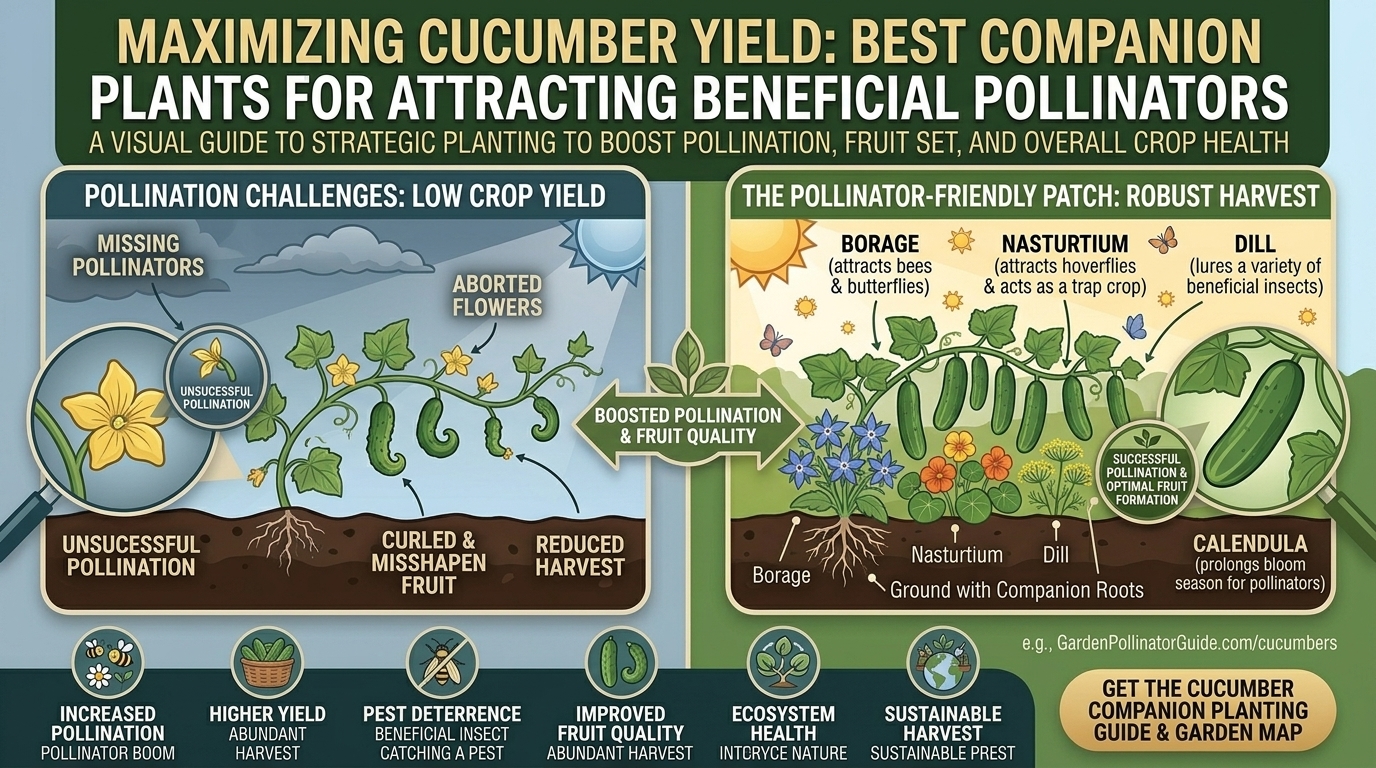
A female cucumber blossom is typically only receptive to pollen for a single day—often just a few morning hours. If a bee does not visit that specific flower and transfer viable pollen grains from a male stamen within that brief window, the flower unfertilizes, turns yellow, shrivels, and falls off the vine. Furthermore, incomplete pollination results in misshapen, bulbous, or curved cucumbers.
By planting high-value companion flowers that bloom continuously and emit powerful visual and olfactory cues, you guarantee a high traffic volume of pollinators hovering directly over your cucumber patch every morning.
Regional Considerations for kcplants.com Growers
Implementing pollinator companion planting requires adapting your floral selections and planting schedules to your local climate dynamics.
Texas: Beating the Heat and Sustaining Summer Pollinators
- The Challenge: Intense Texas heatwaves can cause both cucumber vines and pollinating insects to slow down during peak afternoon hours. High temperatures can also render pollen sterile if temperatures exceed 95°F for extended periods.
- The Solution: Plant heat-tolerant pollinator magnets (such as zinnia and lantana) that bloom relentlessly through the scorching summer months. Position your pollinator patch to catch morning sun, ensuring bee activity peaks during the cooler morning hours when cucumber flowers are freshly open.
New York: Maximizing the Short Summer Window
- The Challenge: New York features a compressed warm-weather season. Pollinators need to find food sources immediately upon emergence to support early spring cucumber plantings.
- The Solution: Interplant early-blooming annuals and hardy herbs like borage and alyssum alongside your cucumber seeds. This ensures a steady food supply for local bumblebees the moment your cucumber vines begin flowering.
California & San Francisco: Leveraging Microclimates and Coastal Fog
- The Challenge: Inland California is hot and dry, while San Francisco and coastal zones experience cool, foggy mornings and brisk breezes that can deter delicate pollinators from flying early in the day.
- The Solution: Choose robust, wind-resistant companion flowers like marigolds and echinacea. In San Francisco’s cooler microclimate, select native California wildflowers that naturally attract local coastal bee species accustomed to marine layers.
Washington: Balancing Pacific Northwest Moisture and Spring Overcast
- The Challenge: Washington springs and early summers are often damp and overcast. On cloudy days, honeybees are notoriously sluggish, reducing natural pollination rates.
- The Solution: Plant bright, highly visible, multi-colored composite flowers (like coreopsis and sunflowers) that attract opportunistic native pollinators and hoverflies, which continue foraging even under hazy or overcast skies.
The Best Companion Plants to Attract Pollinators to Cucumbers
Choosing the right companion plants involves selecting species that offer abundant nectar, contrasting flower shapes, and overlapping bloom times. Here are the top-performing companion plants for your cucumber patch:
1. Borage (Borago officinalis)
- Why It Works: Borage is widely considered the ultimate companion plant for cucumbers. It produces stunning, star-shaped blue flowers loaded with nectar that bees find irresistible. Studies show that borage flowers increase bee visits to neighboring crops by up to 300%.
- Bonus Benefit: Borage is a dynamic accumulator, pulling deep minerals from the soil into its fuzzy leaves. When chopped and dropped as mulch, it feeds your cucumbers.
2. Sweet Alyssum (Lobularia maritima)
- Why It Works: Sweet alyssum forms a low, carpet-like mat of tiny white, pink, or purple flowers that bloom continuously from spring through frost. Its honey-like fragrance is a beacon for beneficial hoverflies (whose larvae devour aphids) and tiny parasitic wasps.
- Best Practice: Plant sweet alyssum as a living ground cover directly around the base of your cucumber trellises to suppress weeds and lock in soil moisture.
3. Marigolds (Tagetes species)
- Why It Works: Marigolds do double duty in the garden. Their bright yellow and orange blossoms attract bees and beneficial predatory insects, while their distinct, pungent root exudates and foliage repel root-knot nematodes and destructive garden pests.
- Best Practice: Intersperse French or Signet marigolds every 2 to 3 feet along your cucumber rows.
4. Sunflowers (Helianthus annuus)
- Why It Works: Sunflowers act as supreme vertical beacons. Their massive, sun-facing yellow heads command the attention of flying pollinators from across the entire garden, drawing them directly into your lower-lying cucumber patch.
- Best Practice: Plant tall single-stem sunflower varieties on the northern or western perimeter of your cucumber bed so they don’t cast unwanted shade on your sun-loving vines.
5. Nasturtiums (Tropaeolum majus)
- Why It Works: Nasturtiums produce cheerful, trumpet-shaped edible flowers rich in nectar that attract bumblebees and honeybees. Additionally, they serve as a sacrificial “trap crop” for aphids, luring pests away from your vulnerable cucumber vines.
- Best Practice: Allow nasturtiums to trail along the ground beneath upright, trellised cucumber vines.
6. Dill and Fennel (Anethum graveolens & Foeniculum vulgare)
- Why It Works: When allowed to bolt and flower, dill and fennel produce flat-topped, umbrella-shaped flower clusters (umbels) that are favorite landing pads for predatory wasps, tachinid flies, and native bees.
- Crucial Warning: While dill is a fantastic companion, never plant fennel directly near cucumbers. Fennel secretes allelopathic chemicals that inhibit the growth of almost all garden vegetables. Grow fennel in a separate container or distinct bed!
7. Echinacea / Coneflowers (Echinacea purpurea)
- Why It Works: As a native perennial, coneflower produces large, sturdy landing platforms with prominent seed cones that attract a massive diversity of native bees, butterflies, and bumblebees throughout the mid-to-late summer fruiting season.
Layout and Design Strategies for Maximum Pollinator Attraction
Simply tossing companion seeds randomly around your garden is a start, but strategic placement maximizes their effectiveness:
1. The Interplanted Matrix
Weave smaller, clumping annual flowers (like sweet alyssum, marigolds, and dwarf nasturtiums) directly into the beds between your cucumber hills. This creates a diverse, multi-tiered floral habitat right where the bees are foraging.
2. The Perimeter Buffer
Plant tall vertical companions (such as sunflowers and borage) along the outer edges of your garden plot. This acts as a windbreak that calms harsh gusts, making it much easier for lightweight bees and beneficial insects to navigate into your low-growing cucumber vines.
3. Succession Sowing for Continuous Blooms
Cucumbers fruit continuously for 6 to 8 weeks or more. If your companion flowers finish blooming halfway through the summer, your pollinator traffic will crash. Succession-sow fast-blooming annuals like alyssum, borage, and cilantro every 4 weeks to guarantee unbroken floral coverage.
Best Practices and Pro Tips for Success
- Eliminate Pesticide Use: Never spray synthetic insecticides, systemic pesticides, or broad-spectrum neonicotinoids on or near your flowering companion plants. Even organic sprays like spinosad or neem oil should be applied only at dusk when bee activity has completely ceased.
- Provide a Bee Waterer: Bees get thirsty while working hard in the garden. Place a shallow dish filled with fresh water and clean pebbles (so bees have a dry platform to stand on while drinking) near your cucumber patch.
- Train Cucumbers Up Trellises: Growing cucumbers vertically on A-frames or netting lifts the female flowers off damp soil, reducing fungal rot while making the blossoms infinitely more visible and accessible to flying pollinators.
Frequently Asked Questions (FAQs)
1. Why are my cucumber flowers dropping off without producing fruit?
This is almost always caused by a lack of pollination. Cucumbers produce separate male and female flowers; if a bee does not transfer pollen from a male to a female blossom within its single day of receptivity, the female flower shrivels and drops off the vine.
2. Do cucumbers require bees to produce fruit?
Yes. Because cucumber pollen is heavy and sticky, wind cannot blow it from flower to flower. They rely 100% on biotic pollinators—primarily honeybees, bumblebees, and native solitary bees—to accomplish fertilization.
3. What is the absolute best companion plant for cucumbers?
Borage is widely considered the single best companion plant for cucumbers. Its striking blue, nectar-rich flowers draw an exceptionally high volume of honeybees and bumblebees directly to the planting area.
4. Can companion flowers compete with my cucumbers for nutrients?
They can if planted too densely. Cucumbers are heavy feeders and drinkers. To prevent competition, space taller companion plants (like sunflowers) at least 2 to 3 feet away from the base of your cucumber vines, and ensure your soil is enriched with plenty of organic compost.
5. Will marigolds really attract pollinators to my cucumber patch?
Yes, single-flowered marigold varieties (like French or Signet marigolds) produce open-faced blooms that provide easy access to nectar for smaller bees and beneficial insects, while also deterring harmful root pests.
6. Why are my cucumbers growing in weird, bulbous, or curved shapes?
Deformed cucumbers are typically the result of incomplete pollination. When only a portion of the flower receives pollen, only that section of the fruit develops fully, resulting in a crooked, lopsided, or bulbous vegetable.
7. How do I attract bees to cucumbers in a small urban space or balcony?
If you are gardening on a sunny urban patio or balcony (such as in New York or San Francisco), plant compact companion herbs and flowers like sweet alyssum, dwarf marigolds, and basil in containers directly alongside your potted cucumber plants.
8. Are there any flowers I should avoid planting near cucumbers?
Avoid planting fennel near cucumbers, as fennel secretes chemical compounds that stunt vegetable growth. Additionally, avoid invasive mints unless strictly contained in pots, as they can quickly overrun your cucumber root zone.
9. How long do companion flowers need to bloom before cucumbers produce fruit?
It is ideal to sow your fast-blooming companion flower seeds (like alyssum or borage) at the exact same time you plant your cucumber seeds or transplants, ensuring a mature, nectar-rich food source is waiting the moment your cucumber vines begin flowering.
10. How does regional climate impact my choice of pollinator plants?
Climate dictates bloom longevity and insect activity. In hot regions like Texas, choose heat-tolerant annuals that won’t wither in July. In cooler, damp zones like Washington or San Francisco, select hardy flowers that tolerate overcast skies and mild temperatures while keeping bee forage active.
Conclusion: Cultivating a High-Yield, Pollinator-Rich Garden
Transforming your cucumber patch from a barren vine into a high-yielding harvest powerhouse requires looking beyond just soil and water. By integrating nectar-rich, strategic companion plants like borage, sweet alyssum, marigolds, and sunflowers, you invite an army of dedicated pollinators right to your doorstep.
Whether you are managing summer heatwaves in Texas, balancing urban container spaces in New York, navigating coastal fog in San Francisco, soaking up coastal sun in California, or working through damp springs in Washington, pollinator companion planting is your ultimate shortcut to success.